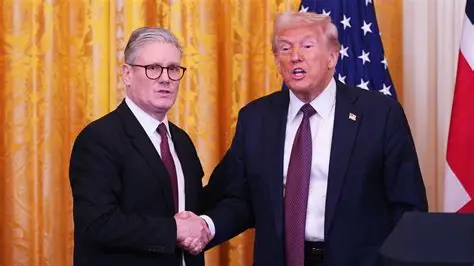
Starmer and Trump Hold First Call After Dispute Over Iran Policy
Iran policy has become one of the sharpest tests of the UK-US relationship under Keir Starmer and Donald Trump. Their first call after the dispute over Britain’s role in the conflict did not remove the tension, but it showed how both leaders were trying to keep military cooperation alive while disagreeing over how far Britain should go.
Downing Street released only a limited readout of the conversation. The two leaders discussed the Middle East security situation and military cooperation between the United Kingdom and the United States, including the use of Royal Air Force bases to support the collective self-defence of partners in the region. Starmer also offered condolences after the deaths of six US service members.
That official language was calm. The politics around it was not.
Trump had criticised Starmer for refusing to allow British bases to be used in the initial US-Israeli strikes on Iran. Starmer later allowed limited use of UK bases for defensive operations, but the first refusal created a visible rift. Trump’s public criticism turned a military decision into a diplomatic argument about loyalty, sovereignty and the future of the so-called special relationship.
The result was a call that mattered less for what was said publicly and more for what it revealed privately. Britain wanted to stay close to Washington without being pulled into a wider war. Trump wanted allies to move faster and show firmer support. Iran was warning Britain not to deepen its involvement. At home, Starmer was defending a line between defensive support and offensive action.
This is why the Iran policy dispute deserves more than a short diplomatic note. It is a case study in how Britain is trying to manage alliance politics in a more volatile world.
The Call in One Page
| Issue | What happened |
|---|---|
| Leaders involved | UK Prime Minister Keir Starmer and US President Donald Trump |
| Main subject | Middle East security and UK-US military cooperation |
| Immediate dispute | Britain refused to support initial US-Israeli strikes on Iran |
| Later UK position | UK bases could be used for limited defensive purposes |
| Downing Street detail | RAF bases were discussed in support of regional partners’ self-defence |
| Trump’s position | He publicly criticised Starmer’s delay and limited support |
| UK argument | Decisions must be made in Britain’s national interest |
| Wider risk | Iran warned against deeper UK involvement |
The key word is “limited”. Britain was not ending military cooperation with America. It was trying to define the terms of that cooperation. That distinction sits at the heart of the Iran policy argument.
What Downing Street Said — And What It Did Not Say
The official readout was short. Starmer and Trump discussed the latest Middle East situation and military cooperation through RAF bases. The prime minister expressed condolences over the deaths of six US soldiers. The two leaders looked forward to speaking again.
That wording was designed to lower the temperature. It did not repeat Trump’s criticism. It did not mention a breakdown in trust. It did not say whether Starmer pushed back against Trump’s public remarks. It did not explain whether the US wanted more support from Britain. It did not discuss aircraft carriers in detail.
That silence matters because diplomatic readouts are often written to signal stability, not emotion. The message was simple: the UK and US are still talking, still cooperating and still coordinating through military channels.
But the Iran policy dispute did not disappear because a readout was polite. The disagreement had already become public. Trump had made clear that he was unhappy with Britain’s initial refusal. Starmer had already told Parliament that the UK was not involved in the first strikes and that the decision was deliberate.
That means the call should be understood as damage management. It was not a victory lap for either side. It was an attempt to keep the alliance functional after a week of unusually open criticism.
The Fault Line: Offensive Strikes vs Defensive Support
The dispute over Iran policy came down to one line: offensive military action versus defensive support.
Starmer refused to join the initial US and Israeli strikes on Iran. He told Parliament that Britain was not involved in those strikes and that the decision was deliberate. He argued that the best path for the region remained a negotiated settlement in which Iran abandoned nuclear ambitions and stopped destabilising activity across the Middle East.
But Starmer’s position changed once Iran began firing missiles and drones at regional partners. He then allowed British bases to support defensive operations aimed at protecting allied countries and British interests. The government’s argument was that defending partners under attack was different from joining the first offensive wave.
That distinction is central to the UK’s Iran policy.
A simplified version looks like this:
| UK decision | Government explanation |
|---|---|
| Refused initial strike support | UK would not join offensive action at the start of the war |
| Allowed defensive base use | UK would help protect partners from Iranian missiles and drones |
| Deployed defensive assets | RAF and regional support focused on intercepting threats |
| Avoided wider-war language | Ministers said Britain would not be drawn into a broader conflict |
Critics on the hawkish side saw hesitation. Anti-war critics saw creeping involvement. The government tried to occupy a narrow middle: close to America, but not automatically aligned with every American strike.
The News Ink’s earlier explainer on why the US and Israel attacked Iran gives the wider conflict background, while our report on Starmer’s economic warning shows why Downing Street was also thinking about domestic consequences.
Why Trump Was Angry
Trump’s criticism was unusually direct for a dispute with a close ally. He argued that Britain had come too late and suggested that help was not needed after the US had already acted. His frustration was not only about military assets. It was about the symbolism of alliance response.
From Trump’s perspective, America had taken the lead against Iran and expected Britain to support the operation quickly. Britain’s refusal to allow initial offensive use of bases was seen by the White House as delay, weakness or disloyalty.
From Starmer’s perspective, the decision was about legal authority, public consent, national interest and the lessons of past Middle East interventions. A Labour prime minister cannot make decisions on Iran without the shadow of Iraq hanging over the debate. That does not mean every Iran decision is Iraq. It means British political culture has changed since 2003.
That is why the Iran policy dispute became personal so quickly. Trump framed it as a question of whether Britain was showing up for its ally. Starmer framed it as a question of whether Britain was making its own sovereign judgement.
Those are not small differences. They are two different theories of alliance politics.
Cooper, Blair and the Iraq Shadow
The domestic British argument sharpened when Tony Blair criticised Starmer’s approach. Blair argued that Britain should have backed America from the beginning and allowed US use of British bases. His point was that alliances are tested in difficult moments, not easy ones.
Foreign Secretary Yvette Cooper rejected that view. She said Britain had to learn the lessons of Iraq and that neither automatically agreeing with the US nor automatically refusing to work with it was in the UK’s national interest. That line became one of the clearest defences of Starmer’s Iran policy.
This part of the story matters because it shows the debate was not only between London and Washington. It was also inside Britain’s own foreign-policy establishment.
One side argued that the US relationship is too important to hesitate when Washington asks for help. The other side argued that the UK must not outsource foreign policy, even to its closest ally. Starmer’s government tried to present itself as serious, cautious and independent rather than anti-American.
The question is whether such a middle position can survive a fast-moving war. Trump’s style of alliance management leaves little patience for nuance. Iran’s retaliation leaves little room for delay. Domestic critics on both sides interpret every decision as either weakness or escalation.
That is the pressure Starmer faced when he spoke to Trump.
The Aircraft Carrier Question
The dispute also drew attention to HMS Prince of Wales. Reports said the aircraft carrier’s readiness had been increased, making it possible to deploy more quickly if ministers decided additional naval forces were needed. Officials stressed that no deployment decision had been made.
The aircraft carrier became politically sensitive because Trump publicly dismissed the idea that Britain’s carrier support was necessary. For Britain, putting the carrier on higher readiness was a signal of preparedness. For Trump, it was too late to matter.
In military terms, readiness is not the same as deployment. A ship can be placed on shorter notice without sailing. A government can prepare options without committing to use them. That is often how crisis management works.
But in political terms, the image was awkward. Britain appeared to be showing capability after refusing the first wave of action. Trump appeared to be saying the capability was no longer required. That made the carrier a symbol of the Iran policy dispute: Britain wanted flexibility, while Washington wanted immediate alignment.
The News Ink’s coverage of depleting weapons stockpiles shows why military readiness is not just theatre. Long conflicts consume equipment, missiles, ships, aircraft hours and political attention quickly.
Iran’s Warning to Britain
Iran also tried to shape Britain’s decision-making. Iranian officials warned that deeper UK involvement could make British facilities or forces part of the conflict. The warning was aimed partly at RAF bases and partly at Britain’s diplomatic calculations.
The UK response was that defensive operations were a response to Iranian attacks on regional partners, not an offensive campaign against Iran. Cooper later told Parliament that the UK was continuing defensive military support for partners against Iranian strikes while also pursuing diplomatic and economic work in the national interest.
This is the difficulty of modern deterrence. One side calls an operation defensive. The other side may call it hostile. Bases used for intercepting missiles can still become targets in the eyes of an adversary. That is why the Iran policy line was so delicate.
Britain wanted to say three things at once:
- it was not joining a wider offensive war;
- it would defend partners and British interests;
- it would not be intimidated out of defensive cooperation.
Keeping those positions together is hard in a conflict that keeps widening.
What the Call Revealed About the UK-US Alliance
The Starmer-Trump call showed that the UK-US alliance is still operationally deep but politically more brittle than its supporters often admit.
Military cooperation remains strong. RAF bases, intelligence links, regional planning, air defence and crisis coordination give the relationship real substance. The two countries are not strangers forced into a last-minute conversation. They are deeply connected through decades of defence architecture.
But political trust is more fragile. Trump’s public criticism showed that he is willing to pressure allies openly. Starmer’s refusal showed that even a strongly pro-NATO British government is not prepared to follow Washington automatically.
That does not mean the special relationship is over. It means the special relationship has become more transactional, more public and more exposed to leader personality.
This is a major shift. In older diplomatic language, allies handled disputes privately and presented unity publicly. In this case, criticism came first, then the call tried to repair the presentation.
The News Ink’s report on G7 oil-price pressure shows how this alliance problem extends beyond military action. Energy markets, sanctions, shipping routes and defence commitments all require coordination.
Why the Strait of Hormuz Made the Dispute Bigger
The Iran conflict quickly became a global economic issue because of the Strait of Hormuz. Western governments later issued a joint statement calling on Iran to stop threats, mines, drone and missile attacks, and other attempts to block commercial shipping. They also said freedom of navigation is a fundamental principle of international law.
That widened the Iran policy debate. Britain was no longer only deciding whether to help the US militarily. It was also thinking about oil flows, gas markets, inflation, shipping insurance, British nationals in the region and global supply chains.
The News Ink has covered those household and market effects in detail, including how the Iran war could affect UK fuel prices and why global markets became volatile. The diplomatic call between Starmer and Trump therefore mattered to households as well as foreign ministries.
If the UK and US cannot coordinate clearly, markets notice. Allies notice. Adversaries notice. The Strait of Hormuz turned the argument from a military-base dispute into a global economic risk.
What Changed After the First Call
The first call did not end the Iran crisis. It was one point in a longer escalation.
By July, Reuters reported that Trump had said an interim US-Iran understanding to end the war was “over” after indirect talks failed to make progress and the US resumed strikes. AP later reported that Washington was pressing Iran to publicly confirm that the Strait of Hormuz was open and that ships would no longer be attacked.
That later context matters for updating this article. The March call looked at first like a moment of tension after the opening phase of the war. In hindsight, it was an early sign of a longer strategic problem: Britain and America had to cooperate through months of escalation while not always agreeing on method, pace or risk.
The UK also hardened parts of its domestic security posture. In July, Starmer announced measures against support for Iran’s Islamic Revolutionary Guard Corps under a new National Security Act framework, stopping short of full proscription but giving law enforcement new powers against those supporting hostile foreign-power activity.
That shows how Iran policy evolved from a question about bases into a broader national-security agenda: military cooperation abroad, protection of British nationals, economic resilience at home and counter-hostile-state activity inside the UK.
Why Starmer’s Position Was Politically Risky
Starmer’s position carried risk in both directions.
If he moved too close to Trump, Labour MPs, anti-war voters and critics of Middle East intervention would accuse him of repeating past mistakes. If he moved too far from Trump, Conservatives, Atlanticists and some former Labour figures would accuse him of weakening Britain’s most important alliance.
That is a difficult balance for any prime minister. It is especially difficult in a crisis where US decisions can move faster than UK parliamentary politics. A prime minister may want careful legal advice, Cabinet discussion and allied coordination. A US president may want immediate operational consent.
The Iran policy dispute also came with practical risks. Britain had hundreds of thousands of nationals across the wider region when the conflict intensified. Airspace closures, missile attacks, airport disruption and Gulf security concerns meant that every military decision had consular consequences.
The UK later organised additional flights and support for citizens trying to leave the region. The News Ink’s report on the first UK evacuation flight from Oman explains how quickly military conflict became a civilian evacuation story.
The Alliance Question Britain Cannot Avoid
The Starmer-Trump dispute raises a bigger question: what does alliance loyalty mean when allies disagree?
For some, loyalty means backing the US in a crisis unless there is an overwhelming reason not to. For others, loyalty means being honest with America when Britain thinks a course of action is wrong, premature or legally risky. Starmer’s Iran policy tried to take the second view while keeping the military relationship intact.
That is easier to defend in speeches than in war. Allies under attack want quick answers. Presidents dislike caveats. Markets dislike uncertainty. Opponents exploit division.
Still, the UK government’s argument is not irrational. Britain cannot commit to every US strike simply because the relationship is close. Parliament, public consent, international law, military readiness and national interest all matter. The challenge is making that independence credible without making Britain look unreliable.
The call with Trump was therefore not only about Iran. It was about how Britain behaves when Washington demands speed and London demands caution.
The Better Way to Read the Call
The strongest reading of the Starmer-Trump call is not that the relationship collapsed, and not that everything was fine. It is that the alliance bent but did not break.
The UK still allowed defensive cooperation. The US still spoke to Starmer. RAF bases remained part of the coordination picture. Both sides had reasons to keep working together. But the dispute revealed real limits.
Those limits are now part of the public record:
- Britain will not automatically join initial offensive strikes;
- Trump will publicly criticise allies he sees as late or weak;
- RAF bases can become a diplomatic flashpoint;
- Iran can use threats to test allied resolve;
- UK domestic politics will shape Middle East decisions;
- the special relationship no longer guarantees quiet unity.
This makes future calls between Starmer and Trump important. Every new escalation will test whether the March dispute was a one-off argument or a new pattern.
The Bottom Line
Iran policy forced Keir Starmer and Donald Trump into one of the most delicate UK-US conversations of the year. The call confirmed continuing military cooperation, especially through RAF bases used for defensive support, but it also followed a public dispute over Britain’s refusal to join the initial US-Israeli strikes on Iran.
Starmer’s government argued that it had to act in the UK national interest, support defensive operations and avoid being drawn into a wider war. Trump argued that Britain’s support came too late and criticised the UK’s limited role. Iran warned against deeper British involvement. British ministers defended the difference between offensive action and defensive protection.
The call did not settle the Iran policy debate. It clarified it. Britain wants to stay close to America, but not at any price. Trump wants allies that move quickly when Washington acts. Iran wants to raise the cost of any Western cooperation. The result is a more strained, more transactional and more exposed version of the UK-US alliance.
For Starmer, the challenge is to keep Britain useful to its allies without surrendering independent judgement. For Trump, the challenge is to keep allies aligned without pushing them into public resistance. For the UK, the wider lesson is clear: the special relationship still matters, but Iran has shown that it no longer operates on autopilot.
For more Middle East and UK foreign-policy coverage, follow The News Ink on X or read our latest analysis on the Iran conflict and the UK economy.