Depleting Weapons Stockpiles Could Shape the Iran Conflict as Missile War Drags On
Depleting weapons stockpiles could become one of the most important factors in the Iran conflict as the United States, Israel and Iran burn through missiles, drones, interceptors and precision weapons at a pace that factories cannot quickly replace.
President Donald Trump has insisted that the United States has a “virtually unlimited supply” of key weapons. Iranian officials have made their own claims of endurance, saying Tehran can resist longer than Washington and Jerusalem expect. Both statements are meant to project strength. Neither removes the basic reality of modern war: advanced weapons are finite, expensive and slow to produce.
The Iran conflict is no longer only a contest of air power, political will or battlefield intelligence. It is also becoming a production race. Every missile launched, every drone intercepted, every Patriot fired, every THAAD battery used and every precision strike ordered reduces stockpiles that took years to build.
That does not mean one side will suddenly run out of weapons and collapse. Wars rarely work that neatly. Ukraine has shown that a country can keep fighting while outnumbered, outgunned and dependent on outside supplies. But depleting weapons stockpiles can shape strategy, tempo and political decision-making. When the most advanced weapons become scarce, commanders must choose targets more carefully, stretch defences wider and accept higher risk.
For wider background on the war, The News Ink has explained why the US and Israel attacked Iran and how the conflict has created fear and shortages inside Iran.
Why depleting weapons stockpiles matter now
Depleting weapons stockpiles matter because the Iran conflict has been fought at high tempo from the beginning. The first wave of US-Israeli strikes began on 28 February 2026. Iran responded with missiles and drones against Israel and Gulf states hosting US-linked military facilities. Since then, the conflict has moved through air campaigns, naval strikes, Gulf retaliation, ceasefire attempts and renewed attacks around the Strait of Hormuz.
Early estimates showed how intense the opening phase had become. Data cited by the Times of India from the Tel Aviv-based Institute for National Security Studies said Iran had launched 571 missiles and 1,391 drones by early March. Many were intercepted by US, Israeli and Gulf air defence systems, but each interception also consumed expensive defensive missiles.
That is the hidden arithmetic of the war. Iran can launch relatively cheaper drones in large numbers. The US, Israel and Gulf states may need to respond with much more expensive interceptors, aircraft sorties, radar coverage and command systems. Even if the defenders win tactically, the cost ratio can be painful.
Depleting weapons stockpiles therefore affect both sides. Iran must preserve missiles, launchers and drone production. The US and its partners must preserve interceptors and precision weapons while also preparing for possible future conflicts elsewhere.
The war has become a stockpile test
At the start of the conflict, the question was whether US and Israeli strikes could weaken Iran’s military system quickly enough to force Tehran to stop. Months later, the question has become more complicated: who can sustain the fight longer without exhausting critical weapons?
A missile war is not measured only by launches. It is measured by replacement rates. A country may have thousands of drones, but if factories are bombed, guidance systems are destroyed and launch teams are hunted, the usable stockpile shrinks. A country may have strong air defences, but if each incoming salvo burns through dozens of interceptors, the defensive shield becomes harder to maintain.
Depleting weapons stockpiles turn battlefield success into a long-term industrial question. Can Iran rebuild drones faster than US and Israeli strikes destroy production lines? Can the US replace Patriot, THAAD, Tomahawk, JASSM and other precision weapons fast enough while also supporting Ukraine, Taiwan planning and Gulf partners? Can Israel preserve enough interceptors for another major missile wave?
These are not theoretical questions. CSIS analysis in April said the United States had enough missiles to continue the Iran war under any plausible scenario, but also warned that some key munitions had been heavily used and that rebuilding to prewar levels could take one to four years.
That means the US may not be running out for this war, but it is paying a future readiness price.
Key stockpile pressures at a glance
| Weapon category | Who relies on it | Why it matters |
|---|---|---|
| Ballistic missiles | Iran | Main tool for long-range retaliation against Israel, Gulf bases and regional targets |
| Shahed-style drones | Iran and partners | Cheaper mass-attack weapon that strains expensive air defences |
| Patriot interceptors | US, Israel and Gulf states | Used to defend bases, cities and infrastructure from missiles and drones |
| THAAD interceptors | US and regional partners | High-end defence against ballistic missiles |
| Tomahawk missiles | US Navy | Long-range strike option against fixed targets |
| JASSM / JASSM-ER | US air power | Precision standoff weapons against defended targets |
| Small attack drones | US and Iran | Cheaper strike option, useful when high-end weapons are conserved |
| Air defence missiles | Iran and US allies | Decide how easily aircraft can operate over contested territory |
Depleting weapons stockpiles do not affect every category equally. Some weapons are easier to produce. Others require specialised electronics, rocket motors, seekers and years of procurement planning.
Iran’s missile launches have slowed
One of the strongest signs of pressure has been the decline in Iranian missile and drone launches after the opening phase of the war. Gen. Dan Caine, chairman of the US Joint Chiefs of Staff, said in early March that Iranian ballistic missile launches had fallen sharply compared with the first day of fighting. He also said drone launches had dropped significantly.
Those numbers do not prove Iran is close to empty. A decline can mean several things. Tehran may be conserving missiles. Launchers may have been destroyed. Command systems may be disrupted. Air defence suppression may make movement harder. Iran may be shifting from mass salvos to targeted attacks. Or it may be waiting for politically valuable moments to strike.
Still, the pattern matters. A country that can fire hundreds of missiles in one day but later fires dozens is showing a change in tempo.
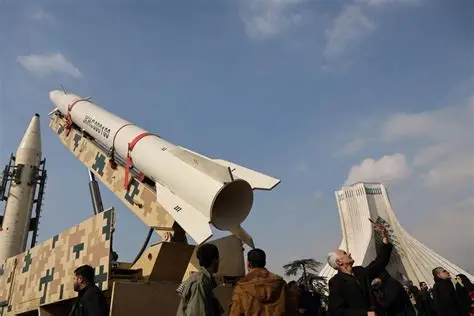
Depleting weapons stockpiles can force that change. Iran’s missile force is not only about warheads in storage. It depends on launchers, crews, fuel, guidance systems, command links, transport vehicles, underground facilities and production plants. US and Israeli strikes have targeted many of those pieces.
If the launch chain is damaged, a missile sitting in storage may not be enough.
Iran’s drone advantage is real but vulnerable
Iran entered the conflict with a major drone advantage. Shahed-style one-way attack drones are cheaper than ballistic missiles and can be produced in large numbers. Iran has exported them to Russia, where they became a major part of Moscow’s war against Ukraine. That experience showed how cheap drones can exhaust expensive air defences.
But drone stockpiles are not unlimited either. They need engines, warheads, airframes, electronics, launch systems and guidance components. If factories are struck repeatedly, production slows. If storage sites are hit, ready-to-launch drones disappear. If command networks are disrupted, mass attacks become harder to coordinate.
DefenseScoop reported in April that Hegseth and Caine claimed Iran’s drone arsenal and weapons stockpiles were mostly depleted and that Iran’s ability to produce new assets had been badly damaged. Caine said US and partner forces had attacked about 90% of Iran’s weapons factories and struck factories producing Shahed drones and guidance systems.
Those are US claims and should be treated as such. Iran has not accepted that description. But even partial damage to drone production would matter because drones have been one of Tehran’s most scalable tools.
Depleting weapons stockpiles therefore apply to low-cost weapons as well as expensive ones. Cheap does not mean infinite.
The US also faces limits
The United States remains the world’s most powerful military, but depleting weapons stockpiles still matter for Washington because advanced munitions are hard to replace quickly.
ABC News reported in March that Trump claimed the US had enough supplies to fight for as long as needed, while Hegseth said American offensive and defensive missile stockpiles were “extremely strong.” But experts warned that a longer war of attrition would pressure key weapons, especially defensive interceptors.
CSIS later gave a more detailed picture. Its April assessment said the US had enough missiles to continue fighting Iran under plausible scenarios, but for four of seven key munitions, the United States may have used more than half of the prewar inventory. It also warned that rebuilding those seven munitions to prewar levels could take one to four years and that the same weapons would be critical in a possible Western Pacific conflict.
That is the strategic problem. The US can keep striking Iran, but every high-end missile used in the Middle East is one less available for deterrence in Asia, Europe or another crisis.
Depleting weapons stockpiles therefore do not only shape the Iran war. They shape US global readiness.
Interceptors are the hardest problem
Offensive weapons often get the headlines. Interceptors may be more important in a long missile war.
Patriot and THAAD interceptors are not cheap, simple or quickly mass-produced. They are also in demand worldwide. Ukraine needs air defence against Russia. Gulf states need protection from Iranian missiles and drones. Israel needs layered defence. European NATO states want more missile protection. Taiwan contingencies require planning. The US military must preserve its own stockpiles.
This is why depleting weapons stockpiles create alliance tension. If the US fires large numbers of interceptors in the Gulf, it may delay deliveries to allies. If allies receive priority, US commanders may worry about their own reserves. If production cannot expand fast enough, every recipient competes with every other recipient.
CSIS warned that diminished inventories would affect US supplies of Patriot, THAAD and Precision Strike Missiles to Ukraine and other allies. The same analysis noted that even before the Iran war, US stockpiles were considered insufficient for a peer-competitor fight.
That is why a war with Iran can affect countries nowhere near Iran. Missile inventories are global assets. When one theatre consumes them, another theatre feels the shortage.
July escalation renewed the pressure
The stockpile question has become more urgent again because the war did not simply end after earlier ceasefire attempts. In July, US and Iranian forces exchanged renewed strikes around the Strait of Hormuz.
US Central Command said it hit more than 80 Iranian targets on 7 July, including air defence systems, command-and-control networks, coastal radar sites, anti-ship missile capabilities and more than 60 IRGC small boats. Reuters reported the same strike package and said it followed attacks on commercial vessels in the Strait of Hormuz.
The Guardian later reported that US and Iranian forces exchanged heavy missile and drone attacks over the weekend and into 13 July, with Iran saying it had targeted US facilities in Bahrain and Kuwait while the US struck Iranian air defence, coastal radar, missile, drone and naval targets.
That matters because depleting weapons stockpiles become more serious each time the war returns to high intensity. A ceasefire can pause consumption. A new wave of strikes restarts it.
The News Ink has also covered how the conflict has affected Strait of Hormuz shipping and global markets.
Why production speed is the real battlefield
The key question is not how many weapons exist today. It is how fast they can be replaced.
Modern missiles require specialised components. Rocket motors, seekers, guidance systems, warheads, electronics, control surfaces and software all depend on supply chains. Some parts may rely on rare materials or limited suppliers. Production lines cannot always double output quickly just because a war begins.
Depleting weapons stockpiles expose a weakness in peacetime defence planning. Many militaries buy enough weapons for expected conflicts, not for prolonged high-intensity wars against states with large missile and drone arsenals. When the real war consumes munitions faster than expected, the procurement system struggles to catch up.
The Iran conflict is therefore similar to lessons from Ukraine. Russia, Ukraine, the US and Europe all learned that artillery shells, air defence missiles and drones are consumed at extraordinary rates. Factories matter. Contracts matter. Stockpiles matter. Industrial depth becomes a form of military power.
A country can win a battle with better weapons. It wins a long war by replacing them.
How stockpile pressure changes military strategy
Depleting weapons stockpiles can change strategy in several ways.
First, commanders become more selective. They may save high-end weapons for high-value targets and use cheaper systems for lower-value missions.
Second, defensive forces may accept more risk. If interceptors are scarce, commanders must decide which incoming threats are worth engaging.
Third, political leaders may seek pauses. A ceasefire can become attractive not only because of diplomacy, but because it gives production lines time to recover.
Fourth, militaries may shift tactics. Iran may use cheaper drones, decoys or smaller salvos. The US may use cheaper attack drones or aircraft bombs instead of scarce standoff missiles when air superiority allows.
Fifth, allies may push for priority access. Ukraine, Israel, Gulf states and European partners all want defensive systems, but US production cannot instantly satisfy everyone.
Depleting weapons stockpiles therefore become a hidden hand behind battlefield decisions. The public may hear about diplomacy or escalation. Inside military planning rooms, the question may be simpler: how many missiles are left, and how many can arrive next month?
Iran’s geography complicates depletion claims
Iran is large, mountainous and filled with dispersed military infrastructure. Even heavy US-Israeli strikes cannot guarantee that every missile bunker, drone storehouse, launcher and production site has been destroyed.
That is why claims of Iranian depletion should be handled carefully. The US may have damaged major factories and destroyed many launchers, but Iran can hide missiles in tunnels, move mobile launchers and preserve strategic reserves. Tehran may also exaggerate its own endurance to deter further attacks.
Depleting weapons stockpiles are often hard to measure from outside. Intelligence agencies may have estimates, but public numbers are usually incomplete. Satellite images, launch counts, intercepted communications and battle damage assessments all help, but none gives a perfect inventory.
That uncertainty cuts both ways. Iran may be weaker than it claims. It may also retain more capability than Washington wants to admit.
A responsible analysis should not predict collapse based only on reduced launches. Lower tempo is evidence of pressure, not proof of exhaustion.
The political use of stockpile claims
Both sides use stockpile claims as propaganda.
When Trump says the US has “virtually unlimited” supplies, he is telling Iran that it cannot wait America out. He is also reassuring allies and domestic voters that the US military can sustain the campaign.
When Iran says it can resist longer than expected, it is trying to show that the strikes have failed to break its will. It wants supporters to believe the state remains capable. It wants adversaries to fear a long war.
Depleting weapons stockpiles sit behind those public messages. No leader wants to admit scarcity. Scarcity encourages enemies and worries allies.
That is why outside analysis from organisations such as CSIS matters. It separates political confidence from industrial reality. The US may be strong enough to continue, but rebuilding key munitions will still take years. Iran may still be dangerous, but its launch tempo and industrial base have clearly come under pressure.
The truth is between the slogans. No major side is helpless. No major side is unlimited.
The economic cost of missile war
Every high-end weapon used in the conflict represents money, time and production capacity. Interceptors can cost millions of dollars each. Precision strike missiles are expensive. Aircraft sorties require fuel, maintenance, spare parts and crews. Drones may be cheaper, but large salvos still consume engines, explosives and electronics.
Depleting weapons stockpiles therefore become an economic story. If a cheap drone forces a million-dollar interceptor launch, the defender may win the tactical exchange but lose economically over time. If a precision missile destroys a high-value launcher, the cost may be justified. If it hits a low-value target, the stockpile cost may be harder to defend.
This cost imbalance is why Iran has relied heavily on drones and missiles. It cannot match US air power directly, so it tries to stretch defences, create fear and force expensive responses.
The US and Israel, meanwhile, try to use air superiority and intelligence to destroy launchers, factories and command networks so they do not have to intercept endless salvos.
The war is therefore not only about what explodes. It is about who pays more to keep fighting.
What this means for allies
Depleting weapons stockpiles are already affecting alliance planning. If the US must preserve Patriot and THAAD interceptors for the Gulf, Ukraine may face delays. If Europe worries that US deliveries are uncertain, it may push harder to build its own defence industry. If Gulf states fear missile attacks, they may demand more US systems and faster replenishment.
The Guardian reported in July that European countries were increasingly concerned about whether the US could continue arming NATO allies as stockpiles were strained by Ukraine, Iran and other global commitments. It reported that deliveries involving systems such as Tomahawk missiles, HIMARS rockets and Patriot interceptors had been delayed or cancelled because of depleted reserves.
That does not mean the US alliance system is collapsing. It does mean the Iran war has widened the conversation about industrial capacity. Defence promises are only credible if factories can produce the weapons behind them.
Depleting weapons stockpiles are therefore pushing allies toward a hard conclusion: deterrence depends on production, not only strategy.
Could stockpile pressure encourage diplomacy?
One of the less visible effects of depleting weapons stockpiles is that it can encourage diplomacy. Leaders may talk about principle, victory and deterrence, but supply pressure can make pauses attractive.
If Iran needs time to move launchers, rebuild drone production or preserve missiles, it may support talks. If the US wants to reduce interceptor use while rebuilding inventories, it may support a ceasefire. If Gulf states fear more missile salvos, they may push mediation. If Israel wants to preserve air defence capacity for future threats, it may accept a pause.
This does not mean diplomacy is only about stockpiles. Civilian casualties, oil markets, elections, public opinion and international pressure all matter. But munitions pressure can shape what leaders privately consider sustainable.
The News Ink has tracked these diplomatic strains in US-Iran ceasefire under pressure and US-Iran talks showing limited progress.
Depleting weapons stockpiles may not force peace, but they can make an endless war less attractive.
The Ukraine lesson
Ukraine remains the clearest modern example of how stockpiles shape war. Russia has more people, more artillery and a larger defence industry. Ukraine has survived through tactical adaptation, Western supplies, drones, air defence and political resilience. But shortages have repeatedly shaped what Ukraine can do.
The Iran conflict is different, but the lesson transfers. A war can be decided not only by who has better weapons, but by who can replace losses faster and keep allies supplied.
Depleting weapons stockpiles are especially important in missile wars because advanced munitions are not like rifle ammunition. Production lines are complex. Stocks are classified. Delivery timelines are long. Political priorities compete.
If the Iran conflict lasts months or years in cycles of escalation and ceasefire, the winner may not be the side with the biggest opening arsenal. It may be the side with the best combination of stockpiles, factories, allies, repair capacity and strategic patience.
What happens next?
The next phase depends on whether July’s renewed fighting expands or is contained. If the conflict returns to full-scale exchanges, stockpile pressure will intensify quickly. Iran may try to ration missiles while using drones and naval harassment. The US may keep striking launchers, boats, radars and command sites while preserving the most scarce munitions. Israel and Gulf states may focus on protecting cities, air bases, energy sites and ports.
If a ceasefire stabilises, the munitions race does not stop. It simply moves behind factory gates. Iran will try to rebuild. The US will replenish. Israel and Gulf states will demand more interceptors. Europe and Ukraine will ask where their promised systems stand. China will watch closely for lessons about US readiness.
Depleting weapons stockpiles could therefore shape the conflict even during pauses. A quiet front does not mean the strategic competition is over. It may mean both sides are reloading.
FAQ: depleting weapons stockpiles
Why do depleting weapons stockpiles matter in the Iran conflict?
Depleting weapons stockpiles matter because missiles, drones and interceptors are being used faster than they can be replaced. That can affect strike tempo, defensive coverage, diplomacy and future military readiness.
Is Iran running out of missiles?
There is no public proof that Iran is running out completely. However, US officials and analysts have reported a sharp decline in Iranian missile and drone launches since the opening phase of the war, suggesting pressure on launchers, stockpiles or command systems.
Is the United States running out of weapons?
CSIS says the United States has enough missiles to continue the Iran war under plausible scenarios. The bigger risk is long-term readiness because some key munitions may take one to four years to rebuild to prewar levels.
Why are interceptors so important?
Interceptors such as Patriot and THAAD missiles protect cities, bases and infrastructure from ballistic missiles and drones. They are expensive, complex and in demand by many US allies.
Could stockpile pressure lead to a ceasefire?
It could contribute to ceasefire pressure. Leaders rarely admit weapons shortages, but munitions limits can make pauses, negotiations and lower-tempo operations more attractive.
The bottom line
Depleting weapons stockpiles may not decide the Iran conflict by themselves, but they will shape how the war is fought, how long high-tempo operations can continue and how much risk each side is willing to accept.
Iran still has missiles, drones, hidden infrastructure and the ability to disrupt the region. But its launch tempo has fallen from the early days, and US officials say major parts of its drone and missile production network have been damaged. The US and Israel still have overwhelming military advantages, but they are using high-end weapons that take years to replace and are needed in other theatres.
That is the central tension. Washington can keep fighting, but not without cost. Tehran can keep resisting, but not without rationing. Allies can ask for more air defence, but factories cannot instantly satisfy every demand.
Modern wars are not won only by bravery, technology or political speeches. They are won by supply chains, production lines, repair crews, stockpiles and the discipline to use scarce weapons wisely.
Depleting weapons stockpiles are now part of the Iran war’s strategic centre. The side that manages scarcity better may shape the next phase more than the side that fires the loudest salvo.
For more Iran conflict analysis and global security coverage, join The News Ink on WhatsApp.