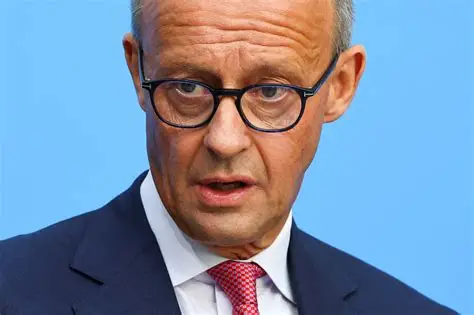
German Chancellor Merz: Urgent 2026 Trade Warning Exposes a Dangerous China Imbalance
German Chancellor Merz used his first official Beijing visit to warn that Germany can no longer treat its trade relationship with China as business as usual. The trip was diplomatic in tone, but the message was sharp: the widening trade imbalance is “not healthy,” and the pressure is now reaching the heart of the German industrial model.
German Chancellor Merz was not calling for a break with Beijing. He was drawing a line between cooperation and dependence. That distinction matters because China is again Germany’s largest trading partner, with bilateral goods trade reaching €251.8 billion in 2025, according to Germany’s Federal Statistical Office.
But the headline hides a problem. German imports from China reached €170.6 billion, while exports to China fell to €81.3 billion. German Chancellor Merz arrived with a difficult task: protect commercial ties with a crucial market while confronting Chinese overcapacity, export controls, market access complaints and Beijing’s relationship with Moscow.
For Germany, China is not simply a customer or supplier. It is a partner, competitor and systemic rival at the same time. Germany’s official China strategy already says Berlin wants de-risking, not decoupling. The difference now is that the imbalance has become harder to ignore.
German Chancellor Merz framed the problem as a trade warning, not a trade break. For readers following the wider pressure on global trade, The News Ink’s economy coverage explains why trade deficits, tariffs and industrial policy have become central political issues rather than technical business topics.
Why German Chancellor Merz put trade first
German Chancellor Merz could have used the Beijing trip to focus only on diplomatic warmth. Instead, he placed the trade imbalance near the centre of the visit because the numbers have moved against Germany quickly. A deficit of roughly €90 billion with China is not a small statistical concern. It reflects a structural shift in how Germany buys, sells and competes.
China regained the top spot among Germany’s trading partners in 2025, overtaking the United States after Germany-China goods trade grew while German-U.S. trade declined. The headline may sound positive, but it hides an import-heavy relationship.
German Chancellor Merz therefore needed to make two points at once. Germany still wants Chinese investment, Chinese buyers and stable diplomatic channels. But Germany also wants more balanced competition, less dependence on critical inputs and fewer distortions from state-backed industrial overcapacity.
That is a narrow path. Push Beijing too hard, and German exporters could face retaliation. Say too little, and German industry may believe Berlin is ignoring one of its biggest competitive threats.
The numbers behind the warning
The 2025 trade figures explain why German Chancellor Merz did not frame the issue as a routine fluctuation.
| Indicator | 2025 figure | What it shows |
|---|---|---|
| Germany-China goods trade turnover | €251.8 billion | China became Germany’s top trading partner again |
| German imports from China | €170.6 billion | China remained a dominant source of goods for Germany |
| German exports to China | €81.3 billion | German sales to China were less than half the import total |
| Approximate German trade deficit with China | Nearly €90 billion | The imbalance became a major political issue |
| U.S.-Germany trade turnover | €240.5 billion | The U.S. fell behind China as Germany’s second-largest partner |
Imports from China were more than double German exports to China. That is a warning sign for any export-led economy, especially one already under pressure from high energy costs, weak domestic growth and fierce global competition.
German Chancellor Merz also knows that the imbalance affects investment decisions. If German firms believe China will remain essential but increasingly difficult, they may keep production close to Chinese customers while reducing investment at home. If they believe Chinese rivals will keep gaining market share in Europe, they may cut costs, move supply chains or lobby for stronger EU trade tools.
The danger is not only that Germany imports too much. The deeper danger is that Germany loses industrial advantage in the sectors that once made its exports hard to replace.
Why this is not a simple anti-China message
German Chancellor Merz avoided full decoupling language for a reason. China is too important to Germany’s economy to be treated as an ordinary rival. German carmakers, chemical companies, machinery firms and technology suppliers have spent decades building relationships in China. Many still rely on Chinese customers, suppliers or production networks.
That is why the official German position remains de-risking rather than separation. Germany wants to reduce dangerous dependence without cutting off trade. It wants to protect critical supply chains without closing the door to cooperation. It wants Europe to defend its industries without destroying export opportunities.
The German government’s Strategy on China describes China as a partner, competitor and systemic rival. That phrase captures the problem better than a simple friend-or-enemy label.
German Chancellor Merz carried that same tension into Beijing. He encouraged Chinese companies to invest in Germany, but he also raised risks around supply chains, export controls and market distortions. That is not contradiction. It is the reality of a relationship where opportunity and vulnerability now sit side by side.
The industrial risk is bigger than the deficit
A trade deficit is a symptom. The underlying disease, in Germany’s view, is a loss of competitiveness in key industrial sectors. Chinese manufacturers are no longer competing only on low-cost consumer goods. They are now challenging Europe in electric vehicles, batteries, solar technology, machinery, electronics, industrial components and advanced manufacturing.
That shift is sometimes described as a second China shock. The first China shock affected manufacturing jobs in advanced economies after China’s entry into global trade systems. The second is different. It involves Chinese firms moving up the value chain into sectors where Germany used to hold a stronger technological edge.
German Chancellor Merz knows that this challenge cannot be solved by one Beijing visit. If Chinese firms produce at scale with heavy state support, lower financing costs and deep domestic supply chains, German firms may struggle even when their products remain high quality.
The risk is visible in the automotive sector. German brands built enormous success in China, but Chinese electric-vehicle companies have grown rapidly, improved quality and started competing aggressively overseas. What began as a China-market challenge is now an export challenge for Europe.
The News Ink’s coverage of electric-car backlash and market pressure shows how the global car industry is being reshaped by pricing, technology and consumer expectations. Germany’s China problem sits inside that larger transformation.
Export controls and critical materials raised business pressure
German business groups pushed German Chancellor Merz to address more than headline trade numbers. Export controls on critical materials have become a major concern because Germany’s industrial base depends on predictable access to components, minerals and intermediate goods.
China has significant influence over several critical supply chains. When export restrictions affect rare earths, basic chips or other industrial inputs, German manufacturers can face sudden bottlenecks. Those restrictions do not only hurt large companies. They can ripple through midsized suppliers that form the backbone of Germany’s manufacturing economy.
This is why de-risking has become a practical business priority. It means mapping supply chains, identifying single-country dependencies, increasing stockpiles, finding alternative suppliers and sometimes bringing production closer to Europe. None of that is cheap. But relying too heavily on one source can become more expensive when politics changes.
German Chancellor Merz therefore had to speak not only for exporters, but also for manufacturers worried about hidden dependencies. A company may appear strong because it sells advanced products globally, yet still be vulnerable if a key component or material comes from a politically sensitive supply chain.
The News Ink’s cloud computing guide covers a different industry, but the same dependency lesson applies: modern economies are built on layered infrastructure, and the weakest layer can decide how resilient the whole system really is.
Airbus showed why Germany will not decouple
The visit was not only about warnings. German Chancellor Merz also pointed to China’s commitment to purchase up to 120 Airbus aircraft, presenting it as evidence that high-level diplomacy can still open doors for European companies.
That matters because aviation is one of Europe’s most strategic industries. Airbus represents advanced manufacturing, skilled jobs, engineering depth and Europe’s ability to compete globally in a sector dominated by a small number of players.
The Airbus announcement also shows why Germany will not choose simple decoupling. Even when trade tensions rise, major deals remain possible. China still needs aircraft, machinery, chemicals, technology and high-quality industrial products. European companies still want access to Chinese demand.
But the Airbus example cuts both ways. A major purchase can create a positive headline without solving the deeper imbalance. Aircraft orders help, but they do not automatically fix market access issues, subsidy concerns or the broader pressure facing German manufacturers.
The News Ink’s article on China agreeing to buy Boeing jets offers a useful comparison. Large aircraft purchases often carry economic and diplomatic meaning at the same time. They can signal goodwill, support jobs and reduce tension, but they rarely settle the underlying trade dispute.
Ukraine made the Beijing visit geopolitical
German Chancellor Merz also urged China to use its influence with Moscow to help end Russia’s war in Ukraine. That point matters because Germany’s China policy cannot be separated from security policy anymore.
Before Russia’s full-scale invasion of Ukraine, German foreign economic policy often assumed that deep trade ties could reduce political risk. The war damaged that assumption. Germany’s dependence on Russian energy became a warning about what can happen when commercial logic ignores geopolitical vulnerability.
That lesson now shapes the China debate. Germany does not see China and Russia as identical cases. But Berlin is much more alert to the danger of strategic dependence. If a critical relationship turns political during a crisis, economic exposure can become a security problem.
German Chancellor Merz was effectively asking Beijing to prove that partnership means responsibility, not just trade. China’s relationship with Moscow therefore matters to German policymakers, even when the official agenda is mainly economic.
The U.S. factor changed Germany’s calculation
German Chancellor Merz also made the trip in a world where Germany’s relationship with the United States has become less predictable. U.S. tariffs and shifting Washington policy have made European governments think harder about how to protect their own industrial interests.
That does not mean Germany is replacing the U.S. with China. The United States remains Germany’s most important export destination. But China’s return as Germany’s largest trading partner shows how global trade is being rearranged.
German Chancellor Merz had to consider both pressures. On one side, Washington wants Europe to be tougher on China. On the other, German businesses worry that too hard a line could damage access to a key market. At the same time, U.S. tariffs can hurt European exporters and push Berlin to keep alternative relationships open.
The News Ink’s guide to Trump’s 10% global tariffs explains why tariff policy has become one of the defining forces in global trade politics. Germany’s Beijing strategy is partly a response to that more protectionist world.
Why Europe matters more than Germany alone
German Chancellor Merz can raise concerns in Beijing, but Germany cannot solve the imbalance alone. Many trade policy tools sit at European Union level. Tariffs, anti-subsidy investigations, market-access rules and many trade-defence instruments require EU coordination.
That is why Germany’s China debate is also a European debate. France has often favoured a tougher industrial-policy response to Chinese competition. Germany has traditionally been more cautious because its exporters have more to lose from retaliation. The result is a constant tension inside Europe: how to defend industry without triggering a wider trade war.
Germany’s official China strategy acknowledges that only a coordinated EU approach can carry enough weight. Beijing can manage pressure from one European capital more easily than a united European position.
German Chancellor Merz therefore needs to align three audiences: Chinese leaders, German businesses and EU partners. If he sounds too soft, European partners may see Germany as protecting narrow export interests. If he sounds too hard, German companies may fear damage to their China operations.
The News Ink’s report on India and U.S. trade talks after tariff uncertainty shows how trade negotiations now depend as much on political leverage as on economic logic.
What German industry wants now
German business groups want a more level playing field. That phrase can sound vague, but the demands are specific: better market access, fairer procurement, fewer forced localisation pressures, less opaque subsidy support for Chinese competitors, fewer export-control surprises and stronger protection for intellectual property.
They also want Berlin and Brussels to improve Europe’s own competitiveness. Companies know that complaining about China is not enough. Germany’s economy has internal problems too: high energy costs, slow permitting, ageing infrastructure, labour shortages, digital delays and tax burdens. If those issues remain unresolved, trade policy alone cannot restore industrial strength.
German Chancellor Merz therefore faces pressure on two fronts. He must ask Beijing for fairer competition, but he must also make Germany a more attractive place to invest and manufacture. Otherwise, German firms may continue shifting production abroad even if trade talks improve.
That is the uncomfortable truth behind the Beijing visit. German Chancellor Merz can pressure China, but Germany must also repair its own competitiveness. China’s policies may be a major challenge, but Germany’s response cannot be only diplomatic. It must also be domestic.
What success would actually look like
The Beijing visit should not be judged only by whether one aircraft order was announced or whether a joint statement sounded positive. The more important test is whether the relationship becomes more balanced over time.
Success would mean German exports stabilising or rising in China. It would mean fewer sudden restrictions on critical inputs. It would mean German firms reporting better market access and less pressure from unfair competition. It would mean China buying more high-value European goods, not only using Europe as a destination for surplus production.
Success would also mean Germany reducing its own vulnerabilities. That includes alternative supply chains for critical materials, more investment in advanced manufacturing, faster industrial permitting, cheaper clean energy and stronger European coordination.
German Chancellor Merz cannot deliver all of that through one trip. But he can set the tone. His “not healthy” warning matters because it signals that Berlin no longer wants to treat the imbalance as a temporary irritation.
The bigger lesson from the first Beijing visit
German Chancellor Merz entered Beijing at a moment when Germany’s economic confidence is under strain. The country still has world-class companies, strong engineering and deep export experience. But it also faces a more difficult China, a less predictable United States and a more fragmented global trading system.
That is why the visit matters. It showed Germany trying to keep the benefits of globalisation while correcting the vulnerabilities that globalisation created. It also showed how hard that task has become.
German Chancellor Merz did not offer a dramatic break with China. He offered a warning wrapped in cooperation. That may be the only realistic strategy for now. Germany cannot afford to walk away from China, but it also cannot afford to ignore a trade pattern that leaves its industrial base exposed.
The next phase will decide whether the warning becomes policy. If Germany and the EU build stronger supply chains, improve competitiveness and negotiate more balanced access, the Beijing visit may be remembered as a useful reset. If not, the imbalance will keep growing, and the phrase “not healthy” may sound less like diplomacy and more like an early diagnosis.
For more global economy and trade analysis from The News Ink, follow The News Ink on X.