India US Trade Talks: How a Crucial Tariff Ruling Reshaped the Deal
India US trade talks have moved from delay to renewed urgency after a major US Supreme Court tariff ruling disrupted the framework of a proposed interim trade agreement. The talks were initially postponed after the court rejected broad tariffs imposed under emergency powers, forcing both governments to reassess the legal and commercial foundation of the deal.
By late June 2026, however, India US trade talks had resumed at ministerial level. Indian Commerce and Industry Minister Piyush Goyal and US Trade Representative Jamieson Greer discussed ways to conclude the first phase of a bilateral trade agreement before a key US tariff deadline on July 24.
The central issue is no longer simply whether the talks will happen. The bigger question is whether India can secure tariff treatment that gives its exporters an advantage over regional competitors while the United States preserves leverage through temporary tariffs, trade probes and demands for wider market access.
The dispute shows how quickly trade negotiations can change when courts, tariff law, domestic politics and strategic diplomacy collide.
India US Trade Talks: What Happened?
India US trade talks were delayed after the US Supreme Court ruled on February 20, 2026, that the International Emergency Economic Powers Act did not authorize the president to impose sweeping tariffs without clearer congressional approval. The decision affected the legal basis for tariff measures that had been central to Washington’s bargaining position.
An Indian delegation had been expected to travel to Washington to work on the final details of an interim trade deal. That trip was postponed while officials studied the effect of the ruling and the new US tariff regime.
The proposed framework reportedly included a reduction in US tariffs on Indian goods from 25% to around 18%. In return, India was expected to lower certain trade barriers and increase purchases of US goods.
The delay did not end the negotiation process. By June, the two countries were again holding high-level discussions. India said both sides had made substantial progress and remained committed to a deal that was balanced and commercially meaningful.
For readers following wider global trade pressures, The News Ink has also explained how Trump’s new global tariffs work after the Supreme Court ruling.
Key Facts at a Glance
| Issue | Current position |
|---|---|
| Main topic | India US trade talks over an interim trade deal |
| Trigger for delay | US Supreme Court ruling against tariffs imposed under emergency powers |
| Original reported tariff target | US tariffs on Indian goods cut from 25% to around 18% |
| Replacement US tariff pressure | Temporary 10% global import tariff for 150 days under Section 122 |
| Key deadline | July 24, 2026, when the temporary tariff regime is due to expire |
| Main negotiators | Piyush Goyal for India and Jamieson Greer for the United States |
| Main Indian demand | Preferential tariff access over competing exporters |
| Main US demand | Fair, reciprocal access and stronger market openings |
| Status by June 24 | Talks resumed, with both sides discussing pathways to an interim deal |
This table matters because India US trade talks are not a single event. They are a moving process shaped by law, tariff deadlines, politics and market access demands.
Why the Supreme Court Ruling Changed the Negotiations
The Supreme Court decision changed India US trade talks because it weakened the legal foundation of tariffs that Washington had used as leverage.
The court ruled that the International Emergency Economic Powers Act, known as IEEPA, did not give the president broad authority to impose tariffs. That mattered because the disputed tariffs had been used to pressure trading partners, including India, into negotiation.
After the decision, the Trump administration moved to a different legal route. It announced a temporary 10% global tariff under Section 122 of the Trade Act of 1974. That provision allows short-term import restrictions in specific circumstances, but it is limited in time.
The new tariff clock created a fresh deadline. The temporary regime is scheduled to expire on July 24 unless extended through proper legal channels or replaced by other measures.
For India, this created both risk and opportunity. A lower universal tariff could reduce the pressure on Indian exporters, but the uncertainty makes it difficult to lock in a stable trade pact. India wants clarity before accepting concessions that could affect agriculture, energy, defence, manufacturing and consumer markets.
For the United States, the ruling did not end tariff policy. It pushed the administration toward other trade tools, including Section 301 unfair-trade investigations and Section 232 national-security measures. That means India US trade talks remain tied to broader uncertainty over how Washington will use trade law after the Supreme Court setback.
Timeline of the India-US Trade Dispute
| Date | Development | Why it matters |
|---|---|---|
| February 2026 | India and the US reportedly reached a preliminary understanding on tariff terms | The framework gave negotiators a starting point for an interim deal |
| February 20, 2026 | US Supreme Court rejected broad emergency-power tariffs | The legal basis of key tariff leverage was weakened |
| February 22, 2026 | India delayed a planned delegation visit to Washington | Officials needed time to assess the ruling and new tariff measures |
| April 2026 | Indian officials held constructive talks in Washington | The delay did not stop the negotiation process |
| June 5, 2026 | India said the first tranche of a deal could be ready by mid-July | The timeline moved closer to the July tariff deadline |
| June 17, 2026 | Narendra Modi and Donald Trump met on the sidelines of the G7 summit | The trade issue returned to the top political level |
| June 23-24, 2026 | Goyal and Greer held renewed ministerial-level discussions | India US trade talks regained momentum |
The timeline shows why the article should not remain framed only as a delay. The more accurate angle is that India US trade talks were disrupted by the ruling, paused for reassessment and then resumed under deadline pressure.
What India Wants From the Deal
India’s main goal is preferential access to the US market.
Trade Minister Piyush Goyal has made clear that India wants a tariff structure that gives Indian exporters an advantage over competitors. That point is important because India is not negotiating in isolation. Vietnam, Bangladesh, Indonesia, Thailand and other export-heavy economies are also trying to protect or improve their access to the American market.
If India accepts new market-opening commitments, it wants something commercially meaningful in return.
The sectors most affected could include textiles, gems and jewellery, pharmaceuticals, engineering goods, chemicals, seafood, electronics and labour-intensive manufacturing. These are areas where tariff differences can influence sourcing decisions by US importers.
India also has sensitive domestic sectors to protect. Agriculture, dairy and parts of retail access are politically difficult. Any agreement that appears to expose Indian farmers or small producers to sudden competition could face criticism at home.
That is why India US trade talks are not just about headline tariff rates. They are about which sectors receive concessions, how long those concessions last and whether the agreement improves India’s competitive position.
The News Ink has also covered broader global trade themes, including Canada’s renewed trade talks with the United States.
What the United States Wants
The United States says it wants a fair and reciprocal trade agreement.
In practical terms, that means Washington wants more access for American exports and fewer barriers for US companies. The pressure points could include agricultural products, energy purchases, defence equipment, industrial goods, technology services and regulatory rules that affect market entry.
The US also wants to reduce its trade deficit with India.
According to the Office of the United States Trade Representative, US goods and services trade with India totalled an estimated $212.3 billion in 2024. USTR also reported that US goods trade with India totalled an estimated $149.4 billion in 2025, with US goods exports to India at $45.6 billion and US goods imports from India at $103.8 billion.
That left the United States with a goods trade deficit of $58.2 billion with India in 2025.
These numbers explain why trade has become such a sensitive issue in Washington. India is a strategic partner, but it is also a major exporter to the US market. The Trump administration wants to show that any agreement narrows imbalances and opens opportunities for American companies.
The challenge is that India wants tariff certainty, while the United States wants leverage. That tension sits at the heart of India US trade talks.
Why the July 24 Deadline Matters
The July 24 deadline matters because the temporary US tariff regime is scheduled to expire after 150 days.
That creates pressure on both sides. India wants to finalize a deal before the tariff environment changes again. The United States wants to use the deadline to push for concessions while it still has a clear tariff mechanism in place.
Deadlines can help trade agreements move. They force negotiators to decide which issues can be settled now and which can be postponed to a later phase.
However, deadlines can also produce weak or incomplete agreements. If India and the United States rush the first phase, they may leave unresolved disputes over agriculture, labour standards, industrial policy, digital rules or future tariff hikes.
That is why an interim deal may be the most realistic outcome. It could cover selected tariff concessions, purchase commitments and market-access improvements while leaving more difficult issues for later rounds.
India US trade talks therefore appear to be moving toward a phased agreement rather than a complete free trade pact.
Historical Context: Why India-US Trade Deals Are Difficult
India and the United States have expanded trade dramatically, but they have never found trade negotiations easy.
The relationship improved after India’s economic liberalisation in the 1990s and deepened further as technology, services, energy and defence cooperation grew. The United States became one of India’s most important commercial partners, while India became central to Washington’s Indo-Pacific strategy.
Yet trade frictions have persisted.
Washington has often complained about Indian tariffs, price controls, digital rules, agricultural barriers and market access restrictions. India has objected to US visa rules, tariff threats, export controls and pressure on domestic policy choices.
The two countries have also disagreed at the World Trade Organization over subsidies, agriculture and industrial policy.
This history explains why India US trade talks often move slowly. Strategic alignment does not automatically solve commercial disagreements. The United States wants deeper access to India’s fast-growing market. India wants access to the US market without sacrificing policy space for domestic development.
That balance is hard to achieve.
What the Numbers Say About the Trade Relationship
The trade relationship is too large for either side to ignore.
| Metric | Latest available figure |
|---|---|
| Total US goods and services trade with India in 2024 | $212.3 billion |
| US goods trade with India in 2025 | $149.4 billion |
| US goods exports to India in 2025 | $45.6 billion |
| US goods imports from India in 2025 | $103.8 billion |
| US goods trade deficit with India in 2025 | $58.2 billion |
| Indian exports to the US in April-May 2026 | $17.29 billion |
| Indian exports to the US in April-May 2025 | $17.21 billion |
The April-May export figures show that Indian shipments to the US were broadly steady despite tariff uncertainty. That resilience gives India some confidence, but it does not remove the risk of future tariff changes.
For exporters, even small duty differences can matter. A tariff rate of 18% may still be high, but it could be better than a rate faced by competitors if India secures preferential terms. That is why India is pushing for an advantage rather than simply accepting a lower tariff in isolation.
For the US, the goods deficit remains politically important. The administration can use that number to argue that India should buy more American goods and reduce barriers.
These figures turn India US trade talks into a test of whether strategic partners can manage commercial imbalance without damaging the wider relationship.
Which Sectors Could Be Affected?
The interim agreement could affect several sectors.
For India, exporters in textiles, apparel, gems and jewellery, pharmaceuticals, engineering goods and chemicals will closely watch tariff outcomes. These industries depend heavily on price competitiveness in the US market.
For the United States, exporters in energy, agriculture, defence, aircraft, industrial products and technology services are likely to seek better access.
Energy purchases may play an important role. The United States often uses energy exports as part of trade-balance discussions, while India has been trying to diversify energy supply and manage the impact of global oil volatility.
The News Ink has covered how energy shocks can affect economies, including oil prices surging amid geopolitical uncertainty.
Agriculture may be more difficult. India has historically protected farmers from sudden import competition. Any deal that opens sensitive agricultural markets could face domestic resistance.
Digital trade may also become important. US technology companies want predictable rules on data, taxation and platform regulation. India wants to protect digital sovereignty while attracting investment.
Why the Deal Still Matters Strategically
India US trade talks are not only about tariffs.
They are part of a larger strategic relationship. The United States sees India as a key partner in Asia. India sees the United States as a major market, technology partner and geopolitical counterweight to China.
Trade tensions can weaken that wider relationship if they are allowed to dominate the agenda.
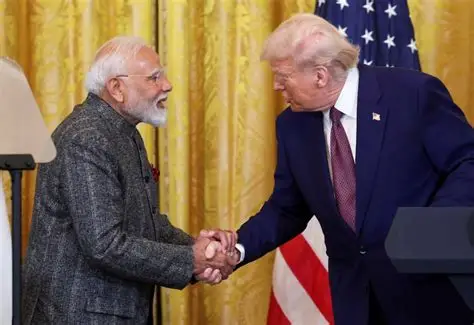
The June 17 meeting between Prime Minister Narendra Modi and President Donald Trump on the sidelines of the G7 summit helped bring the issue back to the political level. After that, negotiators resumed detailed work on possible pathways to an interim agreement.
A successful first-phase deal would not solve every trade dispute. It would, however, show that both governments can manage legal uncertainty and still produce a practical outcome.
A failed deal would increase the risk of more tariff actions, retaliation, business uncertainty and diplomatic friction.
For readers tracking global economic shifts, The News Ink’s economy coverage provides wider context on how tariffs, interest rates and geopolitical risks shape markets.
What Could Happen Next?
There are three realistic outcomes.
First, India and the United States could announce an interim deal before the July 24 deadline. This would likely include limited tariff commitments, purchase pledges and a roadmap for further negotiations.
Second, the two sides could extend talks without a formal agreement. This would keep negotiations alive but leave exporters uncertain about tariff exposure.
Third, negotiations could stall again if either side decides the proposed concessions are politically or economically unacceptable.
The first outcome is still possible because both governments have incentives to show progress. India wants preferential access. The United States wants reciprocal market openings. Both sides want to avoid another trade dispute that distracts from strategic cooperation.
However, the legal uncertainty around US tariff powers remains important. Even if a deal is reached, businesses will want to know whether tariff terms can survive court challenges and future policy shifts.
That is the unanswered question behind India US trade talks.
FAQ
Why were India US trade talks delayed?
India US trade talks were delayed after the US Supreme Court ruled that broad tariffs imposed under emergency powers were not legally valid. The decision forced both governments to reassess the tariff basis of a proposed interim trade deal.
Have India US trade talks resumed?
Yes. By late June 2026, India US trade talks had resumed at ministerial level, with Piyush Goyal and Jamieson Greer discussing ways to conclude the first phase of a bilateral trade agreement.
What is the July 24 tariff deadline?
The July 24 deadline refers to the expected expiry of the temporary 10% US global import tariff imposed for 150 days under Section 122 of the Trade Act of 1974 after the Supreme Court tariff ruling.
What does India want from the trade deal?
India wants preferential tariff access for its exporters, especially compared with regional competitors. It also wants certainty that future tariff hikes will not erase the benefits of any agreement.
What does the United States want from India?
The United States wants a fair and reciprocal trade agreement, greater market access for American exporters and a reduction in trade imbalances with India.
Final Summary
India US trade talks were initially delayed because the Supreme Court tariff ruling disrupted a proposed deal built around reduced US duties on Indian goods. That delay gave both governments time to study the legal and commercial impact of the ruling.
The story has now moved forward.
By June 2026, both countries had resumed high-level talks and were working toward an interim agreement before the July 24 tariff deadline. The negotiations remain difficult because India wants preferential access, while the United States wants reciprocal concessions and stronger market openings.
The outcome will matter beyond one trade deal. It will show whether India and the United States can protect a major strategic relationship while managing hard economic disagreements over tariffs, market access and trade law.
For more updates on global trade, markets and economic policy, follow The News Ink on X.