Jewish School in Amsterdam: What the Alarming 2026 Explosion Revealed About a Wider Security Threat
The Jewish school in Amsterdam that was targeted by an explosive device in March 2026 became the centre of a much wider security investigation than the first reports suggested. The blast happened in the early hours of Saturday, 14 March, at an outside wall of Cheider in the Buitenveldert area. No one was injured and the physical damage was limited, but Amsterdam’s mayor, police and public prosecutors treated the incident as a targeted attack against the Jewish community.
At first, the case appeared to be a local attack carried out by two unidentified people on a motor scooter. Within days, Dutch police were examining possible links to an explosion at a synagogue in Rotterdam and another explosion at the Atrium office complex on Amsterdam’s Zuidas. In the months that followed, the investigation became part of a broader European terrorism picture involving attacks claimed by Harakat Ashab al-Yamin al-Islamiya, often abbreviated HAYI.
The case matters for more than the damage to one wall. The Jewish school in Amsterdam attack raised questions about antisemitism, protection of Jewish institutions, the use of young local operatives and the international character of security threats facing European cities.
What Happened at the Jewish School in Amsterdam
According to Amsterdam police, two suspects arrived at the school on a motor scooter at about 03:45 on 14 March. CCTV footage showed the pair stopping outside the building. One of them placed an object against the outside wall before they left in the direction of Van Nijenrodeweg. The device exploded as they were getting away.
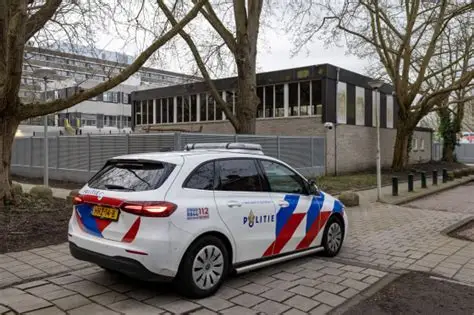
Police and firefighters responded quickly. Their rapid arrival limited the damage, and no injuries were reported.
The city’s official March 14 statement said the Amsterdam “triangle” of the mayor, public prosecutor and police regarded the explosion as a targeted attack against the Jewish community. Mayor Femke Halsema described it as a cowardly act of aggression and said a school should be a place where children can learn safely.
That official language is important. The explosion at the Jewish school in Amsterdam was not initially described by authorities as an accidental blast, vandalism of uncertain origin or an ordinary property offence. From the beginning, city leaders treated the identity of the institution and the community it serves as central to the incident.
Amsterdam’s official school directory identifies Cheider as a Jewish school on Zeelandstraat in Amsterdam-Zuid. Its secondary-school profile describes it as an Orthodox Jewish school offering both the regular Dutch curriculum and an extensive Jewish programme.
The First Police Investigation Quickly Widened
The first public appeal in the Jewish school in Amsterdam case focused on identifying the two people seen on CCTV. Police later released clearer images of the suspects and their motor scooter and asked the public for information through an official police appeal.
Investigators from the Forensic Investigation unit, the Major Investigation Team and Amsterdam-South detectives worked on the case. Police also coordinated with national security services and maintained contact with the Jewish community.
The investigation into the Jewish school in Amsterdam did not take place in isolation. A day earlier, an explosive device caused a brief fire at a synagogue in Rotterdam; no one was injured. Dutch authorities then activated a national coordination structure to strengthen protection around Jewish sites.
Within another two days, an explosion occurred at the Atrium office complex on Amsterdam’s Zuidas. Police again investigated two suspects, this time reported to have arrived on a fatbike. The blast caused substantial property damage but no injuries.
Police openly examined whether the incidents could be connected. That was an important shift because the Jewish school in Amsterdam was no longer being viewed only as a single local case.
Timeline of the Major Developments
| Date | Development |
|---|---|
| 13 March 2026 | Explosion and fire at a synagogue in Rotterdam; no injuries reported |
| 14 March 2026 | Explosive detonated at the Jewish school in Amsterdam; two suspects fled on a motor scooter |
| 16 March 2026 | Police released CCTV images and appealed for help identifying the school suspects |
| 16 March 2026 | Explosion damaged the Atrium office complex on Amsterdam’s Zuidas |
| 19 March 2026 | NCTV described strengthened protection around Jewish institutions |
| 23 April 2026 | A 17-year-old was arrested over the separate Atrium explosion |
| May 2026 | Dutch reporting said the two school attackers had still not been arrested |
| May 2026 | U.S. prosecutors announced terrorism-related charges against Mohammad Baqer Saad Dawood Al-Saadi |
| June 2026 | The Netherlands joined an international statement condemning HAYI-claimed attacks and Iranian state threats |
| 20 August 2026 | Amsterdam District Court sentenced the teenager involved in the separate Atrium explosion |
The timeline shows why the Jewish school in Amsterdam story changed after the first report. A current account must include the later evidence, claims of responsibility and international investigation without treating allegations as proven facts.
The Attack Was Claimed as Part of a Wider Campaign
A major development came when the same group was reported to have claimed both the school attack and the later Atrium explosion.
Dutch television programme Opsporing Verzocht reported that the two Amsterdam attacks were claimed by the same organisation, Harakat Ashab al-Yamin al-Islamiya.
The most significant later evidence came from the United States. In May, U.S. federal prosecutors charged Mohammad Baqer Saad Dawood Al-Saadi, a dual Iranian-Iraqi national, with terrorism-related offences. Prosecutors alleged that he helped plan, coordinate and publicise approximately 18 attacks and attempted attacks across Europe in the name of HAYI.
A U.S. federal court filing specifically refers to the 14 March explosion at a Jewish school in Amsterdam. It alleges that on the same day Al-Saadi posted a propaganda video showing an explosion outside the school and the assailants escaping on a motorcycle, with the HAYI logo appearing in the footage.
These are serious allegations, but they remain allegations in an active criminal case. They should not be presented as a final judicial finding. Al-Saadi is entitled to the presumption of innocence unless and until convicted.
That distinction is crucial when reporting on the Jewish school in Amsterdam. A propaganda claim is relevant evidence, but claiming responsibility online does not by itself prove who physically carried out an attack, who ordered it or what every participant knew.
What U.S. Prosecutors Allege About HAYI
The U.S. Justice Department case alleges that HAYI was not simply an independent new organisation. Prosecutors say it functioned as a front connected to Kata’ib Hizballah and other groups designated by the United States as foreign terrorist organisations.
The indictment further alleges that Al-Saadi had long-standing connections to Kata’ib Hizballah and Iran’s Islamic Revolutionary Guard Corps and that he was involved in media, psychological warfare, strategy and military intelligence.
According to prosecutors, propaganda videos were used to amplify the psychological impact of attacks across Europe. The case materials describe communications, videos and phone evidence allegedly linking Al-Saadi to planning and promotion of multiple incidents.
For readers following the wider conflict, The News Ink has also examined why the United States and Israel attacked Iran. That geopolitical background matters, but it must not collapse separate legal questions into one narrative.
There is a major difference between saying U.S. prosecutors allege links among HAYI, Kata’ib Hizballah and the IRGC, and saying the Iranian government has been judicially proven to have ordered the attack on the Jewish school in Amsterdam. The available public record does not justify the latter conclusion.
International Concern Over Iranian State Threats
By June, the Netherlands was among 24 countries issuing a joint statement on Iranian state threats and attacks claimed by HAYI.
The statement condemned what the countries described as malign actions by Iranian security services. It also condemned a campaign of attacks across Europe targeting Jewish communities, Iranian journalists and U.S. interests that had been claimed by HAYI. The governments said Iranian security services had a longstanding history of using international and local criminal groups.
This added international context to the Jewish school in Amsterdam case, but the statement was not a court judgment assigning criminal responsibility for the bombing to a specific state official. Reporting should therefore preserve terms such as “alleged,” “claimed” and “according to prosecutors.”
Why Security at Jewish Institutions Was Already High
The Jewish school in Amsterdam had significant security before the March explosion. Amsterdam’s official statement said Jewish schools and institutions in the city were permanently protected and that security had already been intensified following incidents in Liège and Rotterdam.
The Netherlands’ National Coordinator for Security and Counterterrorism later explained that protective arrangements around Jewish schools, synagogues and institutions had existed for years. After the March attacks, local authorities could add further measures while the NCTV continued supporting security planning.
The Netherlands had also adopted a national strategy against antisemitism for 2024-2030. By April 2026, the government said registered incidents were still rising, from verbal abuse and online hate to physical threats and attacks.
The News Ink has separately examined rising antisemitism in the UK, where similar concerns centre on whether Jewish people feel able to study, worship and live publicly without intimidation.
The policy challenge is difficult: Jewish institutions need protection, but heavy security can itself remind children and families that they are considered potential targets.
Dutch Government Expanded Security Funding
The security debate continued after the attack on the Jewish school in Amsterdam.
In June 2026, the Dutch government opened a security fund for Jewish institutions with €2 million available for 2026. Jewish schools, institutions and organisations could apply for support for security cameras, access control, security advice and additional personnel.
The fund formed part of the broader national strategy against antisemitism. The government said it was intended to help Jewish organisations meet the unusually high costs of protecting pupils, visitors, staff and members.
The attack on the Jewish school in Amsterdam therefore sits at the intersection of physical security and social policy. Protection is necessary, but cameras and guards cannot by themselves eliminate antisemitic hatred, extremist recruitment or criminal intermediaries.
The School Was Threatened Again Two Months Later
The sense of insecurity around the Jewish school in Amsterdam did not disappear after March.
In May, Cheider temporarily closed following a telephone threat. Police arrested a minor in connection with that separate incident. Dutch media later reported that the boy was released but remained a suspect in the threat investigation.
The May threat was not the same case as the March explosion, and there was no public basis to treat the incidents as having the same perpetrators. However, the episode illustrated why the Jewish school in Amsterdam remained under exceptional security pressure.
At that time, a police spokesperson told Dutch media that the two people filmed during the March attack had not yet been arrested. That was an important clarification because an arrest made in April over the Atrium explosion did not mean police had solved the school case.
The distinction between separate investigations is essential. A person suspected or convicted in one connected or similar incident should not automatically be described as responsible for another.
The Separate Atrium Case Produced a Conviction
The explosion at the Atrium building on the Zuidas became one of the clearest examples of how young local offenders could become involved in a wider series of attacks.
A 17-year-old from Uithoorn was arrested in connection with the Atrium explosion. On August 20, the Amsterdam District Court convicted him of jointly causing the explosion and sentenced him to 165 days of juvenile detention, 122 days of which were suspended, with time already spent in pre-trial detention deducted.
The court case concerned the Atrium blast, not the Jewish school in Amsterdam. That difference must remain explicit.
The Amsterdam District Court judgment summary said the teenager had made a “very wrong choice” because he wanted to earn money quickly. The court discussed the social fear caused by improvised explosions but did not convict him for the school attack.
Another 16-year-old was arrested in June on suspicion of helping prepare the Atrium attack. The Dutch Public Prosecution Service said the broader investigation covered several attacks and attempted attacks involving Jewish sites and the Zuidas explosion.
This illustrates an important feature of modern extremist and criminal operations. A wider ideological organisation may seek publicity from an attack while an individual recruited locally may be motivated by payment, status or other non-ideological reasons.
Antisemitism and Geopolitics Should Not Be Confused
The attack on the Jewish school in Amsterdam occurred during intense international conflict involving Israel, Iran and the United States. That context influenced public concern and later investigations, but political criticism, geopolitical conflict and hatred of Jewish people must not be treated as the same thing.
Jewish citizens in Amsterdam are not representatives of the Israeli government. A Jewish school is not a military installation, embassy or political organisation.
Dutch government discussions on antisemitism have similarly stressed that Jewish people must not be held individually or collectively responsible for actions of the state of Israel.
Reporting on the Jewish school in Amsterdam can explain the international background while still making clear that targeting Jewish civilians or institutions because of identity is fundamentally different from political criticism of a government.
The News Ink has also reported on a security incident at a Michigan synagogue, showing that concerns about violence against Jewish institutions are not confined to one European city.
What Investigators Established and What Remains Uncertain
Several facts about the Jewish school in Amsterdam are well established.
Police confirmed that two suspects arrived on a motor scooter, placed an explosive device at the outside wall and fled. No one was injured. Amsterdam authorities treated the incident as a targeted attack on the Jewish community, and CCTV images were released publicly.
It is also established that HAYI claimed the attack and that U.S. prosecutors later included the Amsterdam school explosion in their wider terrorism allegations against Al-Saadi.
What remains legally different is individual responsibility. Prosecutors’ allegations and publicly released intelligence are not the same as final convictions for the school attack. Dutch reporting in May said the physical perpetrators filmed leaving on the motor scooter had still not been arrested.
That is why the Jewish school in Amsterdam should not be rewritten as a completely solved case when the public record does not support that conclusion.
Why This Case Matters Beyond Amsterdam
The attack on the Jewish school in Amsterdam shows how an explosion causing relatively limited physical damage can produce consequences far beyond the immediate scene.
There were no deaths and no injuries. Yet the attack triggered a national police response, increased protection around Jewish sites, became part of an international terrorism investigation and reinforced a wider Dutch debate about antisemitism.
It also illustrated how modern extremist campaigns can combine local operatives, social-media propaganda, international political narratives and alleged coordination across borders.
For Jewish families, the meaning was more immediate. A school had been deliberately targeted. Parents and children were reminded that an ordinary place of education required permanent security.
That is the most important human context of the Jewish school in Amsterdam case. The significance of an attack on a school cannot be measured only by the size of the explosion or repair costs.
Where the Jewish School in Amsterdam Case Stands
The Jewish school in Amsterdam remains an important example of how quickly a local criminal investigation can develop into a broader national-security case.
The March 14 explosion was described by Amsterdam authorities as a deliberate, targeted attack against the Jewish community. Police identified two suspects on CCTV and investigated connections with other incidents. HAYI later claimed the attack, and U.S. prosecutors alleged that the organisation was part of a wider network connected to Kata’ib Hizballah and the IRGC.
At the same time, legal caution remains necessary. Claims of responsibility, intelligence assessments and criminal allegations should not be reported as convictions. The public evidence provides a much clearer picture than was available in the first hours after the explosion, but questions about the physical perpetrators and complete chain of command have not all been resolved publicly.
For Amsterdam, the lasting issue is safety. The city and national government have expanded protection and funding for Jewish institutions, but the need for such security is itself evidence of the pressure facing the community.
The Jewish school in Amsterdam story is therefore not only about an explosive device placed against a wall. It is about whether children can attend school without fear, whether Jewish residents can live openly and safely, and whether European authorities can disrupt networks that use intimidation and violence to turn international conflicts into attacks on local communities.
Readers can follow The News Ink on X for further international news and updates.