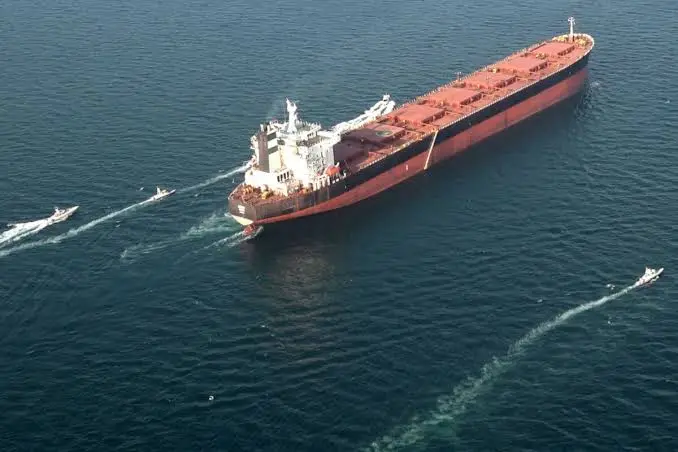
Trump Threatens Countries Supporting Iran as Strait of Hormuz Crisis Pushes Oil Higher
The Strait of Hormuz crisis entered a more dangerous economic phase on August 20, 2026, after U.S. President Donald Trump threatened “tremendous economic consequences” for any country that gives Iran what he described as a financial, commercial or logistical lifeline. The warning came as oil prices climbed to three-week highs and ship traffic through the Gulf chokepoint remained dramatically below pre-war norms.
Trump did not name a country and did not explain exactly what penalties Washington would impose. His statement was a threat of future economic action, not a published sanctions package. But the Strait of Hormuz crisis gives the warning immediate market weight: China buys more than 80% of Iran’s shipped oil, Washington is already enforcing a naval blockade on Iranian trade, and U.S. sanctions have expanded across Iran-linked ships, financial networks and energy transactions.
Oil responded quickly. At 12:57 GMT on Thursday, October Brent crude futures were up 2.39% at $93.81 a barrel. September West Texas Intermediate futures rose to $88.16, while the more-active October WTI contract climbed to $86.83. Both benchmarks reached their highest levels since July 24 and extended gains into a fifth consecutive session.
The Strait of Hormuz crisis is therefore no longer simply a debate over whether Iran can technically close the waterway. Shipping data show that traffic can remain severely depressed even when some vessels still pass. That is enough to restrict exports, raise insurance and freight costs, tighten refined-fuel markets and keep a geopolitical premium embedded in energy prices.
Strait of Hormuz Crisis: Key Numbers on August 20
| Indicator | Latest verified figure | Why it matters |
|---|---|---|
| Brent crude, Oct. futures | $93.81 a barrel | Up 2.39% intraday |
| WTI crude, Sept. futures | $88.16 a barrel | Up $2.33 intraday |
| Commodity vessels crossing Hormuz Wednesday | 9 | Far below normal traffic |
| Pre-war daily ship crossings | More than 130 | Shows scale of disruption |
| Hormuz oil flows, 4Q25 | 21.6 million b/d | Pre-war comparison |
| Hormuz oil flows, 2Q26 | 4.9 million b/d | About 77% below 4Q25 |
| July Middle East oil shut-ins | 5.5 million b/d | Supply remains constrained |
| China share of Iran’s shipped oil | More than 80% | Central to sanctions risk |
| U.S. gasoline price, Aug. 14 | About $4.08 a gallon | 29% higher than year earlier |
These figures explain why the Strait of Hormuz crisis remains a global economic story rather than a regional shipping dispute. The U.S. Energy Information Administration estimates that oil flows through Hormuz averaged 21.6 million barrels per day in the fourth quarter of 2025. In the second quarter of 2026, the average had fallen to only 4.9 million barrels per day.
What Trump Actually Threatened
Trump said any country allowing its financial institutions, businesses, airports or government entities to provide “any type of lifeline” to Iran could face major U.S. economic consequences.
That wording could reach beyond sanctions placed directly on Iranian entities. It raises the possibility of secondary measures against foreign banks, refiners, shipping companies, airports or businesses that keep Iranian commerce moving.
But the limits of the announcement are just as important. Trump did not identify countries, announce tariff rates, publish a sanctions list or explain how Washington would treat humanitarian commerce and diplomatic mediation.
The Reuters report on Trump’s warning noted that Trump’s social-media threats are not always implemented exactly as written. The Strait of Hormuz crisis should therefore not be described as if a new worldwide sanctions regime has already taken effect.
What has changed is the risk calculation for governments and companies still doing business with Iran. That broader uncertainty is one reason the Strait of Hormuz crisis is again dominating energy markets.
China Is the Biggest Economic Pressure Point
China is the clearest country to watch if Washington converts Trump’s warning into enforceable secondary sanctions.
Kpler data cited by Reuters show China bought more than 80% of Iran’s shipped oil in 2025. Independent Chinese refiners have been important buyers, giving Tehran a route to earn hard currency despite existing sanctions.
Cutting those sales could deepen the economic pressure created by the U.S. blockade and damage to Iranian infrastructure. It could also intensify the Strait of Hormuz crisis by removing more supply from an already constrained market.
Washington could sanction individual refiners, shipping firms or financial intermediaries. It could also target banks handling Iran-linked transactions. Reuters reported that the U.S. Treasury has already warned two larger Chinese banks that they could face secondary sanctions if Iranian funds were found moving through their systems. That makes the Strait of Hormuz crisis a potential pressure point in U.S.-China relations.
The Reuters analysis of Washington’s economic options shows why Beijing represents the most difficult target: aggressive measures could hurt Iranian oil revenue but also trigger Chinese retaliation and disrupt other strategically important trade.
Why the Strait of Hormuz Cannot Easily Be Replaced
The Strait of Hormuz sits between Iran and Oman and connects the Persian Gulf with the Gulf of Oman and Arabian Sea.
Before the war, U.S. Energy Information Administration data show that 20.9 million barrels per day of crude oil, condensate and petroleum products moved through Hormuz in the first half of 2025.
That was around 20% of global petroleum liquids consumption and approximately one-quarter of maritime oil trade.
The strait also carried 11.4 billion cubic feet per day of liquefied natural gas in the first half of 2025, representing more than 20% of global LNG trade.
Saudi Arabia and the United Arab Emirates have pipelines capable of bypassing Hormuz, but EIA estimates put their combined bypass capacity at about 4.7 million barrels per day.
That gap is the foundation of the Strait of Hormuz crisis. A route that normally moves more than 20 million barrels of oil and petroleum products each day cannot be completely replaced by existing pipelines.
When tankers avoid Hormuz because of security risk, oil can remain trapped inside the Gulf even when producers still have capacity underground.
Shipping Data Show the Strait Is Far From Normal
Washington and Tehran do not even agree on whether the waterway is open.
Trump said on August 18 that the Strait of Hormuz was “open and operating” and that mines had been removed or detonated. Iran said it remained shut and linked a full reopening to U.S. concessions, including an end to the blockade on Iranian ports, sanctions relief, release of frozen assets and an end to military threats.
Actual vessel movements fall between those political claims.
The latest Hormuz ship-tracking report found that nine commodity vessels crossed on Tuesday and another nine on Wednesday.
That is movement, but it is nowhere close to the more than 130 ships per day recorded before the conflict.
Earlier in August, the Strait of Hormuz crisis became even more severe. Reuters reported only two vessels crossing during part of August 14, with no crude shipment visible.
| Shipping measure | Pre-war / earlier level | Latest cited level |
|---|---|---|
| Daily vessel crossings | More than 130 | 9 on Wednesday |
| Hormuz oil flows | 21.6m b/d in 4Q25 | 4.9m b/d in 2Q26 |
| Hormuz LNG flows | 10.5 Bcf/d in 4Q25 | 0.8 Bcf/d in 2Q26 |
| July oil production shut-ins | — | 5.5m b/d |
A strait does not have to be physically sealed to create an economic blockade. Shipowners and insurers can pull back when the security risk becomes too high. The Strait of Hormuz crisis is therefore about usable capacity, not just geography.
Oil Prices Rise as Peace Hopes Fade
Oil prices rose sharply on August 20 because traders see a greater risk that Middle Eastern supply disruption will persist.
Brent climbed to $93.81 a barrel in Thursday trading, while WTI also moved higher. Both benchmarks reached their highest levels since July 24.
The latest Reuters oil-market update linked the latest gains to continued concern over Middle Eastern supply, uncertainty surrounding peace efforts and Trump’s warning to countries providing Iran with an economic lifeline.
Recent price history shows how strongly the market reacts to diplomacy.
After the June memorandum of understanding between Washington and Tehran, Brent spot crude fell as low as $69 a barrel on July 2 as traders anticipated better shipping conditions.
Those hopes faded after tanker attacks and renewed restrictions. The EIA said Brent spot crude reached about $105 on July 23.
The agency’s August outlook estimates that Middle Eastern production shut-ins averaged 5.5 million barrels per day in July. It assumes severe Hormuz constraints will persist through August, with flows beginning to rise slowly in September.
| Oil-market moment | Brent level or development |
|---|---|
| July 2 | Spot Brent fell as low as $69/b |
| July 23 | Spot Brent reached about $105/b |
| Aug. 11 EIA outlook | 3Q26 Brent forecast around $85/b |
| Aug. 20 | Oct. Brent futures at $93.81/b at 12:57 GMT |
| Current trend | Fifth consecutive session of gains |
The Strait of Hormuz crisis has created an oil market capable of moving by tens of dollars as expectations shift between ceasefire and escalation.
Why Economic Threats Can Move Oil Before New Sanctions Arrive
Secondary sanctions influence behavior partly through uncertainty.
A refinery, bank or shipowner does not necessarily wait to be formally penalized. If executives believe Iran-related business could cost them access to the U.S. financial system or American markets, they may reduce exposure in advance.
That means Trump’s warning can intensify the Strait of Hormuz crisis before the Treasury Department announces a new package. The Strait of Hormuz crisis can move markets on expectations alone.
Reuters reported that the Treasury Department’s Office of Foreign Assets Control has sanctioned more than 1,000 people, vessels and aircraft since Trump began his second term. Measures have targeted Iran’s shadow oil fleet, shipping insurers, weapons procurement networks and digital exchanges.
The next stage could focus more aggressively on third-country institutions. Reducing Iranian exports may hurt Tehran, but it can also tighten global supply and complicate diplomacy.
The Strait of Hormuz crisis is therefore testing how much economic pain Washington can impose on Iran without creating larger costs elsewhere.
The UAE Has Already Cut Economic Ties
The United Arab Emirates has already taken one of the most significant regional economic steps.
The UAE said it was suspending trade activities, commercial exchanges and financial transactions with Iran until further notice. The move followed Emirati claims that missiles launched from Iran had targeted maritime traffic. Iran rejected those accusations as baseless.
The development deepens the Strait of Hormuz crisis because the UAE is both a major oil exporter and an important commercial hub for regional trade. The Strait of Hormuz crisis is now affecting diplomacy, commerce and security at the same time.
Worsening UAE-Iran relations can restrict Iranian access to business and financial channels while simultaneously increasing the security risk around shipping.
The News Ink has tracked this deterioration through its coverage of UAE-Iran missile tensions and the broader oil-price surge around Hormuz.
Those developments now form part of the same problem: economic isolation and maritime insecurity are reinforcing one another.
Can the U.S. Blockade Force Iran to Change Course?
The Trump administration says it can maintain its naval blockade of Iran as long as necessary.
Defense Secretary Pete Hegseth said on August 13 that the U.S. Navy could keep the operation going “indefinitely” by rotating ships through the region. Washington argues that the blockade has cut Iran off from an important source of foreign currency.
The Reuters report on the U.S. blockade also showed the other side of the pressure strategy: Iran has sought leverage by restricting shipping through Hormuz.
The Strait of Hormuz crisis therefore spreads economic damage beyond Iran and the United States.
The EIA’s August energy outlook expects severe shipping constraints to continue through August and says most Gulf crude production may not return close to pre-conflict levels until early 2027.
That is a forecast based on assumptions, not a certainty. A durable agreement could improve the outlook quickly; renewed attacks could worsen it.
Iran Rejects Trump’s Threat
Iranian Foreign Minister Abbas Araqchi rejected Trump’s warning and accused Washington of using economic coercion.
Iran argues that sanctions and the U.S. blockade are worsening domestic inflation and economic hardship. Iranian officials also say they remain open to dialogue but will not accept demands they view as surrender.
The Associated Press account of Iran’s response reported that Araqchi dismissed the new economic pressure campaign as another failed U.S. policy.
Diplomatic messaging remains contradictory.
Trump said on August 18 that no talks were taking place or scheduled. A day earlier, special envoy Jared Kushner had said discussions were still underway and were more robust than before. That mixed messaging is another source of volatility in the Strait of Hormuz crisis.
The United States and Iran announced ceasefire arrangements in April and June, but both broke down. Shipping companies therefore have reason to wait for evidence of sustained safe passage rather than rely on political announcements.
How the Strait of Hormuz Crisis Reaches Consumers
Crude oil is only the first part of the economic chain.
When the Strait of Hormuz crisis restricts crude and refined-product supplies, the effects can move into gasoline, diesel, aviation fuel, trucking, food distribution and manufacturing.
Reuters reported that the average U.S. gasoline price was about $4.08 a gallon on August 14, around 29% higher than a year earlier. Trump told supporters that paying somewhat more for gasoline was a cost worth bearing in the confrontation with Iran.
The Reuters report on gasoline prices and Hormuz illustrates why the conflict is increasingly becoming a domestic economic issue in the United States as well as a foreign-policy dispute.
Refined-fuel markets are also under severe strain. The U.S. diesel crack spread — a measure of the value of diesel relative to crude — surpassed $100 a barrel for the first time, amid reduced supplies from the Middle East and Russia.
The News Ink has explained how Hormuz disruption can raise costs for food, medicines and electronics and compared today’s disruption with the 1970s oil crisis.
That is why the Strait of Hormuz crisis matters to households far beyond the Middle East.
Seven Risks That Could Decide What Happens Next
| Scenario | Likely effect |
|---|---|
| Shipping gradually normalizes | Oil risk premium eases |
| Traffic stays near current levels | Supply remains tight |
| New tanker attacks occur | Insurance and freight costs jump |
| U.S. sanctions Chinese refiners or banks | Iran revenue falls, China tensions rise |
| A durable ceasefire holds | Oil could lose part of its risk premium |
| Conflict spreads to more Gulf states | Energy infrastructure faces greater danger |
| Bab el-Mandeb disruption worsens | Alternative export routes become less useful |
The downside risks matter because some energy buffers have already been used. That leaves less room for the Strait of Hormuz crisis to worsen without wider economic consequences.
EIA estimates show U.S. strategic oil inventories fell from 413 million barrels in the fourth quarter of 2025 to 321 million in the second quarter of 2026.
The News Ink has also covered warnings that oil at $150 could threaten the global economy. Brent is well below that level today, but the warning illustrates how quickly a prolonged energy shock can become a growth problem.
What to Watch Next in the Strait of Hormuz Crisis
Five developments now matter most.
1. The U.S. Sanctions Package
Trump’s statement is not yet a detailed legal program. Markets will watch the Treasury Department for specific designations, restrictions and enforcement guidance.
2. China’s Response
Beijing has urged diplomacy and said sanctions and pressure will not solve the conflict. A move against major Chinese refiners or banks would be a major escalation.
3. Daily Ship Crossings
Political claims matter less than actual traffic. Nine commodity-vessel crossings remain nowhere close to the pre-war level of more than 130 per day.
4. Tanker Security
Another serious attack could cause shipowners and insurers to pull back even without a formal closure. Recent attacks and reported projectile strikes show that this remains a live risk.
5. Diplomacy
The Strait of Hormuz crisis is unlikely to normalize sustainably without a political arrangement that protects commercial shipping. After two failed ceasefires, implementation will matter more than announcements.
Frequently Asked Questions
What did Trump threaten countries supporting Iran with?
Trump warned that any country allowing banks, companies, airports or government bodies to provide a “lifeline” to Iran could face major U.S. economic consequences. He did not name specific countries or announce exact penalties.
Which country is most exposed to Trump’s warning?
China is the most obvious major exposure because it buys more than 80% of Iran’s shipped oil, according to Kpler data cited by Reuters.
Is the Strait of Hormuz completely closed?
Not completely in a physical sense. Iran says it remains closed under its authority, while Trump says it is open. Tracking data show some ships crossing, but traffic remains dramatically below normal.
How much oil normally travels through Hormuz?
EIA data show about 20.9 million barrels per day crossed the strait in the first half of 2025, equivalent to roughly one-fifth of global petroleum liquids consumption.
Why are oil prices rising now?
The Strait of Hormuz crisis is keeping Middle Eastern supply risks high. On August 20, Brent and WTI hit their highest levels since July 24 as low shipping traffic and Trump’s threat of broader economic pressure reduced hopes of a rapid settlement.
Conclusion
The Strait of Hormuz crisis is moving from a military and maritime confrontation into a wider test of global economic power.
Trump’s warning potentially puts foreign banks, companies and governments at risk if Washington decides they are keeping Iran connected to trade and finance. Yet the administration has not identified targets or published the penalties it intends to use.
China is the clearest pressure point because it buys more than 80% of Iran’s shipped oil. Targeting that trade could deprive Tehran of revenue, but it could also provoke Beijing and tighten an oil market already struggling with reduced Gulf exports.
Shipping remains nowhere close to normal. Nine commodity vessels crossed Hormuz on Wednesday, compared with more than 130 daily before the war. EIA data show oil flows averaged only 4.9 million barrels per day in the second quarter, down from 21.6 million in the final quarter of 2025.
Oil prices are already responding. Brent reached $93.81 a barrel during Thursday trading, while WTI also climbed strongly. The longer the Strait of Hormuz crisis persists, the greater the risk that higher energy costs spread into transport, food, manufacturing and inflation.
The next phase of the Strait of Hormuz crisis depends heavily on diplomacy. A durable ceasefire could quickly remove part of that risk premium. A wider sanctions confrontation with China, another tanker attack or a regional escalation could do the opposite.
For now, the most important signal is not what Washington or Tehran calls the strait. It is how many ships can actually cross it safely and consistently.
For continuing coverage of the Iran conflict, energy markets and global economic risks, follow The News Ink on X.