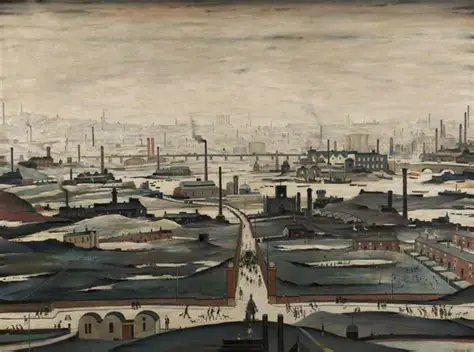
LS LOWRY, one of Britain’s most beloved artists, often described himself as a simple man using simple materials. Yet behind his famous industrial city scenes lay a deep sense of loneliness and meticulous artistic practice.
Lowry died on 23 February 1976 at the age of 88. Most people did not know he had worked as a full-time rent collector even after gaining fame for his depictions of northern England’s sooty landscapes. Success came late in life, but Lowry stayed humble. He even turned down a knighthood to avoid appearing pretentious. He left most of his fortune to a young woman who had written to him at age 13 seeking artistic advice.
In 1957, Lowry appeared in a BBC documentary. He explained how he created his matchstick figures and industrial scenes from imagination. “I see them like that, so I paint them like that, that’s all there is to it,” he said. Despite presenting himself as naïve, his work was underpinned by decades of learning and practice.
Lowry retired from his day job at 64, having worked for years collecting rents in Salford and Manchester. These same streets had inspired revolutionary ideas in Karl Marx and Friedrich Engels a century earlier. Lowry insisted he painted these scenes not as a social reformer, but because he was drawn to their visual character. “I just paint the scenes that I see,” he told the BBC.
A popular story claims Lowry decided to become an artist in 1916 after missing a train and discovering a mill and terraced houses. While this romantic tale paints him as a spontaneous talent, Lowry had studied art formally for at least 20 years at the Manchester Municipal and Salford Schools of Art. Critics who called him a “Sunday painter” misunderstood his training and dedication.
Like some of Picasso’s work, Lowry’s paintings may appear naïve at first. Yet he first mastered traditional rules before developing his distinctive style. He was inspired by Adolphe Valette, who introduced French Impressionism to Manchester in 1906 and influenced Lowry’s focus on modern industrial life.
Lowry’s industrial scenes were mostly imagined. He preferred starting with a blank canvas and painting from his mind’s eye. Buildings often came first, and the rest of the scene evolved naturally. “It sometimes comes very well and sometimes…not at all well,” he explained. His paintings could take years to complete, as they required intricate detail and careful balance.
Through his work, Lowry captured both the energy and the desolation of industrial life, blending imagination with painstaking observation. Beneath the charming matchstick figures lay the depth of a solitary, devoted artist.