Carney India Visit: Powerful 2026 Reset Tests Canada’s Risky Balance With Modi
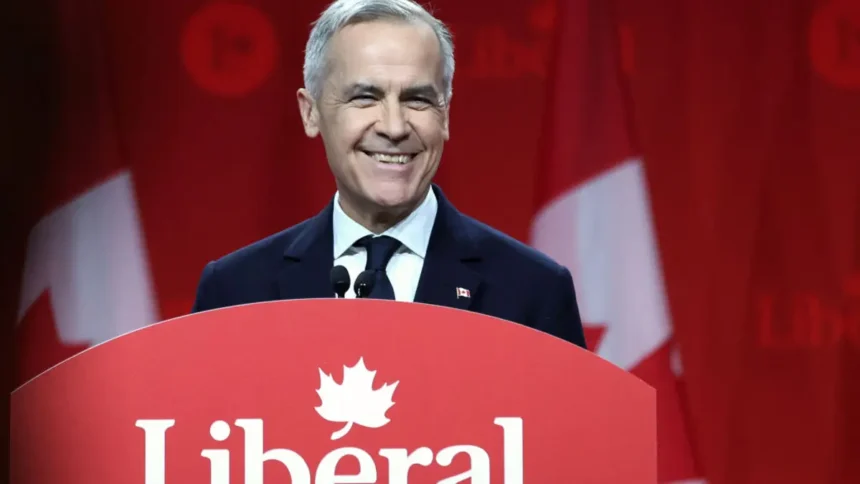
Carney India visit was more than a diplomatic photo opportunity. It was a calculated attempt by Canada to rebuild ties with India after one of the sharpest bilateral breakdowns in recent memory, while also reducing Ottawa’s dependence on the United States at a time of tariff pressure and global economic uncertainty.
The trip began in Mumbai, where Canadian Prime Minister Mark Carney met business leaders, and moved to New Delhi for talks with Indian Prime Minister Narendra Modi. By the end of the visit, the two governments had agreed to launch formal negotiations toward a Comprehensive Economic Partnership Agreement, or CEPA, with the aim of concluding talks by the end of 2026.
That made the Carney India visit a clear economic reset. The official joint statement set an ambition to expand bilateral trade to CAD 70 billion, or INR 4.65 lakh crore, by 2030. Reuters reported the target as roughly $50 billion, compared with nearly $9 billion in 2024-25. The two sides also announced a CAD $2.6 billion Cameco uranium supply agreement, new cooperation on critical minerals, energy, defence, maritime security, education, artificial intelligence and culture.
But the visit was not clean or uncomplicated. Canada and India are still working through the damage caused by the 2023 killing of Canadian Sikh separatist Hardeep Singh Nijjar near Vancouver. Former Canadian Prime Minister Justin Trudeau publicly alleged credible links between Indian agents and the killing. India denied the allegation and called it absurd. The dispute led to diplomatic expulsions, frozen trade talks and deep suspicion on both sides.
Carney India visit therefore carried two meanings at once. For Canada, it was a pragmatic move toward trade diversification. For Modi, it was a strategic win that showed India could weather a serious diplomatic crisis and still draw a G7 partner back to the table.
For readers following the wider economic backdrop, The News Ink’s economy coverage explains why trade diversification and supply-chain security now drive major foreign-policy decisions.
Why Carney India visit mattered for Canada
Carney India visit mattered because Canada’s trade model has long depended heavily on the United States. That dependence became more uncomfortable after Donald Trump’s tariff threats and wider pressure on Canadian exports. Carney has repeatedly framed diversification as a national economic priority, including a goal to double Canada’s non-U.S. exports over the next decade.
India is an obvious target for that strategy. It is the world’s most populous country, one of the fastest-growing large economies, a major energy consumer and a market where Canada can offer resources, education, finance, food, technology and critical minerals. For Ottawa, India is not just another partner. It is a hedge against overexposure to one neighbour.
That is why the Carney India visit focused heavily on business rather than symbolism. Carney went to Mumbai and New Delhi, not Punjab. He met executives, talked trade and emphasised sectors where Canada wants commercial outcomes: energy, agriculture, education, artificial intelligence, defence and investment.
The message was clear. Canada wants to move from grievance management to economic delivery.
The News Ink’s report on India and U.S. trade talks after tariff uncertainty gives useful context because Canada’s push toward India is happening while many countries are rethinking their exposure to U.S. trade policy.
Why Modi gained from the visit
For Modi, the Carney India visit was a diplomatic win because it showed India did not remain isolated after the Nijjar dispute. Canada had accused India of involvement in the killing of a Canadian citizen on Canadian soil, one of the most serious claims one democracy can make against another. New Delhi rejected the allegation, and relations plunged.
Yet by March 2026, the Canadian prime minister was in India talking about a trade pact, uranium, energy security, defence cooperation and maritime awareness. That shift strengthened Modi’s argument that India is too economically and strategically important to sideline.
The visit also fit India’s broader diplomacy. New Delhi wants deeper ties with G7 economies while preserving strategic autonomy. It wants investment, technology, energy supplies and defence cooperation without being trapped inside one bloc. A reset with Canada helped that goal.
That does not mean India got everything it wanted. Canada did not erase the Nijjar issue from history. Sikh-diaspora concerns did not disappear. Security talks remain sensitive. But Modi gained a major optics victory: a strained partner returned with business priorities at the front of the agenda.
Carney India visit was therefore a reset for Ottawa, but also a validation moment for New Delhi.
Key outcomes from the trip
| Area | Outcome | Why it mattered |
|---|---|---|
| Trade | CEPA negotiations launched with a target to conclude by end-2026 | Restarts a long-delayed economic framework |
| Trade target | CAD 70 billion / INR 4.65 lakh crore by 2030 | Sets a large growth benchmark for bilateral commerce |
| Nuclear energy | CAD $2.6 billion Cameco uranium supply agreement | Supports India’s civil nuclear energy plans |
| Energy | Cooperation on LNG, LPG, crude oil, uranium and clean energy | Gives Canada a role in India’s energy diversification |
| Critical minerals | Memorandum of Understanding on critical minerals cooperation | Connects Canadian resources to Indian manufacturing and clean-tech needs |
| Defence | Maritime security partnership and defence dialogue | Expands ties beyond trade into strategic cooperation |
| Education | Higher education and skills cooperation | Builds on Indian student and talent links with Canada |
| Security | Liaison mechanisms and counterterrorism dialogue | Keeps foreign-interference and enforcement issues on the table |
This table shows why Carney India visit cannot be reduced to one handshake. It produced a broad framework that touches trade, resources, national security and people-to-people links.
CEPA is the centrepiece
The biggest economic result of the Carney India visit was the relaunch of the Comprehensive Economic Partnership Agreement process. Canada and India have discussed trade liberalisation for years, but politics repeatedly slowed progress. The 2023 diplomatic crisis froze momentum almost completely.
The 2026 joint statement changed that. Both sides signed terms of reference for CEPA negotiations and said they wanted to conclude talks by the end of the year. If achieved, the agreement would give Canada more predictable access to a vast Indian market and give India a stronger commercial bridge into North America.
The sectors matter. Canada can export energy, potash, pulses, uranium, education services, technology and financial expertise. India can expand exports in pharmaceuticals, technology services, textiles, engineering goods, food products and professional services. A stronger agreement could also help supply chains move away from overdependence on any single country.
But CEPA will not be easy. India has traditionally guarded sensitive sectors. Canada will face pressure from domestic industries and diaspora groups. Both governments will need to handle labour mobility, agriculture, investment protection, services access and regulatory barriers.
Carney India visit created momentum. It did not remove the hard negotiating work.
The uranium deal was strategically important
The CAD $2.6 billion uranium supply agreement between Cameco and India’s Department of Atomic Energy was one of the most concrete outcomes of the visit. Modi called it a landmark deal for long-term uranium supply, while the joint statement said it would support India’s civil nuclear energy generation, clean-energy transition and long-term energy security.
This matters because India needs reliable baseload power as its economy grows. Renewable energy is expanding, but nuclear power remains part of India’s strategy to reduce emissions while meeting electricity demand. Canada has uranium, technical experience and a history of civil nuclear cooperation with India.
For Canada, the deal creates commercial value and strengthens its role as a reliable resource partner. For India, it diversifies fuel supply and reduces vulnerability to energy shocks.
The News Ink’s coverage of global trade and tariff pressure is relevant here because energy security and trade security are now closely linked in international politics.
Critical minerals and AI widen the agenda
Carney India visit also pushed the relationship beyond old trade categories. The joint statement highlighted critical minerals cooperation, clean energy, battery storage, carbon capture, artificial intelligence, research partnerships and digital innovation.
That is important because Canada has natural-resource strengths that India needs for electric vehicles, batteries, clean technology and advanced manufacturing. India, meanwhile, has scale, engineering talent and a fast-growing digital economy. If the two countries can combine Canadian resources with Indian manufacturing and technology capacity, the partnership could become more strategic than a simple goods trade.
Artificial intelligence is also part of the reset. Canada has deep AI research capacity, while India has a massive digital-services base and a growing policy focus on AI adoption. Cooperation in AI, education and skills could help both sides build talent pipelines.
The News Ink’s AI trends in 2026 coverage gives useful background on why governments now treat AI cooperation as an economic and geopolitical priority, not just a technology issue.
The Nijjar case still shadows the reset
No serious article on the Carney India visit can ignore Hardeep Singh Nijjar. His killing in Surrey, British Columbia, in June 2023 triggered the crisis that Carney is now trying to manage. Nijjar was a Canadian citizen and Sikh separatist activist whom India had designated a terrorist. Canada’s allegation of possible Indian government involvement led to a historic diplomatic rupture.
India denied involvement. The dispute led to expelled diplomats, reduced visa services and a breakdown of trust. For many Sikh Canadians, the issue remains personal and urgent. Some community leaders warned that trade should not come at the expense of safety, civil liberties or accountability.
That concern gained new context in July 2026, when Reuters reported that U.S. prosecutors charged imprisoned Indian gang leader Lawrence Bishnoi and his deputy Goldy Brar with orchestrating Nijjar’s killing. Reuters also noted that the U.S. indictment did not implicate the Indian government. That development may ease some state-to-state tension, but it does not remove the need for Canada to protect citizens facing threats.
Carney India visit therefore required careful balancing. Canada could pursue trade with India, but it could not appear to forget why relations collapsed.
Sikh-diaspora concerns remain politically sensitive
Canada has one of the world’s largest Sikh diasporas, and Sikh political engagement has long shaped Canada-India relations. For India, some pro-Khalistan activism in Canada is viewed as extremism and a security threat. For many Sikh Canadians, political advocacy for self-determination is a protected democratic activity, even when India strongly opposes it.
That disagreement did not disappear because Carney and Modi shook hands. It is built into the relationship. India wants Canada to act against separatist networks it considers dangerous. Canada wants India to respect Canadian sovereignty, legal process and free expression.
The Carney India visit avoided some symbolic risks. Carney did not visit Punjab, and the itinerary stayed focused on Mumbai and New Delhi. That choice signalled that the trip was about state-to-state and business relations rather than diaspora politics.
But avoiding Punjab did not avoid the issue. Sikh groups in Canada still watched the trip closely. Their concern was that Ottawa might soften its language on foreign interference and transnational repression to secure trade gains.
A sustainable reset must show that economic pragmatism and citizen safety can coexist.
Security cooperation is now part of the bargain
The joint statement included security and law-enforcement language. The two leaders supported liaison mechanisms to improve bilateral communication and information-sharing. They also committed to cooperation on cybersecurity and immigration enforcement and called for the next meeting of the Joint Working Group on Counterterrorism.
That matters because trade cannot fully recover if security distrust remains unmanaged. Canada needs credible assurances that threats to residents on Canadian soil will be addressed. India wants stronger action against networks it links to extremism. Both sides need channels that reduce public accusations and increase evidence-sharing.
The danger is that security cooperation becomes politically one-sided. Canada cannot simply adopt India’s terminology for diaspora activism without applying its own legal standards. India cannot dismiss every Canadian concern as vote-bank politics. If either side treats the other’s security concerns as illegitimate, the reset will remain fragile.
The News Ink’s cybersecurity guide is relevant because the official agenda also included cybersecurity cooperation, a field where law enforcement, data protection and national security now overlap.
Canada’s realpolitik is obvious
Carney India visit was an exercise in realpolitik. Canada needed a reset with India because the global economy has changed. The United States is less predictable. China remains complicated. Europe is slow-growing. India offers scale and growth.
That does not mean values vanished. It means Carney chose to put trade, energy and strategic diversification at the front of the relationship while keeping security discussions alive in the background.
This is the kind of foreign policy that often disappoints activists and satisfies business groups. Human-rights advocates worry that governments move on too quickly from unresolved allegations. Business leaders argue that countries must engage important partners even when disagreements remain.
Both views have force. Canada cannot ignore India’s importance. It also cannot ignore the safety concerns of its own citizens.
The real test of the Carney India visit is whether Canada can do both at once.
What Canada gets
Canada gets access to a fast-growing market and a chance to reduce economic vulnerability. A successful CEPA could create opportunities for Canadian agriculture, energy, education, finance, infrastructure, clean technology and minerals.
Canada also gets a stronger Indo-Pacific position. India is central to the region’s balance of power, maritime security and supply-chain diversification. A better relationship with New Delhi gives Ottawa more credibility in the Indo-Pacific.
Canada also gets a potential outlet for resources. Uranium, LNG, LPG, heavy oil, potash and critical minerals all fit India’s long-term demand profile. That is useful for a resource-rich country looking for non-U.S. buyers.
The News Ink’s report on Germany warning China over trade imbalance shows a similar pattern: major economies are trying to rebalance trade exposure without cutting themselves off from essential markets.
What India gets
India gets energy security, resource access, investment and diplomatic rehabilitation with a G7 country. It also gets validation that Canada is willing to compartmentalise the Nijjar dispute in pursuit of broader interests.
India also gains from Canada’s education and talent ecosystem. Indian students and professionals have been central to Canada’s immigration and university systems. A stable relationship helps protect that flow, even as Canada adjusts immigration and housing pressures.
India also gets strategic cooperation in maritime security. The joint statement welcomed a new maritime security partnership and defence linkages, including Canada’s appointment of a defence attaché to India. That matters because India wants partners that support a free and open Indo-Pacific without necessarily forcing India into alliance politics.
Carney India visit therefore gave India commercial, diplomatic and strategic gains.
The risks for Carney
Carney’s risk is domestic. If Sikh Canadians believe the government has traded accountability for market access, the reset could become politically costly. If another threat, killing or interference allegation emerges, Ottawa will face questions about whether it moved too fast.
There is also a trade risk. Announcing ambitious targets is easier than delivering them. Canada and India have tried before to deepen trade. Regulatory barriers, political sensitivities and slow negotiations can weaken momentum. If CEPA talks miss the end-2026 goal, the visit may look more symbolic than transformational.
There is also a U.S. risk. Canada’s diversification strategy is sensible, but the U.S. will remain Canada’s dominant economic partner. India can reduce vulnerability, but it cannot replace the United States. Overpromising diversification would be a mistake.
Carney India visit was therefore bold, but not risk-free.
The risks for Modi
Modi’s risks are different. India wants investment and trade, but it also wants Canada to act against pro-Khalistan activism. If Canada refuses to move as far as India wants, tensions could return.
India also faces reputational risk. The Nijjar case, the U.S. indictment linked to Bishnoi, and earlier U.S. allegations involving another Sikh separatist activist have kept transnational repression concerns alive. Even if state involvement is not proven in a specific case, India’s critics will continue to scrutinise its diaspora policies.
A reset with Canada helps Modi, but it does not erase those questions.
Why the trip avoided Punjab
Carney’s itinerary was politically meaningful. He visited Mumbai and New Delhi, the business and government centres. He did not visit Punjab, which has deep emotional and political significance for many Sikh Canadians and for India’s concerns about separatism.
That choice made sense for a trade-focused trip. It reduced the chance of symbolic controversy. It also showed that Carney wanted to speak to India’s economic and political leadership rather than perform diaspora balancing.
But the omission also revealed the sensitivity of the relationship. A normalised Canada-India relationship should eventually be able to include cultural and regional engagement without triggering a diplomatic storm. In 2026, the reset was not mature enough for that.
Carney India visit was carefully designed because trust remains incomplete.
What happens next
The next test is CEPA. If negotiators make visible progress and meet the end-2026 target, the visit will be remembered as a turning point. If talks stall, the reset may remain a headline without durable economic architecture.
The second test is security cooperation. The liaison mechanisms and counterterrorism dialogue must produce enough trust to prevent another rupture. If Canada and India can share evidence, manage threats and avoid public escalation, the relationship can stabilise.
The third test is diaspora confidence. Canada must show Sikh citizens that engagement with India does not weaken their rights. India must show that it can work with Canada without treating every diaspora disagreement as hostility.
The fourth test is commercial delivery. Business announcements matter only if companies invest, trade volumes rise and regulatory barriers fall.
The final takeaway
Carney India visit gave both countries something they needed. Canada gained a pathway to trade diversification, energy cooperation and a deeper Indo-Pacific presence. India gained a strategic reset with a G7 country after a damaging diplomatic dispute. Modi gained international validation. Carney gained a practical economic opening.
But the reset is delicate because the underlying tensions remain. The Nijjar case, Sikh-diaspora concerns, foreign-interference allegations and security distrust still shape the relationship. Trade can create incentives for stability, but it cannot replace accountability.
The best way to understand the Carney India visit is as a bargain built on necessity. Canada needs partners beyond the United States. India wants reliable access to energy, investment and Western markets. Both governments want to move forward. Neither can fully escape the past.
That is why the trip was a strategic win for Modi and a delicate balance for Carney. It opened a door, but keeping it open will require more than handshakes, uranium contracts and trade targets. It will require trust that both governments have not yet fully rebuilt.
For more world news and geopolitical analysis from The News Ink, follow The News Ink on X.