LS Lowry: Powerful 2026 Look at Hidden Loneliness Behind the Crowds
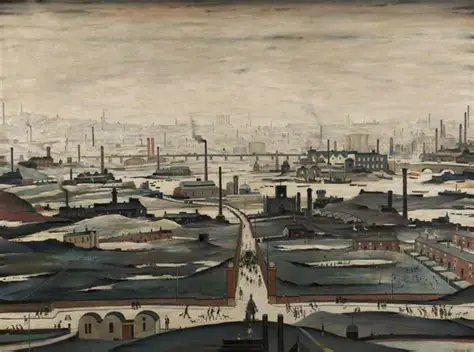
LS Lowry remains one of Britain’s most recognisable artists because his industrial cityscapes look crowded at first glance and lonely at second glance. The mills, terraces, smoking chimneys and famous matchstick figures seem to describe public life in northern England, yet the emotional force of the paintings often comes from distance: people moving together without quite meeting, streets filled with activity but emptied of intimacy.
That is why the familiar story of LS Lowry as a “simple” painter has always been too small. He encouraged the idea himself, presenting his materials and methods as plain and direct. But the work was not accidental. Behind the apparently childlike figures was a lifetime of drawing, evening study, disciplined observation and private obsession. Behind the crowded streets was a man who spent much of his life outside the social worlds he painted.
This updated article is not only about how LS Lowry painted factories and workers. It is about how he turned an industrial landscape into a psychology of modern life. His best-known paintings are full of people, but they rarely feel sociable. That tension is the reason they still hold attention in 2026, 50 years after his death.
For wider arts and culture context, The News Ink’s music and pop culture coverage shows how popular taste often protects figures who the formal art world is slower to embrace.
Why LS Lowry still feels modern in 2026
LS Lowry died on 23 February 1976, aged 88, but his paintings have not settled into comfortable nostalgia. They are often reproduced as images of an older industrial north, yet they also feel strangely contemporary. The loneliness in his streets belongs to the factory age, but it also belongs to the age of commuter crowds, digital isolation and cities where people move near each other without knowing each other.
The reason is composition. Lowry’s crowds do not behave like heroic communities. They drift, hurry, gather and separate. People stand at corners, enter factories, wait outside gates, move towards football grounds or schoolyards, and disappear into terraces. They are recognisable as human beings, but rarely individualised enough to become portraits. That choice gives the work its emotional ambiguity.
If the figures were too detailed, they would become characters. If they were too abstract, they would become decoration. LS Lowry found the unsettling middle ground. His people are anonymous but not empty. They are small, but they carry weight. They make the city alive while showing how little space the city gives them.
This is why his industrial cityscapes are not simply records of Manchester and Salford. They are studies of urban feeling.
The myth of the “simple” painter
The myth says LS Lowry was a natural, almost naïve artist who stumbled into a style and painted what he saw. The truth is more disciplined. The Lowry in Salford states that he studied painting and drawing in the evenings at Manchester Municipal College of Art from 1905 to 1915 and at Salford School of Art from 1915 to 1925, while working as a rent collector during the day.
That means his training lasted roughly two decades. It included life drawing, formal instruction and exposure to serious artistic ideas. His tutor Adolphe Valette, a French artist who brought knowledge of Impressionism to Manchester, mattered deeply to him. Lowry later said he could not overestimate Valette’s effect on him.
This history matters because critics often dismissed LS Lowry as a “Sunday painter” after learning that he had worked full-time for much of his career. The phrase is misleading. He was not a hobbyist who painted occasionally. He was a working man who built a serious artistic practice around a day job, often painting at night and developing a visual language that did not fit neatly into London art-world categories.
His simplicity was partly real and partly performance. He used a restricted palette: flake white, ivory black, vermilion, Prussian blue and yellow ochre. He often worked at home, in what he called his workroom rather than a grand studio. But those limits became tools. His pale grounds made figures stand out. His blacks and reds gave the city rhythm. His reduced bodies made crowds readable from a distance.
A life split between rent books and painting
For much of his adult life, LS Lowry worked for the Pall Mall Property Company, collecting rents across Salford and Manchester. He retired in 1952, when he was 65. That biographical fact is not just trivia. It helps explain why his paintings feel both intimate and detached.
A rent collector sees doors, streets, debt, housing conditions and repeated human routines. He enters working-class districts, but not as a neighbour in the same way residents do. He observes closely, but from a role that carries authority and separation. That position may have sharpened Lowry’s eye for urban life while also deepening his outsider status.
The tension appears in the paintings. He was drawn to working streets, mills and terraces, but he did not paint them as campaign posters. He was not a social reformer in the direct political sense. He did not give viewers speeches about poverty. He arranged the world visually: chimneys, church spires, railings, roads, factory gates and figures moving like notes across a score.
The result is more complicated than sentiment. LS Lowry could show the crush of industrial life without telling the viewer exactly what to feel. That restraint is one reason the paintings survive repeated looking.
The industrial cityscapes were imagined, not copied
The popular image of LS Lowry is of a painter standing in front of northern streets and copying what he saw. That is not quite right. He sketched outdoors, sometimes quickly and on scraps of paper, but many finished pictures were built later from memory, invention and compositional instinct.
The Lowry notes that after about 1910 he painted at home rather than outside. That distinction is crucial. The industrial cityscapes are not photographic documents. They are constructed worlds. Buildings may resemble real places, but they often function like stage sets. Roads curve into pale space. Chimneys punctuate the skyline. Crowds collect in clusters that feel choreographed.
This helps explain the emotional atmosphere. Because the scenes are not simple reportage, they can become more dreamlike. A street may look ordinary, yet feel oddly suspended. A crowd may be busy, yet strangely silent. Smoke rises, but weather often seems absent. Shadows are minimal. Time feels held in place.
That is where loneliness enters. The city is full, but soundless. The people are many, but alone. LS Lowry turned industrial modernity into a kind of theatre, and the theatre is rarely cheerful for long.
Lowry’s crowds and the hidden loneliness
The phrase “matchstick men” is useful shorthand, but it can flatten the achievement. Lowry’s small figures are not merely cute or simple. They are part of a visual system. Their thin bodies and dark marks allow the city to remain vast around them. They look fragile because the buildings are heavy. They look lonely because the streets are wide and pale.
In many paintings, the figures move in the same direction without appearing connected. They share a workplace, a street or a destination, but not necessarily a community. That is one of the secrets of LS Lowry: he painted mass life without romanticising togetherness.
The loneliness also reflects his own life. He never married, lived for years with demanding family responsibilities, cared for his mother after his father’s death, and became famous late enough that success could not easily repair earlier isolation. Recent interest in the BBC documentary LS Lowry: The Unheard Tapes has strengthened this reading by bringing attention to interviews from his final years, when he spoke with unusual candour about solitude, regret and artistic compulsion.
This does not mean every painting should be treated as autobiography. The cityscapes are not diary entries. But an artist’s emotional habits shape what he notices. Lowry noticed people together and apart at the same time.
The role of Adolphe Valette
Adolphe Valette’s influence helps correct another misunderstanding. LS Lowry was not cut off from European art. He did not imitate Impressionism, but he learned from a teacher who had absorbed French modern painting and brought those ideas into Manchester.
Valette helped Lowry see the city as a worthy subject. Industrial Manchester was not a lesser theme because it lacked pastoral beauty. Smoke, fog, factories and tramlines could be painted with seriousness. That lesson was transformative.
Tate’s Lowry and the Painting of Modern Life exhibition placed him within a broader tradition of modern urban painting, including the idea that industrial landscapes could speak as powerfully as boulevards, parks or rural views. That framing is important because it moves LS Lowry away from local curiosity and towards modern art history.
He was not painting Manchester because he had no imagination. He was painting it because he understood that modern life had changed where beauty, melancholy and drama could be found.
Key facts that reshape the story
| Common idea about Lowry | Better reading |
|---|---|
| He was a naïve painter | He trained for years while working full-time |
| His figures are simple | Their simplicity is a deliberate compositional tool |
| His cityscapes are documentary records | Many are imagined constructions based on memory and observation |
| He painted working-class life as social protest | He usually insisted he painted visual character, not political argument |
| His crowds are cheerful nostalgia | The crowds often reveal isolation, repetition and emotional distance |
| Fame solved his isolation | Success came late and did not erase his private loneliness |
This fuller reading makes LS Lowry more interesting, not less accessible. It allows the popular affection for him to sit beside a serious account of technique, psychology and modernity.
Why the “Sunday painter” label was unfair
The “Sunday painter” insult says more about class and art-world prejudice than about the paintings. LS Lowry worked outside the conventional full-time artist model, and he painted subjects associated with the industrial north rather than elite interiors or fashionable abstraction. That made it easy for some critics to place him below more obviously avant-garde names.
Yet his practice was demanding. He drew constantly, revised slowly and sometimes worked on paintings over long periods. His apparently spare figures required control. A few wrong marks could make a crowd look silly rather than alive. A building placed too heavily could crush the composition. A pale ground that looked empty in one work could feel luminous in another.
That is why comparing him to an untrained amateur misses the point. LS Lowry knew enough about traditional drawing to simplify with purpose. He knew enough about composition to make emptiness active. He knew enough about the city to invent it convincingly.
The News Ink’s article on the Rijksmuseum confirming a lost painting as a genuine Rembrandt is a useful reminder that art history often depends on looking past surface assumptions and studying method, provenance and evidence.
The private artist behind a public image
Lowry’s public persona was self-effacing. He turned down honours, including a knighthood in 1968, and became known as someone suspicious of pretension. The Lowry records multiple refused honours, including an OBE, CBE, knighthood and appointments to the Order of the Companions of Honour. The Guardian has described him as holding the record for the most honours turned down.
That refusal fits the image of a plain-speaking northern artist, but the private life was more complicated. He could be elusive, contradictory and guarded. He left much of his estate to Carol Ann Lowry, an unrelated young woman who had first written to him for artistic advice, a decision that later became part of the more unsettling debate around his private world.
A responsible article should not reduce LS Lowry to either saintly loneliness or scandal. The better approach is to accept complexity. His warmth, oddness, generosity, secrecy and emotional difficulty all belong to the same life. So do the paintings.
The art remains powerful because it does not explain itself fully. It holds back, as he often did.
Lowry’s continued pull in Salford and beyond
Fifty years after his death, LS Lowry is still central to how Salford and Manchester imagine their industrial past. The Lowry arts centre at Salford Quays holds the largest public collection of his work, and Art UK records more than 400 works in that collection, including 57 oil paintings.
His legacy has also become part of public education. In 2026, Tate lent his 1927 painting Dwelling, Ordsall Lane, Salford to the Lowry Academy in Salford, in a project designed to bring major art directly to young people. The loan mattered because Lowry painted streets and children who might once have been considered unworthy of major art. Bringing the painting into a school gave that democratic impulse a new form.
This is where his popularity still matters. LS Lowry is not only a museum name. He is an artist many people recognise before they know art history. That recognition can become a doorway into bigger questions about class, cities, memory and the emotional cost of industrial life.
The News Ink’s piece on Gibellina’s revival as an art town offers a useful parallel: places often use art to rebuild memory, identity and civic imagination after disruption.
Why the paintings are not just nostalgia
There is a danger in loving Lowry too comfortably. His industrial cityscapes can be turned into cosy images of a vanished north: factories, flat caps, terraced streets and people on their way to work. That reading misses the chill.
Many of the paintings are not warm. They are pale, smoky and emotionally restrained. Their crowds can look busy but not joyous. Their architecture often feels severe. Their humour, when present, is dry. Their charm is real, but it is edged with desolation.
This is why LS Lowry remains stronger than many imitators. The imitators often copy the matchstick figures and chimneys but miss the silence. Lowry’s best work is not only about what industrial streets looked like. It is about how they felt: repetitive, crowded, watchful, sometimes absurd, often lonely.
The same issue appears in debates about popular painters more broadly. The News Ink’s feature on Thomas Kinkade and the paintings that divided America shows how mass affection and critical suspicion can exist around the same artist. Lowry’s case is different, but the tension between popularity and seriousness is familiar.
The deeper reason LS Lowry endures
LS Lowry endures because he made ordinary people visible without turning them into slogans. He painted a world shaped by industry, but he did not reduce that world to economics. He painted crowds, but he did not pretend crowds cured loneliness. He painted cities, but he made them feel psychological.
His work also asks a question that has not disappeared: what happens to human feeling inside systems built for work, movement and repetition? The mills may have changed. The chimneys may have gone. But the experience of being surrounded by people and still feeling alone has not vanished.
That is why this article’s original phrase, “hidden loneliness,” is the right doorway into the subject. The loneliness is hidden because the pictures are full. It is hidden because the figures are active. It is hidden because Lowry’s own public voice was so plain and evasive.
But once seen, it is difficult to miss.
LS Lowry was not simply the painter of matchstick men. He was a painter of distance: between people, between classes, between public fame and private need, between the city as a machine and the city as a home. His industrial cityscapes still matter because they refuse to choose between affection and unease.
Fifty years after his death, that refusal feels more modern than ever.
For more arts, culture and long-form features from The News Ink, follow The News Ink on X.