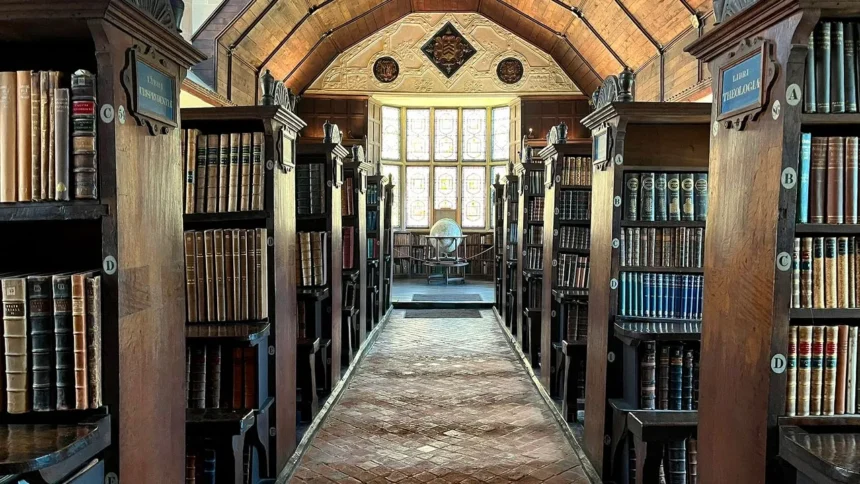
Merton College Library Celebrates 750 Years of Continuous Academic Legacy
Merton College Library is one of the most remarkable surviving academic institutions in the world. With a continuous history stretching back over 750 years, it represents not just a collection of books, but a living record of how knowledge, education, and scholarship have evolved across centuries.
From medieval manuscript storage systems to modern digital archives, Merton College Library stands today as a powerful symbol of intellectual continuity. Its long history reflects the transformation of libraries from guarded collections of handwritten texts to open spaces of learning used by students and researchers daily.
Unlike many historic institutions that have changed function or location over time, Merton College Library has remained in continuous academic use since its earliest foundations in the 13th century. This uninterrupted legacy places it among the oldest functioning university libraries in Europe.
The medieval origins of Merton College Library
The origins of Merton College Library date back to 1276, when church authorities required Oxford colleges to build shared collections of books. At the time, books were rare and extremely valuable, often handwritten over months by scribes.
Instead of a traditional library, Merton initially used a secured chest system. Books were stored in a locked chest and only accessed in the presence of key holders. This ensured both preservation and controlled access.
Over time, this system evolved into something more structured. Books were later chained to desks inside a designated room, allowing scholars to read them while preventing theft. This method of protection became common across medieval Europe.
For historical context on early book preservation systems, you can explore resources like the British Library archives and Oxford University Library history.
From chained books to modern shelving systems
As the collection grew, Merton College Library adapted its storage methods. One of its most significant innovations was the introduction of upright shelving, an early version of modern library design.
Books were arranged with their fore-edges facing outward, with handwritten titles displayed on the exposed edge. This allowed easier identification while still maintaining security through chains.
This transitional system reflects an important moment in library history, where accessibility slowly began to replace strict restriction.
Today, only a few chained books remain, preserved for display. Most of the collection now follows modern cataloging systems, making research easier and more efficient for students.
More information on medieval book preservation can be found through Cambridge University Libraries.
A library that survived centuries of change
What makes Merton College Library especially unique is its uninterrupted survival. It has remained active through major historical events, including the Black Death, the Renaissance, industrialization, and even modern global pandemics.
This continuous usage is rare among historical institutions. Many ancient libraries were destroyed, relocated, or repurposed over time, but Merton’s core academic role has remained unchanged.
It has been used by generations of scholars, including notable historical figures and writers such as J.R.R. Tolkien, who studied and worked within Oxford’s academic environment.
To understand how ancient libraries evolved globally, institutions like UNESCO World Heritage Centre provide useful context.
Why Merton College Library is historically significant
Merton College Library is often described as one of the oldest continuously functioning academic libraries in Europe. While debates exist about the “oldest library in the world,” Merton stands out for its uninterrupted academic purpose.
Its significance lies not only in its age but also in its role as a living academic environment. Unlike museum-style archives, it is still actively used by students and researchers today.
The library also reflects how medieval educational systems prioritized collective knowledge sharing. The tradition of book donation introduced in the 13th century continues in symbolic form even today.
Evolution into a modern academic space
Over the centuries, Merton College Library has evolved from a restricted manuscript collection into a modern research facility. While its medieval room remains preserved, new facilities and digital systems now support academic work.
Many manuscripts have been digitized, allowing global access to rare texts without damaging fragile originals. This balance between preservation and accessibility is a key feature of modern library science.
Digital transformation projects like these are also seen in institutions such as Europeana Digital Library, which hosts millions of digitized cultural artifacts.
Architectural and cultural importance
Beyond its academic role, Merton College Library is also a significant architectural landmark. The medieval reading room, with its wooden beams and historic design, remains largely unchanged.
Visitors often describe it as a “time capsule” of medieval scholarship. The atmosphere reflects centuries of continuous intellectual activity, creating a strong connection between past and present learners.
Its preservation efforts ensure that both students and historians can experience an authentic medieval academic environment.
The role of libraries in preserving human knowledge
Libraries like Merton College Library highlight the importance of preserving written knowledge across generations. They serve as bridges between historical scholarship and modern research.
In a digital era, physical libraries still play a vital role. They provide curated knowledge, historical context, and access to rare materials that are not always available online.
Institutions such as
Library of Congress demonstrate how global libraries continue to preserve human history in both physical and digital formats.
Global comparison with other ancient libraries
While Merton College Library is among the oldest academic libraries, other institutions also claim long historical continuity. Examples include monastic libraries and ancient manuscript collections across Europe, Africa, and Asia.
However, what distinguishes Merton is its continuous academic use within a university setting. This makes it not only a preserved site but an active part of educational life.
For global library history comparisons, the UNESCO Memory of the World Programme offers extensive documentation.
The future of Merton College Library
Looking ahead, Merton College Library continues to evolve with technology. Digitization projects are expanding access to rare manuscripts, ensuring long-term preservation while making materials accessible worldwide.
Despite modernization, the library maintains its historical identity. Students still study within its ancient walls, continuing a tradition that has lasted over seven centuries.
This combination of history and innovation ensures that the library remains relevant in the modern academic world.
Final reflection
Merton College Library is more than just an old building filled with books. It is a continuous thread of human learning stretching across 750 years of history.
Its survival through wars, pandemics, and technological revolutions highlights the enduring importance of knowledge preservation.
To explore more global history, education, and cultural heritage stories, you can visit The News Ink