5G and Beyond Tech Trends Are Reshaping the Digital Future
5G and beyond tech trends are redefining how the world connects, communicates, and computes. What began as faster mobile internet is now evolving into a full-scale digital transformation powered by ultra-low latency networks, artificial intelligence integration, and advanced machine-to-machine communication.
The rollout of 5G has already changed industries like healthcare, transport, gaming, and manufacturing. But what comes next is even more significant. The “beyond 5G” era is expected to introduce intelligent networks that can think, adapt, and self-optimize in real time.
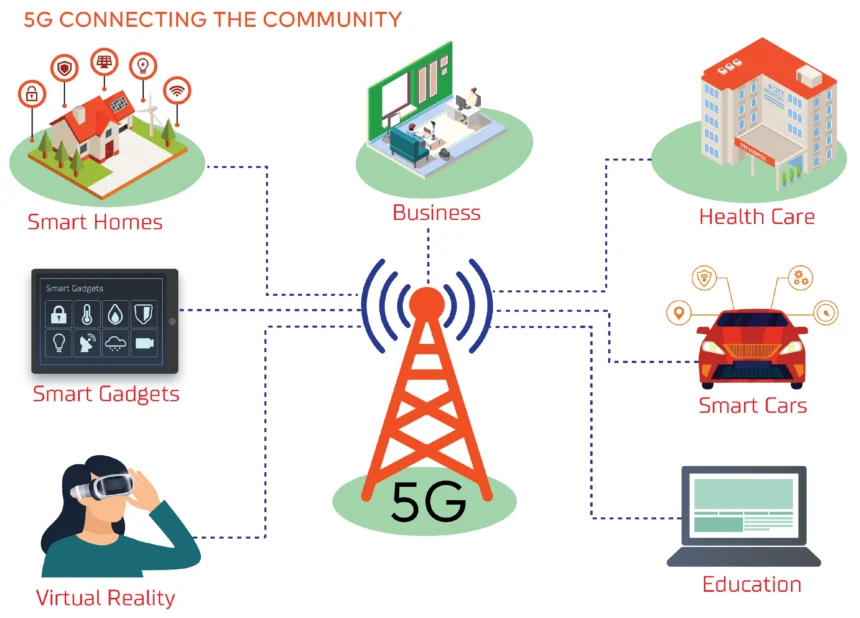
These changes are not just upgrades in speed. They represent a shift toward a fully connected digital ecosystem where billions of devices interact seamlessly.
Below are the 3 major tech trends that define 5G and beyond tech trends shaping the next decade.
1. Ultra-low latency networks and real-time connectivity
One of the most important developments in 5G and beyond tech trends is ultra-low latency communication. Latency refers to the time it takes for data to travel between devices. With 5G, this delay has already dropped significantly, but future networks aim to reduce it almost to zero.
This advancement will make real-time communication possible at a scale never seen before. Applications such as autonomous vehicles, remote surgery, and industrial robotics depend heavily on instant data transfer.
For example, self-driving cars require constant communication with sensors, traffic systems, and other vehicles. Even a delay of milliseconds can impact safety decisions. Ultra-low latency networks aim to eliminate this risk entirely.
Real-world impact comparison
| Technology Area | Current 5G Capability | Beyond 5G Expectation |
|---|---|---|
| Self-driving cars | Fast response with slight delay | Near-instant decision making |
| Remote surgery | High precision with stable connection | Zero-delay robotic control |
| Online gaming | Low latency gameplay | Fully immersive real-time VR |
| Smart factories | Automated processes | Fully autonomous production lines |
You can explore global 5G development updates from GSMA official insights.
As networks evolve beyond 5G, latency is expected to drop further, enabling near-instant digital responses across systems.
2. AI-powered networks and intelligent automation
Another major pillar of 5G and beyond tech trends is the integration of artificial intelligence into network infrastructure. Future networks will not just transmit data—they will analyze, predict, and optimize it automatically.
AI-powered networks will help manage traffic, reduce congestion, and improve energy efficiency. Instead of manual intervention, systems will self-adjust based on demand and usage patterns.
For instance, during peak hours, networks can automatically allocate more bandwidth to high-demand areas. Similarly, in low-usage periods, they can reduce power consumption to save energy.
Key benefits of AI-driven networks include:
- Smarter traffic management
- Predictive maintenance of infrastructure
- Enhanced cybersecurity detection
- Reduced operational costs
According to research from International Telecommunication Union, AI integration is essential for scaling future global networks efficiently.
Beyond 5G, AI will become deeply embedded in telecom infrastructure, turning networks into intelligent systems rather than passive data channels.
3. Expansion of IoT and hyper-connected ecosystems
The third major direction in 5G and beyond tech trends is the massive expansion of the Internet of Things (IoT). With billions of connected devices expected globally, 5G provides the foundation for seamless communication between machines.
From smart homes to smart cities, IoT devices are becoming central to modern infrastructure. However, beyond 5G networks will take this further by supporting ultra-dense device environments with minimal delay and maximum reliability.
Examples of IoT expansion include:
- Smart cities with connected traffic lights and sensors
- Wearable health monitoring devices
- Smart agriculture systems using soil and weather sensors
- Industrial IoT for predictive manufacturing
As more devices come online, data generation will increase exponentially. This requires networks that can handle massive scale without performance loss.
For deeper insights into IoT development, you can refer to IEEE technology research publications.
The combination of IoT and 5G will create hyper-connected ecosystems where everything from refrigerators to traffic systems communicates in real time.
How 5G and beyond tech trends are changing industries
The impact of 5G and beyond tech trends is not limited to telecommunications. Entire industries are being transformed by faster and smarter connectivity.
Healthcare
Remote surgeries, real-time diagnostics, and wearable health tracking are becoming more reliable due to improved network speed and stability.
Education
Virtual classrooms and immersive learning experiences using augmented reality are becoming more accessible.
Manufacturing
Factories are adopting smart automation systems that rely on machine-to-machine communication.
Entertainment
Cloud gaming and ultra-HD streaming are becoming smoother with reduced buffering and latency.
For global digital transformation insights, visit World Bank digital economy reports.
Beyond 5G: what comes next?
While 5G is still being deployed in many regions, research into 6G and beyond has already begun. The next generation of networks is expected to introduce even more advanced capabilities.
These may include:
- Holographic communication
- Fully immersive extended reality (XR)
- AI-native network architecture
- Space-based global connectivity
The goal is to create a fully integrated digital environment where communication is instantaneous and intelligent.
Organizations like Nokia Bell Labs research are already exploring early 6G concepts and future network frameworks.
Challenges in adopting future networks
Despite rapid progress, 5G and beyond tech trends also come with challenges.
Infrastructure costs
Building advanced networks requires massive investment in hardware, towers, and fiber systems.
Security risks
More connected devices mean a larger attack surface for cyber threats.
Digital divide
Developing regions may struggle to keep up with advanced infrastructure deployment.
Energy consumption
Massive data processing and connectivity demand efficient energy solutions.
Governments and private companies must work together to ensure balanced and secure adoption of these technologies.
Economic and global impact
The global economy is expected to benefit significantly from 5G and beyond tech trends. According to industry forecasts, trillions of dollars could be added to global GDP through improved productivity, automation, and digital services.
Countries investing early in advanced connectivity are likely to gain a competitive advantage in innovation, manufacturing, and digital services.
This transformation is not just technological—it is economic, social, and structural.
Real-world examples of 5G adoption
Several countries are already leading in 5G implementation:
- South Korea has one of the fastest 5G networks globally
- China has deployed large-scale industrial 5G applications
- United States continues expanding nationwide coverage
- European nations are integrating 5G into smart city projects
These early adopters are setting the foundation for the next wave of innovation.
Conclusion: the future is hyper-connected
5G and beyond tech trends are not just about faster internet—they represent a complete shift in how the world operates digitally.
From AI-driven networks to massive IoT ecosystems, the future will be defined by intelligent connectivity. Industries, governments, and individuals will all experience changes in how they communicate, work, and interact with technology.
As we move beyond 5G, the digital world will become faster, smarter, and more integrated than ever before.
To stay updated on emerging technologies, global innovation, and digital transformation trends, visit The News Ink.