China Growth Target: Alarming 2026 Slowdown Warning for Beijing
China growth target has been lowered to 4.5%-5% for 2026, marking Beijing’s most cautious official expansion goal in decades and signalling that the world’s second-largest economy has entered a more difficult phase.
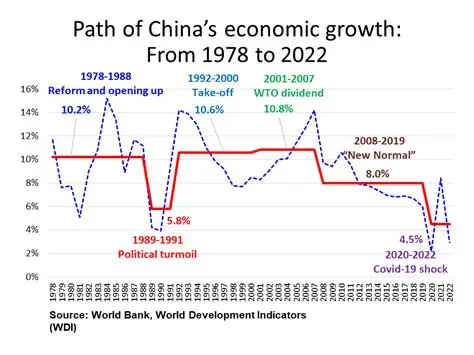
The new range, announced during China’s annual “two sessions” political gathering, is below the 5% pace recorded in 2025 and replaces the previous “around 5%” language. It is also the lowest official growth ambition since 1991, according to economists cited by Reuters. That matters because China’s annual target is not only a forecast. It is a political signal, a policy guide and a message to local governments, investors, state banks and households.
The message this year is clear: Beijing still wants growth, but it knows the old growth engine is weaker. Property is no longer lifting the economy the way it once did. Consumers are cautious. Local governments are heavily indebted. China’s population is shrinking. Exports remain strong, especially in technology and AI-related products, but they cannot fully replace weak domestic demand.
That is why the China growth target should be read as a warning rather than a simple downgrade. Beijing is not admitting crisis, but it is acknowledging pressure. The challenge now is whether China can manage a controlled slowdown while shifting from property-led expansion toward consumption, technology, advanced manufacturing and services.
For wider global context, The News Ink’s economy coverage explains how growth targets, inflation, trade and energy shocks shape markets far beyond one country.
Why the China growth target matters
China growth target matters because it tells officials how ambitious they should be and tells markets how much stimulus Beijing may be willing to use. For decades, China’s local governments, banks and state companies treated growth targets as instructions. A higher target encouraged more borrowing, construction and investment. A lower range suggests Beijing wants more flexibility.
The new target of 4.5%-5% gives policymakers room to accept slower expansion without looking as if they have failed. It also reduces pressure on provincial officials to chase growth through wasteful projects, inflated investment or another property push.
That does not mean Beijing is stepping back from economic management. The 2026 government work report still promised a proactive fiscal policy, a budget deficit of around 4% of GDP, continued support for technology, and efforts to expand domestic demand. But the lower China growth target shows that officials are trying to balance short-term support with longer-term reform.
The shift is important because China’s growth model is changing. The country can no longer rely only on apartments, infrastructure and exports. It must persuade households to spend more, private companies to invest more and young people to believe the future is stable enough to start families, buy homes and build careers.
What changed from 2025
China reported 5% GDP growth in 2025, with official data showing output reaching 140.19 trillion yuan. That allowed Beijing to say it met its annual goal. But the headline number hid a weaker finish. Growth slowed to 4.5% in the final quarter of 2025, while consumption, property and confidence remained under pressure.
The China growth target for 2026 reflects that weaker momentum. Reuters reported in July that economists expected second-quarter growth to slow to 4.5% from 5.0% in the first quarter, putting the economy at the lower end of the official target range. For the full year, economists expected growth of about 4.6%, then 4.4% in 2027.
Those numbers are still high compared with many advanced economies. But for China, they represent a major change. The country once treated 6%, 7% or even higher growth as normal. Now, the official goal accepts that the next phase will be slower.
The question is whether slower can also mean healthier. If the slowdown comes with stronger household incomes, better services, cleaner technology and less debt risk, Beijing can call it a transition. If it comes with falling confidence, weak jobs and more property losses, the lower target will feel like a warning of deeper stress.
Key numbers behind the slowdown
| Indicator | Latest signal | Why it matters |
|---|---|---|
| 2026 official GDP target | 4.5%-5% | Lowest official ambition since 1991 |
| 2025 GDP growth | 5.0% | Beijing met the previous annual target |
| Q4 2025 growth | 4.5% | Showed weak momentum entering 2026 |
| Q2 2026 forecast | 4.5% | Economists expect cooling after a stronger Q1 |
| 2026 full-year forecast | Around 4.6% | Near the middle of Beijing’s target range |
| 2027 forecast | Around 4.4% | Suggests further slowing |
| Population trend | Fourth straight annual decline in 2025 | Demographics are becoming a structural drag |
| 2030 retail sales goal | Around 60 trillion yuan | Beijing wants consumption to carry more growth |
Property remains the biggest drag
The property crisis is still the most important domestic reason behind the lower China growth target. For years, real estate powered construction, local government finance, household wealth and industrial demand. When apartments sold quickly and prices rose, developers borrowed, local governments sold land, households felt richer and factories supplied steel, cement, glass, appliances and furniture.
That cycle has broken. Since the property downturn began, developers have defaulted, unfinished homes have damaged confidence, prices have fallen and buyers have waited on the sidelines. Reuters reported in June that new home prices fell 0.2% in May from April and 3.5% from a year earlier, while property sales and investment fell more sharply in the first five months of 2026.
This matters because property affects psychology as much as construction. In China, homes are a major store of family wealth. When households fear that home values will fall, they become less willing to spend. When young people doubt the housing market, they delay purchases. When local governments lose land-sale revenue, they cut back or borrow more.
The China growth target therefore cannot be separated from housing. Beijing wants to reduce reliance on property, but it cannot allow the sector to collapse disorderly. That balance is difficult: too much support risks reviving old bubbles, while too little support risks deeper deflation and weaker consumption.
Weak consumption is the central problem
Beijing has talked for years about making domestic consumption a bigger driver of growth. The new China growth target shows why that shift is urgent.
Exports and manufacturing can keep headline GDP moving, but they do not automatically make households confident. Reuters reported that China’s recent export strength, including AI-related products, has not translated into a stronger labour market or meaningful profit improvement. That is a serious problem. If factories produce more but workers and households do not feel richer, domestic demand stays weak.
The State Council’s new consumption blueprint aims to raise annual retail sales to about 60 trillion yuan by 2030 and increase household consumption’s share of the economy from around 40%. The plan focuses on higher incomes, stronger social security, better public services, and more services spending in areas such as elderly care, childcare, healthcare, tourism, sports and education.
That is the right direction. But the difficulty is trust. Households spend more when they feel secure. If families worry about jobs, property losses, pensions, healthcare costs and education expenses, they save more and spend less. The China growth target can only become easier to hit if Beijing gives households a reason to reduce precautionary saving.
The News Ink’s personal finance coverage is useful here because the same rule applies everywhere: families spend when income feels stable and future risks feel manageable.
Demographics are no longer background noise
China’s demographic problem is now part of the economic story. Reuters reported that China’s population fell for a fourth consecutive year in 2025, dropping by 3.39 million to about 1.405 billion. Births fell to 7.92 million, the lowest on record, while the share of people over 60 reached about 23%.
That directly affects the China growth target. A shrinking and ageing population reduces the supply of young workers, increases pension and healthcare pressure, and weakens long-term housing demand. It also changes consumer behaviour. Older societies often save differently, spend differently and take fewer risks.
China is not alone in facing ageing. Japan, South Korea and many European economies have similar pressures. But China’s challenge is unusual because it is ageing before reaching the income levels of many advanced economies. That makes the transition harder.
Beijing has introduced pro-birth measures, childcare support and family policies. But reversing demographic decline is extremely difficult. Young couples often cite high housing costs, education pressure, job insecurity and lifestyle concerns. Those issues cannot be solved by slogans. They require deeper economic and social reforms.
The lower China growth target partly reflects that reality.
Trade is helping, but it also creates risk
China’s export machine remains powerful. Reuters polling in July showed June export growth was expected to remain strong, supported by AI-related demand, price competitiveness and early shipments to the United States ahead of possible tariff increases. China’s trade surplus was also expected to remain large.
That helps the China growth target in the short term. Strong exports support factories, logistics, shipping, technology suppliers and industrial output. They also help offset weak domestic spending.
But dependence on exports creates political and economic risk. The United States, Europe and other trading partners are increasingly concerned about Chinese overcapacity, low prices and industrial subsidies. Tariffs, export controls and supply-chain restrictions can quickly change the outlook.
The News Ink’s report on Trump’s global tariff strategy explains how trade policy can reshape business costs and market expectations. China is especially exposed because exports are doing more work at a time when domestic demand is not strong enough.
This is why Beijing wants consumption to rise. An economy that depends too heavily on overseas demand is vulnerable to foreign elections, tariffs, sanctions and geopolitical shocks.
Technology is the new growth engine
Beijing’s answer to slower property growth is not simply more shopping. It is also technology. The 15th Five-Year Plan signals continued investment in artificial intelligence, advanced manufacturing, scientific research, high-tech industries and industrial upgrading.
That strategy makes sense. China wants to move up the value chain, reduce dependence on foreign technology and compete in sectors such as semiconductors, electric vehicles, robotics, green energy and AI systems. If successful, these sectors can support productivity and help the country manage slower labour-force growth.
But technology cannot solve every problem. High-tech exports and AI-driven manufacturing can lift output, but they may not create enough broad-based employment or household income if the gains remain concentrated in certain regions and firms. A country can lead in advanced industries and still struggle with weak consumer confidence.
The China growth target therefore depends on a two-part shift: build new technology sectors, but also make ordinary households feel secure enough to spend. One without the other will not be enough.
For readers following the technology side, The News Ink’s AI trends in 2026 explains why artificial intelligence is becoming central to economic strategy, productivity and global competition.
Local governments face a tougher job
Lower national growth targets also affect provinces and cities. Reuters reported before the two sessions that most provincial governments had already trimmed their growth expectations, signalling greater tolerance for slower but more stable expansion.
That matters because China’s local governments are key players in investment, infrastructure, housing, industrial parks and public services. But many are also under debt pressure after years of borrowing and weaker land-sale income.
In the old model, a local government could chase growth by selling land, building infrastructure and attracting factories. That model is harder now. Land revenue is weaker. Debt constraints are tighter. Property demand is softer. Industrial overcapacity creates price wars. Environmental and technology goals are more complex.
The China growth target gives local officials some breathing room, but it also creates a new discipline. They must deliver better-quality growth, not just more construction.
That is easier to say than do. Local governments still need jobs, revenue and social stability. The temptation to support another round of investment-led growth remains strong.
The Iran war added another complication
The lower China growth target was mainly about domestic structural problems, but the global environment has made it harder. The Iran war and Strait of Hormuz risk have created oil and gas volatility, raising concern about energy costs and global demand.
China is a major energy importer, and the Gulf remains important to its supply chains. If oil prices rise sharply, Chinese manufacturers face higher costs. If global growth weakens because of an energy shock, demand for Chinese exports could suffer. If shipping and insurance costs rise, trade becomes more expensive.
The News Ink’s analysis of global markets during the Iran war explains how energy shocks move through inflation, shipping, interest rates and market confidence. For China, the risk is not only higher energy costs. It is the possibility that global customers slow their purchases at the same time domestic demand remains weak.
That is why economists are watching whether exports can keep supporting the China growth target through the second half of 2026.
Monetary policy is supportive but cautious
China’s central bank has signalled an accommodative stance, but it has not launched dramatic easing. Reuters reported that the People’s Bank of China pledged to maintain supportive policy amid weak demand and external shocks, while analysts expected rates to remain broadly steady through 2026.
That cautious approach reflects the dilemma Beijing faces. Cutting rates aggressively might support borrowing and sentiment, but it could also pressure the yuan, worsen financial imbalances or encourage more debt. Doing too little could leave domestic demand too weak.
Fiscal policy may carry more of the burden. Beijing has set a deficit target around 4% of GDP and lined up heavy bond issuance to support growth. But even fiscal spending must be targeted carefully. China has already learned that building more infrastructure for its own sake can produce debt without lasting demand.
The China growth target is therefore not likely to be met through one big stimulus package. Beijing appears to prefer targeted support: consumption programmes, technology financing, public services, local government support and selective property easing.
What the lower target says about Beijing’s priorities
The China growth target tells us three things about Beijing’s priorities.
First, officials are willing to accept slower headline growth if they believe it supports a more sustainable economy. That is why the target is a range rather than a single aggressive number.
Second, the government still wants enough growth to protect jobs and social stability. A 4.5%-5% target is lower than past ambitions, but it is not low. It still requires strong policy support and solid performance.
Third, Beijing is trying to shift the economy from property and debt toward technology, services and domestic demand. That shift is politically important because it matches Xi Jinping’s wider emphasis on security, self-reliance and high-quality development.
The risk is that old and new priorities conflict. Supporting manufacturing can worsen overcapacity. Supporting property can delay restructuring. Supporting consumption requires income and welfare reforms that may be expensive. Supporting technology can increase trade tensions.
The lower China growth target gives Beijing more room, but it does not remove those contradictions.
What investors should watch next
Investors should watch several signals in the second half of 2026.
First, retail sales. If household spending does not improve, the consumption plan will look more like aspiration than recovery.
Second, property prices and sales. Stabilisation in major cities would help confidence, but deeper declines would damage wealth and local finances.
Third, export growth. Strong exports can keep GDP on track, but tariffs and global slowdown remain risks.
Fourth, employment. Growth that does not create enough secure jobs will not restore household confidence.
Fifth, fiscal spending. Beijing may speed up bond issuance and local support if growth falls too close to the bottom of the target range.
Sixth, policy tone from the Politburo and central bank. Investors will watch whether officials choose modest support or stronger stimulus.
The China growth target will remain achievable if enough of these indicators improve. If several weaken together, pressure for more forceful policy will rise.
The final judgment
China growth target has been lowered because Beijing is facing a more complicated economy than at any point in recent decades.
The country is still large, productive and globally important. It remains a manufacturing powerhouse, a technology competitor and a major driver of trade. But the old formula is weaker. Property is no longer a reliable engine. Local government debt is heavier. Consumers are cautious. The population is shrinking. Export strength is helpful, but politically exposed.
The new 4.5%-5% target is therefore both cautious and ambitious. It is cautious because it accepts slower growth. It is ambitious because achieving even that range will require stronger household demand, stable housing, resilient exports, careful fiscal support and success in new technology sectors.
For China, the challenge is not only reaching a number. The challenge is changing what that number means. Growth built on empty apartments, debt and price wars will not solve the deeper problem. Growth built on household confidence, services, productivity and innovation would be more durable.
The China growth target marks the beginning of that harder test. Beijing has lowered the bar, but it has also raised the importance of proving that slower growth can still be stable, credible and strong enough to carry China into its next economic era.
For more economy and global market analysis from The News Ink, follow The News Ink on X.