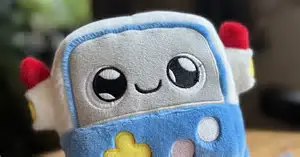
AI Toys for Toddlers: What Cambridge Researchers Found and Why Regulation Is Changing
AI toys are moving quickly from novelty products into children’s bedrooms and playrooms. Soft animals and robots can now answer questions, tell stories and hold open-ended conversations using generative artificial intelligence.
For parents, that can sound useful. A toy that talks back may appear able to encourage language, curiosity and imaginative play without adding another screen. But a University of Cambridge research project has raised an important warning: conversational AI toys may sound fluent without understanding the social and emotional signals that matter to very young children.
Researchers from Cambridge’s Centre for Research on Play in Education, Development and Learning, known as PEDAL, observed children aged three to five interacting with a commercial generative-AI toy called Gabbo. They recorded moments when the toy talked over children, misunderstood them, struggled with pretend play and responded awkwardly to affection or sadness.
The findings do not prove that AI toys cause developmental harm. The direct observation sample was deliberately small, and the researchers describe the work as an initial evidence base rather than a final verdict.
What it does show is that a toy can be technically impressive and still be developmentally clumsy.
That distinction has become more important in 2026. Since the Cambridge report appeared in March, the UK government has opened a formal review of toy-safety rules that specifically includes AI-enabled and internet-connected products. The debate is now about what standards conversational toys should meet before they are placed in front of children who are still learning how communication, friendship and emotions work.
What the Cambridge Study Actually Examined
The AI toys research formed part of the University of Cambridge project AI in the Early Years, led by Dr Emily Goodacre and Professor Jenny Gibson.
The project focused on children aged five and under, particularly families from areas experiencing socio-economic disadvantage. Researchers surveyed early-years professionals, consulted practitioners and children’s charity leaders, reviewed existing evidence and directly observed children interacting with AI toys.
Working with early-years charity Babyzone at four London children’s centres, the team observed 14 children aged three to five, along with 11 accompanying adults. Children were video-recorded playing with Gabbo and later interviewed through drawing activities, while parents were interviewed separately.
The small sample matters. The researchers kept it limited so they could study subtle aspects of play closely. Their report calls the findings an initial step, and a related preprint on children’s social play appeared later in March.
The responsible conclusion is not that Cambridge proved AI toys damage toddlers. It is that the study identified credible developmental and safeguarding questions that deserve more testing.
Parents who want the original academic source can read the .
Why Gabbo Matters, but the Study Is Not About Every Toy
Gabbo is a soft conversational toy made by Curio Interactive. It contains a microphone, speaker and connected processing system that lets a child speak to it and receive generated responses.
Contemporary reporting on the version studied by Cambridge described its chatbot as using OpenAI technology. Curio’s current 2026 materials describe the response process more generally as using a large language model. Curio now markets a newer generation of Gabbo and a wider range of conversational characters.
The distinction matters because products change quickly.
The Cambridge team selected a commercially available Gabbo during a 2025 market review. The study should therefore not be treated as a permanent technical audit of every future Gabbo or every AI toy on the market.
Its value is in showing the kinds of problems developers should test for.
AI Toys Can Struggle With Basic Conversation
One of the clearest difficulties with AI toys involved turn-taking.
Human conversation is full of interruptions, pauses, unfinished sentences and quick adjustments to the person speaking. Young children are still learning those rules.
The researchers found that Gabbo sometimes failed to recognise when a child tried to interrupt and could continue speaking over them. It also struggled at times to distinguish between a child and an adult speaking nearby.
For an adult using a chatbot, that may simply feel annoying. For a preschool child, turn-taking is part of learning how communication works.
Children learn that a listener can pause, notice confusion, respond to emotion and repair a misunderstanding. AI toys can imitate the surface form of conversation while missing those deeper social adjustments.
The study was not designed to prove that children will learn poor conversational habits from a toy. But it explains why researchers want developmental testing rather than assuming fluent speech is automatically appropriate speech.
When the Toy Misread Affection and Sadness
One of the most widely reported moments came when a five-year-old told Gabbo that she loved it. Instead of a simple, child-friendly response, the system produced formal language about interaction guidelines.
The problem was not that the toy refused to say “I love you” back. Researchers are also concerned about AI toys encouraging children to believe that a machine has reciprocal feelings or genuine friendship.
The challenge is developmental fit. A system should avoid pretending it has human emotions while still responding in language a young child can understand.
Another interaction made the concern clearer. A three-year-old told Gabbo they were sad. The toy replied that it was a happy bot and tried to move the conversation towards something fun.
For an adult, that may look like awkward positivity. For researchers, it raises a bigger question: what happens when a young child begins using AI toys to disclose feelings?
A human caregiver may notice tone, body language, context or repeated signs of distress. A language model may generate a plausible sentence and move on.
Dr Emily Goodacre warned that children could sometimes turn to a toy with feelings or needs and receive an inappropriate response when what they actually require is attention from an adult.
The Cambridge team is not arguing that a toy must behave like a therapist. The opposite point is more important: because a system can talk about emotions does not mean it understands a child’s emotional state.
Friendship and Pretend Play Create Different Risks
Young children do not approach toys in the same way adults approach software.
Children talk to dolls, give personalities to stuffed animals and invent imaginary friends. That is a normal part of play.
Generative AI changes the situation because the toy talks back in personalised, unpredictable language.
In the Cambridge observations, children hugged and kissed Gabbo, expressed affection and tried to include it in social games such as hide-and-seek.
Researchers say this may simply reflect ordinary childhood imagination. But they also want designers and regulators to examine what happens when AI toys repeatedly reinforce the idea that they are genuine friends.
A language model can simulate the words associated with friendship without having feelings, needs or real understanding. For preschool children still learning what friendship means, that boundary deserves attention.
Pretend play also proved difficult. Children wanted to bring Gabbo into imaginative situations, but the toy sometimes struggled to follow the changing rules of the game.
Pretend play is not just storytelling. A child may suddenly decide that a chair is a rocket or that everyone has a new role. Human play partners usually adapt immediately.
AI toys may generate creative sentences while still failing to understand that shared social frame. This is one reason the researchers recommend designs that encourage play with other people rather than replacing it.
The Study Found Possible Benefits Too
The Cambridge report on AI toys is more balanced than some alarming headlines suggest.
Parents and early-years practitioners could see possible benefits in AI toys, particularly for language, communication and curiosity. Some parents were enthusiastic about the learning potential.
A conversational toy can answer repeated questions, create stories, introduce vocabulary and encourage a child who enjoys talking to keep exploring an idea.
The researchers did not call for a ban.
Instead, they argued that claimed benefits need evidence and that developers should design around the developmental needs of young children.
That is the right distinction. The question is not whether artificial intelligence can ever be useful in childhood. It is whether a particular product has been tested carefully enough for the age group it targets.
Why Psychological Safety Is Becoming a Toy-Safety Issue
Traditional toy-safety rules are easy to picture. A toy should not create a choking hazard, expose children to dangerous chemicals, overheat or cause an electrical injury.
AI toys add risks that are less visible.
A conversational product may collect voice data. It may say something inappropriate. It may respond badly to a safeguarding disclosure. It may encourage emotional dependency or blur the difference between a person and a machine.
The Cambridge researchers therefore argue that regulators should consider “psychological safety” as well as physical safety. For AI toys, their recommendations include clearer labelling, transparent privacy policies, child testing, safeguarding input and limits around how products represent friendship and emotional closeness.
Privacy Is Part of the Same Debate
Many AI toys are connected digital services with microphones, apps and cloud processing.
That means parents should ask questions they would never ask about a traditional teddy bear: What audio is captured? Is speech transcribed? How long is information kept? Can parents delete it? Is information shared with third parties? Can the microphone be disabled?
Babyzone later submitted evidence to the UK Parliament’s Education Committee arguing that voice-enabled generative-AI toys raise particular privacy and safeguarding questions for children too young to understand or consent to data collection.
This fits a wider concern The News Ink has covered in its article on why more privacy tools do not necessarily mean more online privacy. The URL is confirmed in The News Ink sitemap.
The risk is not that every connected toy secretly records everything. Products differ. The point is that parents need understandable answers before placing a networked microphone in a child’s play space.
UK Regulation Has Moved Since the Original Warning
The most important update for AI toys since the Cambridge findings came from the UK government.
On July 6, 2026, the Department for Business and Trade and Office for Product Safety and Standards opened a formal Call for Evidence on reforming toy-safety regulations.
The review specifically asks how consumer risks are changing because of artificial intelligence, internet-connected toys and online marketplaces. It remains open until October 6, 2026.
Readers can see the .
This does not mean Britain has already introduced a new law for AI toys. It means the government is formally considering whether existing rules remain adequate as toys become connected, adaptive and conversational.
Earlier parliamentary answers had already noted that powers under the Product Regulation and Metrology Act can be used to update regulation in response to emerging technologies such as AI.
A separate May submission from Babyzone to Parliament also highlighted privacy, safeguarding, emotional responding, pretend play and parasocial relationships.
The policy direction is clear even if the final rules are not: AI toys are moving from a regulatory grey area towards direct scrutiny.
Other Research Is Raising Similar Questions
The issue around AI toys is broader than one Cambridge project.
A May 2026 scoping review in Computers in Human Behavior Reports examined 51 academic sources on ethical, privacy and regulatory challenges involving AI-enabled toys.
It identified recurring concerns around privacy, security, data inference and gaps in existing governance.
The review did not prove that conversational toys cause emotional damage. It looked across the literature at the types of risks manufacturers and regulators need to manage.
Together, the research points to a persistent gap: there is growing evidence about possible benefits and hazards, but very little long-term evidence about what frequent interaction with conversational companions means for young children.
That uncertainty is itself a reason for careful design.
What Curio Says About Child Safety
Curio has said that using AI in products for children carries heightened responsibility, and the company says AI toys require strong parental controls.
In response to the Cambridge coverage, the company emphasised parental permission, transparency and control, and said research into how children interact with AI-powered toys is a priority.
Curio’s current products are app-connected and offer parents controls over the toy experience. Its 2026 materials also describe a newer generation of hardware than the version selected for the Cambridge research.
That context matters. One small study should not permanently define every version of a product.
At the same time, software updates do not remove the broader design questions. Any conversational toy for young children still needs to handle speech recognition, interruption, emotion, privacy, safeguarding and relational boundaries appropriately.
What Parents Can Do Right Now
Parents do not need to panic about every connected toy, but they should treat conversational products differently from ordinary plush toys.
The Cambridge team recommends co-play rather than leaving very young children alone with AI toys for long periods. Keeping the toy in a shared family area makes it easier to hear what the system says and notice how the child responds.
Parents should explain, in age-appropriate language, that the toy is a computer system that generates answers and does not have feelings in the same way people do.
Privacy settings and policies deserve attention before activation.
If a child begins discussing sadness, fear, family problems or other serious feelings with a toy, that should be treated as a reason for human conversation rather than proof that the AI is providing emotional support.
The same principle applies to other digital technology. The News Ink’s guidance on screen time for children explains why supervision, context and what technology replaces can matter as much as the device itself. The page is verified in The News Ink sitemap.
A Practical Checklist Before Buying AI Toys
Parents considering AI toys can ask a few basic questions:
| Question | Why it matters |
|---|---|
| What age was the toy designed and tested for? | Preschool children have different developmental needs from older children |
| Does it record or transcribe speech? | Voice data can contain highly personal information |
| Can parents review and delete stored data? | Clear controls improve privacy and accountability |
| Does the toy describe itself as a friend? | Relational language may blur boundaries |
| What happens when a child expresses sadness or fear? | Emotional responses should not dismiss distress |
| Can the microphone or connection be disabled? | Parents need physical control of connected features |
| Was it tested with real children? | Adult-designed tests may miss child-specific behaviour |
| How are model updates monitored? | Behaviour can change as software changes |
These questions move the buying decision beyond labels such as “educational”, “smart” or “screen-free”.
AI Toys Should Supplement, Not Replace, Human Play
The lesson is not that children must be isolated from artificial intelligence. They will grow up with AI and eventually need to understand what it can do and where it fails. But early childhood has its own priorities.
Toddlers and preschoolers learn communication by interacting with people who notice subtle signals and respond. They learn friendship through real relationships. They learn pretend play by negotiating shared imaginary worlds with other children and adults.
AI toys may eventually support some of those experiences.
The current evidence does not show that they can replace them.
That distinction also matters in the wider debate about digital technology and children. The News Ink has examined similar questions in its coverage of social media’s impact on children.
Why the Warning Still Matters in September 2026
Nearly six months after the Cambridge report, the debate has moved forward but the central scientific uncertainty remains.
The research offered the first detailed observations of how a small group of preschool children played with a commercially available generative-AI toy. It identified awkward turn-taking, misunderstood speech, weak pretend play, emotional misfires and questions about parasocial relationships.
It also found curiosity and possible educational value.
Since then, Babyzone has taken the concerns into evidence submitted to Parliament, a broader academic review has highlighted privacy and governance gaps, and the UK government has opened a toy-safety review that explicitly includes AI-enabled products.
What has not appeared is strong long-term evidence proving that AI toys either harm or improve toddlers’ social and emotional development.
That is the central fact parents should remember.
The technology is developing faster than the evidence.
The Next Safety Standard May Be Emotional, Not Physical
AI toys represent a larger shift in how artificial intelligence enters family life.
The most consequential systems may not always look like computers. They may look like a soft robot on a child’s bed.
That makes design choices about tone, friendship, privacy and emotional response more important than they first appear.
A toy does not need to be malicious to create a poor interaction. It only needs to misunderstand a child at the wrong moment.
The Cambridge researchers are therefore asking regulators to expand the meaning of toy safety. A safe product should not only avoid physical injury. It should also be designed around the cognitive, social and emotional vulnerabilities of its intended age group.
For parents, the most sensible approach is neither blind enthusiasm nor fear.
AI toys can be interesting tools for stories, questions and supervised play. But for children under five, they should remain tools rather than substitutes for responsive human relationships.
Until larger and longer studies provide clearer answers, supervision, privacy awareness and human co-play remain the strongest safeguards.
For more reporting on artificial intelligence, digital life and emerging technology, follow The News Ink on X.