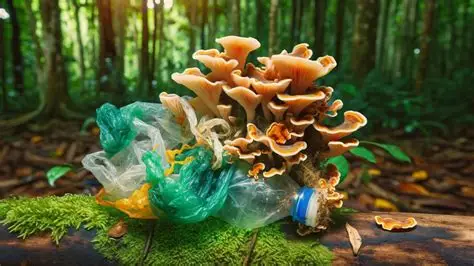
Plastic-Eating Fungi: How HIRO’s Diapers Aim to Cut Nappy Waste
Plastic-eating fungi are being tested against one of the least glamorous but most persistent forms of household waste: disposable nappies. The idea sounds almost too convenient. A parent changes a baby, places a small pouch of dormant mycelium inside the used nappy and throws it away as normal. After moisture wakes the fungi, the company behind the system says enzymes begin attacking some of the plastics and other materials that would otherwise remain in landfill for decades or centuries.
That company is Austin-based HIRO Technologies, whose MycoDigestible diaper system has moved from an unusual start-up experiment into a commercially available product. The technology has also attracted attention from Nature Biotechnology and Reuters. But the most important point for readers is that plastic-eating fungi are promising, not proven as a complete solution to disposable nappy waste at global scale.
HIRO says its laboratory work shows fungal colonisation can begin within weeks and that its long-term goal is for the diaper to break down far faster than a conventional disposable. Yet the company is still collecting evidence across real-world landfill conditions. Its own roadmap says it aims during 2026–2027 to reach the point where it can legally describe a diaper as “landfill biodegradable.” That makes the distinction between laboratory promise and independently verified environmental performance essential.
Why plastic-eating fungi are being tested on nappy waste
The scale of disposable nappy waste is enormous. The United Nations Environment Programme has cited an estimate that more than 300,000 disposable nappies are incinerated, sent to landfill or enter the environment every minute worldwide. A major 2026 Nature Sustainability paper from University College London researchers broadened the issue to absorbent hygiene products, including baby nappies, adult incontinence products and menstrual products, estimating a global waste stream of roughly 160–200 million tonnes a year.
Plastic-eating fungi are attractive partly because nappies are unusually difficult to process after use. A typical disposable nappy is not one material. It is a composite product containing cellulose or fluff pulp, superabsorbent polymer, polypropylene, polyethylene, polyester, elastics, adhesives and other components. Once urine and faeces are added, separating and recycling those layers becomes even harder.
The U.S. Environmental Protection Agency estimated that disposable diapers and adult incontinence products generated 4.1 million tons of municipal solid waste in the United States in 2018. The EPA identified no significant recycling or composting of that waste in its dataset.
This is why the problem cannot be solved by simply putting used nappies into conventional plastic-recycling bins. The products are mixed-material, biologically contaminated and designed to remain intact while absorbing large amounts of liquid.
The News Ink has also examined another consequence of persistent plastics in its reporting on microplastic exposure.
Microplastics found in home air
For the wider environmental context, see The News Ink’s climate coverage.
A triplet mother shows why convenience matters
The environmental debate can easily ignore why disposable nappies became dominant in the first place: they save time.
Leila Green, a mother of triplets in Broadstairs, Kent, told a 2026 report that she had expected to use reusable nappies before her children were born. The reality of caring for three babies changed that plan. In the early months, she said the family could go through about 25 disposable nappies a day.
Her experience helps explain why plastic-eating fungi have attracted attention. Many parents would prefer to reduce waste, but sustainability choices compete with sleep deprivation, childcare costs, laundry, work and the basic need for a product that does not leak.
A greener nappy that requires complex sorting, specialist collection or home composting will struggle to reach families who are already overloaded. HIRO’s pitch is designed around that problem: add the pouch, roll the nappy and dispose of it through the normal rubbish system.
That simplicity may be one of the technology’s strongest commercial advantages. It is also the reason the scientific evidence behind what happens after the bin is collected matters so much.
How HIRO’s plastic-eating fungi system works
HIRO does not place live fungi directly against a baby’s skin. Each diaper is supplied with a separate Myco-Pod or pouch containing a proprietary blend of shelf-stable mycelium. After a nappy is soiled, the parent places the sealed pouch inside it before disposal.
The company says moisture activates the dormant organisms after disposal. The mycelium then releases enzymes capable of breaking chemical bonds in certain plastic materials. HIRO’s current website says activation can begin in a couple of weeks and that the company’s vision is to break down soft plastics in under 12 months in landfill conditions. That remains a company target rather than an independently established universal landfill timeline.
Plastic-eating fungi are not science fiction. Fungi are natural decomposers that evolved enzymes capable of attacking difficult carbon-rich materials such as lignin in wood. Some of those biochemical tools can also act on synthetic polymers.
HIRO’s current diapers still contain plastics. Its ingredient list includes polypropylene in the topsheet, polyester in an acquisition layer and polypropylene/polyethylene materials in the fastening system. It also contains sodium polyacrylate superabsorbent polymer. The company says the product uses about 50% less virgin plastic than conventional alternatives, but “less plastic” is not the same as plastic-free.
That makes plastic-eating fungi central to the disposal concept: rather than claiming the diaper contains no synthetic material, HIRO is trying to make the remaining material more susceptible to biological breakdown after use.
The science behind plastic-eating fungi
There is a genuine scientific foundation for the broader idea. In 2011, researchers reported in Applied and Environmental Microbiology that strains of the fungus Pestalotiopsis microspora could degrade polyester polyurethane. One isolate showed degradation under both aerobic and anaerobic conditions, which attracted attention because oxygen-poor environments are relevant to landfills.
That study is important, but it should not be overstated. It did not test a HIRO diaper. It did not prove that every plastic used in a modern nappy will disappear inside an ordinary municipal landfill. It also did not show that every plastic-eating fungus performs equally well across temperatures, moisture levels, waste compositions and landfill designs.
The phrase plastic-eating fungi can therefore make the technology sound simpler than it is. Fungi do not “eat plastic” in the everyday sense. Their enzymes can depolymerise or chemically alter certain polymers, and the organisms can use some breakdown products as carbon sources. Efficiency depends on the organism, polymer chemistry, material structure and environmental conditions.
A real disposable nappy is a harder target than a laboratory sample of one polymer because the product combines several materials engineered for strength, dryness and absorbency.
What HIRO has demonstrated and what remains unproven
HIRO says it has spent years developing its fungal system and has generated extensive laboratory and field data. Its website shows treated and untreated material comparisons and says fungal activity can become visible after roughly two weeks under favourable conditions.
Reuters reported in 2025 that sealed jars in the company’s Austin laboratory showed stages of treated diaper decomposition and that a nine-month sample resembled dark soil. Importantly, the company also acknowledged that more research was needed to understand performance in different climates and real landfill conditions.
Nature Biotechnology covered plastic-eating fungi and HIRO’s diaper in April 2026, confirming that the product had reached the market and explaining the pouch-based activation concept. However, that publication was a news feature, not a peer-reviewed efficacy trial demonstrating complete real-world degradation of the whole diaper.
This distinction is crucial.
| Claim | Evidence status |
|---|---|
| Some fungi can degrade certain plastics | Strong scientific basis, including peer-reviewed research |
| HIRO mycelium can colonise or digest diaper materials under controlled testing | Supported mainly by HIRO testing and reported demonstrations |
| A complete HIRO diaper reliably biodegrades across ordinary landfills within a fixed period | Not yet independently established at global real-world scale |
Plastic-eating fungi may ultimately perform extremely well, but the third claim requires the strongest evidence because it is the one consumers may assume when they hear terms such as “biodegradable.”
HIRO itself says the technology is still developing
One of the most useful pieces of evidence comes from HIRO’s own roadmap.
The company says its 2026–2027 target is to safely move the mycelium inside the diaper and reach the point where it can legally call a diaper “landfill biodegradable.”
That wording matters because it indicates that the current commercial system should not automatically be treated as the final version of the technology.
HIRO currently describes its system as MycoDigestible and says its fungi are designed to help a diaper break down faster after disposal. The company’s longer-term plans include licensing the technology to other brands and expanding plastic-eating fungi into other plastic-heavy products.
If successful, the platform could have applications beyond baby nappies. Adult incontinence products, menstrual products and other absorbent hygiene products use related combinations of nonwoven fibres, absorbent polymers and plastics.
But moving from one branded product to an industry-wide waste solution would require manufacturing scale, regulatory confidence, independent environmental testing and evidence that fungal breakdown does not simply create undesirable intermediate products.
The current price is lower than the original report suggested
The original version of this article cited monthly prices around $136 and a package reaching approximately $199.
Those figures are now outdated.
As of September 2026, HIRO’s U.S. website lists its monthly diaper plan at $109 with subscription or $119 as a one-time purchase.
The number of diapers varies by size, from approximately 132 to 198 per delivery, with a corresponding number of Myco-Pod pouches.
That still places the product toward the premium end of the market.
Comparing it with one universal “normal diaper” monthly price would be misleading because conventional nappy costs vary substantially according to brand, country, retailer, size and the number of daily changes.
Price matters because plastic-eating fungi will have limited environmental impact if the technology remains accessible only to a small group of environmentally motivated households. For a disposable alternative to shift global waste volumes, it must eventually compete on convenience, leak protection, safety and cost.
Green’s experience with triplets makes this point especially clear. A household changing 25 nappies a day cannot treat every change as a boutique environmental purchase.
Reusable nappies remain part of the solution
The rise of plastic-eating fungi does not make reusable nappies irrelevant.
In July 2026, UCL researchers publishing in Nature Sustainability argued that the absorbent-hygiene waste crisis requires several interventions rather than one technological fix. Their recommended research priorities include reducing unnecessary use, increasing reuse where appropriate, developing scalable recycling technologies and developing truly compostable products that can enter suitable processing systems.
A separate 2026 UK study involving 624 parent surveys and 35 interviews found that reusable diapering remains a minority practice and that many parents who use reusables combine them with disposables rather than switching completely.
That hybrid approach is realistic.
Some families may use washable nappies at home and disposables overnight, during travel or at childcare. Others may not have reliable washing facilities, sufficient drying space or enough available time to make reusable nappies practical.
Plastic-eating fungi could therefore occupy a different part of the solution: improving the end of life of disposable products that people are likely to continue using.
Why “biodegradable” claims require careful wording
A material can be biodegradable in one environment and extremely persistent in another.
Industrial composting facilities can control temperature, oxygen and moisture. Landfills are designed primarily to contain waste, not to operate as efficient compost heaps.
This is why the phrase “biodegradable nappy” should always be followed by another question: biodegradable where, under what conditions and over what period?
Plastic-eating fungi are interesting partly because certain fungal systems have demonstrated degradation under limited-oxygen conditions. But landfill conditions still vary dramatically. A dry landfill in one climate is not equivalent to a warm, moist laboratory vessel or managed composting facility.
Even a nappy with more plant-derived material can remain difficult to process if plastic films, elastics, adhesives or superabsorbent polymers remain mixed throughout the product.
Strong environmental claims therefore require clearly defined test conditions, measurable breakdown targets and evidence showing what remains after degradation.
Plastic-eating fungi still depend on waste infrastructure
HIRO’s approach is unusual because it is explicitly intended to work through the ordinary rubbish stream rather than requiring parents to find a specialist industrial composting service. That could eliminate one of the largest practical barriers facing some compostable products.
However, plastic-eating fungi do not eliminate the importance of waste infrastructure.
Municipal rubbish may be incinerated instead of landfilled. Some landfill sites are extremely dry. Others control moisture or capture landfill gas differently. In regions without adequate formal waste collection, used nappies may be dumped or openly burned rather than buried inside engineered landfill cells.
A technology that performs effectively through one disposal pathway may therefore produce very different outcomes somewhere else.
The 2026 UCL analysis argues for a systems approach because absorbent hygiene waste sits at the intersection of product design, human behaviour, public health, collection systems, recycling technology and economics.
The News Ink has examined a similar end-of-life problem in the clothing industry.
How donated clothes end up in Chile’s desert waste crisis
The lesson is similar: making a product greener at the point of sale does not automatically guarantee a circular outcome after disposal.
Could the technology eventually work beyond nappies?
The bigger opportunity for plastic-eating fungi may be the underlying platform rather than the diaper itself.
Absorbent hygiene products share many materials, including polypropylene, polyethylene, polyester, cellulose and superabsorbent polymers. If fungal systems can be tuned to attack several difficult components safely and predictably, the same biological approach could potentially support waste treatment for adult incontinence products and menstrual products.
HIRO has said it ultimately wants to extend its technology to other plastic-heavy products.
That ambition is plausible at the concept level because microbial and fungal plastic degradation is an active field of research.
But scale introduces new questions.
A laboratory culture can be optimised carefully. Municipal waste cannot. Any industrial application would need to demonstrate consistency, ecological safety, compatibility with existing waste systems and a meaningful reduction in overall environmental impact.
Plastic-eating fungi should therefore be viewed as a biotechnology tool, not a magic organism capable of making the wider plastic crisis disappear.
What would prove plastic-eating fungi really work?
For plastic-eating fungi to move from an intriguing sustainability product into genuinely transformative waste technology, several milestones would strengthen the case.
First, independent researchers would need to reproduce HIRO’s results using complete diapers rather than selected materials.
Second, testing should cover different temperatures, moisture levels, waste systems and landfill conditions.
Third, researchers should measure not merely visible disintegration but the actual chemical breakdown of polymers.
The fate of superabsorbent polymers, adhesives and mixed plastic components also matters. So does whether degradation creates persistent microplastic fragments or other undesirable residues.
Finally, full life-cycle analysis is necessary.
Research on absorbent hygiene products has shown that environmental burdens do not occur only at disposal. Manufacturing, raw-material extraction, energy use, transport and the production of superabsorbent polymers can all contribute significantly to total environmental impact.
If a product reduces landfill persistence but requires substantially more energy, water or high-impact materials during production, the overall environmental gain may be smaller than expected.
That is why researchers are investigating recycling, reusable systems, compostable materials, behavioural change and biotechnology together rather than looking for one universal answer.
A promising biotechnology, not yet the end of nappy waste
Plastic-eating fungi offer one of the most imaginative attempts yet to deal with disposable nappy waste without asking exhausted parents to redesign their routines.
The scientific foundation is credible. Fungi capable of degrading certain plastics have been documented in peer-reviewed research. HIRO has converted that idea into a consumer system consisting of a disposable diaper and a separate pouch containing dormant mycelium.
The product is commercially available. Its laboratory demonstrations are encouraging. Nature Biotechnology has highlighted the concept, and the broader science of fungal polymer degradation is legitimate.
But plastic-eating fungi have not yet solved the nappy-waste crisis.
The global problem is far larger than one company. More than 300,000 nappies are discarded every minute, while absorbent hygiene products as a whole create an enormous and growing waste stream. Reusable products, better recycling, compostable materials, improved collection systems and lower-plastic designs will all have roles to play.
HIRO’s strongest contribution may eventually be demonstrating that biology can be incorporated into the end-of-life design of a disposable product instead of treating disposal as someone else’s problem.
If independent testing eventually shows that plastic-eating fungi can reliably break down complex nappies across different real-world landfills, without leaving problematic residues and at a price ordinary families can afford, the idea could move from clever niche innovation to genuinely important waste technology.
For now, the evidence supports cautious optimism.
Plastic-eating fungi are real. Their ability to attack some polymers is real. The commercial diaper system is real.
What is still being established is how completely, consistently and safely the entire process works after millions of used nappies leave the nursery and enter the unpredictable conditions of the global waste system.
For continued science, climate and sustainability reporting, follow The News Ink on X.