NASA Space Telescopes Explained: Hubble, Webb, Roman and the Future of Astronomy
NASA space telescopes have fundamentally changed what humanity can see.
For most of history, astronomers were limited to observing the universe through Earth’s atmosphere.
That atmosphere is essential for life.
For astronomy, however, it creates problems.
It blurs incoming light.
It absorbs some ultraviolet radiation.
It blocks X-rays and gamma rays almost completely.
It also interferes with large portions of infrared radiation.
Placing telescopes above the atmosphere allows astronomers to investigate parts of the electromagnetic spectrum that are difficult or impossible to observe from Earth’s surface.
That strategy has produced some of the most important scientific instruments ever built.
Hubble transformed visible and ultraviolet astronomy.
Chandra opened detailed views of the X-ray universe.
Spitzer explored infrared space for more than 16 years.
The James Webb Space Telescope is now examining distant galaxies, stellar nurseries and planetary atmospheres in unprecedented infrared detail.
SPHEREx is mapping the entire sky spectroscopically.
And on August 30, 2026, NASA launched the Nancy Grace Roman Space Telescope, a new wide-field infrared observatory designed to investigate dark energy, dark matter and planets beyond our solar system.
The future may become even more ambitious.
NASA is developing the concept for the Habitable Worlds Observatory, a next-generation telescope intended to directly image potentially Earth-like worlds and search their atmospheres for possible signs of life.
Understanding NASA space telescopes therefore means understanding something bigger than individual spacecraft.
It means understanding why astronomers need different telescopes, different wavelengths and different observing strategies to reconstruct the universe.
NASA Space Telescopes at a Glance
| Observatory | Main Wavelengths | Launch | Current Status | Major Purpose |
|---|---|---|---|---|
| Hubble | Ultraviolet, visible, near-infrared | 1990 | Active | General astrophysics |
| Chandra | X-ray | 1999 | Active | Black holes, supernovae, hot cosmic environments |
| Spitzer | Infrared | 2003 | Mission ended 2020 | Infrared universe |
| Webb | Near- and mid-infrared | 2021 | Active | Early universe, stars, planets, exoplanets |
| SPHEREx | Optical/near-infrared spectroscopy | 2025 | Active | All-sky spectral mapping |
| Roman | Infrared | 2026 | En route/commissioning phase | Dark energy, dark matter, exoplanets |
| Habitable Worlds Observatory | UV/visible/infrared | Future concept | Under study | Search for potentially habitable exoplanets |
No one of these NASA space telescopes can answer every astronomical question.
Their power comes partly from combining their observations.
Why Put Telescopes in Space?
Earth’s atmosphere protects the planet from dangerous radiation.
But that same protection means much of the universe’s light never reaches telescopes on the ground.
Gamma rays are blocked.
X-rays are blocked.
Much ultraviolet radiation is absorbed.
Large parts of the infrared spectrum are also difficult to observe through the atmosphere.
Even visible light is distorted by atmospheric turbulence.
NASA explains that Hubble’s position above most of the atmosphere allows it to observe ultraviolet, visible and near-infrared wavelengths while producing extremely sharp images.
That gives NASA space telescopes several advantages.
They can observe wavelengths unavailable from the ground.
They can avoid atmospheric turbulence.
Infrared observatories can be designed to operate in extremely cold environments.
And telescopes placed far from Earth can achieve specialized thermal and observational conditions.
The disadvantage is equally obvious.
Space telescopes are extraordinarily difficult to build, launch, repair and upgrade.
Hubble was designed for astronaut servicing.
Webb was not.
Roman is traveling roughly a million miles from Earth.
Every telescope therefore represents a compromise among scientific ambition, cost, orbit, engineering risk and maintainability.
Light Is the Key to Understanding NASA Space Telescopes
Visible light is only a small portion of the electromagnetic spectrum.
Different cosmic objects reveal themselves at different wavelengths.
Ultraviolet
Useful for studying hot stars, gas and energetic processes.
Visible light
The portion human eyes can detect and one of Hubble’s major strengths.
Infrared
Useful for seeing through dust, observing cooler objects, investigating planetary atmospheres and detecting extremely distant galaxies whose light has been stretched to longer wavelengths.
X-rays
Produced by highly energetic environments such as material surrounding black holes, neutron stars and supernova remnants.
Gamma rays
Associated with some of the most violent processes in the universe.
This is why the question:
Which NASA telescope is the best?
does not have a useful single answer.
A telescope can be extraordinary at one wavelength and unable to observe another.
The Great Observatories Changed NASA Space Astronomy
NASA’s Great Observatories Program demonstrated this multi-wavelength approach particularly well.
The four observatories were:
Hubble Space Telescope
Compton Gamma Ray Observatory
Chandra X-ray Observatory
Spitzer Space Telescope.
Together they were designed to investigate different regions of the electromagnetic spectrum.
NASA describes the program as a demonstration of the scientific power created when astronomers observe the cosmos across multiple wavelengths rather than relying on one type of light.
Compton’s mission ended in 2000.
Spitzer was decommissioned in 2020.
Hubble and Chandra remain active.
Newer NASA space telescopes now extend this philosophy into the Webb, SPHEREx and Roman era.
Hubble Space Telescope: The Observatory That Changed Astronomy
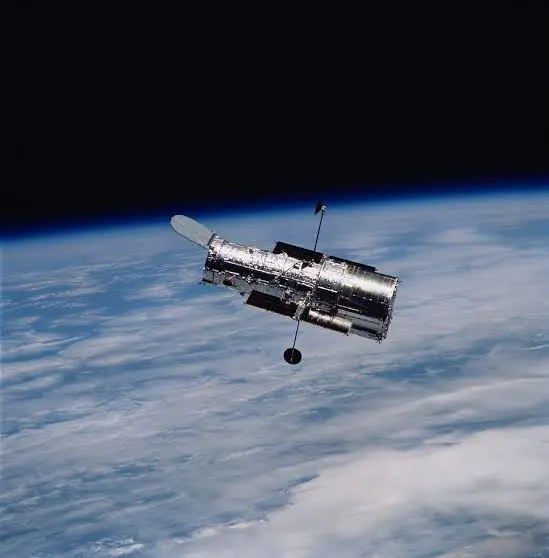
The Hubble Space Telescope launched aboard Space Shuttle Discovery on April 24, 1990.
More than 36 years later, NASA still lists Hubble as an active mission.
Hubble occupies low-Earth orbit.
Unlike a ground-based telescope, it sits above most atmospheric distortion.
Its instruments observe:
ultraviolet,
visible,
and near-infrared light.
That wavelength range allows Hubble to investigate an enormous variety of astronomical targets.
Planets.
Stars.
Nebulae.
Galaxies.
Black holes.
Supernovae.
Exoplanet atmospheres.
And the expansion of the universe.
The Hubble Mirror Crisis
The early history of Hubble almost became one of NASA’s greatest technological embarrassments.
Shortly after launch, scientists discovered that the telescope’s primary mirror had been manufactured with a very small but critical error.
Images were less sharp than expected.
Hubble had been designed for astronaut servicing, however.
In 1993, Space Shuttle astronauts installed corrective optics and new equipment.
The repair transformed Hubble.
NASA ultimately conducted five astronaut servicing missions, adding new scientific instruments and extending the telescope’s operational life.
The result is one reason Hubble holds such a unique place among NASA space telescopes.
It was not simply launched.
It evolved in orbit.
Hubble’s Scientific Legacy
By its 35th anniversary, NASA reported more than:
1.7 million Hubble observations
across its mission.
Hubble contributed to research involving:
- the expansion rate of the universe;
- dark energy;
- galaxy evolution;
- star formation;
- black holes;
- exoplanets;
- planetary atmospheres;
- objects throughout our own solar system.
Hubble’s images also became culturally important.
The telescope helped turn deep-space astronomy into something millions of people could visually experience.
Yet perhaps the most important fact about Hubble in 2026 is this:
Hubble has not been replaced by Webb.
NASA continues to operate it because its capabilities remain scientifically valuable and complementary.
James Webb Space Telescope: A New Infrared View
The James Webb Space Telescope, commonly called Webb or JWST, launched on December 25, 2021.
NASA lists Webb as an active international mission involving:
NASA
European Space Agency
and
Canadian Space Agency.
Webb does not orbit Earth in the same way Hubble does.
It operates around the Sun-Earth L2 region, approximately 1.5 million kilometers, or about one million miles, from Earth.
This location helps Webb maintain the cold and stable environment required for highly sensitive infrared observations.
Why Webb Looks Different From Hubble
Webb was designed primarily for infrared astronomy.
Its enormous primary mirror consists of 18 segments and measures approximately 6.5 meters across.
Its five-layer sunshield is roughly the size of a tennis court.
The telescope had to fold to fit inside its Ariane 5 launch vehicle and then unfold in space.
That engineering was necessary because infrared astronomy requires more than collecting light.
The observatory itself must remain extremely cold.
Otherwise heat from the telescope would interfere with the faint infrared signals astronomers are trying to detect.
What Does Webb Study?
Webb’s science is organized around several major areas:
the early universe
galaxy evolution
the birth and death of stars
planet formation
exoplanets
objects within our solar system.
Infrared light is particularly valuable because it can penetrate clouds of dust that obscure visible-light observations.
That allows Webb to look deeply into star-forming regions.
Infrared observations also help astronomers investigate the early universe.
As the universe expands, light from extremely distant galaxies becomes redshifted toward longer wavelengths.
Webb was designed specifically to detect that faint infrared light.
Webb and Exoplanet Atmospheres
One of Webb’s most important capabilities is spectroscopy.
Instead of simply taking a picture, astronomers can divide light into different wavelengths and investigate how matter absorbs or emits specific parts of that light.
For exoplanets, this can provide evidence about atmospheric chemistry.
Webb can investigate molecules and atmospheric properties on some worlds orbiting other stars.
NASA emphasizes that Webb’s instruments can study the composition, climate and weather of some exoplanet atmospheres.
This does not mean Webb can simply photograph an Earth twin and determine whether aliens live there.
That is a much more difficult scientific problem.
But Webb is helping establish the techniques future observatories will need.
Hubble vs Webb: They Are Not Competitors
The relationship between Hubble and Webb is often explained incorrectly.
Webb is newer.
It is much larger.
It has extraordinary infrared sensitivity.
But those facts do not make Hubble useless.
| Hubble | Webb |
|---|---|
| Low-Earth orbit | Sun-Earth L2 region |
| Launched 1990 | Launched 2021 |
| UV, visible, near-infrared | Near- and mid-infrared |
| 2.4-meter primary mirror | 6.5-meter primary mirror |
| Designed for astronaut servicing | Not designed for crew servicing |
| Excellent ultraviolet capability | Powerful deep infrared capability |
| Still active | Active |
Hubble can observe important ultraviolet wavelengths Webb cannot.
Webb can investigate infrared wavelengths and faint targets far beyond Hubble’s infrared capability.
Researchers can combine both datasets.
That complementary approach is fundamental to understanding NASA space telescopes.
Chandra X-ray Observatory
Some of the universe’s most energetic objects cannot be understood primarily through visible or infrared light.
That is where the Chandra X-ray Observatory becomes important.
Chandra launched on July 23, 1999.
NASA continues to list it as an active mission.
It investigates X-rays from extreme environments associated with:
black holes,
neutron stars,
supernova remnants,
galaxy clusters,
and extremely hot gas.
NASA describes Chandra as the world’s most powerful X-ray telescope, with far greater resolution and sensitivity than earlier X-ray observatories.
Chandra demonstrates again why NASA space telescopes cannot be reduced to Hubble and Webb.
The high-energy universe requires completely different instruments.
Spitzer Space Telescope: Webb’s Infrared Predecessor
NASA’s Spitzer Space Telescope launched in August 2003.
It became the infrared member of the Great Observatories.
Spitzer investigated:
star-forming regions,
galaxies,
dust,
brown dwarfs,
our solar system,
and exoplanets.
NASA credits Spitzer with becoming the first telescope to directly detect light from an exoplanet and with playing an important role in studying the seven Earth-sized planets of the TRAPPIST-1 system.
Its mission ended on January 30, 2020 after more than 16 years of science operations.
Spitzer’s legacy matters because Webb did not emerge from nowhere.
NASA’s modern infrared astronomy program built on decades of technical and scientific experience.
SPHEREx: Mapping the Entire Sky in 102 Colors
NASA launched SPHEREx on March 11, 2025.
Its full name is:
Spectro-Photometer for the History of the Universe, Epoch of Reionization and Ices Explorer.
The observatory is currently active.
SPHEREx is fundamentally different from Webb.
Webb can examine small regions and individual targets with extraordinary sensitivity.
SPHEREx is designed to repeatedly survey the entire sky.
It observes in:
102 infrared colors
or wavelength bands.
NASA says the planned mission will gather data involving more than:
450 million galaxies
and
100 million Milky Way stars.
Why SPHEREx Matters
SPHEREx is investigating several major scientific questions.
Cosmic inflation
Scientists want to understand the extremely early expansion of the universe.
The distribution of galaxies can preserve statistical clues about this ancient period.
Galaxy history
By mapping enormous numbers of galaxies, researchers can investigate how light production changed through cosmic time.
Water and life’s ingredients
SPHEREx maps frozen molecules in the Milky Way, including materials connected to water and the chemistry associated with planet-forming environments.
By late 2025, SPHEREx had completed the first of its planned all-sky infrared maps in 102 colors.
That makes it one of the most unusual active NASA space telescopes.
Nancy Grace Roman Space Telescope: NASA’s Newest Major Observatory
The biggest 2026 development in NASA space astronomy arrived on:
August 30, 2026.
NASA launched the Nancy Grace Roman Space Telescope aboard a SpaceX Falcon Heavy from Kennedy Space Center.
Roman is now traveling roughly one million miles toward its destination near the Sun-Earth L2 region. NASA described the journey as taking approximately three months.
Roman is therefore launched but is not yet in routine science operations.
This distinction should remain clear when reporting its current status.
Why Roman Is Different
Roman has a primary mirror roughly comparable in diameter to Hubble’s.
But its defining feature is not simply mirror size.
It is:
field of view.
NASA says Roman’s field of view will be at least 100 times larger than Hubble’s, allowing it to survey huge portions of the sky far more efficiently while preserving sharp infrared imaging.
A useful analogy is:
Hubble gives astronomers a detailed view.
Roman gives them a detailed panorama.
Webb goes exceptionally deep.
Roman goes exceptionally wide.
What Will Roman Study?
Roman’s major scientific goals include:
dark energy
dark matter
galaxy evolution
exoplanets
black holes
and broad astrophysical surveys.
NASA says Roman could potentially measure light from around a billion galaxies over its lifetime.
The observatory will also perform a statistical census of planetary systems using gravitational microlensing.
That could reveal planets at distances from their stars that are difficult to study using other exoplanet techniques.
Roman’s Coronagraph Technology
Roman also carries a Coronagraph Instrument technology demonstration.
A coronagraph suppresses bright starlight so that much fainter objects near the star can be detected.
This is extremely difficult.
A planet can be billions of times fainter than the star it orbits.
Roman’s coronagraph is intended to demonstrate advanced technologies that may eventually support future missions designed specifically for direct exoplanet imaging.
That creates a direct technological bridge between Roman and NASA’s future Habitable Worlds Observatory concept.
Hubble vs Webb vs Roman
These three NASA space telescopes illustrate why different designs can complement rather than replace one another.
| Feature | Hubble | Webb | Roman |
|---|---|---|---|
| Launch | 1990 | 2021 | 2026 |
| Current status | Active | Active | En route/commissioning |
| Main wavelength strength | UV/visible/near-IR | Near/mid-IR | Wide-field near-IR |
| Primary mirror | 2.4 m | 6.5 m | 2.4 m class |
| Orbit/region | Low-Earth orbit | Sun-Earth L2 | Traveling to L2 |
| Main advantage | Sharp multi-wavelength observations | Deep infrared sensitivity | Vast field of view |
| Major science | Broad astrophysics | Early universe, stars, planets | Dark universe, surveys, exoplanets |
NASA itself emphasizes the complementary nature of Hubble, Webb and Roman rather than describing them as successive replacements.
One Telescope Finds Targets, Another Studies Them
The future of NASA space telescopes increasingly involves cooperation.
Imagine that Roman surveys an enormous region of the sky and identifies thousands of unusual galaxies.
Astronomers could then use Webb to examine some of the most interesting examples in greater detail.
Hubble might contribute ultraviolet or visible-light observations.
Chandra could determine whether powerful X-ray sources indicate active black holes.
SPHEREx could provide broader spectral context.
The result is something no single observatory could produce independently.
This approach is sometimes called multi-wavelength astronomy.
It is one of the central ideas behind modern astrophysics.
NASA Space Telescopes and Exoplanets
Planets around other stars have become one of astronomy’s fastest-growing fields.
NASA missions have contributed at several stages.
Kepler discovered thousands of planets through transits.
TESS continues finding nearby planetary systems.
Hubble studies atmospheric properties of selected worlds.
Spitzer made pioneering infrared exoplanet measurements.
Webb can conduct detailed atmospheric spectroscopy.
Roman will conduct a large statistical census of planetary systems.
The next great step could involve directly imaging worlds similar to Earth.
That is where the Habitable Worlds Observatory enters the picture.
Habitable Worlds Observatory: NASA’s Future Flagship Concept
The Habitable Worlds Observatory, or HWO, is currently in early conceptual development.
It is not a launched mission.
It does not yet have a final spacecraft design or launch date.
NASA describes the concept as its proposed next major flagship astrophysics observatory after Roman.
Its defining science goal is extraordinary:
directly identify and characterize potentially habitable planets around nearby stars.
NASA currently describes a goal of directly imaging approximately 25 potentially habitable worlds and using spectroscopy to investigate their atmospheres.
Could HWO Find Life?
Potentially, it could search for evidence associated with life.
That is not the same as guaranteeing a discovery.
HWO would attempt to separate the extremely faint light of a planet from the overwhelming brightness of its star.
Once the planet’s light is isolated, spectroscopy could be used to study atmospheric gases.
NASA highlights gases such as:
oxygen
and
methane
as possible pieces of evidence researchers could investigate in the search for biosignatures.
But interpreting possible biosignatures is complex.
Non-biological processes can sometimes produce gases associated with biology.
Finding one molecule would not automatically prove extraterrestrial life.
Researchers would need to understand the entire planetary environment.
Why HWO Is So Technically Difficult
Directly imaging an Earth-like planet near a Sun-like star is one of astronomy’s hardest observational problems.
The star is enormously brighter than the planet.
The angular separation is tiny.
The telescope must maintain extraordinary optical stability.
NASA is therefore studying technologies involving:
- highly stable mirrors;
- coronagraphs;
- precision wavefront control;
- advanced detectors;
- ultraviolet, visible and infrared instrumentation.
NASA says HWO remains under study, with engineering teams currently evaluating different architectural concepts rather than finalizing one specific design.
The responsible way to describe HWO in 2026 is:
a future observatory concept under development.
Not:
NASA’s next telescope launching on a fixed date.
No such final launch date is currently established.
NASA Space Telescopes Have Different Lifetimes
One interesting lesson from space astronomy is that mission lifetime can be difficult to predict.
Hubble has operated since 1990.
Spitzer operated for more than 16 years before retirement.
Webb was designed with limited consumables but may potentially remain useful for many years.
SPHEREx has a planned two-year primary mission.
Roman is only beginning its journey.
Technology, fuel, component health, orbit and mission design all affect longevity.
A spacecraft can greatly exceed expectations.
It can also suffer an early failure.
That uncertainty is one reason astronomical archives are valuable.
Even when an observatory stops operating, its data can produce discoveries for years afterward.
Retired Telescopes Still Produce Science
Spitzer demonstrates this particularly well.
Its spacecraft operations ended in 2020.
Yet astronomers continue analyzing the enormous archive it produced.
NASA notes that observations from retired missions such as Spitzer and Kepler continue contributing to new exoplanet discoveries when combined with newer datasets.
This means the scientific lifetime of NASA space telescopes can extend much longer than the hardware’s operating lifetime.
A telescope may stop collecting photons.
Its dataset does not disappear.
Why NASA Needs Ground-Based Telescopes Too
Space telescopes are powerful, but they do not make ground observatories obsolete.
Ground-based telescopes have major advantages.
They can have enormous mirrors.
They can be repaired and upgraded more easily.
They can use new instruments throughout their lifetimes.
Space telescopes provide access to wavelengths and environments unavailable from the ground.
Ground telescopes provide scale, flexibility and complementary observations.
Modern astronomy increasingly combines both.
An object might be discovered from the ground.
Observed by Hubble.
Analyzed by Webb.
Surveyed by Roman.
And studied in X-rays by Chandra.
The best astronomical system is therefore not:
space versus ground.
It is:
space plus ground.
What NASA Space Telescopes Have Taught Us
Collectively, NASA space telescopes have helped scientists investigate some of the largest questions humans can ask.
How old is the universe?
Observatories help constrain the history and expansion of the cosmos.
How do galaxies form?
Deep observations reveal galaxies across different stages of cosmic history.
How are stars born?
Infrared instruments can penetrate dusty stellar nurseries.
How do stars die?
Visible, infrared and X-ray observatories examine supernova remnants, neutron stars and stellar debris.
How do black holes affect galaxies?
X-ray and infrared observations reveal energetic processes surrounding black holes.
How common are planets?
Space missions have shown planetary systems are widespread.
Could another world support life?
Atmospheric spectroscopy and future direct imaging may increasingly address planetary habitability.
These questions explain why telescope development remains one of NASA’s most scientifically important activities.
NASA Space Telescope Timeline
| Year | Major Milestone |
|---|---|
| 1990 | Hubble launches |
| 1993 | First Hubble servicing mission corrects optical problem |
| 1999 | Chandra launches |
| 2003 | Spitzer launches |
| 2020 | Spitzer mission ends |
| Dec. 2021 | Webb launches |
| 2022 | Webb begins routine science |
| March 2025 | SPHEREx launches |
| Late 2025 | SPHEREx completes first all-sky 102-color map |
| Aug. 30, 2026 | Roman launches |
| Sept. 2026 | Hubble, Webb, Chandra and SPHEREx remain active |
| Future | Roman science operations after commissioning |
| Future | Habitable Worlds Observatory under development |
Frequently Asked Questions About NASA Space Telescopes
What are NASA space telescopes?
NASA space telescopes are astronomical observatories operating above Earth’s atmosphere. They study the universe using wavelengths including ultraviolet, visible, infrared, X-ray and other forms of electromagnetic radiation.
Why does NASA put telescopes in space?
Earth’s atmosphere blocks or distorts many wavelengths of light. Space observatories can access radiation unavailable from the ground and avoid much atmospheric turbulence.
Is Hubble still working in 2026?
Yes. NASA continues to classify the Hubble Space Telescope as an active mission more than 36 years after its 1990 launch.
Did James Webb replace Hubble?
No. Webb and Hubble observe different wavelength ranges and remain scientifically complementary. Hubble has important ultraviolet capability, while Webb specializes in powerful infrared observations.
Is the James Webb Space Telescope still active?
Yes. Webb is an active NASA/ESA/CSA observatory operating around the Sun-Earth L2 region.
What is NASA’s newest major space telescope?
The Nancy Grace Roman Space Telescope launched on August 30, 2026. It is currently traveling toward its operational region near Sun-Earth L2 and is not yet in routine science operations.
How is Roman different from Hubble?
Roman has a field of view at least 100 times larger than Hubble’s, allowing it to conduct enormous infrared surveys while maintaining sharp imaging.
What is SPHEREx?
SPHEREx is an active NASA observatory launched in March 2025. It surveys the entire sky in 102 infrared wavelength bands and is designed to study hundreds of millions of galaxies and more than 100 million Milky Way stars.
What does Chandra observe?
Chandra observes X-rays from energetic cosmic environments such as black holes, neutron stars, supernova remnants and hot gas in galaxy clusters.
Is Spitzer still active?
No. NASA ended Spitzer’s mission on January 30, 2020 after more than 16 years of infrared observations.
What is the Habitable Worlds Observatory?
The Habitable Worlds Observatory is a future NASA flagship telescope concept currently under study. Its major goal would be to directly image potentially habitable exoplanets and search their atmospheres for possible biosignatures.
Has NASA found an Earth-like planet with life?
No confirmed extraterrestrial life has been detected. NASA has discovered and studied thousands of exoplanets, but identifying a potentially habitable world is not the same as proving that it contains life.
Conclusion: NASA Space Telescopes Work Best as a Team
The history of NASA space telescopes is not a story of one telescope replacing another.
It is a story of expanding vision.
Hubble gave astronomers an extraordinarily sharp ultraviolet, visible and near-infrared view above Earth’s atmosphere.
It helped measure the universe.
Investigate galaxies.
Study planets.
Observe stars.
And transform the public image of astronomy.
More than 36 years after launch, Hubble remains active.
Chandra revealed a different cosmos.
Its X-ray vision showed energetic environments surrounding black holes, neutron stars, supernova remnants and galaxy clusters.
Spitzer opened the infrared universe for more than 16 years.
Then Webb expanded infrared astronomy to a new level.
Its 6.5-meter mirror, enormous sunshield and sensitive instruments allow astronomers to study the early universe, dusty star-forming regions and planetary atmospheres from approximately one million miles away.
SPHEREx then introduced another strategy.
Not ultra-deep observations of selected objects.
An enormous spectral survey of the entire sky.
One hundred and two infrared colors.
Hundreds of millions of galaxies.
Hundreds of millions of astronomical sources.
The observatory completed its first full-sky map by late 2025 and remains active in 2026.
Now Roman has joined the story.
The newest major NASA observatory launched on August 30, 2026.
It is currently traveling toward the Sun-Earth L2 region.
Its strength will be scale.
Roman will combine sharp infrared imaging with a field of view at least 100 times larger than Hubble’s.
That could allow astronomers to survey vast regions of the universe and identify targets worthy of deeper investigation.
Then Webb can look closer.
Hubble can contribute another wavelength.
Chandra can reveal X-rays.
Ground observatories can add their own information.
That is the future of astronomy.
Not one perfect telescope.
A network of specialized instruments.
And the next step may be even more ambitious.
NASA’s Habitable Worlds Observatory remains in conceptual development, but its central goal reflects how far NASA space telescopes have progressed.
Astronomers once struggled simply to determine whether planets existed around other stars.
Thousands are now known.
The next challenge is to characterize nearby worlds that might resemble Earth.
HWO is being developed specifically around the possibility of directly imaging potentially habitable planets and examining their atmospheres for evidence relevant to the search for life.
Success is not guaranteed.
Finding oxygen would not automatically mean biology.
Finding methane would not prove life.
A true biosignature claim would require extraordinary evidence and careful analysis of the entire planetary environment.
But the fact that engineers are designing telescopes capable of attempting these measurements shows how dramatically astronomy has changed.
Hubble helped astronomers understand the universe at unprecedented resolution.
Webb is investigating cosmic history and planetary chemistry.
Roman will map the universe on an enormous scale.
SPHEREx is creating a spectral atlas of the entire sky.
And the next generation may attempt to examine worlds resembling our own.
That progression is why NASA space telescopes remain one of the most important parts of NASA’s scientific mission.
They extend human vision beyond the limits of our eyes.
Beyond Earth’s atmosphere.
Beyond visible light.
And increasingly toward questions that once belonged only to philosophy:
How did the universe begin?
How did galaxies evolve?
How did planetary systems form?
How common are worlds like Earth?
And eventually:
Are any of them alive?
For The News Ink’s NASA structure, this article should link upward to the NASA Explained main pillar once its live URL is confirmed.
It should also connect contextually to NASA History Explained, especially from the Great Observatories section, and later to NASA Space Technology Explained as that cluster develops.
Follow The News Ink
Stay connected with The News Ink for technology, science, space and global coverage:
X
Pinterest
Medium
Quora
TikTok
Instagram
Substack
Threads
Bluesky
Mastodon