NASA Explained: Complete Guide to Missions, Artemis, Mars, Telescopes and Space Exploration
NASA is one of the most recognizable scientific and exploration organizations in the world, but its work extends far beyond launching astronauts and sending spacecraft toward distant planets.
The agency studies Earth.
It operates and supports human spaceflight.
It explores the Moon and Mars.
It searches for potentially dangerous asteroids.
It studies the Sun.
It develops experimental aircraft.
It operates major space observatories.
It tests propulsion, communications, robotics and autonomous systems that could eventually support human exploration much farther from Earth.
NASA’s official mission portfolio is broadly divided across human spaceflight, science, space technology and aeronautics, although the agency reorganized parts of its management structure in 2026.
Its ambitions are also changing.
The Apollo era focused on reaching the Moon.
Modern NASA is trying to build something more sustainable: an exploration system in which low-Earth orbit, commercial space stations, lunar missions, advanced technology and Mars preparation increasingly connect.
That strategy is especially visible in NASA’s evolving Moon to Mars Architecture, which treats lunar exploration as a proving ground for capabilities that could eventually support human missions to Mars.
At the same time, NASA continues missions that have nothing directly to do with sending humans beyond Earth.
Hubble is still observing the universe.
The James Webb Space Telescope is studying distant galaxies, stars, planets and exoplanet atmospheres.
The Nancy Grace Roman Space Telescope launched on August 30, 2026.
Perseverance and Curiosity continue exploring Mars.
NASA satellites monitor Earth’s oceans, atmosphere, ice, vegetation and climate.
And its X-59 research aircraft reached supersonic speed for the first time in June 2026.
This is what makes NASA difficult to summarize in a single sentence.
It is simultaneously a space agency, science organization, research institution, engineering enterprise, exploration program and aeronautics laboratory.
This complete guide explains how those pieces fit together.
NASA at a Glance
| Category | NASA |
|---|---|
| Full name | National Aeronautics and Space Administration |
| Created | 1958 |
| Became operational | October 1, 1958 |
| Type | U.S. civilian space and aeronautics agency |
| Major historical programs | Mercury, Gemini, Apollo, Space Shuttle |
| Major human-spaceflight focus | Low-Earth orbit, Artemis, Moon to Mars |
| Current Moon program | Artemis |
| Major Mars missions | Curiosity, Perseverance and orbital missions |
| Major observatories | Hubble, Webb, Roman and other science missions |
| Earth science | Satellites, aircraft, instruments and research |
| Planetary defense | Asteroid detection, tracking and deflection research |
| Aeronautics | Experimental aircraft and future aviation technology |
| Long-term human exploration goal | Moon, Mars and beyond |
Current NASA Snapshot for 2026
Because its missions evolve constantly, current schedules should be separated from the evergreen history.
As of September 2026:
| Current Program | Status |
|---|---|
| Artemis II | Completed April 1–10, 2026 |
| Artemis II type | Crewed lunar flyby |
| Artemis III | Planned 2027 demonstration in low-Earth orbit |
| Artemis IV | NASA targeting first Artemis lunar surface return in 2028 |
| Roman Space Telescope | Launched August 30, 2026 |
| International Space Station | NASA plans operations through 2030 |
| Mars | Perseverance and Curiosity remain active |
| X-59 | First flew in 2025 and first went supersonic June 2026 |
| Planetary defense | DART demonstrated asteroid deflection; NEO Surveyor is in development |
| Long-term exploration | Moon to Mars |
The biggest recent human-spaceflight milestone was Artemis II.
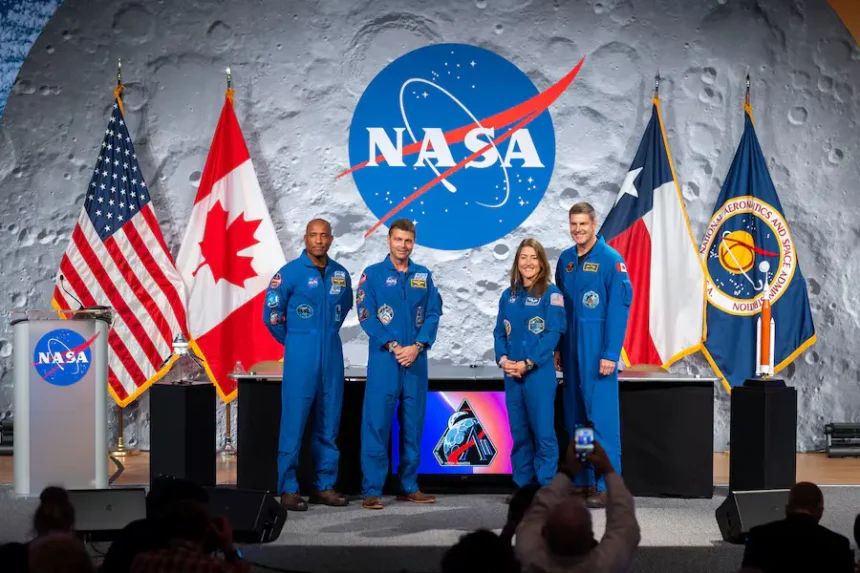
NASA launched Reid Wiseman, Victor Glover, Christina Koch and Canadian Space Agency astronaut Jeremy Hansen aboard Orion on April 1, 2026. They completed the first crewed lunar flyby in more than 50 years and splashed down on April 10 after a mission lasting 9 days, 1 hour and 32 minutes.
NASA’s current Artemis plan now places Artemis III in 2027 as a low-Earth-orbit demonstration involving commercial human landing systems, while Artemis IV is targeted for the first crewed Artemis return to the lunar surface in 2028.
That schedule is important because older articles describing Artemis III as the first landing mission are now outdated.
What Is NASA?
NASA stands for:
National Aeronautics and Space Administration.
It is the civilian U.S. government organization responsible for major areas of space exploration, space science and aeronautical research.
The word aeronautics matters.
It does not exist only to explore space.
Research into aircraft, aviation safety, efficiency, propulsion and experimental flight has been part of the organization from its beginning.
NASA itself describes its mission portfolio around four broad areas:
- human spaceflight;
- science;
- space technology;
- aeronautics.
Those categories overlap.
A human Moon mission requires space technology.
A Mars mission needs science.
Astronaut transportation may involve commercial companies.
An Earth-observing spacecraft may require advanced communications and navigation.
NASA therefore works as an interconnected system rather than as a collection of completely separate departments.
Why Was NASA Created?
NASA emerged during the early Cold War and the beginning of the Space Age.
The Soviet Union’s launch of Sputnik in 1957 transformed the political and technological competition surrounding space.
The United States already had the National Advisory Committee for Aeronautics, or NACA, which had conducted aviation research for decades.
President Dwight D. Eisenhower signed the National Aeronautics and Space Act on July 29, 1958.
It officially began operations on October 1 of that year.
The law established a civilian organization rather than placing the national space program entirely under military control.
Its original goals extended beyond simply beating another country to space.
They included expanding scientific knowledge, improving aeronautical and space vehicles, developing spaceflight capabilities and maintaining U.S. leadership in peaceful aerospace activity.
That civilian scientific identity remains central to NASA today.
NASA History: From Mercury to the Moon
The early NASA human-spaceflight programs followed a logical progression.
Project Mercury
Mercury answered the first basic question:
Could humans safely travel into space?
NASA selected seven astronauts for the program.
Alan Shepard became the first American in space in 1961.
John Glenn became the first American to orbit Earth in 1962.
Mercury helped establish the basic systems and procedures required for human spaceflight.
Project Gemini
Gemini was more ambitious.
NASA needed to learn how astronauts could:
- remain in space longer;
- maneuver spacecraft;
- rendezvous and dock;
- perform spacewalks;
- prepare for lunar missions.
Gemini therefore became the engineering bridge between Mercury and Apollo.
Apollo
Apollo transformed NASA into a symbol of lunar exploration.
After President John F. Kennedy challenged the United States to land a person on the Moon and return safely before the decade ended, NASA developed the Saturn V rocket, Apollo spacecraft and lunar module system necessary to do it.
On July 20, 1969, Apollo 11 astronauts Neil Armstrong and Buzz Aldrin became the first humans to walk on the Moon while Michael Collins remained in lunar orbit.
Five additional Apollo missions later landed astronauts on the lunar surface.
In total, 12 people walked on the Moon during Apollo. NASA’s historical record places those achievements among the defining accomplishments of its first decades.
NASA After Apollo
Apollo was spectacular, but it was not designed as a permanent lunar settlement system.
After the final lunar mission, Apollo 17, in 1972, NASA’s human-spaceflight priorities changed.
The agency worked on:
- Skylab;
- the Space Shuttle;
- long-duration low-Earth-orbit operations;
- international cooperation;
- eventually the International Space Station.
This evolution shifted NASA away from short lunar expeditions and toward reusable transportation and long-term orbital research.
The Space Shuttle Era
NASA’s Space Shuttle became the world’s first operational reusable winged spacecraft system.
Shuttles launched satellites.
Carried astronauts.
Supported scientific missions.
Helped build the International Space Station.
And deployed the Hubble Space Telescope.
The Shuttle era also demonstrated that human spaceflight carries serious risks.
The Challenger accident in 1986 and Columbia accident in 2003 killed 14 astronauts and led to major investigations into engineering, management and safety.
NASA retired the Shuttle fleet in 2011.
That ended one era while accelerating another: greater reliance on commercial companies for transportation to low-Earth orbit.
NASA and the International Space Station
The International Space Station is one of the largest cooperative engineering projects ever undertaken in space.
The laboratory has supported continuous human presence in orbit for decades.
NASA uses it to investigate subjects including:
- human physiology;
- materials;
- biology;
- combustion;
- technology demonstrations;
- long-duration spaceflight;
- life-support systems.
The value of the station is not only the science conducted there.
It also helps NASA learn how people and machines behave during long stays away from Earth.
That knowledge matters for future Moon and Mars missions.
It currently plans to operate the ISS through 2030, while helping commercial companies develop replacement destinations in low-Earth orbit. NASA’s long-term goal is to become one customer among many purchasing services from commercially operated stations rather than owning the entire future low-Earth-orbit platform itself.
This commercial transition represents one of the biggest structural changes in modern NASA.
NASA and Commercial Spaceflight
NASA increasingly works with private companies rather than designing, owning and operating every system itself.
The Commercial Crew Program is a major example.
Under the older model, NASA was deeply involved in designing and owning crew transportation systems.
The commercial model gives companies greater responsibility for developing and operating their spacecraft while requiring them to meet NASA safety and performance standards.
SpaceX’s Crew Dragon has been certified for regular NASA missions to the International Space Station.
NASA says Boeing continues corrective work toward making Starliner capable of safely carrying crews following problems identified during its 2024 flight test.
Commercial partnerships also extend to:
- cargo transportation;
- lunar payload delivery;
- launch services;
- future commercial space stations;
- human landing systems for Artemis.
This does not mean NASA is being replaced by private companies.
The relationship is better understood as a changing division of responsibilities.
NASA defines missions, provides science and engineering expertise, establishes requirements, performs oversight and purchases services.
Private companies increasingly own and operate some of the transportation hardware.
The NASA Artemis Program
Artemis is NASA’s central human lunar exploration program.
Its goal is not simply to recreate Apollo.
NASA wants to develop more sustainable capabilities around and on the Moon while using those missions to prepare for eventual human exploration of Mars.
The program brings together:
- the Space Launch System;
- Orion spacecraft;
- commercial lunar landers;
- surface technologies;
- international partnerships;
- science;
- communications;
- navigation;
- future lunar infrastructure.
Artemis is one part of the larger Moon to Mars strategy rather than an isolated Moon project.
Artemis I
Artemis I launched in November 2022.
It was an uncrewed integrated test of SLS and Orion.
The mission sent Orion around the Moon and back to Earth.
Its purpose was to test the major deep-space transportation system before astronauts flew aboard it.
Artemis II
Artemis II became the first crewed flight of the program.
It launched on April 1, 2026.
NASA astronauts Reid Wiseman, Victor Glover and Christina Koch flew with Canadian Space Agency astronaut Jeremy Hansen.
The crew traveled around the Moon aboard Orion and returned safely to Earth on April 10.
Their mission marked the first time humans had departed Earth orbit for the lunar region since Apollo 17 in 1972.
Artemis III
NASA’s current 2026 architecture gives Artemis III a different role from many older plans.
The mission is planned for 2027 in low-Earth orbit.
NASA intends to use it to test critical rendezvous and docking operations between Orion and one or both commercial human landing systems being developed by SpaceX and Blue Origin.
Artemis IV
NASA currently targets Artemis IV for the first crewed Artemis lunar surface return in 2028.
Under the plan, astronauts will travel aboard Orion and transfer to a commercial human landing system for the journey to the lunar surface.
That makes Artemis IV one of the most important future NASA missions to watch.
Why NASA Wants to Return to the Moon
Returning to the Moon serves several goals.
Science
The lunar surface preserves information about the early solar system.
Certain areas, particularly around the poles, are scientifically valuable because permanently shadowed regions may contain volatile materials including water ice.
Technology testing
The Moon provides an environment where NASA can test:
- habitats;
- power systems;
- mobility;
- communications;
- autonomous robots;
- resource utilization;
- surface operations.
Mars preparation
The Moon is vastly closer to Earth than Mars.
Lessons learned during sustained lunar operations can expose problems before crews face far more difficult missions to another planet.
NASA’s Moon to Mars architecture explicitly identifies systems such as autonomous robotics, communications, habitation, power, mobility, transportation and in-situ resource utilization as capabilities required for long-term exploration.
Robotics and autonomous systems are therefore becoming increasingly important to space exploration, an area that also connects naturally with The News Ink’s Robotics Explained pillar.
NASA Mars Exploration
Mars has been one of NASA’s most important robotic exploration targets for decades.
The agency has sent:
- flyby spacecraft;
- orbiters;
- landers;
- rovers.
Past missions dramatically changed our understanding of Mars.
Viking landed successfully in the 1970s.
Pathfinder demonstrated new landing and rover concepts.
Spirit and Opportunity transformed knowledge of ancient Martian environments.
Curiosity began investigating Gale Crater in 2012.
Perseverance landed in Jezero Crater in 2021.
Curiosity and Perseverance
Both Curiosity and Perseverance remained active in 2026.
NASA noted in April 2026 that the two rovers were exploring regions separated by thousands of kilometers while investigating different chapters of Mars’ ancient history.
Curiosity
Curiosity studies whether ancient Mars offered environments capable of supporting microbial life.
Its long journey through Gale Crater and Mount Sharp has revealed evidence of past lakes, water-related minerals and changing environmental conditions.
Perseverance
Perseverance is exploring Jezero Crater.
Its objectives include astrobiology and the search for signs that ancient microbial life may once have existed.
The rover also collects and stores carefully selected samples of Martian rock and regolith for possible future study.
Perseverance carried the Ingenuity helicopter to Mars.
Ingenuity became the first powered aircraft to fly on another world and demonstrated that controlled flight was possible in Mars’ extremely thin atmosphere.
Will NASA Send Humans to Mars?
NASA’s long-term architecture includes human exploration of Mars.
But a crewed Mars mission is vastly harder than a lunar mission.
Challenges include:
- travel duration;
- radiation;
- isolation;
- life support;
- food and supplies;
- communications delay;
- landing massive spacecraft;
- surface power;
- launch from Mars;
- safe return to Earth.
NASA’s Moon to Mars architecture describes human Mars exploration as a later segment that will build upon capabilities developed in low-Earth orbit and around the Moon.
NASA is therefore not treating the Moon and Mars as competing destinations.
The Moon is part of the preparation for Mars.
NASA Space Telescopes
Some of NASA’s greatest discoveries come from observatories rather than astronauts or planetary rovers.
Three observatories illustrate how different telescope designs can work together:
Hubble
James Webb
Nancy Grace Roman
Hubble Space Telescope
Hubble launched aboard Space Shuttle Discovery in 1990.
More than three decades later, it remains scientifically active.
NASA says Hubble has made more than 1.7 million observations and contributed to more than 23,000 peer-reviewed science papers.
Its discoveries have influenced research on:
- galaxies;
- black holes;
- stars;
- planetary systems;
- exoplanet atmospheres;
- the expansion of the universe.
Hubble observes primarily ultraviolet, visible and near-infrared wavelengths.
Its continued operation alongside newer telescopes shows that a more modern observatory does not automatically make an older one useless.
Different instruments can answer different questions.
James Webb Space Telescope
The James Webb Space Telescope launched in 2021 and operates roughly 1.5 million kilometers from Earth around the Sun-Earth L2 region.
Webb specializes in infrared astronomy.
Its enormous segmented mirror and cold operating environment allow it to study:
- early galaxies;
- star formation;
- planetary formation;
- exoplanet atmospheres;
- objects within our own solar system.
Webb is an international mission led by NASA with major participation from the European Space Agency and Canadian Space Agency.
Hubble and Webb are therefore not simply old and new versions of the same machine.
Their capabilities complement each other.
Nancy Grace Roman Space Telescope
NASA added another major observatory in 2026.
The Nancy Grace Roman Space Telescope launched on August 30, 2026 aboard a SpaceX Falcon Heavy from Kennedy Space Center.
NASA says Roman is traveling roughly one million miles toward the Sun-Earth L2 region.
Roman’s major science goals include:
- dark energy;
- dark matter;
- exoplanets;
- wide-field surveys of the universe.
Its field of view is designed to be at least 100 times larger than Hubble’s, allowing it to map enormous areas of the sky efficiently.
That combination gives NASA a powerful observatory ecosystem:
Hubble for high-resolution ultraviolet, visible and near-infrared observations
Webb for deep infrared observations
Roman for wide-field infrared surveys.
NASA Science Goes Far Beyond Telescopes
NASA’s Science Mission Directorate works across five broad scientific areas:
- Earth Science;
- Planetary Science;
- Biological and Physical Sciences;
- Heliophysics;
- Astrophysics.
This matters because people often associate NASA science only with astronomy.
The agency also studies:
Earth’s climate and oceans.
The Sun and space weather.
Planetary geology.
Human and biological processes in space.
The physical behavior of materials in microgravity.
Asteroids and comets.
And worlds orbiting other stars.
NASA Earth Science
NASA studies Earth as a planet.
Its Earth science missions use:
- satellites;
- instruments aboard the International Space Station;
- aircraft;
- balloons;
- ships;
- ground measurements.
The data help researchers investigate:
- atmospheric composition;
- vegetation;
- oceans;
- sea level;
- ice;
- climate;
- clouds;
- aerosols;
- water cycles;
- carbon cycles.
NASA is therefore not an organization that studies everywhere except Earth.
Earth is one of its most important scientific targets.
Space-based observations are especially valuable because satellites can repeatedly measure large areas of the planet using the same instruments.
That makes them useful for identifying long-term change.
NASA and Climate Science
Climate research is part of NASA’s broader Earth-system science mission.
NASA studies interactions among:
- oceans;
- atmosphere;
- ice;
- land;
- ecosystems.
Its role is particularly important in collecting and analyzing large-scale observational datasets.
NASA does not replace organizations responsible for daily weather forecasting.
Instead, it contributes global satellite observations and scientific research that help researchers understand how Earth’s interconnected systems behave over time.
NASA Planetary Defense
One of NASA’s least understood responsibilities is planetary defense.
Earth exists in a solar system containing millions of smaller objects.
Most pose no threat.
But sufficiently large near-Earth asteroids or comets can create serious consequences if they collide with the planet.
Planetary defense therefore involves:
- discovering potentially hazardous objects;
- determining their orbits;
- estimating impact probabilities;
- studying possible mitigation techniques.
DART and Asteroid Deflection
NASA’s Double Asteroid Redirection Test, or DART, became the world’s first demonstration of asteroid-deflection technology.
The spacecraft intentionally struck Dimorphos, the small moon of asteroid Didymos.
The goal was not to destroy the asteroid.
It was to test whether a spacecraft impact could alter the orbit of an asteroid-like object.
NASA now presents DART as the first demonstrated asteroid-deflection technology mission.
The experiment provided evidence that a kinetic impactor could become one possible planetary-defense technique if a hazardous asteroid were detected sufficiently early.
NEO Surveyor
Finding dangerous objects before they become an immediate emergency is arguably even more important than deflecting them.
NASA’s NEO Surveyor is being developed specifically to search for potentially hazardous near-Earth asteroids and comets using infrared observations.
NASA currently lists launch as no earlier than September 2027.
Planetary defense is therefore not science-fiction emergency planning.
It is an active scientific and engineering program.
NASA Studies the Sun
Heliophysics studies the Sun and the space environment influenced by it.
Solar activity can affect:
- satellites;
- radio communications;
- navigation;
- astronauts;
- electrical systems.
Understanding space weather therefore has practical importance.
NASA missions study the Sun, solar wind, Earth’s magnetosphere and the wider heliosphere.
The Sun is also scientifically important because it is the closest star to Earth.
Studying it gives researchers a detailed laboratory for understanding stellar processes that would be impossible to observe as closely elsewhere.
NASA and the Search for Life
One of the biggest questions connecting many NASA missions is:
Are we alone?
NASA approaches this question from multiple directions.
Mars rovers investigate whether the planet once possessed environments suitable for microbial life.
Europa and other icy-world research explores environments where liquid water could exist beneath frozen surfaces.
Space telescopes study planets orbiting other stars.
Webb can examine the chemical composition of some exoplanet atmospheres.
Roman will greatly expand the statistical study of planetary systems.
None of this means NASA has confirmed extraterrestrial life.
It means the scientific search has become increasingly sophisticated.
The question is no longer simply whether planets exist beyond our solar system.
Thousands are known.
The harder questions involve their environments, atmospheres, chemistry and potential habitability.
NASA Aeronautics: The Part People Often Forget
NASA’s name includes aeronautics for a reason.
Its roots reach back to NACA, the organization that preceded NASA.
Aeronautical research continues today in areas such as:
- aircraft efficiency;
- advanced aircraft design;
- air traffic systems;
- sustainable flight;
- autonomy;
- supersonic aviation.
One of the most visible modern programs is Quesst and its experimental X-59 aircraft.
NASA X-59 and Quiet Supersonic Flight
The X-59 is designed to help determine whether future supersonic aircraft could fly over land while producing a much quieter sonic signature than traditional sonic booms.
The aircraft completed its first flight on October 28, 2025.
Then, on June 5, 2026, it exceeded the speed of sound for the first time.
NASA reported that the aircraft reached approximately Mach 1.1 at 43,400 feet.
The mission is not about building a commercial passenger aircraft for NASA to operate.
NASA’s role is research.
Data from experimental aircraft can help regulators and industry understand what future technology may make possible.
NASA Space Technology
Exploration requires technology that often does not yet exist at sufficient maturity.
NASA therefore invests in developing and demonstrating new systems before they become part of major missions.
Current technology work spans areas such as:
- propulsion;
- power;
- autonomous systems;
- robotics;
- communications;
- navigation;
- manufacturing;
- spacecraft servicing;
- nuclear technology.
Following a 2026 agency realignment, aeronautics, space technology, nuclear power and propulsion, and key communications capabilities were brought together under NASA’s Research and Technology Mission Directorate.
The relationship between space exploration and intelligent autonomous machines is becoming especially important as missions travel farther from Earth, where communications delays make continuous human control impractical.
This is also where NASA’s work increasingly overlaps conceptually with developments covered in The News Ink’s Artificial Intelligence Explained pillar.
Nuclear Propulsion and Deep-Space Travel
Chemical rockets are powerful, but future Mars missions may benefit from different propulsion technologies.
NASA is investigating both:
nuclear thermal propulsion
and
nuclear electric propulsion.
NASA says nuclear thermal propulsion could provide high thrust with roughly twice the propellant efficiency of conventional chemical systems, while nuclear electric concepts could support other high-efficiency deep-space applications.
These technologies are not yet the standard transportation system for astronauts traveling to Mars.
They represent research aimed at overcoming difficult engineering limitations.
NASA Communications and Navigation
Reaching distant destinations is useless if spacecraft cannot communicate or determine where they are.
NASA operates major communications and navigation capabilities that support missions near Earth and across deep space.
As missions become more complex, future networks will have to handle:
- greater data volumes;
- larger distances;
- lunar operations;
- autonomous navigation;
- Mars communication delays.
NASA’s Moon to Mars architecture therefore treats communications, positioning, navigation and timing as one of the core capabilities necessary for sustainable exploration.
How NASA Uses Robotics and Artificial Intelligence
Robots can operate in environments too dangerous, distant or expensive for humans.
NASA uses robotic systems for:
- planetary rovers;
- spacecraft navigation;
- instrument positioning;
- sample handling;
- orbital operations;
- autonomous driving;
- scientific planning.
Perseverance, for example, can perform substantial autonomous navigation on Mars.
That ability becomes increasingly important because Mars and Earth are separated by distances that make real-time joystick control impossible.
Future lunar and Mars exploration could require robots to:
prepare sites,
move cargo,
inspect infrastructure,
conduct science,
and operate while astronauts are absent.
NASA’s Moon to Mars architecture explicitly identifies autonomous systems and robotics as a core exploration sub-architecture.
NASA’s Current Organization Is Changing
NASA itself changes as missions and political priorities change.
In May 2026, NASA announced a significant internal realignment.
The former Exploration Systems Development and Space Operations directorates were unified into a new Human Spaceflight Mission Directorate.
Aeronautics and space technology were brought together under the Research and Technology Mission Directorate.
NASA Science retained its scientific mission structure.
For readers, the exact administrative names matter less than the larger picture.
Modern NASA can be understood through four practical functions:
| Area | What NASA Does |
|---|---|
| Human spaceflight | ISS, commercial crew, Artemis, Moon and future Mars preparation |
| Science | Earth, planets, Sun, universe, biological and physical sciences |
| Research and technology | Aerospace technology, propulsion, communications, aviation |
| Mission support | People, facilities, finances and technical infrastructure |
NASA Is Increasingly a Partnership Organization
Modern missions are rarely completed by one organization alone.
NASA works with:
- U.S. companies;
- international space agencies;
- universities;
- research institutions;
- government laboratories.
Webb involves ESA and CSA.
Artemis II carried a Canadian astronaut.
Commercial Crew relies heavily on private industry.
Commercial lunar missions deliver NASA instruments.
Future commercial stations are expected to support NASA research after the ISS.
This collaborative model allows NASA to concentrate its resources on difficult research, exploration and scientific objectives while purchasing some services from organizations capable of providing them.
Does NASA Own Every Rocket It Uses?
No.
This is another outdated assumption.
NASA owns or directly manages some major systems.
SLS and Orion are central Artemis systems.
But NASA also launches scientific spacecraft on commercially provided rockets.
Commercial Crew astronauts fly aboard privately owned spacecraft.
The Roman Space Telescope launched on a SpaceX Falcon Heavy in August 2026.
The future of NASA exploration is therefore likely to remain a mix of:
government-owned systems,
commercially supplied services,
international contributions,
and scientific partnerships.
NASA’s Moon to Mars Strategy
NASA’s long-term exploration plan is broader than a sequence of individual Artemis missions.
Its Moon to Mars Architecture describes four evolving segments:
- Human Lunar Return
- Foundational Exploration
- Sustained Lunar Evolution
- Humans to Mars
The logic is incremental.
First prove that humans can return safely to the lunar environment.
Then build greater capabilities.
Then learn to operate sustainably.
Then adapt those systems for missions much farther away.
The Moon is therefore not NASA’s final destination.
It is part of a larger architecture.
Why Mars Is So Much Harder Than the Moon
The Moon is only a few days away using current crewed-spaceflight systems.
Mars missions would involve journeys lasting months.
Communications are delayed.
Emergency return is far more difficult.
Radiation exposure increases.
Crews need much greater independence.
Landing large vehicles on Mars is technically difficult because the atmosphere is thick enough to create heating but too thin to provide the braking effectiveness available on Earth.
NASA therefore needs advances in:
- propulsion;
- life support;
- autonomy;
- radiation protection;
- surface power;
- food;
- maintenance;
- medicine;
- resource utilization.
That is why the phrase Moon to Mars should be understood as a long-term engineering strategy, not a promise that astronauts will simply travel from one destination to the other soon.
Why NASA Still Matters
NASA’s value is sometimes reduced to spectacular images and rocket launches.
Its deeper importance is broader.
Scientific discovery
NASA missions help researchers investigate Earth’s climate, the solar system and the wider universe.
Technology development
Extreme mission requirements force engineers to solve problems involving power, materials, communications, computing and autonomy.
Planetary protection and defense
NASA helps identify potential asteroid hazards and researches ways to respond.
International cooperation
Large missions increasingly involve multiple countries and scientific institutions.
Education and inspiration
Space exploration has motivated generations of students to enter science and engineering.
Long-term exploration
NASA preserves expertise needed for missions whose time horizons are measured in decades rather than quarterly business cycles.
NASA’s Biggest Historical Eras
| Era | Major NASA Focus |
|---|---|
| 1958–1961 | Building the new agency and Project Mercury |
| 1960s | Mercury, Gemini and Apollo |
| 1970s | Final Apollo missions, Skylab, planetary exploration |
| 1980s–2000s | Space Shuttle, robotic science, Hubble |
| 1998–present | International Space Station |
| 2000s–present | Mars rovers and expanded planetary science |
| 2010s–present | Commercial space partnerships |
| 2020s | Artemis, Webb, Roman, commercial LEO transition |
| Long term | Sustained lunar exploration and human Mars preparation |
Major NASA Programs Explained
| Program | Purpose |
|---|---|
| Mercury | First U.S. human spaceflight |
| Gemini | Develop techniques needed for lunar missions |
| Apollo | Human lunar exploration |
| Space Shuttle | Reusable orbital transportation |
| ISS | Long-duration orbital research |
| Commercial Crew | Commercial astronaut transportation |
| Artemis | Return humans to lunar exploration |
| Mars Exploration | Robotic study of Mars and astrobiology |
| Hubble | Ultraviolet, visible and near-infrared astronomy |
| Webb | Deep infrared astronomy |
| Roman | Wide-field infrared astronomy |
| Earth Science | Observe Earth’s interconnected systems |
| Planetary Defense | Detect and mitigate asteroid hazards |
| Quesst | Research quiet supersonic aviation |
| Moon to Mars | Long-term human deep-space architecture |
Common Misconceptions About NASA
NASA only explores space
False.
Aeronautical research has existed throughout NASA’s history.
NASA stopped going to the Moon permanently after Apollo
False.
Human lunar exploration paused after 1972, but Artemis II returned astronauts to the lunar vicinity in 2026 and NASA is preparing future surface missions.
Every NASA spacecraft carries astronauts
False.
Most NASA missions are robotic or scientific.
NASA only studies other planets
False.
Earth science is a major part of NASA Science.
NASA owns every rocket used for its missions
False.
Commercial launch services and private spacecraft are increasingly important.
NASA has already found extraterrestrial life
No confirmed discovery of extraterrestrial life has been established.
NASA is actively investigating habitability and potential biosignatures, but those are not the same as confirmed life.
The Future of NASA
The next phase of NASA could look very different from the Apollo or Shuttle eras.
Several transformations are happening simultaneously.
More commercial low-Earth-orbit operations
NASA plans to transition away from the ISS after 2030 and purchase services from commercial stations.
Renewed lunar exploration
Artemis II is complete.
Artemis III is planned as a 2027 demonstration.
Artemis IV is targeted for the first Artemis lunar surface return in 2028.
More powerful astronomy
Webb continues science operations while Roman begins its journey toward commissioning after its August 2026 launch.
Advanced aviation
X-59 testing is exploring whether the sonic-boom problem can be reduced enough to influence future rules for commercial supersonic flight over land.
Mars preparation
NASA continues developing the technologies and architecture required for eventually sending people far beyond the Earth-Moon system.
None of these programs should be treated as guaranteed to happen on every currently announced date.
Spaceflight schedules change.
Budgets change.
Engineering problems emerge.
Mission priorities evolve.
A strong NASA pillar should therefore separate what has already happened from what NASA currently plans to do.
Frequently Asked Questions About NASA
What does NASA stand for?
NASA stands for the National Aeronautics and Space Administration.
When was NASA created?
President Dwight D. Eisenhower signed the National Aeronautics and Space Act on July 29, 1958, and NASA began operations on October 1, 1958.
Why was NASA created?
NASA was established as a civilian organization to advance U.S. aeronautics, space exploration and scientific research during the early Space Age.
What does NASA do today?
NASA works in human spaceflight, space and Earth science, aeronautics, space technology, planetary exploration, asteroid defense and long-term Moon-to-Mars exploration.
Has NASA returned astronauts to the Moon?
NASA’s Artemis II mission carried four astronauts around the Moon in April 2026. It did not land. The crew launched April 1 and returned April 10.
When will NASA land astronauts on the Moon again?
NASA currently targets Artemis IV in 2028 for the first crewed Artemis lunar surface landing. Mission schedules can change.
What happened to Artemis III?
NASA’s current plan describes Artemis III as a 2027 low-Earth-orbit demonstration mission intended to test commercial human landing systems and docking operations needed for later lunar surface missions.
Is NASA planning to send humans to Mars?
Yes, human Mars exploration is part of NASA’s long-term Moon to Mars architecture, but NASA has not reached the stage of routine crewed Mars missions.
What NASA rovers are currently on Mars?
Curiosity and Perseverance were both active in 2026, exploring different regions and periods of Mars’ geological history.
Is the James Webb Space Telescope owned only by NASA?
No. Webb is an international mission led by NASA with major participation from ESA and the Canadian Space Agency.
Is Hubble still operating?
Yes. NASA describes Hubble as an active mission more than three decades after its 1990 launch.
What is NASA’s newest major space telescope?
The Nancy Grace Roman Space Telescope launched on August 30, 2026 aboard a SpaceX Falcon Heavy and is traveling toward its operational region near Sun-Earth L2.
Does NASA protect Earth from asteroids?
NASA operates planetary-defense programs that discover and track near-Earth objects and research methods of changing an asteroid’s trajectory. DART became the first demonstration of asteroid-deflection technology.
Does NASA still research airplanes?
Yes. Aeronautics remains a major NASA mission. The X-59 quiet-supersonic research aircraft first flew in 2025 and reached supersonic speed for the first time in June 2026.
Conclusion: NASA Is Building on Apollo, Not Repeating It
NASA began operating in 1958.
Its early history moved extraordinarily quickly.
Mercury put Americans into space.
Gemini taught astronauts how to work there.
Apollo reached the Moon.
Twelve people eventually walked on the lunar surface.
The Space Shuttle transformed orbital transportation.
The International Space Station created decades of continuous human activity in low-Earth orbit.
Robotic spacecraft moved farther.
Mars rovers transformed knowledge of the Red Planet.
Hubble changed astronomy.
Webb opened a new infrared view of the universe.
NASA’s role also expanded in ways that are less visible than Moon landings.
Earth-observing satellites study oceans, atmosphere, vegetation and ice.
Planetary-defense programs search for hazardous asteroids.
Experimental aircraft investigate the future of aviation.
Engineers work on robotics, nuclear propulsion, communications and autonomous systems.
Private companies now provide services that NASA once expected to own entirely.
And in 2026, several of those threads converged.
Artemis II carried humans around the Moon for the first time since the Apollo era.
The Nancy Grace Roman Space Telescope launched to begin a new generation of wide-field astronomy.
The X-59 flew supersonically for the first time.
NASA continued preparing for a commercial transition in low-Earth orbit while developing an exploration architecture intended eventually to extend from the Moon toward Mars.
That makes modern NASA fundamentally different from the agency of Apollo.
Apollo was built around a clear destination and deadline.
Today’s NASA operates many scientific and technological programs simultaneously.
It is studying Earth while preparing lunar missions.
It is exploring Mars robotically while studying distant galaxies.
It is working with commercial companies while maintaining government-led exploration systems.
It is developing aircraft that never leave Earth’s atmosphere while designing technologies intended for deep space.
The central question is therefore no longer simply:
Can NASA reach the Moon?
That question was answered decades ago.
The modern challenge is harder:
Can humans learn to operate sustainably beyond Earth while continuing to expand scientific knowledge across the solar system and universe?
Artemis is part of that answer.
The International Space Station is part of it.
Mars rovers are part of it.
Hubble, Webb and Roman are part of it.
Earth science is part of it.
Planetary defense is part of it.
Aeronautics and advanced technology are part of it.
That broader mission is why NASA remains one of the world’s most important scientific and engineering organizations nearly seven decades after its creation.
And its next era may ultimately be judged not by whether it recreates Apollo, but by whether it can turn short expeditions into sustainable exploration from low-Earth orbit to the Moon, Mars and beyond.
Follow The News Ink
Follow The News Ink for technology, science, space exploration and global-news coverage:
X
Pinterest
Medium
Quora
TikTok
Instagram
Substack
Threads
Bluesky
Mastodon