

NASA International Space Station Explained: Research, Astronauts and the Future
The NASA International Space Station is one of the most complex engineering projects humanity has ever assembled beyond Earth.
It is a spacecraft.
A home.
A laboratory.
A testbed.
An international partnership.
And, increasingly, a bridge between the government-led human spaceflight era of the past and the commercial space stations NASA wants to use in the future.
The first ISS module reached orbit in November 1998.
The first long-duration crew arrived on November 2, 2000.
Humans have lived aboard the station continuously ever since. NASA marked 25 years of uninterrupted human presence in November 2025. By 2026, more than 290 people from 26 countries had visited the orbiting laboratory, while researchers from more than 110 countries had participated in its scientific work.
The NASA International Space Station circles Earth roughly 250 miles above the surface at about 17,500 miles per hour. It travels around the planet approximately once every 90 minutes, meaning astronauts can experience about 16 sunrises and sunsets every 24 hours.
But speed and altitude are only the most visible facts.
The real importance of the ISS lies in what has happened inside it.
More than 4,000 research investigations and technology demonstrations have been conducted aboard the station. NASA reported in 2026 that station research had contributed to more than 5,000 scientific publications and had been cited more than 100,000 times.
Scientists use the unique microgravity environment to investigate human health, biology, materials, combustion, fluids, plants, pharmaceuticals, Earth observation and technologies that could eventually support astronauts traveling to the Moon and Mars.
Yet the NASA International Space Station is also approaching a transition.
NASA and its partners currently plan to operate the station through 2030. NASA wants commercially owned stations to take over much of its future low-Earth-orbit research activity, while SpaceX is developing a specialized U.S. Deorbit Vehicle to help dispose of the ISS safely when its operating life eventually ends.
Understanding the ISS therefore requires looking both backward and forward.
It is one of NASA’s greatest completed engineering achievements.
And it is still actively helping design what comes next.
For the broader agency context, read NASA Explained: Complete Guide to Missions, Artemis, Mars, Telescopes and Space Exploration.
NASA International Space Station at a Glance
| Category | ISS Fact |
|---|---|
| First module launched | November 20, 1998 |
| First permanent crew arrived | November 2, 2000 |
| Continuous human presence | More than 25 years |
| Orbit | Low-Earth orbit |
| Typical altitude | About 250 miles / 400 km |
| Speed | About 17,500 mph |
| Time per orbit | Roughly 90 minutes |
| Orbits per day | About 16 |
| Length | About 356 feet / 109 meters |
| Main partner agencies | NASA, Roscosmos, ESA, JAXA, CSA |
| Visitors by 2026 | More than 290 people from 26 countries |
| Research | More than 4,000 investigations and demonstrations |
| Current NASA operating plan | Through 2030 |
| Future NASA model | Commercial low-Earth-orbit stations |
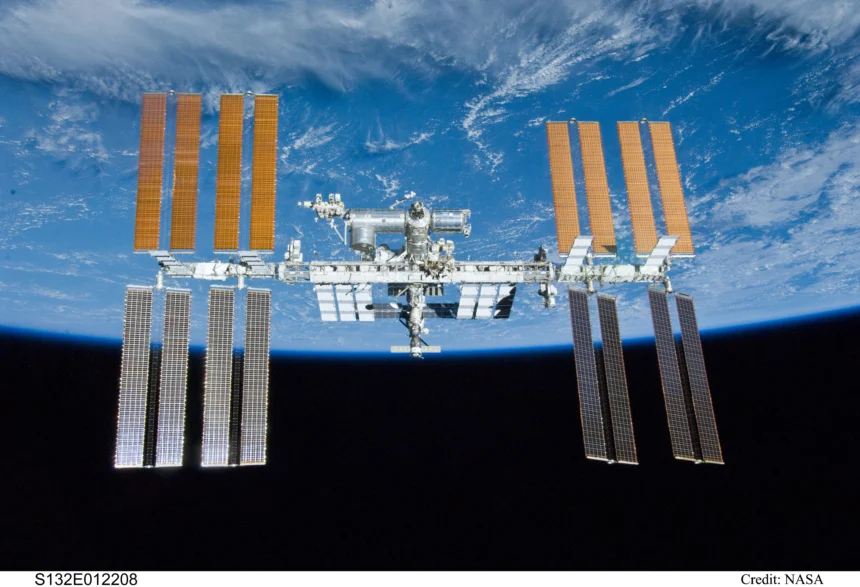
NASA describes the station as approximately 356 feet end to end, just short of the full length of an American football field including the end zones.
What Is the NASA International Space Station?
The NASA International Space Station, usually shortened to ISS, is a permanently crewed research facility in low-Earth orbit operated through an international partnership.
Calling it “NASA’s space station” is convenient, but technically incomplete.
NASA is a major partner, not the sole owner of the entire complex.
Five major space agencies contributed to its construction and operation:
NASA in the United States, Roscosmos in Russia, ESA in Europe, JAXA in Japan and the Canadian Space Agency.
NASA’s station facts describe the ISS as a partnership involving five space agencies and historically 15 participating countries in the original international framework.
Different partners contributed different systems.
The United States provided laboratories, nodes, solar-power infrastructure and many other components.
Russia contributed major modules and propulsion capabilities.
Europe provided the Columbus laboratory and other systems.
Japan developed the Kibo laboratory complex.
Canada supplied robotics including Canadarm2.
This shared architecture makes the NASA International Space Station fundamentally different from an individual spacecraft such as Apollo or Orion.
It was never meant to be built by one launch or one country.
How the International Space Station Began
The origins of the ISS stretch into the Cold War.
The United States had discussed a permanently crewed station for decades, and President Ronald Reagan formally called for a U.S.-led space station in 1984.
Canada, Japan and European partners became involved.
After the Cold War, the architecture changed again.
Russia joined the partnership in the 1990s, bringing extensive experience from its Salyut and Mir space stations.
The resulting ISS combined technologies, modules and operational expertise from former geopolitical rivals.
NASA describes this international merger as the foundation of the modern station program.
That political history makes the NASA International Space Station more than an engineering achievement.
It became one of the longest-running examples of large-scale international cooperation in space.
Zarya: The First ISS Module
The first physical piece of the International Space Station was Zarya.
It launched from the Baikonur Cosmodrome on:
November 20, 1998
Zarya means “sunrise” in Russian.
NASA explains that it was U.S.-funded but Russian-built and initially provided power, communications and orientation control for the emerging station.
At that moment, the ISS was little more than one module orbiting Earth.
Three weeks later, the project became visibly international.
Unity Connects the Station Together
Space Shuttle Endeavour launched the U.S.-built Unity module in December 1998.
On December 6, astronauts used the Shuttle’s robotic arm and spacecraft maneuvering to connect Unity with Zarya.
The remarkable part was that the two major pieces had been designed and constructed thousands of miles apart and had never been physically joined on Earth.
They fit together in orbit.
NASA considers this the beginning of on-orbit station assembly.
Construction then continued for more than a decade.
Modules, laboratories, trusses, solar arrays and equipment arrived aboard Space Shuttles, Russian launch vehicles and other spacecraft.
Humans Move Permanently Into Orbit
The next historic milestone came in 2000.
The Expedition 1 crew consisted of:
William Shepherd of NASA,
Yuri Gidzenko,
and Sergei Krikalev.
They launched from Baikonur on October 31 and docked with the station on:
November 2, 2000.
NASA notes that this date effectively became the last day since then when no humans were living and working in space.
By November 2025, that continuous presence had reached 25 years.
It continued into 2026.
This is arguably one of the greatest achievements of the NASA International Space Station.
The important record is not one individual astronaut remaining in orbit.
It is civilization maintaining an uninterrupted human foothold beyond Earth for more than a quarter century.
How Big Is the International Space Station?
The ISS is difficult to appreciate from photographs because there is little visual scale in space.
NASA says it is approximately:
356 feet or 109 meters long.
Its living environment is often compared with a large house and contains multiple laboratories, crew quarters, bathrooms, exercise equipment and the famous Cupola observation area.
Huge solar arrays extend from the station’s truss.
Eight miles of wiring connect its electrical systems.
The Canadian-built Canadarm2 robotic arm stretches roughly 55 feet and can move equipment, assist with spacecraft operations and support astronauts during some external activities.
The structure did not reach this scale quickly.
NASA says assembly continued for approximately 13 years and required dozens of major flights.
Major International Space Station Modules
The ISS is not one enormous hollow spacecraft.
It is a network of connected pressurized modules and external structures.
Some of the most important include:
| Module / Area | Main Role |
|---|---|
| Zarya | First station element; early power and control |
| Unity | Connecting node |
| Zvezda | Russian service module and living systems |
| Destiny | Main U.S. laboratory |
| Columbus | ESA laboratory |
| Kibo | Japanese laboratory complex |
| Harmony | Connecting node and docking infrastructure |
| Tranquility | Life-support equipment and connections |
| Cupola | Seven-window Earth and robotics observation area |
| Quest | Airlock for spacewalks |
Later modules and commercial elements expanded the architecture further.
NASA says the most recently installed major station module is Russia’s Prichal docking module, added in November 2021.
Why Microgravity Makes the ISS Valuable
The scientific importance of the NASA International Space Station comes largely from microgravity.
The station is not outside Earth’s gravity.
Gravity remains strong at its altitude.
Instead, the ISS and everything inside it are continuously falling around Earth.
The station moves forward so quickly that as it falls, Earth’s curved surface falls away beneath it.
Astronauts and experiments therefore experience persistent free fall.
This produces the floating conditions commonly described as “zero gravity.”
Microgravity allows scientists to study processes differently from laboratories on Earth.
Gravity normally influences:
fluid movement,
heat transfer,
sedimentation,
plant growth,
human bones and muscles,
cell behavior,
combustion
and material formation.
Remove gravity as a dominant factor and researchers can observe effects that are difficult to isolate on the ground.
More Than 4,000 ISS Experiments
The research record has become enormous.
NASA reported after the station’s 25th anniversary that more than 4,000 experiments and technology demonstrations had been conducted, involving more than 5,000 researchers from approximately 110 countries.
The pace remains high.
NASA reported that more than 750 experiments were supported during 2025 alone.
Research includes fields such as:
human physiology,
medical science,
microbiology,
plant biology,
materials,
physics,
combustion,
Earth science,
astronomy,
robotics,
computing,
manufacturing
and life-support technology.
That breadth is why describing the ISS merely as an astronaut residence misses its primary purpose.
It is an orbiting laboratory.
Studying the Human Body in Space
Humans evolved under Earth’s gravity.
Living in microgravity changes the body.
Astronauts can experience:
muscle loss,
bone-density changes,
fluid shifts toward the head,
cardiovascular changes,
vision-related effects,
immune-system changes,
and altered balance.
Scientists monitor astronauts before, during and after their missions.
This provides knowledge important for two very different purposes.
First, it can improve understanding of human physiology and medicine on Earth.
Second, NASA needs to know how to keep astronauts healthy during missions lasting months or potentially years.
This is where the NASA International Space Station directly supports future exploration.
A trip to Mars cannot depend on rapid medical evacuation back to Earth.
Why Astronauts Exercise So Much
Without Earth’s normal gravitational loading, bones and muscles do not have to work as hard.
Astronauts therefore exercise for significant periods almost every day.
The station contains specialized exercise equipment including resistance devices, treadmills and a stationary bicycle.
Exercise helps reduce physical deterioration, although it does not eliminate every physiological effect of microgravity.
This long-duration experience contributes to NASA’s planning for the Moon and Mars.
Growing Plants in Space
Plants are another major area of ISS research.
Experiments investigate how microgravity affects:
roots,
plant direction,
water movement,
growth,
genetics,
and food production.
The long-term reason is obvious.
Future astronauts traveling far from Earth may not be able to depend entirely on packaged food launched years earlier.
Plants could potentially contribute fresh food and psychological benefits while eventually playing a role in more closed-loop life-support systems.
The station has therefore become a practical laboratory for learning how biological systems behave away from Earth.
Recycling Water on the International Space Station
One of the most important engineering lessons from the ISS involves something far less glamorous than rockets:
water.
Launching water from Earth is expensive.
Future Mars crews cannot simply request a continuous supply convoy.
NASA therefore needs life-support systems that recycle as much water as possible.
The ISS Environmental Control and Life Support System collects moisture from cabin air and processes wastewater, including water recovered from urine.
NASA announced in 2023 that station technology demonstrated approximately 98% total water recovery, reaching a major target for future deep-space exploration systems.
That means roughly 98 pounds of every 100 pounds of recoverable water can continue circulating through the system instead of needing complete replacement from Earth.
This is one of the clearest examples of how the NASA International Space Station helps prepare technology for Mars.
How Astronauts Breathe in Orbit
The station also has to continuously manage its atmosphere.
NASA’s Environmental Control and Life Support System controls:
oxygen,
carbon dioxide,
air circulation,
contaminants,
pressure,
water
and waste.
An Oxygen Generation System can split water using electrolysis.
This produces oxygen for the cabin and hydrogen as a byproduct.
Other equipment removes carbon dioxide breathed out by the crew.
The result is a partially regenerative life-support system.
Developing increasingly closed systems is essential because missions farther from Earth cannot depend on continuous resupply.
Space Station Robotics
Robotics are fundamental to ISS operations.
Canada’s Canadarm2 has helped move equipment, capture visiting spacecraft and support station maintenance.
The station has also hosted smaller experimental robots.
NASA’s Astrobee free-flying robots, for example, help researchers test autonomous robotic technologies inside the station.
Robots become more important as human missions move farther away.
A future lunar outpost may need robotic systems that continue working while no astronauts are present.
A Mars mission may face communication delays that make real-time remote control impossible.
The ISS therefore provides an operational environment where human-robot interaction can be developed before much harder missions begin.
For the larger role of autonomous machines, read Robotics Explained: Complete Guide.
Powering the NASA International Space Station
The ISS depends primarily on solar power.
Its large solar arrays convert sunlight into electricity.
Batteries maintain power while the station passes through Earth’s shadow.
NASA has upgraded the aging original power system with ISS Roll-Out Solar Arrays, known as iROSAs.
Six were installed between 2021 and 2023, and NASA says they increased available station power by approximately 20% to 30%.
This upgrade is another example of treating the station as an evolving spacecraft rather than a finished structure.
Major hardware has been repaired, replaced or augmented throughout its life.
Spacewalks Keep the Station Alive
A spacecraft operating for decades requires external maintenance.
Astronauts and cosmonauts perform spacewalks to:
repair systems,
install hardware,
upgrade equipment,
manage cables,
prepare docking infrastructure
and maintain station components.
NASA reports that more than 260 spacewalks have been conducted for station assembly, maintenance and reconfiguration.
Spacewalking remains one of the most dangerous routine activities in human spaceflight.
Astronauts must work inside their own miniature spacecraft, the spacesuit, while moving outside an orbital facility traveling at thousands of miles per hour.
How Astronauts Reach the ISS
Transport to the station has changed dramatically during its history.
The Space Shuttle was essential during assembly.
Russian Soyuz spacecraft have carried crews for decades.
After the Shuttle retired in 2011, the United States temporarily lost its independent ability to launch astronauts from U.S. territory.
That changed with NASA’s Commercial Crew Program.
SpaceX Crew Dragon began carrying NASA astronauts in 2020.
The transition demonstrated a new model in which NASA purchases transportation services from commercial providers rather than designing and operating every spacecraft itself.
That commercial model is now central to NASA’s post-ISS plans.
How Cargo Reaches the Station
Crew members cannot live in orbit without a continuous logistics network.
Cargo spacecraft deliver:
food,
clothing,
scientific equipment,
replacement hardware,
experiments
and other supplies.
Different vehicles have supported the station throughout its history, including SpaceX Dragon, Cygnus, Russian Progress vehicles and Japanese cargo spacecraft.
NASA’s station facts note that multiple visiting spacecraft can be attached to the ISS simultaneously.
Regular resupply missions also carry experiments back and forth, making the ISS far more scientifically flexible than a robotic satellite that can never return samples to Earth.
Observing Earth From the ISS
Looking downward is another important scientific role.
The station’s orbital path carries it over regions containing the vast majority of Earth’s population.
Astronauts have taken millions of photographs.
External instruments study:
atmosphere,
weather phenomena,
oceans,
vegetation,
nighttime lights,
disasters
and environmental change.
NASA notes that the ISS orbits roughly 250 miles above Earth, making it useful for repeated observations of the planet.
Earth observation also has an educational benefit.
The Cupola’s seven windows have produced some of the most recognizable images of Earth ever taken by astronauts.
The International Partnership
Few scientific projects have required cooperation on the scale of the NASA International Space Station.
Major hardware was designed in different countries.
Astronauts train across international facilities.
Mission control responsibilities are distributed.
Russian and U.S. segments are technically interconnected.
Europe, Japan and Canada operate major hardware and research systems.
For decades, crews have included people with different languages, cultures and national spaceflight traditions.
The partnership has continued despite political conflicts on Earth.
That does not remove disagreements or operational challenges.
But it makes the ISS a rare example of sustained scientific cooperation under difficult geopolitical conditions.
Why the ISS Matters to Artemis
NASA’s human exploration strategy is now focused increasingly on the Moon through Artemis.
That does not make the ISS irrelevant.
The station has spent decades teaching NASA how to support humans in space for long periods.
Technologies demonstrated aboard the NASA International Space Station include:
water recycling,
air management,
solar-power systems,
robotics,
3D printing,
medical monitoring,
autonomous operations
and long-duration human health countermeasures.
NASA explicitly describes the station as a proving ground for technologies supporting Artemis, future lunar exploration and eventually Mars.
For NASA’s lunar architecture, read NASA Artemis Program Explained.
How the ISS Helps Prepare for Mars
Mars makes the lessons even more important.
A lunar crew may be only days away from Earth.
A Mars crew could be months away.
Mars missions therefore require much greater independence.
Water must be recycled.
Equipment must be repairable.
Medical problems may need to be handled without immediate return.
Computers and robots must operate more autonomously.
Food and life-support systems must last longer.
Crew psychology becomes increasingly important.
The ISS cannot reproduce every aspect of a Mars mission because astronauts remain protected by part of Earth’s magnetic environment and can receive frequent resupply.
But it is still the longest-running laboratory NASA has for understanding what happens when people live continuously in space.
For NASA’s robotic Red Planet program, read NASA Mars Missions Explained.
Scientific Benefits on Earth
Not every ISS experiment is designed for future astronauts.
NASA emphasizes benefits involving:
medical research,
protein structures,
tissue models,
materials,
robotics,
Earth observations
and advanced manufacturing.
Microgravity can change how cells grow or how crystals form.
That can give researchers different ways to study biological and chemical processes.
Some station technologies also produce lessons for systems used on Earth.
The scientific value should not be exaggerated into claims that every ISS experiment produces a revolutionary consumer product.
The stronger argument is that the station provides a unique environment in which researchers can perform experiments unavailable in conventional Earth laboratories.
Twenty-Five Years of Research
The 25-year milestone in 2025 provides a useful measure of the program’s scale.
NASA reported:
| Research Metric | Approximate Total |
|---|---|
| Experiments and demonstrations | 4,000+ |
| Researchers involved | 5,000+ |
| Countries represented in research | 110+ |
| Scientific publications | 5,000+ |
| Scientific citations | 100,000+ |
Those statistics distinguish the NASA International Space Station from shorter human-spaceflight missions.
The station’s scientific value comes from repetition.
Researchers can build one experiment on results from another.
New instruments can be installed.
Crew members can perform work that robotic satellites cannot.
Experiments can run for years.
Why the International Space Station Cannot Operate Forever
The ISS is durable, but it was never designed to last indefinitely.
The structure experiences:
thermal cycles,
spacecraft dockings,
thruster loads,
radiation,
micrometeoroid exposure,
atomic oxygen,
and the general wear associated with decades in orbit.
NASA explains that the limiting factor is not simply whether one computer or solar panel can be replaced.
Major structural elements such as modules, radiators and trusses experience accumulated dynamic and thermal stress.
Replacing the entire primary structure would effectively mean building a new station.
NASA therefore plans a controlled transition rather than assuming the ISS can remain operational forever.
Is the International Space Station Retiring in 2030?
NASA currently remains committed to operating the station through:
2030
The United States, Canada, Japan and participating ESA nations have committed to operations through 2030, while Russia currently plans to extend its segment’s participation through 2030 as well. NASA’s ISS FAQ was updated with this status in August 2026.
That does not necessarily mean the station will disappear on January 1, 2031.
“Through 2030” describes the current operating commitment.
The exact retirement and deorbit sequence will depend on station conditions, partner decisions and the readiness of the systems required for a safe disposal.
Why NASA Cannot Simply Leave the ISS in Orbit
The station is enormous.
Its orbit is low enough that atmospheric drag slowly reduces its altitude.
Regular boosts help maintain its orbit.
If the station were simply abandoned, its orbit would eventually decay unpredictably.
Most of the structure would burn during atmospheric re-entry, but some hardware could potentially survive to the surface.
An uncontrolled re-entry would therefore create unnecessary risk.
NASA and its international partners intend to deliberately guide the station into a remote ocean region.
SpaceX and the U.S. Deorbit Vehicle
NASA selected SpaceX in 2024 to develop and deliver the U.S. Deorbit Vehicle.
The spacecraft is intended to provide the propulsive capability needed to help guide the enormous station through a controlled final descent after station operations end.
The plan is fundamentally different from blowing up the station or simply allowing it to fall.
NASA wants to control:
when it re-enters,
where its trajectory passes,
and where surviving debris is directed.
The target will be an unpopulated remote ocean region to minimize risk.
The deorbit vehicle therefore represents one of the final engineering projects of the NASA International Space Station era.
What Comes After the ISS?
NASA does not want its research activity in low-Earth orbit to end when the ISS retires.
Instead, the agency wants to change its business model.
The future concept is:
commercial companies own and operate stations.
NASA buys the research space, crew time and other services it needs.
Other governments, companies, universities and private customers could purchase services too.
NASA calls this the Commercial Low Earth Orbit Development Program.
The objective is similar to what NASA has already done with cargo and crew transportation.
Instead of NASA owning every element of the infrastructure, private industry provides more of the service.
NASA Wants to Become a Customer, Not the Sole Operator
This is the most important concept in the post-ISS strategy.
NASA has explained that it wants to become one of many customers of future commercial low-Earth-orbit destinations.
That could allow NASA to spend fewer resources owning and maintaining its own Earth-orbiting station.
The agency could then direct more of its human-spaceflight budget toward:
Artemis,
lunar exploration,
deep-space technology,
and eventually Mars.
Commercial stations would preserve access to microgravity research closer to Earth.
If successful, the change would mark one of the biggest transitions in the history of human spaceflight.
Could There Be a Gap After the ISS?
Yes.
NASA wants a seamless transition, but commercial stations must actually become operational before the ISS disappears if continuous U.S. access to a crewed low-Earth-orbit research platform is to be maintained.
That remains a significant program risk.
Designing a space station is difficult.
Financing one commercially is also difficult.
Companies need customers beyond NASA for a genuinely independent market to develop.
NASA therefore supports commercial destinations now rather than waiting until 2030 to begin the transition.
The success or failure of this transition could determine whether the ISS becomes the end of one era or the foundation of a much larger low-Earth-orbit economy.
NASA International Space Station Timeline
| Year | Major Milestone |
|---|---|
| 1984 | U.S. space station initiative announced |
| 1990s | International architecture expands, including Russia |
| Nov. 20, 1998 | Zarya launches |
| Dec. 1998 | Unity connects with Zarya |
| Nov. 2, 2000 | Expedition 1 arrives |
| 2001 | Destiny laboratory added |
| 2008 | Columbus and major Kibo elements added |
| 2010 | Tranquility and Cupola installed |
| 2011 | Space Shuttle era ends |
| 2020 | Commercial Crew begins carrying NASA astronauts |
| 2021–2023 | New roll-out solar arrays upgrade station power |
| 2025 | 25 years of continuous human presence |
| 2026 | ISS remains active research laboratory |
| Through 2030 | Current NASA operating commitment |
| After operations | Controlled deorbit planned |
| Future | NASA transitions toward commercial LEO stations |
Frequently Asked Questions About the NASA International Space Station
What is the NASA International Space Station?
The NASA International Space Station is a continuously crewed research laboratory in low-Earth orbit operated through a partnership involving NASA, Roscosmos, ESA, JAXA and the Canadian Space Agency.
When was the International Space Station launched?
The first ISS component, Zarya, launched on November 20, 1998.
When did astronauts begin living permanently on the ISS?
Expedition 1 arrived on November 2, 2000, beginning the period of continuous human occupation that continues today.
How high is the International Space Station?
The station generally orbits approximately 250 miles, or around 400 kilometers, above Earth.
How fast does the ISS travel?
NASA lists its orbital speed at approximately 17,500 miles per hour, or roughly five miles every second.
How often does the ISS orbit Earth?
It completes one orbit roughly every 90 minutes, making around 16 orbits each day.
How many people have visited the International Space Station?
By 2026, NASA reported that more than 290 people from 26 countries had visited.
How many experiments have been performed on the ISS?
More than 4,000 research investigations and technology demonstrations had been conducted by the station’s 25-year human-presence milestone.
Does NASA recycle urine into drinking water?
The station’s life-support system recovers water from multiple wastewater sources, including processed urine. NASA demonstrated approximately 98% overall water recovery, an important milestone for future deep-space life-support systems.
Will the International Space Station retire in 2030?
NASA and its partners currently plan station operations through 2030. The exact retirement and deorbit sequence will depend on future operational and technical decisions.
How will NASA destroy the ISS?
NASA plans a controlled deorbit rather than uncontrolled destruction. SpaceX is developing a U.S. Deorbit Vehicle intended to help guide the station into a remote ocean region after operations end.
What will replace the International Space Station?
NASA wants commercially owned and operated low-Earth-orbit stations to provide future research and astronaut services. NASA plans to purchase services rather than own the entire replacement platform.
Conclusion: The NASA International Space Station Changed What It Means to Live in Space
The NASA International Space Station began as separate pieces built in different countries.
Zarya launched first.
Unity followed.
Astronauts connected them in orbit.
Then more modules arrived.
More laboratories.
Solar arrays.
Robotic systems.
Docking ports.
Life-support equipment.
By November 2000, the station was ready for permanent residents.
Humans moved in.
And they never completely left.
That uninterrupted presence has now lasted for more than 25 years.
During that time, the ISS became much more than the collection of modules launched in the late 1990s and 2000s.
It became a laboratory where researchers learned what microgravity does to humans, plants, materials, fluids and biological systems.
It became a test site for technologies designed for journeys much farther from Earth.
It became a proving ground for water recycling.
NASA demonstrated a system capable of recovering approximately 98% of available water, an efficiency considered highly important for future deep-space missions.
It became a robotics laboratory.
A medical laboratory.
An Earth-observation platform.
A technology demonstrator.
A destination for government astronauts and commercial missions.
And one of the world’s longest-running international science partnerships.
The numbers show the scale.
More than 290 visitors from 26 countries.
More than 4,000 investigations and demonstrations.
More than 5,000 researchers from more than 110 countries.
Thousands of scientific publications.
But perhaps the most important contribution of the NASA International Space Station is harder to reduce to one number.
It normalized living in space.
Before the ISS, human spaceflight largely consisted of missions with clear beginnings and endings.
Launch.
Complete the mission.
Return home.
The station created a different model.
Space became somewhere people continuously lived and worked.
Crews arrived while other crews departed.
Hardware was repaired instead of abandoning the spacecraft.
Experiments continued across expeditions.
The station became infrastructure.
That is why its influence reaches directly into NASA’s future.
The NASA Artemis Program is moving human exploration back toward the Moon.
Future missions will require stronger life-support systems, robotics, power technology, medical knowledge and crew experience.
Mars would make those requirements even more demanding.
The ISS has spent decades developing that knowledge.
NASA explicitly identifies station technology and research as part of the preparation for Artemis and future Mars exploration.
Yet even successful infrastructure eventually reaches the end of its engineering life.
NASA currently plans to operate the station through 2030.
After that, the agency does not intend to abandon an enormous spacecraft and hope it falls safely.
SpaceX is developing a specialized U.S. Deorbit Vehicle.
The station will eventually be guided toward a controlled re-entry over a remote region of ocean.
That will be an extraordinary moment.
Something built through decades of launches and hundreds of spacewalks will disappear into Earth’s atmosphere.
But the end of the physical station should not be confused with the end of what it created.
NASA wants commercial space stations to inherit the low-Earth-orbit research role.
Private companies would own more of the infrastructure.
NASA would purchase services.
Other customers could do the same.
The model would shift from:
government owns the station
to:
government becomes one customer in a larger orbital economy.
Whether that transition succeeds is still uncertain.
Commercial stations must be financed.
Built.
Launched.
Certified.
And capable of sustaining people safely.
But if it works, the greatest legacy of the NASA International Space Station may be that it made its own replacement possible.
It proved humans can maintain a permanently occupied research platform in orbit.
It taught agencies how international crews can live together.
It helped private companies learn how to deliver cargo and astronauts.
It produced decades of data about the human body in space.
And it helped transform low-Earth orbit from a destination visited occasionally into an environment where people continuously work.
The ISS will not last forever.
Its influence will.
For the complete NASA entity guide, read NASA Explained.
For the historical path from NASA’s founding through Apollo, Shuttle and the ISS era, read NASA History Explained.
For NASA’s return to lunar human exploration, continue with NASA Artemis Program Explained.
For the robotic exploration preparing knowledge about humanity’s longer-term destination, read NASA Mars Missions Explained.
For NASA’s major observatories beyond Earth, see NASA Space Telescopes Explained.
Follow The News Ink
Stay connected with The News Ink for technology, science, space exploration and global coverage:
X
Pinterest
Medium
Quora
TikTok
Instagram
Substack
Threads
Bluesky
Mastodon