




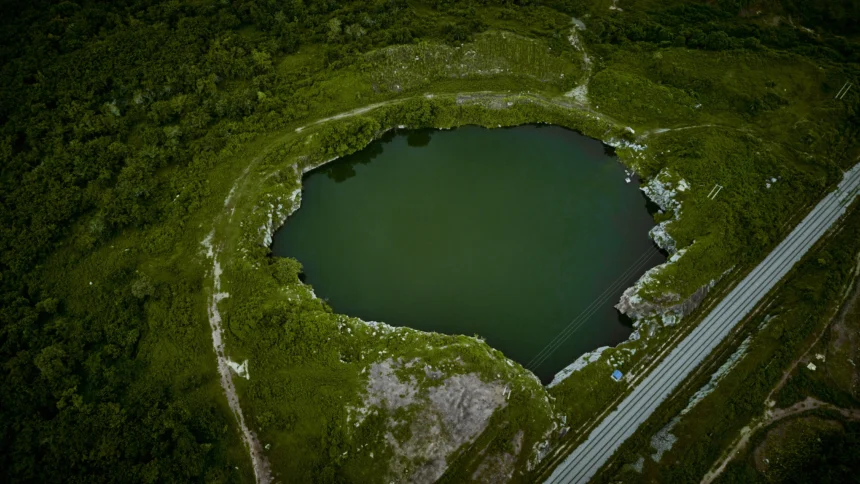
Real Places on Earth That Scientists Still Struggle to Explain
Science has explained an extraordinary number of things that once looked impossible.
Rocks that seemed to move by themselves across California’s Racetrack Playa were eventually caught moving when thin sheets of ice and wind pushed them across wet mud.
The strange red water flowing from Antarctica’s Blood Falls is now understood to come from iron-rich brine that oxidizes when exposed to air.
Lightning over Venezuela’s Lake Maracaibo is not supernatural; geography, moisture and converging winds help create exceptionally frequent thunderstorms.
Yet genuine unexplained places on Earth still exist.
“Unexplained” needs an important qualification.
Scientists usually know something about these places.
Researchers may know what a formation is made from, approximately when it appeared, which physical processes are possible and which popular explanations are almost certainly wrong.
What remains uncertain is often the exact mechanism.
Two scientific explanations may fit much of the evidence.
A geological event may have destroyed the clues needed to reconstruct its own history.
A phenomenon may occur too unpredictably to measure easily.
Or new data may overturn an explanation that once appeared settled.
That is what makes the best unexplained places on Earth more interesting than supernatural stories.
There are real observations.
Real measurements.
Real peer-reviewed research.
And still, in some cases, no final answer.
Eight Unexplained Places on Earth at a Glance
| Place | Location | What Scientists Know | What Remains Uncertain |
|---|---|---|---|
| Namib Fairy Circles | Namibia and nearby southern Africa | Regular bare patches occur in arid grassland | Termites vs plant self-organization and water competition |
| Hessdalen Valley | Norway | Recurrent lights have been instrumentally recorded | Physical mechanism behind genuine anomalous lights |
| Mima Mounds | Washington, USA | Thousands of soil mounds occur on glacial landscapes | Exact mound-forming process |
| Devils Tower | Wyoming, USA | Tower is an exposed igneous intrusion | Exact shape and emplacement mechanism |
| Great Unconformity | Grand Canyon and worldwide | Vast intervals of geological history were erased | Relative roles of tectonics, erosion and ancient glaciation |
| Yamal Craters | Siberian Arctic | Gas pressure causes explosive crater formation | Exact pressure-building mechanism and triggers |
| Don Juan Pond | Antarctica | Extremely salty calcium-chloride brine keeps it liquid | Relative importance of shallow versus deep water sources |
| Patom Crater | Siberia | Young cone consists largely of local broken rock | Exact process that created the structure |
These are not eight places where scientists know nothing.
They are eight unexplained places on Earth where the final piece of the story remains contested, incomplete or actively under investigation.
1. Namibia’s Fairy Circles
Fly above parts of the Namib Desert and the landscape appears covered in polka dots.
Thousands upon thousands of almost circular bare patches interrupt otherwise sparse grassland.
Each empty circle is often surrounded by taller grass.
Even stranger, the circles can be remarkably regularly spaced.
These are the famous Namib fairy circles.
Despite the name, serious researchers are not proposing fairies.
The real scientific debate has persisted for decades.
Two explanations dominate.
Theory One: Termites Engineer the Circles
One hypothesis argues that sand termites remove vegetation and alter soil conditions beneath each circle.
By killing grass within a territory, termites may create reservoirs of relatively moist soil while neighboring colonies help produce the regular spacing.
The explanation has substantial field evidence.
Termites are frequently found around fairy circles, and researchers have documented damage consistent with termite activity.
Theory Two: Plants Organize Themselves
Another group of scientists argues that the pattern emerges primarily through competition for scarce water.
Grass surrounding one area draws water away from neighboring soil.
Under certain environmental conditions, mathematical models predict that vegetation-water feedback can spontaneously produce regularly spaced gaps remarkably similar to real fairy circles.
A major 2025 scientific review concluded that the argument is still unresolved. Termites and vegetation self-organization remain the leading explanations, but both have weaknesses that require experimental testing.
The 2025 review of fairy-circle research specifically called for experiments manipulating termites, soil water and nutrients rather than relying only on correlations.
That puts Namibia firmly among the strongest unexplained places on Earth.
Scientists understand the ecology.
They can reproduce aspects of the pattern mathematically.
They can identify organisms associated with it.
They still disagree about what is doing most of the work.
The News Ink’s article on places where it almost never rains explains why the Namib’s extreme shortage of rainfall makes competition for water such a powerful ecological force.
2. The Hessdalen Lights, Norway
Hessdalen is a small valley in central Norway.
It became internationally famous for something that appears above it.
Lights.
Residents reported an unusually intense wave of luminous phenomena during the early 1980s, sometimes seeing lights repeatedly during a single week.
They have been described as:
white;
yellow;
red;
stationary;
slow moving;
or rapidly changing.
This is exactly the kind of story that attracts UFO mythology.
But Hessdalen differs from most internet stories about mysterious lights because researchers actually installed instruments.
Cameras, radar, spectrometers and electromagnetic equipment have been used there for decades.
A 2024 study in the Journal of Applied Geophysics mapped conductive structures beneath the valley and found mineral-rich zones that could be relevant to whatever process generates some of the luminous events. The authors suggested that local geology may help create conditions favorable to the phenomenon, but they did not establish a complete mechanism.
The 2024 Hessdalen geophysical study is particularly useful because it demonstrates why Hessdalen belongs among credible unexplained places on Earth rather than paranormal folklore.
There are hypotheses.
Researchers have proposed:
ionized dust;
plasma;
combustion-like processes;
electrical effects related to rocks and minerals.
Some reported lights also undoubtedly have ordinary explanations such as:
aircraft;
astronomical objects;
vehicles;
atmospheric optical effects.
That distinction matters.
Scientists do not need every light reported in Hessdalen to represent one mysterious process.
The interesting question is whether the best-instrumented residual events share a physical mechanism—and what that mechanism is.
Research is still continuing in the valley in 2026.
3. The Mima Mounds, Washington
South of Olympia in Washington State lies a prairie covered by thousands of small rounded earth mounds.
They are known as the Mima Mounds.
Many are roughly chest-high.
Viewed from above, they produce an irregular but unmistakable pattern across the landscape.
For more than a century, scientists have argued about how they formed.
Washington’s Department of Natural Resources still describes multiple possibilities, including processes involving:
burrowing animals;
earthquake-related effects;
soil expansion and contraction;
and the unusual glacial deposits beneath the prairie.
Washington Geological Survey’s overview of the Mima Mounds openly states that several theories remain.
The Gopher Hypothesis
Pocket gophers have received enormous attention.
Computer models have shown that generations of territorial burrowing animals can theoretically push soil into mound-like patterns.
The idea is attractive because similar-looking structures elsewhere have biological origins.
But not every observation fits perfectly.
Geological Alternatives
Other proposals involve:
runoff and erosion;
shrinking or expanding soils;
ancient permafrost processes;
glacial environments.
An extensive Washington review concluded that no single proposed mechanism explains every Mima-like mound field around the world.
That is the recurring pattern among unexplained places on Earth.
A plausible mechanism is not necessarily a proven mechanism.
The Mima Mounds Natural Area remains an active research site, not simply a curiosity whose answer has been lost in an old textbook.
4. Devils Tower, Wyoming
Devils Tower rises almost vertically from northeastern Wyoming.
Its enormous rock columns look so geometrically strange that the formation seems almost artificial.
Geologists know a great deal about it.
The tower consists of an igneous rock called phonolite porphyry.
Molten material moved upward underground roughly 50 million years ago.
It cooled.
The surrounding sedimentary rock eventually eroded away.
What remains is the spectacular tower.
So where is the mystery?
Scientists still disagree on exactly what the original underground body was.
The National Park Service says geologists continue to debate whether Devils Tower formed as:
a small intrusive stock;
part of a laccolith;
a volcanic neck or plug;
or a structure associated with a maar-diatreme volcanic system.
NPS’s explanation of Devils Tower’s formation states directly that the broad geological story is understood while details of the magma’s emplacement remain unresolved.
That makes Devils Tower one of the best examples of how unexplained places on Earth can be only partly mysterious.
Nobody needs aliens to explain the columns.
Cooling magma naturally contracts and fractures.
The puzzle is reconstructing what existed around the tower millions of years ago before erosion removed much of the evidence.
There is also an important cultural dimension.
Devils Tower is sacred to multiple Indigenous peoples of the region and is known by traditional names connected with long-standing oral histories. Those cultural traditions deserve respect in their own right; they are not simply alternative scientific hypotheses to be “tested” against geology.
Readers interested in how landscapes preserve deep layers of human and geological history can explore The News Ink’s Historical Travel guide.
5. The Great Unconformity in the Grand Canyon
One of the biggest mysteries on this list is not an object.
It is something missing.
At places inside the Grand Canyon, relatively young sedimentary rock rests directly on rock that is more than a billion years older.
The layers representing an enormous interval of Earth’s history are gone.
Geologists call this boundary the Great Unconformity.
Similar gaps occur across multiple continents.
Charles Darwin was already aware that Earth’s geological record contained enormous missing intervals.
What removed so much rock became one of geology’s great questions.
A landmark Nature study argued that widespread erosion associated with the Great Unconformity radically altered ocean chemistry and may even have helped set conditions for the Cambrian diversification of animal life. The Nature study described a long episode of continental denudation before later seas flooded the continents.
But what drove the erosion?
For years, one influential idea involved Snowball Earth.
During episodes of extreme Neoproterozoic glaciation, vast ice sheets may have scraped enormous quantities of continental rock away.
Other researchers emphasized:
tectonic uplift;
breakup of the supercontinent Rodinia;
regional erosion occurring at different times.
The debate changed again in 2026.
A new study published in Proceedings of the National Academy of Sciences argued that tectonism rather than global Snowball Earth glaciation was the dominant driver in creating the Great Unconformity. The 2026 PNAS study adds important evidence but does not make every unconformity worldwide identical.
The Grand Canyon therefore contains one of the most intellectually impressive unexplained places on Earth.
The mystery is a missing archive.
Scientists are trying to reconstruct events using the fragments that erosion failed to destroy.
6. The Exploding Craters of the Yamal Peninsula
In 2014, an enormous hole appeared in Siberia’s Yamal Peninsula.
Its steep walls descended into Arctic permafrost.
More craters were subsequently identified in northern Russia.
They initially inspired speculation about:
meteorites;
underground explosions;
strange geological collapse.
Scientists quickly established that pressurized gas was central to the phenomenon.
The harder question has been exactly how that pressure builds until the frozen ground explosively fails.
One model proposed that a subsurface body of unfrozen ground became sealed as surrounding permafrost refroze. Pressure accumulated until the system ruptured catastrophically.
A newer 2024 study proposed a different mechanism involving warming, osmotic movement of water into salty underground layers, fracturing of overlying permafrost and destabilization of methane hydrates.
The American Geophysical Union described the work as a new explanation because ordinary permafrost warming alone could not account for the required explosion pressure. AGU’s summary of the Yamal crater research explains the pressure-building model in detail.
The broad outline is no longer mysterious:
gas + pressure + frozen ground → explosive failure.
The unresolved part is the underground sequence responsible for each crater and the conditions that determine when and where another one forms.
That is why Yamal belongs among unexplained places on Earth without being genuinely inexplicable.
The mystery is becoming narrower as measurements improve.
The phenomenon also illustrates why permafrost matters in a warming climate. The News Ink’s Climate Change guide explains how rising temperatures can alter frozen ground, water cycles and other environmental systems.
7. Don Juan Pond, Antarctica
Antarctica’s McMurdo Dry Valleys already look alien.
They receive extraordinarily little precipitation.
Much of the landscape contains exposed rock rather than permanent snow.
Then there is Don Juan Pond.
It is an extremely shallow body of water containing astonishingly concentrated calcium-chloride brine.
Its salt concentration can approach roughly 40% by mass.
That chemistry lowers the freezing point so dramatically that liquid brine can persist at temperatures at which ordinary freshwater would be completely frozen.
Scientists understand the basic chemistry.
What has generated debate is where the unusual calcium-chloride-rich water comes from.
A 2013 Scientific Reports study used time-lapse observations and argued that shallow processes—including salty water moving above permafrost and water absorbed from atmospheric moisture—could explain important inputs to the pond. The researchers did not observe the deep groundwater inflow favored by older models. The 2013 Don Juan Pond study supported a near-surface explanation.
Then another team revisited the chemistry.
A 2017 study in Earth and Planetary Science Letters concluded that the chemical composition fits deep groundwater much better than shallow sources and proposed a regional subsurface flow system feeding the pond. The 2017 geochemistry study explicitly challenged the shallow-source model.
That scientific disagreement is exactly why Don Juan Pond belongs among unexplained places on Earth.
Scientists are not debating whether the pond exists or why salt lowers its freezing point.
They are debating the hidden plumbing beneath one of Earth’s harshest deserts.
Because the Dry Valleys resemble some Martian environments, Don Juan Pond has also been studied as an analogue for salty liquid water on other worlds.
The News Ink’s Space and Astronomy guide explores why extreme environments on Earth frequently become laboratories for understanding conditions elsewhere in the Solar System.
8. Patom Crater, Siberia
Deep in eastern Siberia stands one of the strangest geological structures on this list.
The Patom Crater, or Patomskiy Crater, is not shaped like an ordinary impact crater.
It resembles a large cone made from broken limestone, with an annular depression and another mound near its center.
It was documented scientifically in 1949.
The first obvious hypothesis was a meteorite impact.
Later studies found no convincing meteoritic material.
That moved attention toward processes originating beneath Earth’s surface.
Researchers have proposed:
deep gas or fluid eruptions;
hydrothermal processes;
explosive degassing;
frost-related deformation.
A 2023 ground-penetrating-radar investigation detected a water-saturated vertical feature beneath the central portion of the structure. The authors concluded that several formation pathways remained plausible, including processes involving fracturing and subsequent frost heaving. The 2023 Patom Crater geophysical study added new subsurface information without delivering a universally accepted final mechanism.
Earlier geological and geochemical research favored an endogenous process involving fluids rising from depth rather than a meteorite.
Yet the structure remains unusual enough that the precise sequence of events is still disputed.
Patom is therefore one of the more literal unexplained places on Earth:
researchers can stand on the rocks.
Measure the rocks.
Image below them.
Estimate their age.
And still argue about exactly what happened there.
Why Are Some Places So Difficult to Explain?
The difficulty often has nothing to do with the phenomenon being supernatural.
Nature destroys evidence.
Geological Evidence Disappears
Devils Tower probably once existed beneath large quantities of material that have since eroded away.
Scientists cannot inspect rock that no longer exists.
Events Can Be Rare
A Yamal crater forms catastrophically.
Researchers normally arrive afterward.
Reconstructing the pressure system from the resulting hole is much harder than observing the entire process.
Some Phenomena Are Unpredictable
Hessdalen lights do not appear on command.
A researcher cannot simply schedule one for Tuesday afternoon and point every instrument toward it.
Different Processes Can Produce Similar Results
Termites can create vegetation gaps.
So can plant-water feedback.
Both could potentially operate together.
Hidden Systems Are Hard to Measure
Scientists studying Don Juan Pond cannot casually excavate kilometers of Antarctic subsurface simply to map every pathway followed by brine.
Uncertainty therefore does not mean science has failed.
Often it reflects the difficulty of reconstructing complex natural systems from incomplete evidence.
Scientific Mystery Does Not Mean “Anything Is Possible”
This distinction is crucial when discussing unexplained places on Earth.
If scientists have not fully explained a phenomenon, that does not make every proposed explanation equally reasonable.
Take Patom Crater.
A meteorite hypothesis can be tested by looking for:
shock effects;
meteoritic chemistry;
impact geometry.
If those signatures are missing, confidence in the impact explanation falls.
Likewise, Hessdalen researchers can identify airplanes, astronomical sources and other ordinary lights and remove those from the genuinely unusual observations.
Science narrows possibilities.
An unanswered question does not create unlimited possibilities.
It creates a smaller set of explanations waiting for better evidence.
Some Famous “Mysteries” No Longer Belong on This List
Many articles about unexplained places on Earth repeat mysteries that science has largely solved.
Racetrack Playa’s Moving Rocks
The rocks really move.
Researchers directly observed thin floating ice panels driven by light winds pushing rocks across shallow water and leaving trails in soft mud.
No mysterious magnetic force is required.
Blood Falls, Antarctica
Its red color is produced when iron-rich salty water reaches the surface and iron oxidizes.
Lake Maracaibo’s Lightning
The frequency is remarkable, but researchers have identified the major ingredients: warm lake water, moisture and local wind convergence influenced by surrounding mountains.
Peru’s Boiling River
The Amazonian thermal river is extraordinary, but its heat is understood as a non-volcanic geothermal system in which water circulates deep underground, heats and returns along fault pathways.
Removing solved mysteries actually makes the remaining unexplained places on Earth more interesting.
The goal should not be preserving mystery.
The goal should be finding the answer.
Why Scientists Sometimes Disagree for Decades
Scientific disagreement is not necessarily a weakness.
Consider Namibia’s fairy circles.
Researchers supporting termite explanations have collected one set of observations.
Researchers supporting plant self-organization have collected another.
Both groups publish data.
Other scientists review it.
New experiments are proposed.
Eventually, one explanation may outperform the other—or the answer may turn out to involve both.
That process can take decades.
Nature does not owe scientists a simple mechanism.
Complex ecosystems may contain multiple causes operating simultaneously.
Geology can preserve only fragments of an event.
Atmospheric phenomena can depend on extremely specific conditions.
The most interesting unexplained places on Earth often sit exactly at those boundaries where several scientific disciplines overlap.
Extreme Environments Create Particularly Difficult Mysteries
Several locations on this list are unusually difficult to study simply because reaching them is hard.
Antarctica.
Arctic Siberia.
Remote parts of Namibia.
Deep wilderness in eastern Russia.
Scientific instruments must survive the same environment researchers are attempting to measure.
This is why exploration technology matters.
Remote sensing.
Satellite imagery.
Ground-penetrating radar.
Automated cameras.
Geochemical analysis.
Genetic testing.
Computer models.
Each reveals another part of the puzzle.
The News Ink’s article on life in the Challenger Deep shows the same challenge at the bottom of the ocean: sometimes the biggest barrier to understanding a place is simply obtaining reliable measurements from it.
Could AI Help Solve Unexplained Places?
Increasingly, yes—but not by magically producing answers.
Machine learning can help researchers search enormous datasets for patterns involving:
satellite imagery;
seismic measurements;
weather records;
chemical signatures;
camera observations.
For fairy circles, algorithms can quantify patterns across enormous landscapes.
For atmospheric lights, computer vision can help classify routine aircraft or celestial objects.
For Arctic craters, satellite archives can reveal terrain changes that occurred before an explosion was noticed.
But AI still depends on high-quality observations.
A model cannot reconstruct evidence that erosion destroyed hundreds of millions of years ago.
Technology improves the questions scientists can ask.
Nature still has to provide enough clues.
Frequently Asked Questions
Are there really unexplained places on Earth?
Yes. There are unexplained places on Earth where the broad science is understood but the precise mechanism remains debated. Examples include Namibia’s fairy circles, the Mima Mounds, Hessdalen lights and Patom Crater.
What is the most scientifically mysterious place on Earth?
There is no objective winner. Namibia’s fairy circles have one of the clearest active ecological debates, while the Great Unconformity involves an enormous missing interval in Earth’s geological history.
Are the Hessdalen lights real?
Luminous phenomena have been photographed and studied with scientific instruments in Hessdalen. Some sightings have ordinary explanations, while researchers continue investigating a subset of unusual recurring light phenomena.
Have scientists solved Namibia’s fairy circles?
Not completely. The main debate remains between termite-driven explanations and vegetation self-organization related to competition for water. A 2025 scientific review concluded that additional direct experiments are needed.
Do scientists know how Devils Tower formed?
Partly. Geologists agree it formed from magma that cooled underground and was later exposed by erosion. They still debate the exact type of intrusion and geological setting responsible for its distinctive shape.
What is the Great Unconformity?
It is a major gap in the geological record where much younger sedimentary rocks lie directly above vastly older rocks, indicating that enormous quantities of material and geological time are missing.
What creates the Siberian Yamal craters?
Scientists agree that pressurized gas plays a major role, but competing models differ over exactly how warming, groundwater, salty unfrozen layers, methane hydrates and freezing processes build the pressure.
Why doesn’t Don Juan Pond freeze?
Its water contains an exceptionally high concentration of calcium chloride, which dramatically lowers its freezing point. The continuing scientific debate concerns where that unusual brine originates.
Was Patom Crater made by a meteorite?
Current geological evidence does not strongly support a conventional meteorite impact. Researchers have proposed subsurface fluid, gas, frost and other geological mechanisms, but no single detailed model has achieved universal acceptance.
The Most Fascinating Mysteries Become Smaller as Science Gets Better
There is a pattern running through all of these unexplained places on Earth.
The mystery rarely remains as large as it began.
Scientists once ask:
What is this?
Eventually they can say:
We know what it is made from.
Then:
We know approximately when it formed.
Then:
We know which processes could have produced it.
Eventually the remaining question becomes highly specific.
For Namibia’s fairy circles, the question is no longer whether invisible forces remove the grass.
It is whether termites, self-organizing vegetation—or an interaction between both—best explains the pattern.
For Devils Tower, nobody needs a supernatural explanation for a columned rock monolith.
The question is what specific geometry of underground magma produced it.
For the Yamal craters, researchers know pressurized gas is involved.
Now they are trying to understand the pressure system well enough to explain exactly when a crater will explode.
Don Juan Pond contains no magical antifreeze.
Calcium chloride explains the liquid water.
The debate has moved underground to the source of the brine.
That is what genuine scientific mystery looks like.
Every discovery makes the mystery narrower.
Sometimes the answer creates an even more interesting question.
And occasionally new evidence forces researchers to reopen an explanation that once seemed settled.
The existence of unexplained places on Earth therefore does not reveal the limits of science in the way conspiracy theories often suggest.
It reveals how science works.
Observe something strange.
Measure it.
Propose an explanation.
Try to disprove that explanation.
Collect better data.
Argue.
Revise.
Repeat.
Eventually, many mysteries disappear.
Rocks stop moving “by themselves.”
Red waterfalls stop looking supernatural.
A strange light becomes an aircraft.
A bizarre landscape becomes the predictable result of geology.
But Earth is large, old and complicated enough to keep some questions open.
For now, these unexplained places on Earth remain natural laboratories where the most scientifically valuable words may still be:
“We don’t know exactly yet.”
Follow The News Ink
Follow The News Ink for research-driven explainers covering science, geography, geology and the world’s strangest natural phenomena on X, Instagram, Threads, Medium, Substack, Pinterest, TikTok, Quora, Bluesky and Mastodon.