Mojtaba Khamenei Reportedly Alive as Long Absence Deepens Iran’s Leadership Questions
Mojtaba Khamenei is believed to be alive and recovering from injuries sustained in the 28 February 2026 strike that killed his father, but Iran’s supreme leader still has not made a verified public appearance more than four months after taking office.
The clearest early reassurance came from Yousef Pezeshkian, the Iranian president’s son and a government adviser. On 11 March, he said people in contact with Mojtaba Khamenei had told him the new leader was “safe and sound.” That statement addressed rumours of death or incapacity; it did not deny that he had been wounded.
Later reporting established that the injury claims were more than speculation. Iran’s ambassador to Cyprus said Mojtaba Khamenei suffered injuries to his limbs in the attack on Ali Khamenei’s residence. Senior Iranian sources subsequently told Reuters that he had facial disfigurement and other wounds, was involved in decisions and had not recovered sufficiently to appear publicly.
The most accurate current assessment is therefore cautious: Mojtaba Khamenei survived, has communicated through written statements and is reportedly exercising authority from a secure location. His precise condition, level of recovery and direct control over daily decisions remain impossible to verify independently.
What Is Confirmed About Mojtaba Khamenei
Iran’s Assembly of Experts selected Mojtaba Khamenei as the country’s third supreme leader on 8 March, one week after Ali Khamenei was killed in the opening US-Israeli attacks. The 88-member clerical body said it chose him by a decisive vote. The office gives him ultimate authority over Iran’s armed forces, foreign policy, judiciary, state broadcasting and other central institutions.
Several points are reasonably well established:
- He survived the strike that killed his father.
- Iranian officials have acknowledged that he was wounded.
- President Masoud Pezeshkian said in May that he met him and that his health was improving.
- Written statements have been issued in his name.
- He has not appeared in verified contemporary footage since becoming supreme leader.
- He did not attend the major funeral and burial ceremonies for his father in July.
The unresolved questions concern the severity of his injuries, his physical capacity and whether the Revolutionary Guard or other senior institutions are exercising more power because he remains unseen.
“Safe” Did Not Mean Uninjured
The original reports created confusion because “safe” was sometimes interpreted as proof that the injury claims were false.
Yousef Pezeshkian’s statement was narrower. He wrote that he had heard reports of an injury and contacted people communicating with the new leader. They told him Mojtaba Khamenei was alive and there was no immediate cause for concern.
Iran’s ambassador to Cyprus, Alireza Salarian, then gave a more direct account. He said Mojtaba Khamenei had been inside the compound when it was attacked and suffered injuries to his legs, hand and arm. Salarian believed he was receiving hospital treatment and said the wounds likely explained why he could not address the country.
Iranian state television also described the new leader as a “wounded veteran” of what it called the Ramadan War. Reuters reported that one Iranian official called the injuries light, while later senior sources portrayed them as more serious and disfiguring.
These accounts differ over severity, but they point toward the same conclusion: Mojtaba Khamenei survived and was injured. The credible debate is how badly he was hurt, how much he has recovered and whether the public is receiving an accurate account.
Why Mojtaba Khamenei Remains Out of Sight
Iranian officials and senior sources have offered two explanations for his absence: health and security.
The health explanation is straightforward. A leader recovering from facial, leg or other injuries may be unable—or politically unwilling—to appear before cameras. Iran presents the supreme leader not only as a political decision-maker but as a religious and revolutionary authority. Officials may fear that visible wounds would weaken the image of command they want to project. This is an inference based on the reported nature of his injuries and Iran’s political presentation of the office.
The security explanation is also credible. Israel has threatened to kill Mojtaba Khamenei, and his father was located and killed in the first wave of the war. A live appearance, identifiable setting or small visual clue could expose his location.
Both explanations can be true. Yet secrecy creates its own risk. Reuters reported on 10 July that there had been no new image or voice recording since his appointment and that concern was growing among Iranians. Staying hidden protects the leader, but it also makes it harder to prove that he is personally exercising the powers of his office.
Written Statements Are Not Public Appearances
Mojtaba Khamenei has not been completely silent. On 12 March, Iranian state television broadcast his first statement on the war, but a presenter read the message. The audience did not see or hear the supreme leader himself.
The statement supported continued pressure through the Strait of Hormuz, warned regional countries hosting US forces and promised retaliation for Iranian deaths. It established the political direction associated with his leadership without resolving questions about his health or location.
Further written messages followed. In July, after Ali Khamenei’s burial, Mojtaba Khamenei pledged to avenge his father and called retaliation a national demand. State television carried the message, but he again did not appear.
This distinction matters. A written statement proves that an official communications operation is functioning. It does not independently reveal who drafted the text, how directly the leader shaped it or whether he can carry out the full daily responsibilities of office.
His Absence From the Funeral Raised the Stakes
The funeral ceremonies for Ali Khamenei in July created the clearest opportunity for Mojtaba Khamenei to appear, even briefly or through a verified recording.
Iran’s president, parliament speaker, senior military figures and the new leader’s three brothers attended. AP reported that Mojtaba Khamenei was absent from the main prayers, while Reuters said he also missed the burial in Mashhad.
The ceremonies were designed to display unity and continuity after the killing of Iran’s longest-serving leader. Crowds carried portraits of father and son, and other members of the family represented the ruling household. Yet the man who had inherited the country’s highest office remained unseen.
Security concerns during renewed fighting were substantial, so the absence did not prove critical illness. Nevertheless, it transformed a private health issue into a public legitimacy problem. Many Iranians were no longer asking only whether he was alive. They were asking who was visibly leading the country. Reuters’ interviews with Iranian residents support this interpretation.
The Vali Asr Square Mural and the Succession Message
Soon after the leadership change, a large mural in Tehran’s Vali Asr Square depicted a young Mojtaba Khamenei receiving the Iranian flag from his father, with the Islamic Republic’s founder, Ruhollah Khomeini, incorporated into the scene.
The image supplied the visual transition that the new leader himself did not provide. It presented the succession as continuity between the revolution’s founder, Ali Khamenei and his son.
At the same time, it highlighted the most controversial aspect of the appointment. Iran’s 1979 revolution overthrew the hereditary monarchy of Shah Mohammad Reza Pahlavi. A father-to-son transition in the supreme leadership allowed critics to argue that the Islamic Republic was reproducing the dynastic principle it had opposed.
The mural framed family succession as the transfer of a national and religious duty. It was also politically risky because it made the hereditary appearance impossible to ignore.
How Iran Chose Its New Supreme Leader
Iran’s constitution gives the Assembly of Experts responsibility for choosing the supreme leader. Its members are clerics elected by the public, although candidates must first be approved by the Guardian Council.
Mojtaba Khamenei had long been influential inside his father’s office and had close relations with the Islamic Revolutionary Guard Corps, but he had never held a major elected or executive government position.
Reuters reported that the Guard pushed hesitant clerics toward his appointment and overcame resistance from pragmatists and some senior figures. AP also reported criticism of a succession that appeared hereditary.
The Assembly formally elected him, so it would be inaccurate to say he automatically inherited the office under law. It would be equally misleading to ignore the family relationship and institutional pressure surrounding the vote. Mojtaba Khamenei was constitutionally selected, but he entered the process with unusual advantages created by his father’s office and his ties to the security establishment.
Why the Revolutionary Guard’s Role Matters
The continuing absence of the new leader has increased attention on the Revolutionary Guard.
For years, he operated behind the scenes inside Ali Khamenei’s office and developed strong relationships with the Guard. Reuters reported that senior Iranian sources regarded the force as central to securing his appointment. The war then expanded its practical influence because it controlled military retaliation, domestic security and much of the emergency state structure.
This does not prove Mojtaba Khamenei is merely a ceremonial figure. Senior sources say he has participated in decisions, and President Pezeshkian said he met him. However, the longer the supreme leader remains invisible, the harder it becomes to separate his authority from that of the military and clerical officials speaking in his name.
The broader setting is explained by The News Ink’s coverage of the US-Israel strikes on Iran and the hidden cyber battlefield, where information control and military pressure have shaped the leadership environment.
Why Visibility Matters More for a Supreme Leader
Iran’s supreme leader is not comparable to an ordinary president temporarily working from a secure location.
The office is the Islamic Republic’s highest political and religious authority. It appoints senior commanders, influences the judiciary and state broadcasting, and has the final word on strategic policy. The president manages the government but operates beneath the supreme leader.
Ali Khamenei spent 37 years building personal authority through speeches, ceremonies, religious imagery and control of appointments. Mojtaba Khamenei began without comparable public experience. Many Iranians knew him as a discreet power broker inside his father’s office rather than a national figure with an established voice.
An extended absence is therefore especially damaging. His authority comes from the office, the Assembly’s decision, family continuity and security-establishment backing. A verified public appearance would help turn those sources into a personal leadership identity. This is an analytical inference supported by Reuters’ reporting on public concern and the new leader’s limited independent profile.
Archived Images Cannot Verify His Present Condition
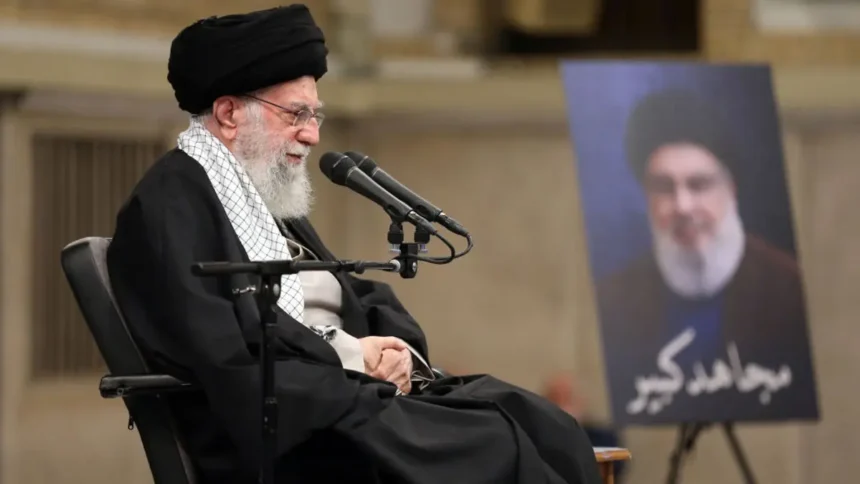
Iranian media initially relied on older footage, portraits, murals and banners to familiarise the country with Mojtaba Khamenei.
Those materials can maintain a visual presence, but they cannot answer a basic question: is there current, authentic evidence showing the leader performing his role?
In a conflict filled with recycled clips, altered pictures and artificial-intelligence content, the source and date of an image matter. A portrait at a rally shows political support. An archival video shows what a person looked and sounded like before the attack. Neither demonstrates his current health.
The absence of verified contemporary media has allowed contradictory reports to flourish. Some accounts describe relatively minor injuries; others suggest grave wounds or incapacity. The responsible position is to avoid both extremes. There is credible evidence that Mojtaba Khamenei survived and remained involved in state activity. There is also credible evidence that his wounds were significant and that Iran has not transparently demonstrated the extent of his recovery.
What His Condition Means for Iran’s War Decisions
Questions about his condition affect decisions involving the war, the Strait of Hormuz, relations with Gulf states, nuclear negotiations and further escalation with the United States and Israel.
His written messages have generally supported retaliation and a hard line. Reuters reported that he pledged revenge for his father after the July burial. Other reporting indicated that he had given tentative support to negotiations during parts of the conflict.
That combination could reflect a deliberate strategy: militant language for domestic legitimacy alongside diplomacy to protect the state. It could also reflect competing centres of power speaking through an absent leader. Both possibilities remain interpretations because Iran’s internal decision-making is opaque.
Iran’s renewed attacks and US strikes in July make the issue more urgent. If Mojtaba Khamenei is directing those choices, a verified appearance or recording would strengthen that claim. If decisions are being made collectively by the Guard, president, parliament speaker and security council, the public description of power may not match the reality.
The civilian and economic consequences are visible in Iranian cities facing attacks and power cuts and in volatile oil and financial markets.
What Is Known, Claimed and Still Unproven
| Question | Best-supported answer |
|---|---|
| Is Mojtaba Khamenei Iran’s supreme leader? | Yes. The Assembly of Experts appointed him on 8 March 2026. |
| Did he survive the strike that killed his father? | Available official and independent reporting strongly indicates that he did. |
| Was he injured? | Yes. Iranian officials and multiple reports acknowledge injuries. |
| How serious were the injuries? | Unclear. Accounts range from limb injuries to serious facial disfigurement and broader wounds. |
| Has he appeared publicly since taking office? | No verified public appearance has been reported as of 18 July 2026. |
| Has he issued statements? | Yes, through written texts read or broadcast by state media rather than a verified new video or voice recording. |
| Is he making decisions? | Iranian officials and senior sources say he is, but the arrangement cannot be independently observed. |
| Why is he hidden? | Health recovery and fear of another assassination attempt are the most credible explanations. |
The table reflects the combined reporting of Reuters, AP, The Guardian and Iranian officials rather than independently released medical or operational records.
The Most Accurate Description of His Status
The headline should not suggest that injury reports were merely rumours. Later official comments confirmed that Mojtaba Khamenei was wounded.
The most accurate wording is that he is reportedly alive, recovering and involved in decisions while remaining out of public view. His exact condition is not independently known.
It is also inaccurate to say he released no official statement. He issued several written messages, beginning with the 12 March statement read on television. The accurate point is that he has not appeared on camera or supplied a verified contemporary recording of his voice.
The four questions should remain separate:
- Is he alive?
- Was he injured?
- Has he communicated?
- Has he appeared publicly?
The evidence points to yes, yes, yes and no.
Why the Silence Is Becoming a Political Liability
During the first weeks after the attack, secrecy could be explained as emergency protection. Months later, it is harder to sustain without political cost.
Supporters want reassurance that the supreme leader can direct the country. Opponents see the absence as evidence of fragility. Foreign intelligence services study the gap for signs of factional competition. The Revolutionary Guard gains operational space from an unseen leader but also carries greater responsibility for failures.
Reuters quoted Iranians who said the country needed to see its leader during war and uncertainty. That concern does not necessarily signal opposition to the Islamic Republic. Even loyalists can demand visible evidence of command.
Mojtaba Khamenei may eventually appear when his health improves or security officials consider the risk manageable. Until then, every written statement will carry an unanswered question about the person behind it.
The Bottom Line
Mojtaba Khamenei is not simply the subject of an unconfirmed injury rumour. Iranian officials have acknowledged that he was wounded in the 28 February strike that killed his father, while senior sources say he continued participating in decisions during his recovery.
Yousef Pezeshkian’s assurance that he was “safe and sound” was evidence of survival, not proof that he escaped unharmed. President Masoud Pezeshkian later said he met Mojtaba Khamenei and that his health was improving.
The central issue is now his continued absence. He was appointed supreme leader on 8 March, has issued written messages and has been represented through portraits, banners and state symbolism. Yet he did not appear at his father’s funeral, and no verified current image or recording of his voice had emerged by 18 July.
Health and security offer credible explanations, but they do not remove the political consequences. Iran’s highest office depends heavily on personal authority, and Mojtaba Khamenei assumed it without the public stature his father had accumulated.
For now, the evidence indicates that Mojtaba Khamenei is alive, injured and governing from a concealed location. What remains uncertain is how fully he has recovered, how directly he controls state decisions and how long Iran can maintain a supreme leader its people have never seen in office.
For continuing coverage of Iran’s leadership and the regional conflict, readers can follow The News Ink on X.