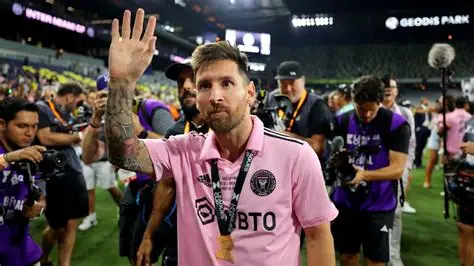
Lionel Messi: Why His Stunning White House Visit Became More Than an MLS Celebration
Lionel Messi and Inter Miami arrived at the White House to celebrate a football achievement. They left behind a moment that said almost as much about American sports, politics and celebrity power as it did about Major League Soccer.
The scene was historic on the surface. Inter Miami had won the 2025 MLS Cup, the first league title in the club’s short history. The team were invited to Washington by President Donald Trump, who welcomed the players, coaches, owners and league officials to the East Room. Messi stood on stage in a dark Inter Miami suit, surrounded by teammates and club staff, as the club’s rise from expansion project to MLS champion was formally recognized.
For a normal American sports champion, a White House visit is familiar. For Inter Miami, it was different. This was an MLS club built around global icons, co-owned by David Beckham, lifted by the Mas family’s investment and transformed by the arrival of the greatest footballer of his generation. Lionel Messi was not merely another athlete in the room. He was the reason the room felt bigger than a routine champions’ ceremony.
The event also became unusual because Trump mixed sports praise with politics. He discussed the ongoing conflict with Iran, touched on Venezuela and Cuba, spoke about the economy and tariffs, and only later returned fully to Inter Miami’s championship. That made the visit more complicated than a celebration of goals, trophies and club history.
Still, for Inter Miami, the symbolism was powerful. The club had won MLS Cup by beating Vancouver Whitecaps 3-1 in December 2025, with Messi assisting late goals from Rodrigo De Paul and Tadeo Allende. The win gave Miami their first Philip F. Anschutz Trophy and confirmed what the club had promised since signing Messi in 2023: it wanted to change the scale of soccer in the United States.
For readers following The News Ink’s wider football coverage, this visit mattered because it showed how far American soccer’s celebrity economy has moved. MLS no longer sells only local rivalry and future potential. With Lionel Messi, it sells global attention.
Why the White House visit mattered
Lionel Messi has been honored almost everywhere football can honor a player. He has won the World Cup, the Copa America, the Champions League, domestic titles, Ballon d’Or awards and individual records across two continents. Yet the White House visit still mattered because it placed him at the centre of American sporting ceremony.
For Inter Miami, the event was validation. MLS is still fighting for space in a crowded U.S. sports market dominated by the NFL, NBA, MLB and college football. A White House ceremony gives a club a kind of national recognition that normal league matches cannot always deliver.
For MLS, the visit was also useful. Commissioner Don Garber has spent years trying to position the league as both domestic and global. Messi’s arrival accelerated that effort. His presence brought international viewers, sold-out stadiums, higher ticket prices, new sponsorship energy and an aura the league had never possessed at this scale.
That is why Lionel Messi standing beside Trump was such a striking image. It showed MLS entering political and cultural spaces that once felt reserved for the biggest American sports leagues.
The visit was not only about honoring Inter Miami. It was about soccer proving it could command the White House stage.
Inter Miami’s MLS Cup journey
Inter Miami’s White House moment began with the 2025 MLS Cup final. The club beat Vancouver Whitecaps 3-1 at Chase Stadium in Fort Lauderdale, ending the season with the title that had become the obvious target after Messi’s arrival.
Vancouver fought hard and equalised through Ali Ahmed, but Miami’s late quality proved decisive. Messi set up Rodrigo De Paul to restore the lead, then assisted Tadeo Allende in stoppage time to seal the victory. MLS described the win as Miami climbing the mountaintop, and that was fair. The club had gone from a struggling young franchise to league champion in only a few years.
Lionel Messi did not score in the final, but his influence shaped the result. That is often the mark of his late-career brilliance. He no longer has to dominate every match with endless dribbles or goals. He can decide matches with timing, weight of pass and the ability to slow pressure around him.
The MLS Cup also added another trophy to a career already crowded with silverware. Trump referred to Messi’s career trophy count during the ceremony, praising the scale of his achievements and his decision to choose Miami when he could have played elsewhere.
For Inter Miami, the title turned the Messi project from spectacle into success.
Messi’s American chapter became longer
The White House visit carried extra weight because Lionel Messi had already committed his future to Inter Miami. In October 2025, the club announced that he had signed a contract extension through the 2028 MLS season.
That matters because Messi’s U.S. move was initially seen by some as a glamorous final stop. The extension changed the meaning. It suggested he was not just passing through. He was willing to remain part of MLS through a crucial period that includes the 2026 World Cup in North America, Inter Miami’s stadium ambitions and the league’s push for broader international relevance.
At the White House, Trump thanked Messi for choosing Miami and said the country was lucky to have him playing every week. That line captured the commercial reality. Lionel Messi is not simply an Inter Miami player. He is one of MLS’s most important assets.
His presence affects Apple’s MLS Season Pass, stadium attendance, international coverage, club valuations and the perception of the league among players who might previously have dismissed the United States as a retirement option.
The White House ceremony celebrated one title, but the contract extension showed the bigger plan. Messi’s American chapter is still being written.
The ceremony turned political
The most unusual part of the event was not the football. It was the way the ceremony drifted into politics.
Trump opened with remarks about U.S. and Israeli actions in Iran. He later discussed Venezuela, Cuba and tariffs. The Guardian described the Inter Miami players as standing behind him while the speech moved through subjects far away from MLS Cup. AP also reported that the event turned political at times before returning to praise for Messi and Miami.
This created an awkward contrast. Lionel Messi is famously cautious about politics. He rarely makes public political statements and has usually preferred to keep his public persona focused on football, family and charity. At the White House, he stood silently while the event shifted into geopolitical territory.
That does not mean Messi endorsed every political remark made around him. A team visit to the White House is ceremonial. Players often stand politely while presidents speak. But images matter, especially when the athlete is Messi and the president is Trump.
That is why the visit became more than a sports photo. It became part of a wider conversation about how athletes, clubs and leagues navigate political spaces.
The News Ink’s reporting on U.S. and Israeli strikes on Iran and U.S.-Venezuela resource talks gives the wider background to the issues Trump referenced during a ceremony meant to honor a soccer team.
Trump’s Messi praise
Trump’s football praise was personal and theatrical. He told Messi that his son Barron was excited about the visit and described him as a big fan. He thanked Messi for choosing Miami, praised his talent and joked about whether he might be better than Pele.
The Pele comparison was designed for applause, and it worked because Messi’s greatness is one of the few football topics that can be understood instantly across cultures. Even Americans who do not follow MLS closely know Messi’s name. Many know Pele’s name. Trump used that comparison as a simple way to frame Messi’s status for the room.
He also referenced Messi’s ability to carry expectation. That point was more interesting. Messi arrived in MLS with impossible pressure. He was expected to lift the league, transform Inter Miami, sell out stadiums, improve broadcasts, win trophies and remain elite into his late 30s.
Somehow, he did almost all of it. The MLS Cup title gave the project sporting legitimacy. Without that trophy, critics could have argued that Messi’s Inter Miami era was mainly commercial. With the trophy, the story became harder to dismiss.
Lionel Messi came to Miami as a global brand. He became an MLS champion.
Beckham’s dream reached the White House
David Beckham’s role should not be ignored. Inter Miami’s story is impossible to separate from him. Beckham arrived in MLS as a player in 2007 with LA Galaxy, and part of his league-changing deal included the right to buy into an expansion franchise at a discounted price. Years later, that clause became Inter Miami.
The White House visit therefore felt like the latest chapter in a long Beckham project. He helped sell the idea that global football stars could change American soccer. Then, as an owner, he helped bring the biggest of them all to Miami.
Beckham also became the first person to win MLS Cup as both a player and an owner. That detail matters because it shows how his American soccer story moved from celebrity signing to institutional influence.
Lionel Messi made Inter Miami a global attraction. Beckham helped create the platform that made Messi’s arrival possible.
The two stories are linked. Without Beckham, Inter Miami may not exist in the same way. Without Messi, Inter Miami may not have become a White House-level sports story so quickly.
Jorge Mas and the Miami identity
Club owner Jorge Mas also played a major role at the ceremony. He presented gifts to Trump and spoke about Miami’s identity, the club’s rise and the meaning of its success. Inter Miami is not only Beckham’s glamour project. It is also deeply connected to Miami’s Cuban-American business and cultural networks.
That gave the ceremony another layer, especially because Trump also referenced Cuba and Venezuela. For Miami, politics and sport often overlap because the city’s identity is shaped by migration, exile communities, Latin American business and U.S. foreign policy.
Inter Miami’s success is therefore not just a soccer story. It is also a Miami story. The club reflects the city’s mix of Latin American culture, celebrity, ambition and political energy.
Lionel Messi fits that identity perfectly. He is Argentine, Spanish-speaking, globally famous and commercially powerful. His presence has made Miami feel like a natural centre of world soccer rather than only an American sports market trying to catch up.
The White House event showed that Inter Miami now operates at that intersection: football, business, politics and culture.
Messi did not need to speak
One of the most telling details is that Lionel Messi did not speak during the ceremony. For many athletes, that might have felt strange. For Messi, it felt typical.
He has always been more comfortable letting football speak for him. Even as Argentina captain, he has rarely sought the microphone unless necessary. His power comes from presence, not speeches.
At the White House, that worked in two ways. It made him look respectful and composed. It also prevented him from being drawn deeper into political messaging. Messi could attend, smile, exchange gifts and represent Inter Miami without turning the event into a personal political statement.
That silence also underlined the difference between Messi and Trump. Trump filled the room with words, tangents and comparisons. Messi stood quietly, carrying a different kind of authority.
In global football, Messi does not need to explain why he matters. The room already knows.
MLS gained a visibility boost
For MLS, the White House ceremony was valuable publicity. The league has spent decades trying to break through in American sports culture. Messi’s presence has accelerated that effort, but MLS still faces challenges around television visibility, salary structures, competition format and mainstream attention outside major markets.
A championship team visit to the White House helps because it places MLS in a familiar American sports tradition. It says: this league has champions worth celebrating at the highest symbolic level of U.S. public life.
The timing also mattered. The 2026 World Cup is being staged across the United States, Canada and Mexico. Soccer attention in North America is higher than usual. Messi’s continued presence in MLS gives the league a bridge between club soccer and the global tournament.
That is why the ceremony was not just a backward-looking celebration of the 2025 MLS Cup. It was also forward-looking promotion for soccer in America.
MLS wants the World Cup to leave a lasting domestic legacy. Lionel Messi remains its strongest individual advertisement.
The D.C. United follow-up kept the football moving
The White House visit came just before Inter Miami played D.C. United in the Washington area. The football story did not stop at the ceremony. Messi scored the 899th goal of his career in a 2-1 win over D.C. United, reminding everyone that he was not simply a ceremonial figure collecting praise.
That detail matters because late-career superstar stories can easily become too symbolic. The athlete becomes more brand than player. Messi has resisted that because he still produces decisive moments.
He did it in the MLS Cup final with assists. He did it in early 2026 league play with goals. He did it while balancing club commitments with Argentina’s World Cup expectations.
Lionel Messi is a commercial phenomenon, but the commercial phenomenon still depends on the football. If he stopped delivering, the aura would fade faster. The D.C. United match showed the aura was still backed by performance.
Why this was bigger than a trophy ceremony
The White House event mattered because it brought together several American soccer stories at once.
It celebrated Inter Miami’s first MLS Cup. It recognized Messi’s impact. It gave Beckham’s ownership project national visibility. It placed MLS inside a presidential sports tradition. It connected Miami’s Latin American identity with U.S. politics. It happened months before a North American World Cup. It also showed the awkwardness that appears when sport enters political theatre.
That mixture made the ceremony memorable.
Some supporters saw it as a proud moment for Inter Miami and MLS. Others saw it as an uncomfortable photo opportunity shaped by Trump’s political tangents. Both readings can be true. Sports ceremonies often carry more meanings than the teams intend.
For Lionel Messi, the visit became another strange marker in a career full of surreal stages. He has lifted the World Cup in Qatar, won Champions League titles in Europe, filled stadiums in Asia and America, and now stood in the East Room of the White House as an MLS champion.
It was another reminder that his career has moved far beyond football fields.
Key facts at a glance
| Detail | Figure |
|---|---|
| Event | Inter Miami White House visit |
| Date | March 5, 2026 |
| Host | President Donald Trump |
| Reason | 2025 MLS Cup victory |
| MLS Cup result | Inter Miami 3-1 Vancouver Whitecaps |
| Messi’s MLS Cup final contribution | Two assists |
| Messi contract | Extended through 2028 MLS season |
| MLS MVP record | First back-to-back MVP winner |
| Notable attendees | Luis Suarez, Rodrigo De Paul, Tadeo Allende, Javier Mascherano, Jorge Mas, Don Garber |
| Follow-up match | Inter Miami beat D.C. United 2-1 |
| Messi follow-up milestone | 899th career goal |
The careful takeaway
Lionel Messi and Inter Miami’s White House visit was officially a celebration of the club’s first MLS Cup. It was also much more than that.
It showed how far Inter Miami have travelled since becoming an MLS expansion club. It showed how David Beckham’s long American soccer project reached a new symbolic peak. It showed how Messi’s decision to join Miami has changed the league’s visibility. It also showed how quickly a sports ceremony can become political when held inside the White House.
Trump praised Messi, referenced Barron Trump’s admiration, compared him with Pele and thanked him for choosing Miami. Messi smiled, stood quietly, presented a gift and avoided politics. Inter Miami accepted the honor, while the ceremony around them moved between soccer, Iran, Venezuela, Cuba and American culture.
The result was not a clean sports-only celebration. It was a revealing American soccer moment.
Lionel Messi came to MLS to play football. His presence has turned Inter Miami into a club that can win titles, draw global attention and stand at the centre of national ceremony. Whether that attention always stays on football is another question.
For more football analysis, MLS stories and global sports coverage, follow The News Ink on Medium.