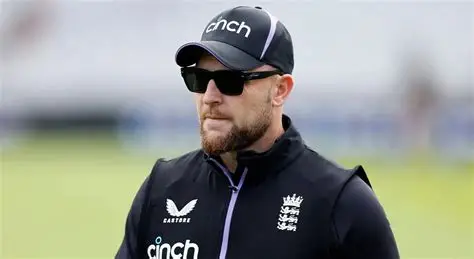
Brendon McCullum England Coach Future Changes After T20 Fight and Test Exit
Brendon McCullum England coach future has changed sharply since he stood near the Wankhede boundary, embraced Harry Brook after England’s T20 World Cup semi-final defeat to India, and said he would “love to carry on” across all formats.
At that moment in Mumbai, McCullum still wanted the full job. England had just lost a thrilling semi-final by seven runs, but the white-ball side had fought with courage. Jacob Bethell had produced a brilliant century, Brook had praised the spirit of the squad, and McCullum believed there was enough evidence of progress to continue.
The question then was whether the England and Wales Cricket Board would agree.
Four months later, the answer is more complicated. McCullum has not been removed completely. He remains head coach of England’s white-ball teams. But his time as Test coach is over. The ECB has split the roles again after a difficult red-ball period, including a heavy Ashes defeat and wider questions about whether the “Bazball” project had run out of direction.
That makes the Brendon McCullum England coach story more layered than a simple stay-or-go decision. He wanted to carry on. Brook strongly backed him. England’s T20 team improved under his influence. Yet the Test results became too difficult for the ECB to ignore.
For more cricket coverage, The News Ink’s cricket guide explains how captaincy, coaching, formats and franchise pressure are reshaping the modern game.
Why Brendon McCullum England coach debate changed
Brendon McCullum England coach debate changed because England became two different teams under the same name.
In white-ball cricket, there was encouragement. England reached the T20 World Cup semi-finals, pushed India to the final over in Mumbai and later climbed to No.1 in the T20 rankings. Brook developed quickly as captain. Young players such as Bethell, Will Jacks, Tom Banton, Sam Curran and Rehan Ahmed showed signs of growth.
In Test cricket, the story was harsher. England’s approach had thrilled supporters in 2022 and 2023, but later results faded. The Ashes defeat in Australia became a major breaking point. The team’s red-ball identity looked less convincing, off-field issues added pressure, and questions grew over whether McCullum’s methods still worked in the longest format.
That split explains the ECB’s eventual decision. McCullum was not judged as a total failure. He was judged differently by format. The T20 side still had momentum. The Test side needed change.
Brendon McCullum England coach future therefore became a story about specialisation. The all-format experiment looked attractive when unity and culture were the priority. It became harder to defend when red-ball results fell and white-ball progress needed protecting.
The emotional moment in Mumbai
The image of McCullum and Brook embracing after the India semi-final carried real meaning. England had lost, but they had not collapsed. They had chased 254 and reached 246-7. Bethell’s 105 from 48 balls had almost produced a miracle. Brook’s players had fought until the final over.
For McCullum, that mattered. He said England’s white-ball side had played with identity under Brook. He praised the captain’s mental fortitude and the team’s toughness after a difficult winter. He also made his own wish clear: he loved the job and wanted to help lead England into the next stage.
Brendon McCullum England coach future still looked open then. There were reasons to keep him. England had shown resilience. Brook trusted him. The squad seemed connected. The T20 campaign, though unfinished, was not an embarrassment.
But the embrace also looked like the end of a long winter. McCullum was going back to New Zealand. Brook was returning to Yorkshire. ECB officials were preparing to review the campaign. The emotional tone reflected uncertainty as much as pride.
England had nearly beaten India. They had also lost another major knockout.
Key facts at a glance
| Issue | Current position |
|---|---|
| Coach | Brendon McCullum |
| Original role | England all-format head coach |
| March 2026 position | Wanted to continue across all formats |
| T20 World Cup result | England lost to India by seven runs in the semi-final |
| Brook’s view | Strongly backed McCullum after the defeat |
| Test record concern | Poor results after the 2023 Ashes, including a 4-1 Ashes defeat in Australia |
| July 2026 update | McCullum removed as Test coach |
| Current role | England white-ball head coach |
| Contract focus | White-ball work through 2027 World Cup cycle |
| Main challenge now | Rebuild ODI cricket while sustaining T20 progress |
This table shows why the Brendon McCullum England coach discussion cannot be answered with one verdict. The formats now tell different stories.
What McCullum said after the semi-final
McCullum did not hide from the pressure after England lost to India. He admitted the winter had been difficult, especially the Test side’s Ashes failure, but he defended the direction of the white-ball team.
He said England had played good cricket with a clear identity under Brook. He praised the squad’s toughness and highlighted the support Brook had received from younger players. He also said he was enjoying the role and would love to carry on.
Brendon McCullum England coach debate was shaped by that tone. He was not pretending everything had gone well. He accepted there were hard conversations ahead. But he believed England had made significant improvements and still had more to achieve.
That is important because McCullum’s coaching style has always been built around belief, freedom and culture. He rarely sounds like a technical analyst first. He speaks about environment, confidence and players becoming the best versions of themselves.
That message can be powerful when results follow. It becomes vulnerable when results fade.
Brook’s backing was emphatic
Harry Brook’s support for McCullum was not cautious. It was loud, personal and direct.
Brook said McCullum was the best head coach he had ever worked with. He praised his communication, his dressing-room aura and the way he had changed English cricket. He also said the partnership between captain and coach had been strong throughout the tournament.
Brendon McCullum England coach future mattered to Brook because his captaincy had grown inside that environment. McCullum gave him freedom. Brook gave the team authority. Their relationship became central to England’s white-ball reset.
That support carried weight. Brook had led England through a difficult tournament and still kept the players together. If the captain believes in the coach, decision-makers must listen.
But captain support is not always enough. The ECB had to judge across formats, not only through Brook’s white-ball lens. Ben Stokes had been central to McCullum’s Test project, while Brook represented the next white-ball chapter. Those two realities eventually pulled the role apart.
Brook’s backing helped McCullum survive in limited-overs cricket. It did not save the Test job.
The India defeat showed progress and limits
England’s semi-final defeat to India was both encouraging and frustrating.
The encouragement was obvious. England chased 254 and stayed alive until the final over. Bethell played one of the great losing innings in T20 World Cup history. Brook said he was extremely proud because his side had not been out of any game until the final over across the competition.
The frustration was just as clear. England conceded 253-7 after choosing to bowl. Sanju Samson made 89 after being dropped on 15. India’s batting depth overwhelmed England’s plans. Jasprit Bumrah bowled the crucial 18th over for only six runs. Hardik Pandya and India held their nerve at the end.
Brendon McCullum England coach future was complicated by exactly that kind of match. England looked brave, connected and dangerous. They also looked short of the clinical execution required to win a World Cup.
That is the difference between a promising campaign and a trophy. England had spirit. India had spirit plus precision.
The News Ink’s detailed report on the India-England T20 World Cup semi-final explains how fine the margins became in Mumbai.
White-ball progress was real
It would be unfair to ignore England’s white-ball progress under McCullum and Brook. The T20 side gained clarity after a period of uncertainty. Jacks found a new finishing role. Bethell emerged as a serious international talent. Banton returned with purpose. Dawson’s recall gave the attack experience and control. Curran contributed in key moments.
Brendon McCullum England coach future stayed alive because the white-ball side looked like a team with energy. It did not win the World Cup, but it was not drifting. It had a captain, a core and a method.
England’s later T20 form strengthened that case. In July, England secured their first T20 series win over India, with Brook and Phil Salt producing a dominant partnership in the fourth match. Reuters reported that England had won 19 of 22 completed T20Is since Brook became captain.
That kind of run makes it hard to argue that McCullum has lost all influence. In T20 cricket, the partnership with Brook is working.
The bigger question is whether that success can be extended to ODIs, where England still need a clearer long-term plan before the 2027 World Cup.
The Ashes changed everything
The Ashes defeat in Australia changed the tone around McCullum’s Test role. England lost the series 4-1, and the result carried more weight because the McCullum-Stokes era had been building toward that challenge.
For years, England’s Test project was judged not only by entertainment but by whether it could eventually win the biggest series. The 2023 Ashes in England ended 2-2 after Australia retained the urn. England then went to Australia hoping to prove the method could travel. Instead, the series became a damaging defeat.
Brendon McCullum England coach scrutiny intensified because the Ashes was not just another series. It was the central test of the project. When England failed heavily, questions about selection, preparation, tactics and discipline all grew louder.
There were also off-field issues during the winter, including drinking-related controversy and criticism of player conduct. McCullum defended and supported his players after disciplinary action, but the wider impression was damaging. A team can survive controversy when it wins. When results are poor, every incident becomes part of the case against the leadership.
The Ashes did not immediately end McCullum’s Test role. But it weakened the ground beneath him.
Bazball’s rise and fall
McCullum’s Test reign will always be linked with Bazball, even if he disliked the label. When he arrived in 2022 with Ben Stokes as captain, England’s Test cricket changed almost overnight. They chased ambitious targets, attacked bowling, backed players and made Test cricket feel urgent again.
The early results were spectacular. England beat New Zealand 3-0, chased 378 against India and later won 3-0 in Pakistan. The team looked fearless and fresh. Supporters who had watched a stale red-ball side suddenly had something thrilling to believe in.
But the style became harder to sustain. The aggression lost some clarity. Results against Australia and India became the measure. By 2026, Guardian analysis described the approach as having burned brightly but briefly. McCullum himself later said the method had never been about reckless scoring rates, but about creating an environment where players could handle pressure.
Brendon McCullum England coach legacy in Tests is therefore mixed. He revived a struggling team and changed the national conversation. He also failed to win the marquee series that would have turned the movement into a lasting dynasty.
That is why the ECB eventually decided the red-ball team needed a new voice.
July update: Test job gone, white-ball role retained
The most important update is the July decision. McCullum has accepted his removal as England’s Test head coach. He said the results were not good enough, apologised for failing to win major series against India and Australia, and said he fully respected the decision.
At the same time, he remains in charge of England’s white-ball sides. That matters. The ECB did not remove him from English cricket. It narrowed his remit.
Brendon McCullum England coach future is now focused on limited-overs cricket. That may actually suit the next phase better. His emphasis on freedom, confidence, attacking intent and player backing aligns naturally with T20 cricket. The challenge is making the ODI side more consistent before the 2027 World Cup.
The split also raises practical questions. England must appoint a new Test coach quickly. Multi-format players will move between different coaching messages. Brook’s future captaincy workload must be managed. Rob Key and the ECB must ensure the white-ball and red-ball setups do not drift into competing cultures.
This is not only a staffing change. It is a structural reset.
What McCullum admitted after the decision
McCullum’s response to losing the Test job was notable because he did not lash out. He accepted the decision and took responsibility for the results.
He said England were in a results business and that the results had not been good enough. He thanked people for their commitment and said he had loved his time in the role. He also said he would work with the next Test coach in a collaborative process.
Brendon McCullum England coach future may depend partly on that professionalism. If he had responded bitterly, the white-ball role could have become awkward. Instead, he left the door open for cooperation.
He also pushed back on simple readings of Bazball. He said his method was about building an environment, not recklessness. That distinction matters for his white-ball future. If he can take the best parts of his philosophy — confidence, clarity and freedom — while avoiding red-ball tactical stubbornness, England may still benefit.
McCullum’s challenge now is to prove that his coaching method is not finished. It has simply moved to the formats where it currently fits best.
What the ECB must solve next
The ECB’s decision solves one problem but creates several others.
First, it must appoint a Test coach quickly enough to prepare for upcoming red-ball series. Names such as Andy Flower, Simon Katich, Rahul Dravid and Stephen Fleming have already been discussed in reporting. Whoever gets the job must build trust fast.
Second, England must decide whether the Test captaincy needs further change. Ben Stokes has been central to the McCullum era, but the red-ball side now needs a fresh structure.
Third, McCullum and the new Test coach must coordinate around multi-format players. Brook, Bethell, Jacks, Archer, Curran and others could be pulled between priorities.
Fourth, the ODI side needs attention. England’s T20 team has been strong, but the 50-over team has lagged. The 2027 World Cup gives McCullum a clear target.
Brendon McCullum England coach future now depends less on personality and more on delivery. The emotional case has been made. The white-ball results must keep coming.
What this means for Harry Brook
Brook is the biggest winner and the biggest pressure point in McCullum’s remaining role.
He has emerged as England’s white-ball captain with strong results, clear backing from the coach and respect from the dressing room. The T20 World Cup campaign strengthened his authority even in defeat. The later T20 series win over India strengthened it further.
But Brook also faces rising workload. He is a major batter, captain, potential red-ball leader in future discussions and central figure across formats. McCullum has praised his mental fortitude, but England must protect him from becoming overburdened.
Brendon McCullum England coach future is tied closely to Brook because the white-ball project now looks like their shared project. If Brook thrives, McCullum’s role looks justified. If Brook struggles, the ECB may question whether the system around him is too narrow.
The relationship has promise. The challenge is sustainability.
The News Ink’s report on Brook team unity and England’s T20 World Cup run explores how the captain built belief during the tournament.
McCullum’s strengths still matter
McCullum still has qualities England value.
He creates confidence. He backs players publicly. He reduces fear of failure. He communicates clearly. He understands attacking cricket. He carries authority from his playing career. He has helped Brook grow quickly. He has made England’s T20 team feel positive again.
Those strengths are not small. International cricket is mentally demanding. Players move between formats, franchise leagues, travel, injuries and public criticism. A coach who can simplify the dressing room can be powerful.
Brendon McCullum England coach future remains viable because white-ball cricket rewards some of those exact traits. T20 players need clarity. They need permission to attack. They need defined roles but freedom within them. McCullum can provide that.
The question is whether he can add more tactical detail around ODI cricket. The 50-over game requires longer planning, more phase management and deeper bowling control than T20. England cannot simply treat ODI cricket as extended T20 and expect success.
That is where McCullum must evolve.
Where criticism remains fair
Criticism of McCullum remains fair because charisma cannot replace results. England’s Test decline was real. The Ashes defeat was real. The failure to win the biggest series was real. Off-field issues happened during his leadership period. Some tactical decisions looked underprepared.
Brendon McCullum England coach supporters may point to culture, identity and early transformation. Critics will point to the scoreboard. Both have evidence.
The fairest view is that McCullum was transformative but not complete. He changed England’s mood, revived Test cricket for a time and helped create a fearless culture. But the project did not mature into sustained dominance. When the biggest tests arrived, England fell short.
In white-ball cricket, he still has the chance to write a different ending. The T20 side is strong. The ODI side is a project. Brook is developing. Bethell and Jacks offer a younger core.
The next two years will decide whether McCullum’s England legacy is remembered as a flash of energy or a broader coaching success.
What success now looks like
Success for McCullum now has a clear shape.
In T20 cricket, England must stay near the top of the rankings and turn strong bilateral results into tournament wins. Semi-finals are not enough forever.
In ODI cricket, England must rebuild before the 2027 World Cup in South Africa, Zimbabwe and Namibia. That means identifying a settled top order, clarifying middle-over bowling roles, rebuilding death bowling and deciding how many T20 specialists can adapt to 50 overs.
In player development, McCullum must help Brook, Bethell, Jacks, Banton, Curran and others become a core rather than a collection of talented individuals.
Brendon McCullum England coach future will be judged by whether he can make England’s white-ball cricket feel sustainable. The Test job is gone. The excuses are fewer. The focus is clearer.
That may be the best thing for him. All-format leadership looked too wide by the end. White-ball focus gives him a cleaner mission.
FAQ: Brendon McCullum England coach
Is Brendon McCullum still England coach?
Yes, but not across all formats. Brendon McCullum remains England’s white-ball head coach, but he has been removed from the Test role.
Why was McCullum removed as Test coach?
The ECB acted after poor red-ball results, including a 4-1 Ashes defeat in Australia and a wider decline in Test performance since the 2023 Ashes.
Did McCullum want to stay?
Yes. After England’s T20 World Cup semi-final defeat to India, he said he loved the job and would love to carry on across formats.
Did Harry Brook support McCullum?
Yes. Brook strongly backed McCullum, calling him the best head coach he had worked with and saying he had changed English cricket for the better.
What is McCullum’s main challenge now?
His main challenge is to keep England strong in T20 cricket while rebuilding the ODI side before the 2027 World Cup.
The bottom line
Brendon McCullum England coach future has moved from uncertainty to reinvention. After England’s T20 World Cup semi-final defeat to India, McCullum wanted to continue across all formats. Brook backed him strongly. The white-ball side had shown real progress. There was a clear case for patience.
But the Test results changed the final decision. The ECB has now removed McCullum from the red-ball role after a damaging period that included Ashes failure, tactical questions and growing pressure around the end of the Bazball cycle.
That does not mean McCullum’s England story is over. It means it has narrowed. He remains in charge of the white-ball teams, where his partnership with Brook has produced momentum, confidence and strong T20 results. The next task is to turn that into trophies and rebuild the ODI side before the 2027 World Cup.
McCullum once wanted to finish the job across all formats. Now he has a different job to finish.
For more England cricket, T20 World Cup and global sports coverage, follow The News Ink on Threads.