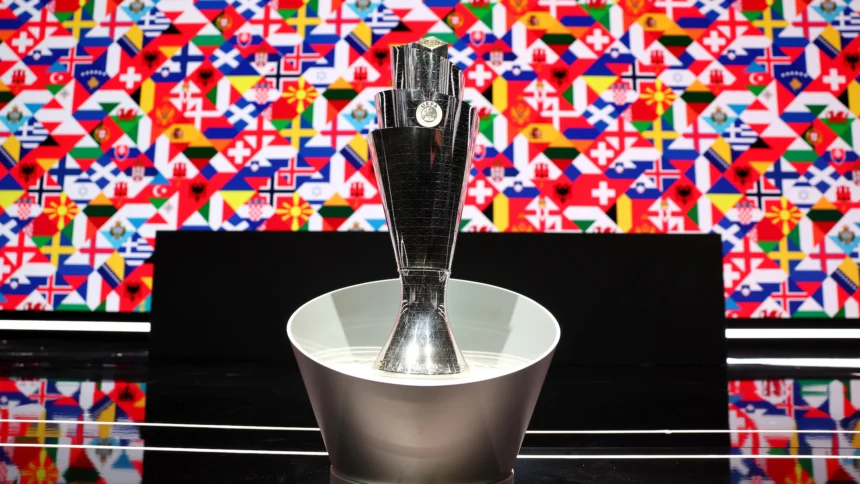
UEFA Nations League 2026/27: September Fixtures, Groups and Format Explained
The UEFA Nations League 2026/27 is ready to bring competitive international football back across Europe, with some of the continent’s biggest national teams facing each other only weeks into the new club season.
The fifth edition of the UEFA Nations League begins on September 24, 2026, and immediately delivers major fixtures.
Netherlands face Germany.
Portugal begin their title defence against Wales.
England meet Spain in a rematch of the UEFA EURO 2024 final.
France travel to Türkiye.
Italy face Belgium.
And Norway, now competing in League A, enter a group containing Portugal, Denmark and Wales.
The UEFA Nations League 2026/27 is about considerably more than those headline matches.
Fifty-four national teams are divided across Leagues A, B, C and D. Teams compete for group positions, promotion and survival, while the strongest League A sides can advance to quarter-finals and eventually the four-team final tournament in June 2027. UEFA’s current competition regulations confirm 14 league-phase groups across the four divisions.
This edition is particularly important because UEFA has also changed the promotion and relegation system ahead of a larger restructuring planned for 2028/29, when the Nations League will move from four leagues to three leagues of 18 teams.
That makes the UEFA Nations League 2026/27 both a major tournament in its own right and a transition point in European international football.
For the wider structure of the sport, tournaments and international competitions, see The News Ink’s Football Guide.
UEFA Nations League 2026/27 at a Glance
| Detail | 2026/27 Competition |
|---|---|
| Edition | Fifth UEFA Nations League |
| Competition begins | September 24, 2026 |
| League phase ends | November 17, 2026 |
| Participating teams | 54 |
| Leagues | A, B, C and D |
| League A groups | Four groups of four |
| League B groups | Four groups of four |
| League C groups | Four groups of four |
| League D groups | Two groups of three |
| League A quarter-finals | March 2027 |
| A/B and B/C play-offs | March 2027 |
| Finals | June 9-13, 2027 |
| Defending champion | Portugal |
| 2028/29 change | Competition moves to three leagues |
Portugal enter the competition as defending champions after defeating Spain on penalties in the 2025 final. Portugal had previously won the inaugural Nations League in 2019, making them the first country to win the competition twice.
What Is the UEFA Nations League?
The Nations League was created partly to replace a large number of international friendlies with competitive matches between countries of broadly comparable strength.
Instead of placing every UEFA nation into one huge competition, teams are separated into divisions according to their previous Nations League performance.
The UEFA Nations League 2026/27 contains:
League A for the highest-ranked nations.
League B for the next tier.
League C below League B.
League D for the remaining teams.
Within the league phase, teams in Leagues A, B and C play the other three countries in their four-team group once at home and once away. That gives each team six group matches.
League D contains two groups of three, so each country plays four group games.
UEFA’s regulations award three points for a win, one for a draw and zero for a defeat.
The league structure gives the UEFA Nations League 2026/27 two parallel battles.
The strongest national teams compete to win the trophy.
Teams throughout the other divisions compete for promotion, survival and a stronger position for future UEFA competitions.
All UEFA Nations League 2026/27 Groups
The league-phase draw was held in Brussels on February 12, 2026. UEFA later confirmed the final group composition following the League C/D play-offs.
League A
| Group | Teams |
|---|---|
| A1 | France, Italy, Belgium, Türkiye |
| A2 | Germany, Netherlands, Serbia, Greece |
| A3 | Spain, Croatia, England, Czechia |
| A4 | Portugal, Denmark, Norway, Wales |
League A contains several exceptional groups.
Group A1 puts France and Italy together with Belgium and Türkiye.
Group A2 renews the Netherlands-Germany rivalry.
But Group A3 may be the most immediately compelling section of the UEFA Nations League 2026/27.
Spain, Croatia, England and Czechia are together, meaning England’s opening match is against Spain before Czechia host England three days later.
Spain and England last met in the UEFA EURO 2024 final, giving the September 26 fixture obvious narrative significance. UEFA has identified England vs Spain as one of the standout opening matches.
For broader coverage of England’s domestic player base during the same season, see The News Ink’s Premier League 2026/27 guide.
League B
| Group | Teams |
|---|---|
| B1 | Scotland, Switzerland, Slovenia, North Macedonia |
| B2 | Hungary, Ukraine, Georgia, Northern Ireland |
| B3 | Israel, Austria, Republic of Ireland, Kosovo |
| B4 | Poland, Bosnia and Herzegovina, Romania, Sweden |
League B could produce some of the most competitive promotion battles.
Scotland face Switzerland, Slovenia and North Macedonia in B1, while Poland and Sweden headline B4.
Sweden arrive after promotion from League C, with UEFA highlighting Viktor Gyökeres after he finished as the leading scorer of the 2024/25 Nations League.
League C
| Group | Teams |
|---|---|
| C1 | Albania, Finland, Belarus, San Marino |
| C2 | Montenegro, Armenia, Cyprus, Latvia |
| C3 | Kazakhstan, Slovakia, Faroe Islands, Moldova |
| C4 | Iceland, Bulgaria, Estonia, Luxembourg |
League C remains highly significant because every group winner is promoted to League B under the updated UEFA Nations League 2026/27 system.
The runners-up also retain a route upward through promotion/relegation play-offs against League B opposition.
League D
| Group | Teams |
|---|---|
| D1 | Gibraltar, Malta, Andorra |
| D2 | Lithuania, Azerbaijan, Liechtenstein |
League D has an unusual role this season because UEFA is preparing to eliminate the fourth division when the competition changes structure in 2028/29.
Under the newly adjusted rules, all six League D teams will be promoted into League C for the next Nations League structure.
That makes the UEFA Nations League 2026/27 the final edition under the familiar four-league format.
UEFA Nations League 2026/27 September Fixtures
The opening international window is unusually intense.
Matchday 1 runs from September 24-26.
Matchday 2 follows immediately from September 27-29.
The competition then continues almost straight into Matchdays 3 and 4 through October 6.
UEFA says teams will generally play four Nations League matches between September 24 and October 6, creating an extended opening international window.
All kickoff times below are CET, following UEFA’s official fixture list.
Thursday, September 24
| Group | Fixture |
|---|---|
| D1 | Andorra vs Malta — 18:00 |
| A2 | Netherlands vs Germany |
| A2 | Serbia vs Greece |
| A4 | Norway vs Denmark |
| A4 | Portugal vs Wales |
| B3 | Austria vs Israel |
| B3 | Kosovo vs Republic of Ireland |
| D2 | Liechtenstein vs Lithuania |
The first night immediately gives the UEFA Nations League 2026/27 one of European football’s traditional rivalries: Netherlands vs Germany.
Portugal also begin their title defence against Wales.
For more background on Portugal’s modern football era, see Cristiano Ronaldo’s Portugal Career.
Friday, September 25
| Group | Fixture |
|---|---|
| B2 | Georgia vs Northern Ireland — 18:00 |
| C2 | Armenia vs Latvia — 18:00 |
| A1 | Italy vs Belgium |
| A1 | Türkiye vs France |
| B2 | Hungary vs Ukraine |
| B4 | Poland vs Bosnia and Herzegovina |
| B4 | Sweden vs Romania |
| C2 | Montenegro vs Cyprus |
Group A1 begins with two major contests.
Italy host Belgium, while France travel to Türkiye.
With France, Italy, Belgium and Türkiye in the same section, dropped points could become expensive quickly because only the top two can reach the League A quarter-finals.
Saturday, September 26
| Group | Fixture |
|---|---|
| B1 | Slovenia vs Scotland — 15:00 |
| C1 | San Marino vs Finland — 18:00 |
| C3 | Faroe Islands vs Kazakhstan — 18:00 |
| C4 | Bulgaria vs Luxembourg — 18:00 |
| C4 | Iceland vs Estonia — 18:00 |
| A3 | Czechia vs Croatia |
| A3 | England vs Spain |
| B1 | North Macedonia vs Switzerland |
| C1 | Albania vs Belarus |
| C3 | Slovakia vs Moldova |
The headline match is clearly:
England vs Spain
It brings together two of Europe’s deepest national-team squads and recreates the pairing from the EURO 2024 final.
For England, it is also the beginning of a demanding A3 schedule that includes Spain, Croatia and Czechia.
UEFA Nations League 2026/27 Matchday 2
There is almost no recovery period before the second round.
Sunday, September 27
| Group | Fixture |
|---|---|
| D2 | Lithuania vs Azerbaijan — 15:00 |
| A2 | Serbia vs Netherlands — 18:00 |
| A4 | Denmark vs Wales — 18:00 |
| B3 | Austria vs Kosovo — 18:00 |
| D1 | Gibraltar vs Andorra — 18:00 |
| A2 | Germany vs Greece |
| A4 | Norway vs Portugal |
| B3 | Israel vs Republic of Ireland |
Norway vs Portugal stands out.
Norway earned promotion into League A and now face the defending Nations League champions.
UEFA also notes that Erling Haaland enters this edition as the competition’s all-time leading scorer with 19 Nations League goals.
That gives Norway’s move into League A an additional storyline: can one of Europe’s most dangerous international scorers maintain that record against stronger opposition?
Monday, September 28
| Group | Fixture |
|---|---|
| B2 | Georgia vs Ukraine — 18:00 |
| C2 | Armenia vs Montenegro — 18:00 |
| A1 | Belgium vs France |
| A1 | Türkiye vs Italy |
| B2 | Northern Ireland vs Hungary |
| B4 | Romania vs Bosnia and Herzegovina |
| B4 | Sweden vs Poland |
| C2 | Latvia vs Cyprus — 18:00 |
Belgium vs France could have immediate significance in A1.
With four high-quality national teams in the section, the first two matches may quickly establish which countries are chasing quarter-final qualification and which are already under pressure.
Tuesday, September 29
| Group | Fixture |
|---|---|
| C1 | Finland vs Belarus — 18:00 |
| C3 | Moldova vs Faroe Islands — 18:00 |
| A3 | Czechia vs England |
| A3 | Spain vs Croatia |
| B1 | Scotland vs Switzerland |
| B1 | Slovenia vs North Macedonia |
| C1 | San Marino vs Albania |
| C3 | Slovakia vs Kazakhstan |
| C4 | Bulgaria vs Estonia |
| C4 | Luxembourg vs Iceland |
Spain vs Croatia gives Group A3 another major international matchup only three days after Spain visit England.
England, meanwhile, go from Spain to an away game against Czechia.
That quick turnaround shows why squad depth will be particularly important during the opening UEFA Nations League 2026/27 window.
Full UEFA Nations League 2026/27 Calendar
| Stage | Dates |
|---|---|
| Matchday 1 | September 24-26, 2026 |
| Matchday 2 | September 27-29, 2026 |
| Matchday 3 | September 30-October 3, 2026 |
| Matchday 4 | October 4-6, 2026 |
| Matchday 5 | November 12-14, 2026 |
| Matchday 6 | November 15-17, 2026 |
| League A quarter-finals | March 25-30, 2027 |
| A/B and B/C play-offs | March 25-30, 2027 |
| Final tournament | June 9-13, 2027 |
UEFA’s current competition schedule confirms that the league phase finishes in November, with League A knockout ties and the principal promotion/relegation play-offs following in March.
How the UEFA Nations League 2026/27 Format Works
Every League A, B and C team plays six group matches.
They face each group opponent:
once at home,
and once away.
League D teams play four matches because each group contains three countries.
The UEFA Nations League 2026/27 uses the normal three-point football system: three points for winning, one for drawing and none for losing.
But what happens after the group stage depends heavily on the league.
How League A Teams Reach the Nations League Finals
League A contains the only teams capable of becoming UEFA Nations League 2026/27 champions.
Finishing first is no longer enough to qualify directly for the four-team finals.
The four League A group winners and four runners-up enter the quarter-finals.
The group winners are seeded.
Each winner is drawn against a runner-up from another group.
The ties are played over two legs, with the group runner-up hosting the first leg.
The four aggregate winners advance to the June final tournament.
The final tournament contains:
- two semi-finals;
- a third-place match;
- the final.
Those matches are single-leg knockout games.
This format creates far more competitive value for finishing inside the top two of League A.
A Major Change: Promotion and Relegation Are Different in 2026/27
This is one of the most important details in the entire UEFA Nations League 2026/27.
On September 15, UEFA approved an adjusted promotion and relegation model because the competition will move from four leagues to three leagues beginning in 2028/29.
The new rules are different from the previous Nations League cycle.
League A
The group winners and runners-up enter the quarter-finals.
The two best third-placed teams remain in League A.
The two lower-ranked third-placed teams and two best fourth-placed teams enter A/B play-offs against League B runners-up.
The two lowest-ranked fourth-placed teams are automatically relegated.
League B
All four group winners are automatically promoted to League A.
The four runners-up enter A/B promotion play-offs.
Third-placed teams remain in League B.
Fourth-placed teams enter B/C play-offs against League C runners-up.
League C
The four group winners are automatically promoted.
The runners-up enter B/C play-offs.
Third- and fourth-placed teams remain in League C.
League D
All League D teams move into League C as UEFA removes League D from the competition’s future three-tier structure.
UEFA says the changes are designed to leave 18 teams in each of the three leagues when the new structure begins.
Why UEFA Is Changing the Nations League Again
Starting with the 2028/29 Nations League, the competition will contain three divisions instead of four.
UEFA has approved:
League A: 18 teams
League B: 18 teams
League C: 18 teams, with an additional team possible depending on total participation.
Each league will generally contain three groups of six teams.
Rather than playing every opponent home and away, teams will play six league games under a revised scheduling model.
That means the UEFA Nations League 2026/27 is the final edition of the original four-division era.
It is effectively a bridge between the competition introduced in 2018 and UEFA’s next international-football system.
The Biggest Groups to Watch
Group A3: Spain, Croatia, England, Czechia
This is arguably the headline group.
Spain arrive as one of Europe’s strongest international sides.
England remain one of the continent’s deepest squads.
Croatia have repeatedly demonstrated their ability to compete deep into major tournaments.
Czechia make the group dangerous because points cannot simply be assumed against any opponent.
England vs Spain on September 26 and Spain vs Croatia on September 29 immediately give the UEFA Nations League 2026/27 high-profile fixtures.
Group A1: France, Italy, Belgium, Türkiye
There are no comfortable trips here.
France and Italy meet later in the league phase, but both first need to navigate Belgium and Türkiye.
UEFA notes that Italy have not recorded a home win against France since 1962, adding another historical layer when that rivalry resumes.
Group A4: Portugal, Denmark, Norway, Wales
Portugal are defending champions.
Denmark have established tournament experience.
Norway bring Erling Haaland into League A.
Wales complete a section in which every country has a realistic reason to believe it can take points from the others.
Portugal’s place as defending champion makes A4 particularly important for The News Ink’s wider football coverage. Readers can also explore Cristiano Ronaldo Explained for the broader history of Portugal’s most prolific international scorer.
The September Schedule Creates a Player-Load Test
The UEFA Nations League 2026/27 starts with an unusual rhythm.
Many players will leave their clubs in late September and potentially play four international matches between September 24 and October 6.
That creates tactical and physical challenges.
National-team coaches may need to rotate more aggressively.
A player who completes 90 minutes twice within a few days cannot automatically be expected to start every match across the extended window.
Squad depth may therefore matter almost as much as first-choice quality.
That will be particularly relevant for countries with players returning immediately to Premier League, La Liga, Bundesliga, Serie A and Champions League schedules.
Why the Nations League Matters Beyond the Trophy
Winning the trophy matters, but the UEFA Nations League 2026/27 has broader consequences.
UEFA says the competition is expected to have a connection to UEFA EURO 2028 qualification, with some teams potentially receiving a second route into the European Championship play-offs based on Nations League performance.
The precise EURO 2028 qualification structure should therefore be followed closely when UEFA completes the relevant competition regulations and draw.
That gives teams further incentive to take group positioning seriously even when they are not realistic Nations League title contenders.
Who Has Won the Nations League?
| Edition | Champion | Runner-up |
|---|---|---|
| 2018/19 | Portugal | Netherlands |
| 2020/21 | France | Spain |
| 2022/23 | Spain | Croatia |
| 2024/25 | Portugal | Spain |
Portugal defeated Spain 5-3 on penalties after a 2-2 draw in the 2025 final in Munich.
That result made Portugal the competition’s first two-time champion.
The UEFA Nations League 2026/27 therefore begins with every other League A contender trying to stop Portugal becoming the first nation to defend the title successfully.
Frequently Asked Questions About the UEFA Nations League 2026/27
When does the UEFA Nations League 2026/27 start?
The UEFA Nations League 2026/27 begins on September 24, 2026. Matchday 1 runs through September 26.
When are the September Nations League fixtures?
Matchday 1 is September 24-26 and Matchday 2 runs September 27-29. Matchday 3 begins on September 30 and continues into October.
Who are the defending Nations League champions?
Portugal are the defending champions after beating Spain on penalties in the 2025 final.
Which group are England in?
England are in League A Group 3 with Spain, Croatia and Czechia.
Which group are Portugal in?
Portugal are in League A Group 4 with Denmark, Norway and Wales.
How many matches does each team play?
Teams in Leagues A, B and C play six group matches. League D teams play four because their groups contain three nations.
How do teams reach the Nations League finals?
League A group winners and runners-up qualify for two-legged quarter-finals. The four winners reach the June 2027 final tournament.
When are the UEFA Nations League 2026/27 finals?
The final tournament is scheduled for June 9-13, 2027.
Is promotion and relegation different this season?
Yes. UEFA changed the system in September 2026 to prepare for the shift from four leagues to three starting in 2028/29.
What happens to League D?
All League D nations are set to move into League C as UEFA transitions to the three-league model.
Conclusion: The UEFA Nations League 2026/27 Has More at Stake Than Ever
The UEFA Nations League 2026/27 begins with almost everything an international football tournament needs.
Major rivalries.
Elite teams.
Promotion battles.
Relegation pressure.
A defending champion attempting to retain the trophy.
And several matches that would not look out of place deep inside a European Championship.
Netherlands vs Germany opens the competition on September 24.
Portugal begin their title defence against Wales on the same night.
France travel to Türkiye.
Italy face Belgium.
Then England host Spain in one of the strongest fixtures of the first international window.
Only three days later, Spain meet Croatia while England visit Czechia.
That concentration of high-level international football makes September particularly important.
But this edition goes deeper than fixtures.
The UEFA Nations League 2026/27 is the final competition before the Nations League begins a major structural transformation.
UEFA has decided that from 2028/29, the familiar four-league structure will disappear and be replaced by three 18-team tiers.
That decision has already changed this season’s promotion and relegation rules.
League D is effectively being absorbed into the future League C.
League A’s third- and fourth-place calculations now include ranking comparisons and play-offs.
League B winners have an automatic route into League A.
League C group winners rise automatically to League B.
Every finishing position therefore matters.
At the top, the route to the trophy is equally demanding.
Winning a League A group does not send a team directly to the four-team finals.
The first- and second-placed teams must survive two-legged quarter-finals in March 2027.
Only four nations will remain for the June tournament.
Portugal know what that path looks like.
They won the inaugural competition in 2019 and became champions again in 2025 after beating Spain on penalties.
Spain want the trophy back.
France want another title.
Germany and the Netherlands are immediately thrown into a major rivalry.
England enter one of the hardest groups.
Norway have climbed into League A and bring the competition’s all-time leading scorer, Erling Haaland, into a section featuring the reigning champions.
That combination makes the UEFA Nations League 2026/27 much more than a replacement for friendly matches.
It is now an established competitive layer of European international football.
For broader tournament structures, international football and the rules behind the sport, readers can continue with The News Ink’s complete Football Guide.
The article should also be updated after each international window with standings, qualification scenarios and confirmed quarter-final positions rather than creating competing broad Nations League explainer pages.
Primary Research Sources
UEFA’s official competition guide confirms the current groups, calendar, tournament purpose and the revised promotion/relegation system. UEFA: 2026/27 Nations League — All You Need to Know
The complete September and league-phase schedule comes from UEFA’s official fixture list. UEFA: Complete 2026/27 Nations League Fixtures
The official competition regulations explain the group system, three-point scoring method and home-and-away league phase. UEFA Regulations: League Phase Match System
UEFA’s regulations also confirm how the League A quarter-finals and final tournament operate. UEFA Regulations: League A Knockout Stage
The September 2026 format update explains why promotion and relegation were changed before the future three-league system. UEFA: New Nations League Promotion and Relegation System
Follow The News Ink
Football does not stop at the final whistle. Follow the stories shaping the game.
Match updates & conversation: X • Threads • Bluesky • Mastodon
Visual football coverage: Instagram • TikTok • Pinterest
Long-form analysis: Substack • Medium • Quora