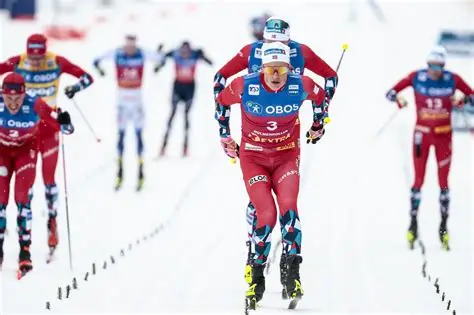
Johannes Klaebo Makes History With a Stunning Six-Gold Winter Olympics Sweep
Johannes Klaebo made Winter Olympics history at Milano Cortina 2026 by winning all six men’s cross-country skiing events. The Norwegian star completed an achievement no athlete had previously managed at a single Winter Games, turning a remarkable fortnight in Tesero into one of the most dominant Olympic performances ever seen on snow.
The final chapter came in the men’s 50km mass start classic on 21 February 2026. Johannes Klaebo crossed the line in 2:06:44.8 after a demanding race that lasted more than two hours, finishing 8.9 seconds ahead of Norwegian teammate Martin Loewstroem Nyenget. Emil Iversen completed an all-Norwegian podium, finishing 30.7 seconds behind the winner.
That victory took Johannes Klaebo to six gold medals from six starts at Milano Cortina 2026 and 11 Olympic gold medals across his career. It also moved him beyond the previous single-Games Winter Olympics record of five golds, set by American speed skater Eric Heiden at Lake Placid in 1980.
The scale of the achievement is difficult to overstate. Johannes Klaebo did not dominate only the sprint events that first established his reputation. He also won races requiring distance control, endurance, tactical patience and the ability to produce decisive speed after sustained physical effort. His clean sweep showed why he has developed from an exceptional sprint specialist into the most decorated Winter Olympian of all time.
Johannes Klaebo Completed the Perfect Olympic Campaign
Johannes Klaebo arrived in Italy with an opportunity to make history, but a six-gold sweep was far from guaranteed. Cross-country skiing is shaped by changing snow conditions, illness, equipment preparation, recovery and the pressure of competing repeatedly over a short period. A skier can be in excellent form and still lose time because of one difficult day.
The Norwegian handled every challenge. He opened with victory in the 10km + 10km skiathlon, then won the sprint classic, the 10km interval start free, the men’s 4×7.5km relay and the team sprint free with Einar Hedegart. The 50km classic became the final test.
| Event | Olympic result | Why it mattered |
|---|---|---|
| Men’s 10km + 10km skiathlon | Gold | Set the tone at the start of the cross-country programme |
| Men’s sprint classic | Gold | Confirmed his continued sprint supremacy |
| Men’s 10km interval start free | Gold | Delivered a breakthrough victory in an event he had not previously won internationally |
| Men’s 4×7.5km relay | Gold | Took his career Olympic total beyond the previous Winter Games record |
| Men’s team sprint free | Gold | Won with Einar Hedegart and reached 10 career Olympic golds |
| Men’s 50km mass start classic | Gold | Completed the first six-gold sweep at a single Winter Olympics |
The FIS season review described the campaign as Olympic perfection: six gold medals from six events. That description fits because the sweep required versatility rather than success in one narrow area.
How the 50km Classic Sealed the Record
The men’s 50km mass start classic was not a ceremonial final lap. It was a serious endurance test with a historic record still unfinished. Johannes Klaebo had already won five golds at the Games, but he needed one more victory to move beyond Heiden’s long-standing mark.
Norway controlled the race. Johannes Klaebo, Nyenget and Iversen separated themselves from the field and created a contest within the leading trio. Nyenget worked hard across the distance and remained a threat deep into the race. Iversen stayed with the front group before losing contact late in the contest.
The decisive move came on the final uphill section. Johannes Klaebo used the speed and climbing strength that have become central to his reputation, creating the gap he needed before the finish. The official FIS race results list his winning time as 2:06:44.8, with Nyenget second and Iversen third.
The Norwegian sweep was emphatic. France’s Theo Schely finished fourth, nearly three minutes behind Johannes Klaebo. Andrew Musgrave was sixth for Great Britain, 3:58.7 behind the winner, while Joe Davies finished 16th.
The final result was a combination of endurance and timing. Johannes Klaebo did not need to attack recklessly from the opening kilometres. He stayed in control, absorbed the pressure and produced the strongest finish when the race demanded it.
Why Six Gold Medals Changed Winter Olympics History
Before Milano Cortina 2026, Eric Heiden’s five-gold performance at the 1980 Winter Olympics remained the benchmark for a single Games. Klaebo went one step further. By winning six events, he became the first athlete to collect six gold medals at one Winter Olympics.
The accomplishment also reshaped the all-time Winter Olympics record. He entered the Games with five Olympic golds from earlier appearances. His relay victory in Italy took him past the previous career record of eight Winter Olympic gold medals held by Norwegian greats Bjorn Daehlie, Marit Bjoergen and Ole Einar Bjoerndalen. By the end of the 50km classic, he had reached 11.
| Olympic milestone | Previous benchmark | Johannes Klaebo’s achievement |
|---|---|---|
| Most gold medals at one Winter Olympics | Eric Heiden: five in 1980 | Six at Milano Cortina 2026 |
| Most career Winter Olympic gold medals | Eight | Eleven |
| Men’s cross-country events won at Milano Cortina 2026 | No previous six-event sweep | Six from six |
| Olympic gold ranking across Summer and Winter Games | Michael Phelps remains first with 23 | Johannes Klaebo moved into second place |
The comparison with Michael Phelps should be understood carefully. Swimming and cross-country skiing are different sports with different event programmes, physical demands and Olympic histories. However, the numbers still show how rare the achievement is. With 11 Olympic golds, Klaebo trails only Phelps in the overall Olympic gold-medal ranking.
Readers interested in sporting achievements that appear almost impossible to surpass can also explore The News Ink’s article on legendary sports records.
Johannes Klaebo Became More Than a Sprint Specialist
Johannes Klaebo built his early reputation through explosive speed, particularly on uphill sections where his running-style movement became distinctive. His sprint victories made him one of cross-country skiing’s most recognisable athletes. Yet the 2026 Winter Olympics demonstrated the depth of his development.
The 10km interval start free was particularly significant. The FIS review of his 2025/26 season noted that it was his first international victory in that event. The result showed that he could win when the race structure gave him less opportunity to rely on direct tactical positioning against rivals.
The 50km classic made the same point in a different way. It required energy management across a prolonged race, the ability to remain calm while teammates pushed the pace and the strength to finish decisively. He did not abandon the sprint qualities that made him famous. He expanded the situations in which those qualities could decide a race.
That evolution matters when assessing his place in the sport. It is one thing to dominate one format. It is far more difficult to win across the complete Olympic programme.
The Relay Gold Created a Major Career Milestone
Johannes Klaebo reached a historic turning point before the final weekend. Norway won the men’s 4×7.5km relay on 15 February, giving him his fourth gold medal of the Games and his ninth Olympic gold overall.
The official FIS relay report stated that Klaebo received a 12-second lead before taking the final leg. He controlled the closing section and crossed the line for Norway, moving beyond Daehlie’s previous cross-country record.
The relay also showed why individual statistics cannot tell the whole story. He acknowledged that his teammates had made his task easier. Olympic success in cross-country skiing depends on collective preparation as well as individual brilliance: athletes, coaches, ski technicians, support staff and teammates all influence the final result.
The wider role of planning, recovery and performance analysis is explored in The News Ink’s sports training guide. Elite results may look effortless at the finish line, but they are usually built through careful preparation over months and years.
Team Sprint Gold Added Another Test
Three days after the relay, Klaebo partnered Einar Hedegart in the men’s team sprint free. Norway won, but the race demanded another sharp finish. The United States remained close, with Gus Schumacher challenging on the final lap before Klaebo made his decisive move uphill.
The FIS team sprint report recorded Norway’s victory, with the United States taking silver and Italy earning bronze. For the Norwegian, the result delivered his fifth gold of Milano Cortina 2026 and his 10th Olympic gold overall.
The event reinforced a pattern visible throughout the Games. Rivals could keep races competitive, but Johannes Klaebo repeatedly found another level at the moment when the result was decided.
Norway’s Cross-Country Strength Was Impossible to Ignore
Johannes Klaebo was the central figure, but Norway’s depth shaped the men’s cross-country programme. The 50km classic produced a Norwegian podium sweep as Nyenget claimed silver and Iversen took bronze. Hedegart contributed to the relay and partnered him in the team sprint. Norwegian skiers consistently created pressure across the programme.
The 50km result was especially striking because the leading trio separated themselves from the rest of the field. Nyenget finished only 8.9 seconds behind Johannes Klaebo, and Iversen ended 30.7 seconds off the lead. Schely, the first non-Norwegian finisher, arrived nearly three minutes after the champion.
That gap showed the quality of Norway’s race management. It also gave the final event a distinctive character. Klaebo was pursuing a personal record, but he was surrounded by teammates capable of challenging for medals themselves.
Great Britain Also Recorded Important Progress
The focus of the day belonged to Johannes Klaebo, but Great Britain completed an encouraging cross-country skiing campaign. Musgrave finished sixth in the 50km classic, while Davies placed 16th on his Olympic debut. The official Team GB report confirmed that Musgrave ended Milano Cortina 2026 with a fourth consecutive top-10 finish.
Musgrave and James Clugnet had already achieved Britain’s best-ever Olympic cross-country skiing finish by taking fifth in the team sprint. Team GB’s report on the team sprint described the result as a new national best.
Anna Pryce also made progress in the women’s programme. Her 32nd-place finish in the sprint classic was initially a British women’s Olympic best in the discipline. She later improved the national benchmark by finishing 24th in the women’s 10km interval start free, as confirmed by Team GB.
| British athlete | Confirmed Milano Cortina 2026 result | Significance |
|---|---|---|
| Andrew Musgrave | Sixth in the men’s 50km classic | Fourth consecutive top-10 result of his Games |
| Joe Davies | 16th in the men’s 50km classic | Strong finish on Olympic debut |
| Andrew Musgrave and James Clugnet | Fifth in the men’s team sprint | Best-ever British Olympic cross-country result |
| Anna Pryce | 24th in the women’s 10km interval start free | Best-ever British women’s Olympic cross-country result |
The 2025 World Championships Foreshadowed the Olympic Sweep
Johannes Klaebo’s success in Italy did not appear without warning. At the 2025 FIS Nordic World Ski Championships in Trondheim, he won all six events on home snow. The achievement made a similar Olympic sweep imaginable, even if repeating it at the Winter Games remained an extraordinary challenge.
The FIS preview before Milano Cortina 2026 noted that he had collected 15 World Championship gold medals after Trondheim. It also highlighted the uncertainties surrounding any championship campaign: ski preparation, form and a measure of luck all matter.
He then reproduced the six-event sweep at the Olympics. That repeat is one reason his 2025/26 season deserves attention beyond the medal count. He arrived with expectations that would have overwhelmed many athletes and still delivered at every stage.
A Different Approach Supported a Historic Season
The FIS season review also identified a change in Johannes Klaebo’s preparation. He credited a lighter mindset and the presence of Iversen in his training group with helping him enjoy the process more. The details matter because elite performance is not only about increasing workload.
He had already reached the highest level of his sport. The challenge was to remain physically prepared while managing pressure, recovery and the mental strain of repeated competition. His comments after the Games suggested that enjoyment and support had become important parts of the formula.
That lesson extends beyond skiing. Athletes need disciplined work, but more training is not automatically better training. The balance between intensity, recovery and mental readiness often shapes performance at major championships.
Frequently Asked Questions About Johannes Klaebo
How many gold medals did Johannes Klaebo win at Milano Cortina 2026?
Johannes Klaebo won six gold medals from six cross-country skiing events at the 2026 Winter Olympics.
Which event completed the six-gold sweep?
Klaebo completed the sweep by winning the men’s 50km mass start classic in 2:06:44.8.
How many Olympic gold medals does Johannes Klaebo have?
Johannes Klaebo has 11 Olympic gold medals, the most won by any Winter Olympian.
Who held the previous single-Games Winter Olympics record?
American speed skater Eric Heiden won five gold medals at Lake Placid in 1980. Johannes Klaebo surpassed that mark with six in 2026.
Who finished behind Klaebo in the 50km classic?
Martin Loewstroem Nyenget won silver, 8.9 seconds behind the champion. Emil Iversen took bronze, 30.7 seconds behind.
Did Klaebo also sweep the 2025 World Championships?
Yes. He won all six cross-country skiing events at the 2025 FIS Nordic World Ski Championships in Trondheim before repeating the feat at Milano Cortina 2026.
Johannes Klaebo Produced a Winter Olympics Performance for the Ages
Johannes Klaebo left Milano Cortina 2026 with a record that immediately became part of Olympic history. Six events brought six victories. The campaign included sprint speed, distance control, relay teamwork and a final 50km performance that completed the perfect sweep.
The numbers are extraordinary: six gold medals at one Winter Games, 11 Olympic golds overall and the most successful Winter Olympics career measured by gold medals. Yet his achievement was also about the way those victories were earned. He adapted across formats, handled pressure and delivered decisive finishes when rivals were still close enough to challenge.
Records are eventually tested by new generations, but this one sets an intimidating standard. Klaebo did not merely win at Milano Cortina 2026. He completed one of the most comprehensive displays of dominance the Winter Olympics has ever seen.
For more major sports stories and analysis, follow The News Ink on X.