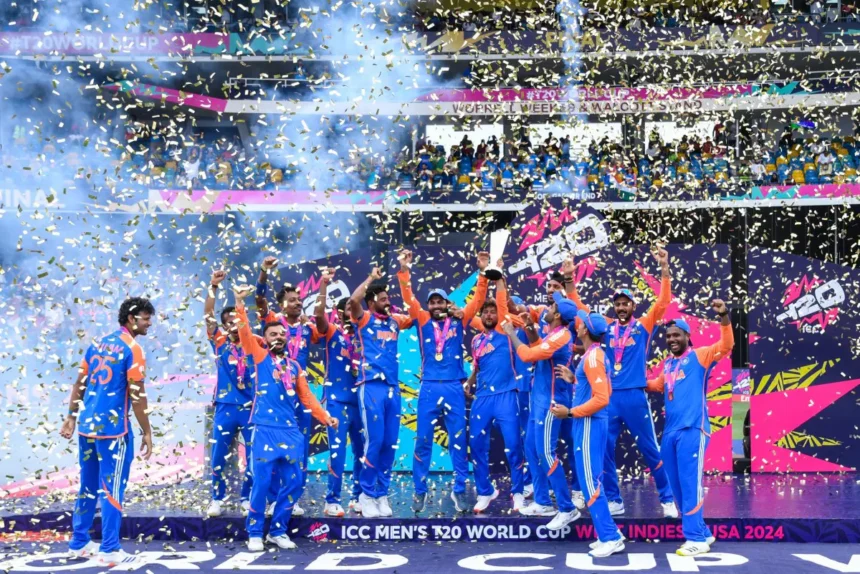
India Defend T20 World Cup Title After Dominant Win Over New Zealand
The T20 World Cup title no longer feels like a short-format prize India occasionally chases. After a ruthless 96-run win over New Zealand in Ahmedabad, it looks like the centrepiece of a new white-ball era. India did not simply win another final. They defended the crown, did it at home, and became the first men’s team to win three T20 World Cup titles.
The final score was brutal: India 255-5, New Zealand 159 all out in 19 overs. The scoreboard captured the difference between a team built for pressure and a team overwhelmed by it. Sanju Samson made 89, Abhishek Sharma launched the innings with a 52-run powerplay assault, Ishan Kishan added 54, and Jasprit Bumrah ended the contest with a final spell of 4-15 that turned New Zealand’s chase into survival.
This was the night India repaired the memory of Ahmedabad. In 2023, the Narendra Modi Stadium had staged one of Indian cricket’s most painful evenings, when Australia beat India in the 50-over World Cup final. In 2026, the same ground witnessed the opposite scene: a blue-clad crowd, a towering total, a broken chase and Suryakumar Yadav lifting the T20 World Cup title as captain.
The important correction to the early version of this story is that the final was not really about Abhishek Sharma alone, even though his fast fifty mattered. It was Samson who shaped the innings, Bumrah who settled the match, and India’s wider system that explained why the result felt so complete.
The Final in 60 Seconds
| Detail | India v New Zealand, 2026 T20 World Cup Final |
|---|---|
| Venue | Narendra Modi Stadium, Ahmedabad |
| Date | 8 March 2026 |
| Result | India beat New Zealand by 96 runs |
| India | 255-5 in 20 overs |
| New Zealand | 159 all out in 19 overs |
| Player of the Match | Jasprit Bumrah, 4-15 |
| Player of the Tournament | Sanju Samson |
| Historical meaning | First men’s team to defend the T20 World Cup title |
The ICC match centre confirmed India’s 96-run win, while the ICC final report described the night as a “coronation” rather than a contest. That was exactly how it felt. New Zealand won the toss, chose to bowl, and then watched India make the highest total ever scored in a men’s T20 World Cup final.
For readers following the tournament from earlier rounds, this result also connects directly with The News Ink’s coverage of India’s narrow semi-final win over England and our wider T20 World Cup 2026 team of the tournament coverage.
Act One: The Powerplay That Broke the Final
The final changed during the first six overs. New Zealand had a chance to test India early with the new ball, but the pressure moved in the other direction almost immediately. Samson and Abhishek were not reckless. They were violent with a plan.
India reached 92-0 after six overs, equalling the highest powerplay score in T20 World Cup history. That start was not only about boundaries. It was about psychological damage. New Zealand’s bowlers lost length, extras piled up, and India’s openers made the field look too small for the occasion.
Abhishek reached his half-century off 18 balls, giving India the kind of left-handed aggression that has become essential in modern T20 cricket. His 52 off 21 did not last long enough to become the innings of the match, but it created the launchpad. Samson then took over with the authority of a player who had timed his peak perfectly.
The T20 World Cup title was effectively decided by this opening phase because New Zealand never regained control. A chasing side can survive 190. It can fight 210. Against 255 in a final, it needs a near-perfect response. New Zealand were already chasing a fantasy before their innings began.
Act Two: Samson Turns Form Into Authority
Sanju Samson’s 89 was not a cameo. It was the innings that gave India structure after the first surge. He had already played a decisive role in the semi-final and entered the final with confidence, rhythm and clear tactical purpose. His shot selection was controlled even when the scoring rate was extreme.
The ICC later named Samson Player of the Tournament, noting that he made 321 runs in five matches at an average of 80.25 and a strike rate of 199.37. His tournament included 97 not out against West Indies, 89 against England in the semi-final, and another 89 in the final. That is not a purple patch; that is a championship-winning sequence.
For years, Indian cricket discussed Samson as a talent who did not always get a settled role. The 2026 tournament changed that. He was not a fringe name anymore. He was the batter who gave India’s title defence its biggest knockout innings.
This is why India’s T20 World Cup title should not be explained only through the usual superstar lens. Rohit Sharma and Virat Kohli had already moved beyond this format at international level. The 2026 triumph belonged to a new structure: Suryakumar’s captaincy, Samson’s late-tournament explosion, Kishan’s aggression, Abhishek’s left-handed power, Hardik Pandya’s balance, and Bumrah’s bowling control.
The News Ink’s cricket guide explains how different roles shape the game, and this final was a perfect case study. India did not win because every player did everything. India won because each player understood the role demanded by the format.
Act Three: Bumrah Removes the Last Doubt
A total of 255 can make bowlers careless. Bumrah did the opposite. New Zealand needed a fast start to make the chase believable, but India’s attack made early damage permanent. Rachin Ravindra fell cheaply, Finn Allen could not reproduce the destruction he had shown earlier in the tournament, and the chase soon became a long march toward the inevitable.
Bumrah’s 4-15 gave the final its finishing signature. His slower yorkers, changes of pace and control at the death made New Zealand’s lower order look trapped. The ICC named him Player of the Match, and the decision was impossible to argue with.
India’s batting built the wall. Bumrah locked the gate.
The most telling part of Bumrah’s tournament was not only the wickets. It was the economy. The ICC’s team of the tournament listed him with 14 wickets in eight matches at an economy of 6.21, joint-top for wickets with Varun Chakaravarthy. In a tournament where totals exploded and batting records fell, Bumrah remained the rare bowler who could slow the game down.
That is what made this T20 World Cup title different from a batting parade. India’s batting was intimidating, but the bowling gave them separation from every other side.
India’s Route Was Not Perfect — That Made It Stronger
The idea that India cruised from start to finish is too simple. Their road to the T20 World Cup title included stress, correction and one major setback.
The ICC road-to-final report showed that India were 77-6 in their tournament opener against the United States before Suryakumar made 84 and rescued a 29-run win. They later lost to South Africa by 76 runs in the Super Eight stage, with India bowled out for 111 after Marco Jansen and Keshav Maharaj shared seven wickets.
That defeat could have damaged the campaign. Instead, it sharpened India. They responded with a 72-run win over Zimbabwe, then beat West Indies and England on the way to the final. The earlier wobble is important because champions are often defined not by never being hit, but by how they behave after being hit.
The News Ink had already tracked India’s progress in pieces such as India thrash Zimbabwe and the tournament qualification picture in our semi-finals explainer. In hindsight, those games show the arc clearly: India were tested, adjusted, and arrived at the final with their best combination working.
Why New Zealand Could Not Keep Up
New Zealand reached another ICC white-ball final, but this one hurt because the gap was so visible. They had enough players to threaten India on paper. They had experience, pace options and hitters capable of changing a chase. Yet in Ahmedabad, every weakness was magnified.
The powerplay with the ball was untidy. The fielding could not rescue the bowling. The chase lost shape early. Once India’s total crossed 240, New Zealand needed their top order to produce something extraordinary. Instead, the innings was reduced to resistance.
This continues a difficult pattern for New Zealand in major white-ball finals. They have reached several ICC finals since 2015 but repeatedly fallen short. Their consistency is admirable, but the final step remains punishing. The T20 World Cup title match in Ahmedabad was not a last-ball heartbreak. It was a defeat by distance.
The earlier The News Ink report on Sri Lanka being knocked out by New Zealand showed how dangerous the Black Caps could be during the tournament. The final showed the other side of knockout cricket: against a peak India, good was nowhere near enough.
Suryakumar Yadav’s Quietly Historic Captaincy
Suryakumar Yadav made a golden duck in the final. It did not matter. His captaincy story was already written across the tournament.
He rescued India against the United States, gave the team a more aggressive T20 identity, and led a side that looked freer than several older Indian white-ball teams. That is not a criticism of the past. It is a recognition of the shift. The 2026 side played like a team built for the format rather than a team carrying the weight of older formats into it.
Suryakumar also joined a small group of Indian captains to win major ICC trophies. Kapil Dev, MS Dhoni and Rohit Sharma had already occupied that space in Indian cricket history. Suryakumar’s path was different. He became an international regular later than most stars, built his reputation through range and invention, and then captained India to a T20 World Cup title in front of a home crowd.
That route gives the victory a different texture. It was not the obvious coronation of a long-groomed captain. It was a late-career leader guiding a team that trusted clarity over hierarchy.
The IPL Engine Behind India’s Depth
India’s T20 World Cup title also reflects the depth created by the Indian Premier League. The IPL does not automatically win World Cups, but it prepares players for pressure, roles, matchups and crowd intensity in a way few domestic structures can match.
Abhishek Sharma’s powerplay aggression, Kishan’s tempo, Dube’s finishing, Varun’s middle-over threat and the calm of players moving in and out of the XI all point to a larger system. India can lose established names and still replace them with players who have faced elite bowlers in high-pressure environments.
That depth is difficult for other nations to match. It is not only about money, though financial strength clearly matters. It is about the volume of high-quality T20 cricket, the exposure to international coaches, the tactical data, and the expectation that young Indian players must produce in front of huge audiences.
The result is a national side with several possible XIs. That is why India can look vulnerable in one phase of a tournament and still finish with the T20 World Cup title. They have enough options to correct mistakes without panicking.
The Numbers That Defined India’s Title Defence
| India’s 2026 title marker | Why it matters |
|---|---|
| 255-5 in the final | Highest total in a men’s T20 World Cup final |
| 92-0 powerplay | Joint-highest powerplay score in T20 World Cup history |
| 96-run margin | One of the clearest final wins in tournament history |
| Three T20 World Cup titles | India moved ahead as the first men’s team to reach three |
| Back-to-back titles | First men’s side to defend the crown |
| Home triumph | First host team to win the men’s event |
| Sanju Samson POTT | Marked a major late-career tournament breakthrough |
| Bumrah 4-15 | Closed the final with elite control |
The Cricbuzz scorecard recorded the basic shape of the final: India 255-5, New Zealand 159, Bumrah Player of the Match. The Guardian match report captured the mood of the night, describing India’s dominance and New Zealand’s chase as a one-sided pursuit long before the 19th over ended.
Prize Money and the Bigger Commercial Picture
The ICC later confirmed that India received $2,639,423 from a total men’s T20 World Cup 2026 prize-money pool of $11.25 million. New Zealand, as runners-up, received $1,422,692. Those figures matter because the T20 World Cup title is now not only a sporting prize but a major commercial event.
The ICC prize-money announcement reflected the growing scale of the tournament. T20 cricket has become the format most capable of reaching casual fans, broadcasters, sponsors and new markets quickly. India’s dominance in that space gives the sport both a powerful centre and a difficult imbalance.
Other teams can catch India in one match. South Africa proved that earlier in the tournament. England pushed India close in the semi-final. New Zealand reached the final. But matching India across repeated tournaments is harder because the player pipeline is so deep.
This is where future tournaments become fascinating. The 2027 ODI World Cup in South Africa, Zimbabwe and Namibia will test India in different conditions. The 2028 T20 World Cup in Australia and New Zealand should bring pace, bounce and larger grounds. Cricket’s return to the Los Angeles 2028 Olympics also gives India another white-ball target.
For now, though, the T20 World Cup title belongs to a side that looks built for the next challenge as much as the last one.
What This Means for the Rest of World Cricket
India’s win creates a simple question: how does the rest of the world respond?
England still have explosive batting and the confidence of a team that believes in white-ball reinvention, even after their painful semi-final defeat. The News Ink’s coverage of Brook and England’s team unity showed why England remain a serious T20 force. South Africa produced the most convincing win over India during the tournament and still have a bowling group suited to major events. New Zealand remain consistent but must find a way to turn finals into trophies. Zimbabwe’s progress, covered in The News Ink’s piece on Zimbabwe cricket, also showed that the T20 map is broadening.
But India are setting the pace. They have hitters for every phase, bowlers who can survive flat pitches, and a selection pool that makes internal competition fierce. The danger for the rest is not only that India won this final. It is that they won it without depending on one once-in-a-generation innings.
This T20 World Cup title was a system win.
The Bottom Line
India defended the T20 World Cup title by playing the final exactly as champions should. They attacked early, kept attacking when the first wicket fell, turned scoreboard pressure into psychological pressure, then let Bumrah finish the work.
The 96-run margin over New Zealand was not a detail. It was the statement. India became the first men’s team to defend the T20 World Cup title, the first host nation to win it, and the first men’s side to claim three crowns. In the process, they turned Ahmedabad from a ground of 2023 heartbreak into the scene of 2026 redemption.
Samson’s 89 gave India authority. Abhishek’s 52 gave them ignition. Kishan’s 54 gave them continuity. Bumrah’s 4-15 gave them certainty. Suryakumar’s leadership gave them identity.
A final can sometimes exaggerate a team’s greatness. This one confirmed it. India are not merely holding the T20 World Cup title. They have become the team everyone else must measure themselves against.
For more cricket and sports coverage, join The News Ink on WhatsApp or read our latest cricket coverage.