Sign In
The News Ink™ | World News | Sports | Technology | Business
  • Technology
  • Anime
  • Sports
  • Business & Finance
  • Beauty & Fashion
  • Top Stories
  • More
    • Lifestyle
    • Bizarre
    • Current Affairs
    • Entertainment
    • Health
    • Opinion
    • Science
    • Travel
Reading: Sri Lanka Knocked Out as New Zealand Storms to 61-Run Win
Share
The News Ink™ | World News | Sports | Technology | BusinessThe News Ink™ | World News | Sports | Technology | Business
Font ResizerAa
  • Travel
  • Opinion
  • Science
  • Technology
  • Beauty & Fashion
  • Technology
  • Anime
  • Sports
  • Business & Finance
  • Beauty & Fashion
  • Top Stories
  • More
    • Lifestyle
    • Bizarre
    • Current Affairs
    • Entertainment
    • Health
    • Opinion
    • Science
    • Travel
Have an existing account? Sign In
The News Ink™ | World News | Sports | Technology | Business > Blog > Sports > Sri Lanka Knocked Out as New Zealand Storms to 61-Run Win
Sports

Sri Lanka Knocked Out as New Zealand Storms to 61-Run Win

Dowry Lane
Last updated: July 12, 2026 10:01 am
Dowry Lane
Share
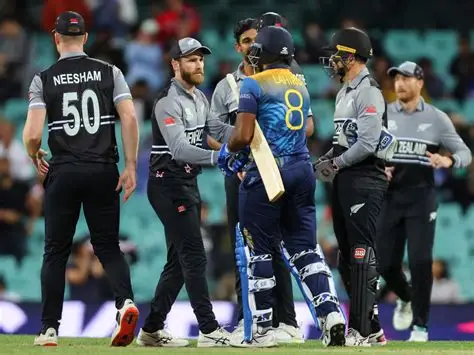
Sri Lanka knocked out after New Zealand win by 61 runs at the 2026 T20 World Cup
Mitchell Santner and Cole McConchie lead New Zealand to a 61-run win over Sri Lanka, knocking the hosts out of the T20 World Cup.
SHARE

Sri Lanka Knocked Out: Why New Zealand’s Dramatic 2026 Win Still Matters

Sri Lanka knocked out became the defining headline in Colombo after New Zealand turned a troubled batting innings into a commanding 61-run win at the 2026 T20 World Cup. What looked for 16 overs like a Sri Lankan rescue mission became a painful home exit, a New Zealand revival and one of the most important results in Super Eight Group 2.

Contents
Sri Lanka Knocked Out: Why New Zealand’s Dramatic 2026 Win Still MattersHow Sri Lanka knocked out became the night’s storySantner and McConchie rescued New ZealandRavindra’s all-round performance broke the chaseMatt Henry made the chase feel impossible earlyWhy Sri Lanka’s batting collapse hurt so badlyNew Zealand’s net run-rate cushion mattered laterWhat the result meant for Group 2Sri Lanka’s home campaign ended with unanswered questionsWhy New Zealand’s win carried into the semi-finalWhat Sri Lanka can learn from New ZealandKey numbers from Sri Lanka vs New ZealandWhy the result still matters after the finalThe careful takeaway

The original match report rightly focused on Sri Lanka knocked out of semi-final contention after collapsing in pursuit of 169. But the tournament has now moved on, so the updated story needs more context. New Zealand did not merely keep themselves alive with this win. They eventually reached the semi-finals on net run-rate, crushed South Africa by nine wickets in Kolkata and reached the final, where India beat them by 96 runs in Ahmedabad.

That later path makes Sri Lanka knocked out more significant than a one-night result. New Zealand’s win over the co-hosts became the net run-rate cushion that Pakistan could not erase. Sri Lanka, meanwhile, were left to finish a disappointing Super Eight campaign that had promised much at home but ended without a win in the second phase.

New Zealand made 168-7 after being 84-6, then bowled Sri Lanka out for 107-8. Mitchell Santner’s 47 from 26 balls and Cole McConchie’s unbeaten 31 from 23 changed the first innings. Rachin Ravindra then completed the job with a brilliant all-round performance, scoring 32 from 22 and taking 4-27. Matt Henry’s new-ball spell of 2-3 from two overs set the tone for Sri Lanka’s chase to fall apart.

For readers following The News Ink’s wider cricket coverage, the match is a perfect example of how T20 games turn. Sri Lanka dominated the middle overs, lost control at the death, then collapsed under scoreboard pressure. New Zealand looked vulnerable, adapted quickly and turned one late partnership into a route toward the last four.

How Sri Lanka knocked out became the night’s story

Sri Lanka knocked out was not the expected direction when New Zealand slumped in the first innings. The hosts had clear control for long periods. Maheesh Theekshana was outstanding early, taking 3-9 in his first three overs and giving Sri Lanka a chance to restrict New Zealand to something close to 130.

Dushmantha Chameera also bowled with discipline, and New Zealand’s middle order faltered badly. They slipped from 75-2 to 84-6 in less than three overs. At that stage, Sri Lanka had done almost everything right. The crowd had energy, the bowlers had rhythm, and New Zealand’s batting order looked uncertain.

But Sri Lanka knocked out became possible because the hosts could not finish the innings. Santner and McConchie changed the tempo completely. Their partnership added 84 for the seventh wicket, with 70 runs coming in the final four overs. That late surge lifted New Zealand to 168-7, a total that looked far bigger than it had any right to be after the collapse.

The final four overs changed the emotional shape of the match. Sri Lanka went from chasing a modest target to facing a total that required composure. Instead, their batting line-up folded.

Santner and McConchie rescued New Zealand

The Santner-McConchie partnership deserves to be treated as the first match-winning phase. When they came together, New Zealand were in trouble. They had lost wickets in clusters and looked short of batting depth. Sri Lanka’s spinners were controlling pace, length and field pressure.

Santner responded like a captain. His 47 from 26 balls was not a reckless swing from a lower-order batter. It was a calculated counterattack. He chose the right moments to target the boundary and forced Sri Lanka to change plans at the worst possible time.

McConchie’s 31 not out from 23 balls was just as important. He did not need to match Santner shot for shot. He needed to stay calm, keep turning over strike and punish loose balls. Together, they turned 84-6 into 168-7, which was enough to make Sri Lanka’s chase feel uncomfortable from the start.

This is why Sri Lanka knocked out is also a lesson in death-overs control. A team can dominate 16 overs and still lose the innings if the final four overs are too expensive. Sri Lanka’s bowling plans, so effective earlier, lost clarity just when New Zealand had no choice but to attack.

Ravindra’s all-round performance broke the chase

Rachin Ravindra was named player of the match, and the decision was easy to understand. His 32 from 22 balls gave New Zealand useful early runs, but his bowling made the bigger difference. Ravindra’s 4-27 destroyed Sri Lanka’s middle order and removed any hope of a controlled chase.

Sri Lanka knocked out became almost certain when Ravindra struck twice in the ninth over. Kusal Mendis and Pavan Rathnayake were both stumped, leaving Sri Lanka at 29-4. That over ended any illusion that the hosts could rebuild calmly. They were already behind the asking rate, four wickets down and trapped against spin.

Ravindra’s spell worked because it attacked both technique and decision-making. Sri Lanka’s batters had to chase boundaries, but they also had to respect turn and flight. That tension created mistakes. The required rate climbed. The crowd quietened. New Zealand sensed that the game had moved permanently their way.

For a player often discussed first as a batter, Ravindra’s bowling impact was a reminder of his wider value. He changed the match in both innings and gave New Zealand a performance that later helped shape their route to the semi-finals.

Matt Henry made the chase feel impossible early

Before Ravindra took over, Matt Henry made sure Sri Lanka never had a comfortable start. His two-over burst produced 2-3, including a first-ball strike against Pathum Nissanka. That wicket gave New Zealand immediate control.

Powerplay wickets matter more when a team is chasing a target that feels just above par. Sri Lanka did not need 220. They needed 169. But losing wickets so early turned a manageable chase into a pressure chase. Every dot ball became heavier. Every new batter had to start against a fielding side that could attack.

Sri Lanka knocked out was confirmed later, but Henry’s spell created the conditions for the collapse. He denied Sri Lanka the opening platform they needed. Once the top order failed, the middle order had to rebuild and accelerate at the same time.

That is a difficult task in T20 cricket. Sri Lanka were not able to do it.

Why Sri Lanka’s batting collapse hurt so badly

The biggest disappointment for Sri Lanka was not simply that they lost. It was how they lost. In a home World Cup, chasing 169 after a strong bowling performance should have produced a serious contest. Instead, Sri Lanka were 20-2 after the powerplay, 29-4 by the ninth over and never close to the target.

Sri Lanka knocked out in that manner exposed deeper problems. Their top order could not absorb early pressure. Their middle order could not reset the chase. Their lower order did not have the power to turn 107-8 into anything threatening. A team that needed calm became frantic almost immediately.

Sri Lanka knocked out at home also showed why home advantage is not enough. Colombo conditions helped Sri Lanka’s bowlers for 16 overs, but the same conditions then exposed the batters. New Zealand’s spinners and seamers used the surface more effectively when scoreboard pressure arrived.

Sri Lanka’s final Super Eight game against Pakistan later ended in another defeat, this time by five runs in Pallekele. That result confirmed a winless Super Eight phase. For a co-host, it was a painful finish.

New Zealand’s net run-rate cushion mattered later

Sri Lanka knocked out by a 61-run margin became crucial beyond Colombo. It was the immediate consequence, but New Zealand’s net run-rate boost was the longer-term value. They later lost to England, which left Pakistan with a chance to pass them in the table. Pakistan beat Sri Lanka, but not by enough.

Pakistan made 212-8 and restricted Sri Lanka to 207-6. That was a five-run win, but it did not improve Pakistan’s net run-rate enough to overtake New Zealand. The result meant New Zealand advanced to the semi-finals despite finishing level with Pakistan on points.

That is why this match should not be remembered only as Sri Lanka knocked out. It was also the result that protected New Zealand. The 61-run margin gave them a cushion. Without it, Pakistan’s final win could have changed the entire tournament bracket.

The News Ink’s full guide to the T20 World Cup semi-finals explains how New Zealand joined England from Group 2, while South Africa and India advanced from Group 1. The Sri Lanka match was one of the key results behind that final table.

What the result meant for Group 2

Group 2 had three different stories running at once. England were already moving strongly toward the semi-finals. New Zealand were trying to stay ahead of Pakistan. Sri Lanka were fighting to avoid elimination in front of their own supporters.

Sri Lanka knocked out simplified the race. After this result, the group became a contest between New Zealand and Pakistan for the second qualifying place behind England. Sri Lanka’s final match against Pakistan still mattered, but not for their own qualification hopes. It mattered because Pakistan needed a huge win.

Sri Lanka knocked out before their final game created a difficult position for an eliminated team. Sri Lanka had pride to play for, home supporters to answer to and a chance to damage Pakistan’s hopes. They nearly did that in Pallekele by pushing Pakistan close, but the earlier New Zealand defeat had already ended their own tournament dream.

For New Zealand, Group 2 became a lesson in tournament survival. They did not finish the Super Eight stage perfectly. They did enough. In a format shaped by small margins, that was enough to reach the last four.

Sri Lanka’s home campaign ended with unanswered questions

Sri Lanka knocked out at home will raise difficult questions about planning, selection and batting structure. The hosts were not short of talent. Theekshana, Chameera, Kusal Mendis, Wanindu Hasaranga, Pathum Nissanka and others have experience and skill. But the Super Eight stage exposed the gap between potential and execution.

Sri Lanka knocked out did not mean the bowling showed no promise. Reducing New Zealand to 84-6 was not an accident. The early overs showed Sri Lanka could still control good teams with spin, pace variation and field pressure.

The batting was the bigger concern. Against New Zealand, it lacked calm. Against Pakistan, Sri Lanka came close but could not finish. Across the Super Eight stage, the side did not produce enough complete performances. A strong phase was too often followed by a damaging collapse.

Sri Lanka knocked out should therefore be viewed as more than one bad night. It was the visible end of a campaign that lacked batting reliability when the tournament became serious.

Why New Zealand’s win carried into the semi-final

Sri Lanka knocked out became more important after New Zealand’s later semi-final performance. After surviving Group 2, they faced unbeaten South Africa at Eden Gardens in Kolkata. South Africa made 169-8. New Zealand chased 173-1 in only 12.5 overs, with Finn Allen scoring a sensational hundred.

That knockout win showed that New Zealand had not simply stumbled into the semi-finals. They had momentum, clarity and players capable of deciding games quickly. The Sri Lanka win had been the first sign of that sharpness in the Super Eight stage.

Sri Lanka knocked out was therefore part of New Zealand’s wider tournament arc. They were under pressure, rescued a poor batting position, bowled with precision, protected their net run-rate and then used that qualification route to reach the final.

New Zealand eventually lost the final to India by 96 runs, but their campaign still had clear strengths. The win in Colombo was one of them.

What Sri Lanka can learn from New Zealand

Sri Lanka knocked out because of execution as much as talent. The biggest difference between the teams was not the quality available on paper. It was adaptability. New Zealand adapted inside the match. Sri Lanka did not.

When New Zealand collapsed, Santner and McConchie changed the plan. They did not try to bat as if the top order had succeeded. They rebuilt, then attacked late. When Sri Lanka began the chase badly, there was no equivalent response. The batters kept falling before the innings found shape.

That is why Sri Lanka knocked out should push the team toward role clarity. Who absorbs pressure in a chase? Who attacks spin? Who finishes? Who changes gears if the powerplay fails? T20 teams need answers before the match, not during the collapse.

The News Ink’s sports training and technology guide explains why modern teams increasingly use role-specific planning. Cricket is no different. Phase control, matchup awareness and pressure roles now decide games as much as raw talent.

Key numbers from Sri Lanka vs New Zealand

Detail Figure
Venue R. Premadasa Stadium, Colombo
New Zealand score 168-7
Sri Lanka score 107-8
Result New Zealand won by 61 runs
Player of the match Rachin Ravindra
Rachin Ravindra 32 off 22 and 4-27
Mitchell Santner 47 off 26
Cole McConchie 31 not out off 23
Matt Henry 2-3 from two overs
New Zealand recovery From 84-6 to 168-7
Late surge 70 runs in final four overs

The table shows the story clearly. New Zealand won because their lower order rescued the innings, their new-ball bowling damaged Sri Lanka early, and Ravindra’s spin finished the chase.

Why the result still matters after the final

Now that the tournament has finished, Sri Lanka knocked out might seem like a smaller story than India’s title or New Zealand’s run to the final. But it remains important because it shaped the route of the knockout stage.

If Sri Lanka had won, New Zealand’s semi-final hopes would have been badly damaged. Pakistan’s path would have changed. England’s final group match would have carried different pressure. The semi-final line-up might have been different. That is how connected tournament cricket can be.

Instead, New Zealand’s 61-run win gave them control of their own net run-rate position. They could afford the later England defeat because Pakistan failed to win big enough. That made the Sri Lanka match one of the hidden turning points of the tournament.

For Sri Lanka, the result will hurt because they had the match in reach for more than half of New Zealand’s innings. Losing from that position is far harder than being dominated from the first ball. It suggests the problem was not only skill, but finishing.

The careful takeaway

Sri Lanka knocked out of the 2026 T20 World Cup after a 61-run defeat to New Zealand, but the result deserves more than a simple elimination headline. Sri Lanka had New Zealand under control at 84-6, then lost the final four overs, the chase, and their semi-final hopes in one painful collapse.

Santner and McConchie turned New Zealand’s innings around. Ravindra and Henry then made sure Sri Lanka could not recover. The victory gave New Zealand the net run-rate cushion that later helped them reach the semi-finals, beat South Africa and reach the final against India.

For Sri Lanka, the match was a warning about finishing games. Bowling well for 16 overs was not enough. Starting a chase without structure was not enough. Home conditions were not enough.

For New Zealand, it was the opposite lesson. A team can be in trouble, adapt quickly and still leave with a decisive win. That is why Sri Lanka knocked out remains one of the most important Super Eight results of the 2026 T20 World Cup.

For more cricket analysis, tournament updates and sports features, follow The News Ink on Medium.

Subscribe to Our Newsletter

Subscribe to our newsletter to get our newest articles instantly!

[mc4wp_form]
TAGGED:Cole McConchieMatt HenryMitchell SantnerNew Zealand CricketRachin RavindraSri Lanka cricketSri Lanka knocked outSri Lanka Knocked Out as New Zealand Storms to 61-Run WinSri Lanka vs New ZealandSuper EightT20 World Cup 2026
Share This Article
Twitter Email Copy Link Print
Previous Article Markram’s 82 for South Africa against West Indies at the 2026 T20 World Cup Markram’s 82* Leads South Africa to Win Over West Indies
Next Article Warner Bros Paramount deal reshaping streaming cinemas and Hollywood media What the Warner Bros–Paramount Deal Could Mean for Streaming, Cinemas, and Media
Leave a comment

Leave a Reply Cancel reply

You must be logged in to post a comment.

Editor's Pick

Hot News

GHC Sportswear® Expands Global Reach as Certified Custom Apparel Manufacturer Serving Brands in 20+ Countries

GHC Sportswear®: Certified Custom Apparel Manufacturer in Pakistan for Global…

June 5, 2026

Employee Revolt Forces Meta U-Turn: Workers Can Now Pause AI Keystroke Tracking for 30 Minutes After “Dystopian” Backlash

Meta Workers Opt Out Tracked Work…

June 4, 2026

SpaceX IPO Valuation Soars to $1.75 Trillion as Elon Musk Targets Record-Breaking Market Debut

Introduction The SpaceX IPO valuation has…

June 4, 2026

Economy Guide: Inflation, Interest Rates, and Recessions Explained

How the Economy Works: Inflation, Interest…

June 3, 2026

Take Control of Your Money: 12 Powerful Habits for a Stronger Financial Future

Take Control of Your Money: 12…

June 3, 2026

You Might Also Like

Norway vs England 2026 FIFA World Cup quarter-final as England win 2-1 after extra time
Sports

Norway vs England: 7 Powerful Takeaways From a Critical 2026 FIFA World Cup Quarter-Final

Norway vs England: 7 Powerful Takeaways From a Critical 2026 FIFA World Cup Quarter-Final Norway vs England gave the 2026…

27 Min Read
Kon Knueppel NBA record after Charlotte Hornets rookie reaches 200 three-pointers
Sports

Rookie Kon Knueppel Sets NBA Record for Fastest 200 Three-Pointers

Kon Knueppel NBA Record: Stunning Rookie Shooting History as Hornets Rout Bulls The Kon Knueppel NBA record story has become…

19 Min Read
World Cup legends including Messi Maradona and Pele
Sports

World Cup Legends Ranked: Messi, Maradona, Pele and the Greatest Players Ever

World Cup Legends: Ranking the Greatest Icons in Football History World Cup Legends Who Defined Football's Biggest Stage World Cup…

8 Min Read
England move closer to win against New Zealand at Lord's Test
Sports

England Move Closer to Win After Robinson’s Masterclass Puts New Zealand on the Brink

England Move Closer to Win in Rain-Affected Lord’s Test England move closer to win the opening Test against New Zealand…

9 Min Read
The News Ink™ | World News | Sports | Technology | Business

Categories

  • Anime
  • Beauty & Fashion
  • Bizarre
  • Business & Finance
  • Current Affairs

Explore

  • Top Stories
  • Entertainment
  • Health
  • Lifestyle
  • Opinion

More

  • Science
  • Sports
  • Technology
  • Travel

Legal Docs

  • Home
  • About Us
  • Contact
  • Blog
  • Privacy Policy
  • Terms and Conditions

© The News Ink. All Rights Reserved. Powered By IQC Solutions ®

Oil prices slide after hopes rise for a US-Iran peace agreement
Join Us!

Subscribe to our newsletter and never miss our latest news, podcasts etc..

Zero spam, Unsubscribe at any time.
Go to mobile version
Welcome Back!

Sign in to your account

Register Lost your password?