Ghislaine Maxwell Connected Bill Clinton to Epstein’s Inner Circle: What the Critical Files Show
Ghislaine Maxwell connected Bill Clinton to Jeffrey Epstein’s social and philanthropic circle in ways that are now receiving renewed scrutiny after the release of Justice Department records, congressional interviews and previously unseen photographs from the early 2000s.
The new material does not accuse Clinton of criminal wrongdoing. That point is essential. Clinton has denied knowing about Epstein’s crimes, has denied visiting Epstein’s private island and has not been charged in connection with Epstein or Maxwell. None of the reviewed material establishes misconduct by the former president.
What the records do show is different but still important. They show how Epstein’s world overlapped with elite politics, philanthropy, celebrity access and donor networking. In that world, Maxwell was not merely a background figure. She appears as a social connector who had access to Clinton’s post-presidency circle, communicated with Clinton aides and helped maintain relationships around travel, events and introductions.
That is why Ghislaine Maxwell connected Bill Clinton is a story that should be reported with precision rather than exaggeration. The issue is not whether the files prove criminal conduct by Clinton. They do not. The issue is how Epstein and Maxwell gained proximity to powerful people, how that proximity helped build influence, and why those links are still being examined years after Epstein’s death and Maxwell’s conviction.
Why Ghislaine Maxwell connected Bill Clinton is back in the spotlight
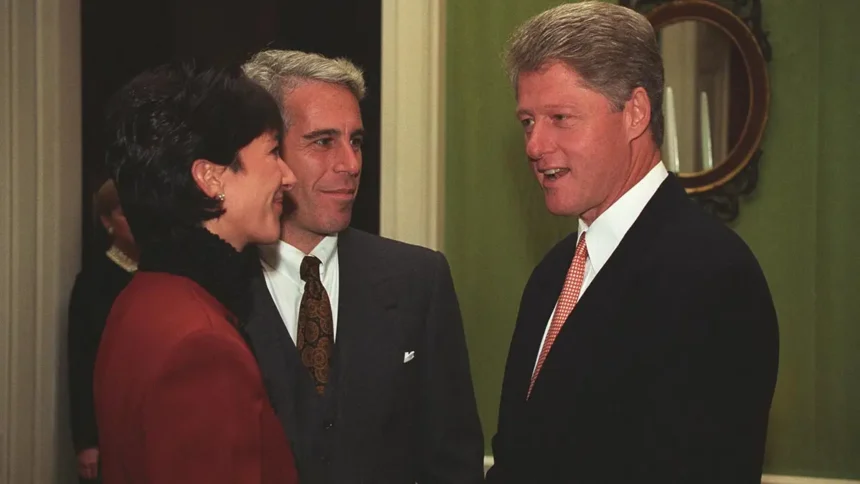
Ghislaine Maxwell connected Bill Clinton has returned to the news because the first major Justice Department release of Epstein-related files included several images of Clinton. Associated Press reported that the released material showed Clinton on Epstein’s private plane, in a pool with Maxwell and another redacted person, and in a hot tub with a woman whose face was redacted. The Justice Department did not provide full context for the photographs.
The photos alone do not prove wrongdoing. They do, however, document Clinton’s presence in Epstein and Maxwell’s orbit at a time when Epstein was cultivating relationships with politicians, celebrities, financiers and philanthropists.
That matters because Epstein’s power was not only financial. It was social. His influence came from access: the ability to host, fly, introduce, donate, advise and appear close to important people. Maxwell’s role was central to that system. She moved comfortably through elite circles and helped connect people who could strengthen Epstein’s standing.
The latest files therefore turn a familiar question into a more detailed one. It is no longer only “Did Clinton know Epstein?” Clinton has already acknowledged knowing him. The more important question is how that relationship was built, who helped maintain it, and what the documents reveal about the machinery of access.
For readers following the related political scrutiny, The News Ink has also covered how Bill Clinton denied knowledge of Epstein’s crimes during congressional testimony.
What the released photos show — and what they do not
The most discussed images show Clinton in social settings connected to Epstein’s wider world. One photo released by the Justice Department shows Clinton swimming with Maxwell and another person whose face is redacted. Another shows Clinton with Jeffrey Epstein. Other images show Clinton in travel or entertainment settings.
Ghislaine Maxwell connected Bill Clinton is a sensitive phrase because photographs can be powerful but incomplete. A photo can show proximity. It cannot automatically show knowledge, intent or participation in criminal activity.
That distinction matters legally and ethically. Epstein was later exposed as a serial sex offender. Maxwell was convicted in 2021 of helping him exploit and traffic girls. But many people photographed with Epstein or Maxwell have never been accused of criminal conduct. Inclusion in investigative files does not mean guilt.
The responsible reading is this: the images help document Epstein’s access to Clinton’s world, and they show Maxwell’s visible presence in that access. They do not, by themselves, show that Clinton knew about Epstein’s crimes.
That is why this article avoids unsupported claims. It focuses on the documented relationship, the role of aides, the philanthropic context and the congressional questions now being asked.
Doug Band’s role in the Clinton-Epstein link
Ghislaine Maxwell connected Bill Clinton partly through the world around Doug Band, Clinton’s longtime aide and adviser. Band was central to Clinton’s early post-presidency operation and helped turn Clinton’s public profile into a global philanthropic network.
ABC News reported that House Oversight Committee Chairman James Comer said lawmakers wanted to question Band because he set up meetings between Clinton and Epstein, accompanied Clinton on several Epstein jet flights and communicated with Maxwell. Band has not been accused of wrongdoing.
Band’s role matters because former presidents rarely manage every logistical detail personally. Travel, meetings, donor introductions and event access often pass through aides. If Epstein and Maxwell wanted proximity to Clinton, aides and schedulers were the practical route.
The records suggest Maxwell’s exchanges with Clinton staff were not random. They involved travel, meetings and social arrangements during the years when Clinton was building his post-presidential philanthropy and later the Clinton Global Initiative.
That is why Ghislaine Maxwell connected Bill Clinton is not only a story about a former president. It is also a story about staff networks, gatekeepers and the way influential outsiders move through political institutions.
Timeline: Clinton, Epstein and Maxwell scrutiny
| Period | Development | Why it matters |
|---|---|---|
| Early 2000s | Clinton travels on Epstein’s private plane for philanthropic trips | Documents Epstein’s access to Clinton’s post-presidency circle |
| 2002–2004 | Maxwell communicates with Clinton aides, including Doug Band | Shows Maxwell’s role as a connector around logistics and events |
| 2006–2008 | Epstein faces criminal allegations and later a controversial plea deal | His public reputation begins to change sharply |
| 2019 | Epstein is arrested on federal sex-trafficking charges and dies in jail | Renewed scrutiny falls on his network |
| 2021 | Maxwell is convicted of sex trafficking and related offences | Her role in Epstein’s crimes is legally established |
| 2025–2026 | DOJ and congressional releases bring new photos and records into public view | Clinton’s past links with Epstein and Maxwell return to political focus |
This timeline shows why Ghislaine Maxwell connected Bill Clinton remains a live story even though many of the events are more than two decades old. The documents are old, but their release is new, and the public questions have not gone away.
Clinton’s public position
Clinton’s position has been consistent on the central allegations. He has said he did not know about Epstein’s crimes, has denied visiting Epstein’s island and has said his contact with Epstein ended before Epstein’s criminal conduct became widely known.
His spokesman has also argued that the focus on Clinton is politically motivated. After the photo release, Clinton aide Angel Ureña said the Epstein investigation was not about Clinton and accused political opponents of trying to shift attention away from other questions in the files.
Ghislaine Maxwell connected Bill Clinton remains politically explosive because the Epstein story has become a proxy battle. Republicans have highlighted Clinton’s connections. Democrats have pointed to Trump’s past relationship with Epstein. Survivors and transparency advocates have argued that the focus should remain on accountability, disclosure and the people Epstein harmed.
The strongest reporting approach is to separate those layers. Clinton’s association with Epstein and Maxwell is documented. Clinton has not been accused of wrongdoing. Political actors may use the files selectively. Survivors continue to demand fuller transparency.
What Maxwell said about Clinton’s circle
In a 2025 Justice Department interview transcript, Maxwell described spending time around Clinton after he left the White House, as he was building his foundation work and the Clinton Global Initiative. According to ABC/GMA, Maxwell said she was part of the early process around the Clinton Global Initiative and said Epstein “may have helped” her help the Clinton operation.
That statement should be treated carefully. Maxwell is a convicted sex trafficker, and her claims require scrutiny. Still, her words are relevant because they match the wider documentary picture: she had access, she interacted with Clinton’s team and she presented herself as useful in elite networking settings.
This is one reason Ghislaine Maxwell connected Bill Clinton has become a serious document-driven story rather than just an online accusation. It is not built only on speculation. It is built on photos, flight records, communications, testimony and congressional interviews.
The question is what those records mean. They show access and influence. They do not show that Clinton participated in Epstein’s crimes.
Why the private jet matters
Much of the public attention has focused on Epstein’s private plane. Flight logs have long been a central piece of Epstein reporting because they document who travelled with him, when and where.
ABC/GMA reported that records created by Epstein’s pilots and made public through civil litigation show Clinton and an entourage that typically included Doug Band aboard Epstein’s plane on more than two dozen flight legs in 2002–03. The same report said pilot logs did not show those flights going to Little St. James, Epstein’s private island.
Ghislaine Maxwell connected Bill Clinton partly through these travel arrangements because the plane was more than transport. It was a tool of access. For Epstein, offering private travel to a former president created proximity and prestige. For Clinton’s team, private travel helped support foundation-related trips and global outreach.
That does not mean every passenger knew Epstein’s crimes. It means Epstein understood how access worked. He used his resources to place himself near powerful people, and Maxwell helped sustain those relationships.
Why the Clinton Global Initiative context matters
After leaving the White House, Clinton built a major philanthropic operation. The Clinton Foundation and the Clinton Global Initiative gave him a global platform where politicians, billionaires, celebrities, executives and activists could gather around public-health, development and humanitarian projects.
That environment made introductions valuable. Donors wanted access. Public figures wanted proximity to Clinton’s network. People with money, planes or elite social connections could become useful quickly.
Ghislaine Maxwell connected Bill Clinton within that ecosystem, according to the records now under scrutiny. Her value was not policy expertise in the traditional sense. It was social access. She knew wealthy people, moved through elite gatherings and was close to Epstein, who wanted legitimacy and influence.
The broader lesson is that philanthropic networks can be vulnerable to reputational risk when access is treated as currency. The more a foundation depends on wealthy donors and global convening, the more carefully it must vet who enters the circle.
The legal boundary: scrutiny is not an allegation
Ghislaine Maxwell connected Bill Clinton is a headline that requires a strong legal boundary. Clinton’s links to Epstein and Maxwell are documented. That does not make Clinton responsible for Epstein’s crimes. It does not establish knowledge of abuse. It does not create a criminal allegation.
The same principle should apply to every person named in Epstein-related material. Some were accused of crimes or civil misconduct. Others were social contacts, business contacts, donors, passengers, employees or people whose names appeared in address books and files. The categories must not be collapsed.
Maxwell’s conviction is different. She was found guilty of helping Epstein recruit and exploit girls. Epstein’s crimes are established. But guilt does not transfer automatically to everyone who met him.
That is why this article repeatedly states what is known and what is not known. The known facts are proximity, travel, communications and renewed congressional scrutiny. The unknowns include the full context of many photos and what Clinton personally understood about Epstein’s conduct at the time.
What Congress is investigating
The House Oversight Committee has been examining Epstein’s network, the handling of federal records and the relationships between Epstein, Maxwell and powerful figures. Lawmakers have questioned former Epstein associates, former staff and prominent people who appeared in documents.
Ghislaine Maxwell connected Bill Clinton is part of that investigation because Clinton’s name appears in files, photos and travel records. Doug Band’s role is also central because he was one of the staff figures who could explain how meetings, flights and introductions were arranged.
ABC/GMA reported that Band’s committee appearance was voluntary and not recorded, and that transcripts are usually reviewed for accuracy and redacted to protect potential victim information. The same report said the committee had recently heard from Bill Gates and former Epstein assistants, with more interviews scheduled.
The congressional process may clarify some details. It may also become more political. Both things can be true. Epstein’s network deserves scrutiny, but politicians can still use parts of that scrutiny for partisan advantage.
Key questions the documents raise
The documents do not settle every issue. Instead, they raise questions that investigators, journalists and the public are still trying to answer.
- How did Epstein first become useful to Clinton’s post-presidential operation?
- What role did Maxwell play in maintaining access to Clinton’s aides?
- Which trips were connected to foundation work, and who arranged them?
- How much did Clinton’s team know about Epstein’s conduct before his first criminal case?
- Why did elite institutions continue to accept Epstein’s access for so long?
- What should foundations and political offices learn from the failure to vet powerful donors and connectors?
These questions show why Ghislaine Maxwell connected Bill Clinton remains important without needing to overstate the evidence. The core issue is not only Clinton. It is how Epstein’s influence machine worked.
The wider Epstein lesson
The Epstein scandal has lasted because it is not simply a criminal case. It is also a story about class, money, secrecy and elite impunity. Epstein’s power came from his ability to move between worlds: Wall Street, politics, academia, philanthropy, science, media and royalty.
Maxwell helped him navigate those worlds. Her social background and confidence gave Epstein access that money alone may not have achieved. She could make introductions, host, flatter, organise and normalise his presence.
That is why Ghislaine Maxwell connected Bill Clinton is not merely about one former president’s poor association. It is about a pattern in which powerful people accepted Epstein’s access before, during and even after warning signs appeared.
The files matter because they show how networks work in practice. Not through a single dramatic conspiracy, but through dinners, flights, events, gifts, introductions and the quiet trust that comes when someone appears to know everyone.
How readers should interpret the files
Readers should approach the Epstein files with two ideas at the same time. First, the public deserves transparency. Epstein and Maxwell harmed vulnerable girls, and many survivors still believe the full story of Epstein’s network has not been told. Second, transparency must not become reckless accusation.
Ghislaine Maxwell connected Bill Clinton is a legitimate subject because the records show real links. But those links must be described accurately. A photograph is not proof of a crime. A flight is not proof of abuse. A meeting is not proof of knowledge.
The files should be used to map access, identify contradictions, test public statements and demand accountability where evidence supports it. They should not be used to turn every association into an unsupported allegation.
This is especially important for news publishers. Epstein stories draw traffic, but careless wording can mislead readers and create legal risk. The strongest article is not the loudest one. It is the one that survives fact-checking.
Why this story still matters in 2026
Ghislaine Maxwell connected Bill Clinton remains significant because Epstein’s network is still being investigated years after his death. Maxwell is imprisoned. Epstein is dead. But the institutions and people that enabled his access remain subjects of public concern.
The Clinton material matters because it shows how Epstein moved from being a wealthy financier to someone who could appear near a former president. The Trump material matters for similar reasons. So do the records involving business leaders, academics, bankers and entertainment figures.
The public question is broader than partisan blame. How did Epstein get so close to so many powerful people? Why were warnings missed or ignored? Why did elite circles continue to reward access and wealth even when reputational risks were obvious?
The answer will not come from one photo or one email. It will come from careful reconstruction of the network.
The bottom line
Ghislaine Maxwell connected Bill Clinton to Epstein’s inner circle through the world of early-2000s elite philanthropy, travel and political access. The released files show photos, flights, communications and social proximity that deserve scrutiny. They also show why Maxwell’s role as a connector was so important to Epstein’s influence.
But the limits of the evidence are just as important. The files do not accuse Clinton of criminal wrongdoing. Clinton has denied knowledge of Epstein’s crimes and denied visiting Epstein’s island. Flight records cited in public reporting show Clinton travelled on Epstein’s plane on multiple legs, but not to Little St. James.
The real story is not that the documents prove what they do not prove. The real story is how Epstein and Maxwell used access to build credibility among powerful people, and how those connections still haunt politics, philanthropy and public trust.
Ghislaine Maxwell connected Bill Clinton is therefore best understood as a documented access story, not a proven criminal accusation. It shows how Epstein’s circle reached into the highest levels of public life — and why the full history of that access still matters.
For more updates on major investigations and global politics, follow The News Ink on Threads.