Israeli Strike on Lebanese Town: The Tahan Family, 8 Deaths and the War That Followed
The Israeli strike on Lebanese town Younine on 11 March 2026 killed eight members of an extended family as they gathered for iftar during Ramadan, turning a small home and adjoining shop in the Bekaa Valley into one of the most personal symbols of Lebanon’s renewed war with Israel. Three children were among those killed. Local relatives and neighbours said the family members were civilians, while the Israeli military told the BBC that it had targeted “Hezbollah terrorist infrastructure” while Hezbollah operatives were present.
Months later, the Israeli strike on Lebanese town Younine can be understood in a much wider context. The attack took place less than two weeks after Hezbollah re-entered direct fighting with Israel on 2 March during the broader Iran-Israel war. What followed was a destructive campaign across Lebanon that eventually killed thousands, displaced more than a million people and damaged tens of thousands of homes before a June ceasefire sharply reduced the fighting.
The central factual dispute around Younine has never been fully resolved in public. Israel said the site was connected to Hezbollah. Relatives, neighbours and a local official rejected that account, and the Lebanese health ministry described those killed as civilians. A Lebanese military inspection was also said by a local official to have found no weapons or military equipment at the scene. No publicly available evidence cited in the reporting reviewed for this article independently established that the people killed were Hezbollah operatives.
What happened in the Israeli strike on Lebanese town Younine
The Israeli strike on Lebanese town Younine hit at about 6:15 p.m. on Wednesday, 11 March, according to later reporting by L’Orient-Le Jour. Members of the Tahan family had gathered at the home of Ali and Ola Tahan to break the Ramadan fast.
Ali and Ola were there with family members including their sons and grandchildren. Ali’s brother Ahmad Tahan, Ahmad’s wife and children were also present. Later reporting identified the gathering as involving three branches of the family. Three people survived and were taken to hospital; eight others were killed.
The BBC, which visited the site days later, reported that the victims included three children and described their ages at the time as five, nine and 14. Other later reports gave slightly different ages for some of the children. Because casualty identification can shift in the immediate aftermath of mass-casualty attacks, this rewrite avoids presenting disputed age details as more certain than the underlying reporting supports.
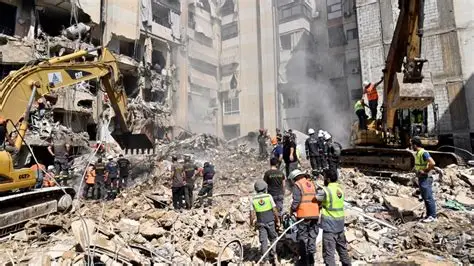
The house also contained or adjoined a small family shop. Residents described seeing children’s belongings, household goods and packaged food scattered through the rubble. Those ordinary items became central to early reporting because they illustrated the civilian daily life that had existed at the site before the blast.
Who were the members of the Tahan family?
Later reporting provided more detail about the family than was available in the first accounts of the Israeli strike on Lebanese town Younine. Ali Tahan was described by relatives as a mechanic who regularly helped neighbours. Ahmad, his younger brother, was remembered as someone who loved tending his garden. The family shop served nearby residents, including poorer families and Syrian refugees who were sometimes allowed to buy groceries on credit.
Hassan Tahan, a brother of Ali and Ahmad, lived only a few hundred metres away. He told reporters that he ran toward the site after hearing the strike. In a later interview, he said the attack had taken eight members of his family in a single evening.
This human detail matters because casualty figures can make war feel abstract. The Israeli strike on Lebanese town Younine was not simply an entry in a military operations list. It removed several members of one extended family from a close-knit community and left surviving relatives, children and neighbours dealing with grief and trauma.
A nearby shepherd told the BBC he had been at the family’s shop roughly half an hour before the attack and had offered to bring yoghurt from his herd. After the explosion, he returned and helped at the destroyed property until emergency responders arrived. His daughter had been close to one of the children who died, and he said she struggled to eat or drink afterwards.
A Syrian woman living nearby also remembered the family for allowing her to take groceries on credit. Her account adds another layer to the Israeli strike on Lebanese town story: the destroyed shop was part of the informal support network on which vulnerable people in the area depended.
Israel said it targeted Hezbollah infrastructure
The Israeli military told the BBC that the Israeli strike on Lebanese town Younine targeted “Hezbollah terrorist infrastructure while Hezbollah operatives were present”. It also said it takes steps to reduce civilian harm and accuses Hezbollah of embedding military infrastructure within civilian communities.
That claim must be reported, but it should not be presented as independently proven. Relatives and neighbours said they were unaware of Hezbollah military activity at the property. The Lebanese health ministry described the eight dead as civilians, and a local official told the BBC that the Lebanese military had inspected the site and found no weapons or military material.
A yellow Hezbollah flag or scarf was visible around the ruins in some reporting. That is evidence of political or communal affiliation around the site, but it does not by itself establish that the destroyed home was a military objective or that those inside were combatants. Hassan Tahan publicly expressed stronger support for Hezbollah after the deaths of his relatives, saying the attack had changed how he viewed the conflict.
The Israeli strike on Lebanese town Younine therefore remains a case where two narratives sharply diverge. Israel described a Hezbollah-linked military target. Local witnesses described a civilian family home and shop. Without an independent investigation that publicly establishes what intelligence was used, it is not possible to resolve that disagreement simply by repeating either side’s assertion as fact.
Why the distinction between civilians and military targets matters
International humanitarian law does not prohibit every attack that causes civilian casualties. It requires parties to distinguish between civilians and combatants and between civilian objects and military objectives. The International Committee of the Red Cross also explains that an attack directed at a military objective can still be unlawful if expected civilian harm would be excessive compared with the concrete and direct military advantage anticipated.
Those rules are relevant to the Israeli strike on Lebanese town Younine because the legal assessment depends on facts that are still contested: whether the site was being used for military purposes, whether Hezbollah operatives were actually present, what Israel knew before the strike, what precautions were taken and what civilian harm was anticipated.
The presence of civilians near a legitimate military target does not automatically make an attack illegal, just as the presence of a political flag does not automatically turn a home into a military target. The legal questions are more specific: distinction, proportionality and feasible precautions.
No court or independent international investigation reviewed for this article has issued a final legal finding on the Younine attack of 11 March. It would therefore be inaccurate to label the Israeli strike on Lebanese town Younine a proven war crime, just as it would be inaccurate to state as established fact that the building was Hezbollah infrastructure.
The attack came during a rapidly expanding Lebanon war
The Israeli strike on Lebanese town Younine occurred during a dramatic regional escalation. Hezbollah began firing missiles and drones toward Israel on 2 March 2026 after the broader U.S.-Israel confrontation with Iran expanded. Israel responded with extensive strikes across Lebanon. Reuters and the Israeli military both identify 2 March as the point at which the new Israel-Hezbollah phase began.
The Israeli military said its campaign was aimed at degrading Hezbollah’s military capabilities, launch sites, command centres and weapons infrastructure. Its operations concentrated heavily on southern Lebanon, the Bekaa Valley and Beirut’s southern suburbs, but strikes also reached central Beirut and other areas.
On 17 March, Israel announced limited ground operations against Hezbollah positions in southern Lebanon. Those operations later expanded, and the conflict produced severe destruction in border towns.
The News Ink has separately documented how southern Lebanon was devastated during Israeli operations. That wider destruction provides essential context for the Israeli strike on Lebanese town Younine because the March attack was an early episode in a war that became much larger than the first casualty figures suggested.
The original “more than 800 killed” figure is now badly outdated
When the Younine story was first reported in mid-March, Lebanon’s health ministry said more than 800 people had been killed in Israeli military action. That figure was accurate for that stage of the war but is no longer suitable for an updated article.
By 14 June, Lebanon’s health ministry reported at least 3,783 people killed and 11,699 injured since the renewed fighting began, according to Reuters. More than 1.2 million people had been displaced.
The Israeli strike on Lebanese town Younine therefore sits near the beginning of a conflict whose human cost became several times greater than the number available when the original article was published.
The Israeli strike on Lebanese town Younine was only one part of a much wider pattern of destruction. Reuters reported that more than 68,000 housing units had been damaged or destroyed by mid-June. By late June, a separate Reuters report said more than 90,000 homes had been damaged or destroyed and tens of thousands of people remained displaced even after a truce.
The News Ink’s coverage of the later Lebanon ceasefire and unresolved peace challenges helps show how the conflict continued to affect communities even after the largest battles subsided.
Health workers and medical facilities were also hit
The original story referred to healthcare workers killed in a separate strike while noting that Israel said the incident was under review. The later scale of damage to Lebanon’s health system was much greater.
A World Health Organization situation report published in early June said more than 191 attacks on healthcare had been reported in Lebanon since 2 March, killing 128 health workers and injuring 357. More than 127,700 people were still displaced in collective shelters at that stage.
That wider health-system toll is relevant to the Israeli strike on Lebanese town Younine because it helps explain the conditions in which survivors and communities were living: repeated displacement, limited access to services, damaged infrastructure and continuing attacks.
The WHO figures do not mean every reported healthcare incident had the same circumstances or legal status. They do show that the conflict created a sustained threat to medical capacity at a time when casualties and displacement were increasing demand for care.
More than one Younine tragedy shaped the town
The March 2026 Israeli strike on Lebanese town Younine was not the first major attack to devastate the area. Human Rights Watch investigated earlier Israeli strikes in Younine during 2024.
One strike on 25 September 2024 killed 23 members of an extended Syrian family, including 13 children, according to Human Rights Watch. Another strike on 1 November killed 10 people, including two children. Human Rights Watch said it found no evidence of military activity or military objectives at those two sites and called the attacks apparent indiscriminate attacks that should be investigated as war crimes.
Those earlier findings should not be automatically transferred to the Israeli strike on Lebanese town Younine in March 2026. They concern different attacks, different victims and different evidence. But they explain why Younine residents entered the 2026 war with recent memories of deadly bombardment.
The pattern also shows why careful incident-by-incident reporting matters. Each strike must be assessed on its own evidence rather than through assumptions about an entire village, religious community or political constituency.
Later investigations raised wider questions about civilian protection
In July, Amnesty International published findings on three separate Israeli strikes in southern Lebanon in March that killed 24 civilians, including 12 children. Amnesty said those attacks should be investigated as possible war crimes because its researchers found evidence suggesting failures of distinction, precautions or protection of civilians.
The Younine attack was not one of the three incidents Amnesty analysed. Its report therefore cannot be used as a legal finding about the Israeli strike on Lebanese town Younine.
It does, however, show that civilian protection during the 2026 Lebanon campaign remained the subject of serious international scrutiny long after the first weeks of fighting. Israel has maintained that it targets Hezbollah and seeks to minimise civilian harm, while rights organisations have argued in multiple cases that precautions or targeting decisions were inadequate.
That disagreement is likely to remain part of the historical record of the war.
The conflict eventually moved toward a June ceasefire
The war did not end in March. Fighting continued through the spring, including Israeli airstrikes, Hezbollah attacks and Israeli ground operations.
A ceasefire tied to a wider U.S.-Iran agreement was announced in mid-June. Reuters reported that fighting eased after the deal, although sporadic attacks continued and Israeli forces remained in parts of southern Lebanon. By 25 June, tens of thousands of Lebanese civilians were still displaced, many because their homes had been destroyed or because areas remained unsafe or under military control.
The Israeli strike on Lebanese town Younine therefore belongs to a conflict whose effects continued beyond the cessation of large-scale fighting. For the Tahan family, there was no return to the life that existed before 11 March. For many other Lebanese families, the ceasefire also came after homes, livelihoods and relatives had already been lost.
The News Ink has also followed how the Israel-Hezbollah ceasefire faced repeated tests as strikes and political disputes continued.
What the Younine attack tells us about reporting war responsibly
The Israeli strike on Lebanese town Younine illustrates why conflict reporting must resist certainty where evidence is incomplete.
There are facts that can be stated firmly. A strike hit a family home and shop on 11 March. Eight members of an extended family died. Children were among the victims. Israel said Hezbollah infrastructure and operatives were present. Relatives and local witnesses denied knowing of military activity. Lebanese authorities described the victims as civilians. The public evidence reviewed here does not independently resolve the competing claims.
There are also facts that should not be inferred. A Hezbollah flag at the ruins does not prove combatant status. A relative’s later declaration of support for Hezbollah does not retrospectively prove that the house was a military facility. Conversely, civilian descriptions by neighbours do not by themselves reveal what intelligence Israel may have possessed before the strike.
For the Israeli strike on Lebanese town Younine, the correct standard is evidence, attribution and precision.
That is especially important in a war where military organisations, governments, political movements and activists all have strong incentives to shape public understanding of individual incidents.
The human meaning of the Israeli strike on Lebanese town Younine
Months after the attack, the strongest reason to revisit the Israeli strike on Lebanese town Younine is not to reproduce graphic descriptions of the rubble. It is to place the deaths in a complete and accurate record.
The family had gathered for iftar. Their home was also tied to a small shop used by neighbours. Eight relatives were killed in one evening. Survivors and residents were left with memories that outlasted the immediate news cycle.
The later course of the war changed the scale of the story but not its essential human reality. By June, thousands of people across Lebanon had died and more than a million had been displaced. Yet every national total was made up of individual incidents like Younine.
The Israeli strike on Lebanese town Younine also remains unresolved in one important respect: the public evidence does not conclusively settle Israel’s claim that Hezbollah operatives and infrastructure were present. That uncertainty should be preserved rather than filled with assumptions.
For an updated account, the fairest conclusion is therefore twofold. The strike undeniably killed eight members of an extended family, including children. The military justification offered for the attack remains disputed in the public record.
The Israeli strike on Lebanese town Younine became one of the early examples of the civilian toll that would define the 2026 Lebanon war. It deserves to be remembered with the same standards that should apply to every conflict story: verify what can be verified, attribute what is contested, and never allow political labels to erase the people who died.
For continuing coverage of Lebanon, Israel and the wider Middle East, readers can follow The News Ink on X.