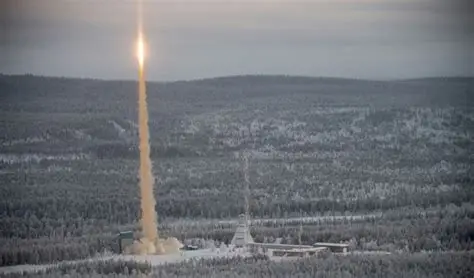
At 04:00 on a snowy hill in Swedish Lapland, north of the Arctic Circle, a countdown echoed: “Three, two, one.” A rocket shot into the dark sky from the Esrange Space Centre near Kiruna, illuminating the valley below. Moments later, a second motor fired, sending the rocket higher.
The German Aerospace Centre-built rocket reached almost 260 km in altitude during its 14-minute flight, carrying experiments that will help researchers study microgravity, biological cells, and material processes. Campaign manager Thomas Voigtmann said, “It was a good flight, we’re really relieved.”
Esrange, operated by SSC Space, has launched more than 600 sub-orbital rockets since the 1960s. Now it is positioning itself for Europe’s orbital launch market. SSC business director Mattias Abrahamsson said, “Within a couple of years, we will have the first satellite launch from here.”
Two clients are preparing orbital launches from northern Sweden: South Korea’s Perigee and the US-based Firefly, which achieved a lunar landing last year. SSC is expanding infrastructure for Firefly’s Alpha rocket, including fuelling, safety, and security systems, says Katarina Lahti from SSC’s orbital launch division.
A US-Sweden technology safeguard agreement now allows American firms to bring advanced space technology to Sweden. Meanwhile, Europe’s first reusable rocket, Themis, is undergoing ground tests at Esrange, alongside engine tests for German start-up Isar Aerospace.
Demand for satellites is soaring, driven by internet, communications, and mapping needs. Abrahamsson said, “There are around 10,000 satellites orbiting now. The plan is to reach 40–50,000 in just a few years.” This growth is attracting commercial companies to a market once dominated by governments.
Europe has several emerging spaceports: Atlantic Spaceport Consortium in the Azores, EuroSpaceport in the North Sea, SaxaVord in Scotland, and others. Hermann Ludwig Moeller of the European Space Policy Institute said, “Spaceports will be like seaports. You will need multiple for traffic and resilience. There will be winners and losers.”
While some ventures like Virgin Orbit and Orbex have failed, SSC hopes its 60-year legacy, northern location, and stable weather will make it a key player in orbital launches. Moeller expects the first successful European continental orbital launch “this year.”