Arctic Space Race: Why Sweden’s 2028 Launch Target Is a Critical Test for Europe
Arctic space race is no longer just a phrase for Cold War history or future-looking policy papers. In northern Sweden, above the Arctic Circle and close to the mining town of Kiruna, Esrange Space Center is trying to turn decades of suborbital research into something more ambitious: routine satellite launches from mainland Europe.
The latest signs in the Arctic space race are not dramatic in the Hollywood sense. There was no giant rocket blasting toward orbit from Swedish Lapland. Instead, the story is being built through test flights, regulatory agreements, launch-pad construction, engine trials and carefully staged partnerships with companies that want European access to polar and sun-synchronous orbits. That build-up is exactly why the Arctic space race matters.
Esrange already has credibility. SSC Space says the site has supported more than 600 sounding rocket launches, and the May 2026 SubOrbital Express-5 mission again showed why researchers keep using the Swedish range. That sounding rocket reached 260 kilometres, carried 12 scientific projects from nine countries, and gave experiments more than six minutes of microgravity. The flight was short, but the message was clear: northern Sweden is not starting from zero.
The bigger prize in the Arctic space race, however, is orbital launch. That is where Sweden’s plans become part of Europe’s larger push for space autonomy, commercial launch capacity and resilient satellite infrastructure. For readers following space and astronomy, the Arctic space race is one of the most important European space stories to watch because it connects scientific research, defence planning, commercial satellites, climate-sensitive infrastructure and the future of small launch vehicles.
Why the Arctic space race has moved to northern Sweden
Esrange Space Center sits roughly 200 kilometres north of the Arctic Circle, a location that gives it two advantages many European launch sites cannot easily match. First, it has a large, sparsely populated surrounding range for rocket and payload recovery. Second, its northern latitude is useful for missions heading into polar or sun-synchronous orbits, which are valuable for Earth observation, weather monitoring, mapping, climate research and security applications.
That is why the Arctic space race is not just about national prestige. A satellite in a polar orbit can pass over much of the planet as Earth rotates beneath it. A sun-synchronous orbit can allow an imaging satellite to observe the same location at a similar local solar time on each pass, creating consistent lighting conditions for analysis. These orbits are especially useful for environmental monitoring, disaster response, defence surveillance and commercial imagery.
Those missions are becoming more important because satellites now sit at the centre of modern digital life. Navigation, banking, broadband, television, weather forecasting, shipping, agriculture, emergency response and military communications all depend on orbital infrastructure. ESA’s space environment statistics show the scale of the change: thousands of satellites are already functioning in orbit, and the number of tracked objects around Earth continues to rise. That makes launch access both an economic issue and a security issue.
For Europe, the Arctic space race also reflects a strategic frustration. The continent has world-class space science, strong manufacturers and the Ariane launch family, but it has often relied on non-mainland launch routes, international partners and a smaller number of heavy launch systems. Small satellites need more flexible launch options. Governments want more resilience. Companies want faster schedules. Esrange wants to become one answer to that demand.
The snowy sounding rocket that showed Esrange’s old strength
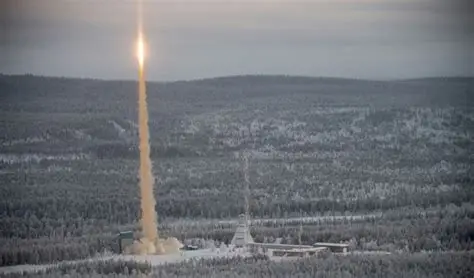
The scene that captures Esrange’s appeal is almost cinematic: a rocket rising before dawn over Swedish Lapland, snow on the ground, darkness over the valley and a launch team waiting for confirmation that a short scientific mission has worked. The May 2026 SubOrbital Express-5 launch was not an orbital mission, but it was a useful reminder that the Arctic space race is built on an older research tradition.
According to SSC Space, the mission launched from Esrange on 31 May 2026 at 06:33 UTC and reached 260 kilometres. The payloads covered physical, biological and medical research, including material science, immune-cell behaviour in microgravity, radiation-shielding concepts and cancer biology experiments. Microgravity can reveal how cells, fluids and materials behave when the pull of Earth is reduced, giving scientists a laboratory condition that is difficult to reproduce on the ground.
That matters because Esrange’s orbital future depends partly on trust. Rocket companies and satellite customers do not choose a site only because it has a dramatic location. They want experience, range safety, logistics, tracking systems, integration facilities, weather knowledge and a workforce that has handled complex campaigns before. In that sense, each successful sounding rocket helps the Arctic space race by showing that Sweden’s spaceport has operational muscle, not just ambition.
It is not only a proposed launchpad looking for customers. It is a working facility that has supported sounding rockets, balloons, ground stations, tests and payload operations for decades. The question now is whether that heritage can be converted into reliable orbital launch.
Sweden’s orbital launch plan now points to 2028
The most important update is the timeline. Earlier expectations around Esrange often pointed toward a first satellite launch in the mid-2020s. The newer Firefly-SSC milestone announcement gives a clearer and more cautious target: the first Firefly Alpha launch from Esrange is now targeted for 2028.
That shift does not mean Sweden has lost the Arctic space race. It means orbital launch is hard, and the difference between a political opening ceremony and a working orbital service is enormous. The work includes launchpad construction, fuelling infrastructure, payload processing, vehicle integration, flight safety systems, security arrangements, regulatory approvals, cross-border coordination and customer commitments.
Firefly Aerospace and SSC Space said in June 2026 that they had completed important milestones, including initial infrastructure, regulatory frameworks and an agreement with the Swedish Defense Materiel Administration. The companies said final construction was continuing at Launch Complex 3C, which is being prepared for Firefly’s Alpha rocket. Alpha is a two-stage launch vehicle designed to carry small payloads to low Earth orbit.
For the Arctic space race, that 2028 target is more credible than vague optimism. It gives editors, investors, customers and policymakers a concrete date to watch. It also shows that mainland European launch competition will be decided by execution, not announcements.
| Key Esrange milestone | What it means |
|---|---|
| More than 600 sounding rockets | Demonstrates long operational history at Esrange |
| May 2026 SubOrbital Express-5 | Reached 260 km with 12 experiments from nine countries |
| U.S.-Sweden Technology Safeguards Agreement | Creates a legal framework for U.S. commercial launch technology in Sweden |
| Firefly Launch Complex 3C work | Moves Alpha launch infrastructure toward operational readiness |
| First Firefly launch target: 2028 | Gives Sweden a clearer orbital launch timeline |
Firefly, Perigee, Themis and Isar make Esrange more than one launchpad
The Arctic space race is bigger than one rocket. Esrange’s current strategy is to become a wider space transportation and test hub, with several different programmes using the site for different reasons.
Firefly is the headline orbital partner because its Alpha rocket gives SSC a flight-proven American vehicle and a path toward small satellite launches from Sweden. Firefly also brings wider credibility after its Blue Ghost Mission 1 successfully landed on the Moon in March 2025 carrying NASA science and technology instruments. The Moon landing does not guarantee success in Sweden, but it shows that Firefly is not merely a paper-space company.
South Korea’s Perigee Aerospace is another name in the mix. SSC and Perigee announced a collaboration in 2024 to launch satellites from Esrange using Perigee’s Blue Whale 1 microlauncher. Public timelines around small-launch programmes often move, so the safest reading is that Perigee remains part of Esrange’s customer pipeline rather than a guaranteed first mover. Still, its involvement strengthens the international character of the Arctic space race.
Then there is Themis, Europe’s reusable rocket demonstrator. Themis is not designed to carry commercial satellites into orbit from Esrange tomorrow. Its role is different: it is a testbed for technologies such as vertical take-off, vertical landing, avionics and engine control. ESA describes Themis as part of its future launchers programme, aimed at developing more reusable and sustainable systems. That makes Esrange relevant not only to today’s small-launch market but also to the next generation of European launch technology.
Isar Aerospace adds another layer. The German company has expanded engine and stage testing at Esrange, with a second test site intended to increase testing capacity for its Spectrum launch vehicle programme. Even if Isar launches from Norway’s Andøya rather than Sweden, its use of Esrange for testing shows how northern space infrastructure is becoming interconnected.
This is why the Arctic space race should not be reduced to “who launches first.” The deeper question is which locations become durable parts of the supply chain: launch, testing, ground stations, payload processing, tracking, range operations and recovery.
Why polar orbit demand is changing the business case
The commercial case behind the Arctic space race starts with satellite demand. Broadband constellations, national security payloads, climate-monitoring satellites, agricultural imagery, maritime tracking, disaster response systems and mapping tools all depend on access to orbit. Many of these missions do not need a heavy-lift rocket. They need reliable, appropriately sized launch options.
For years, small satellites often had to ride as secondary payloads on larger missions. That can be cheaper, but it also limits schedule control and orbital choice. Dedicated small launch services promise more flexibility, especially for customers that need a particular orbit, a narrow timing window or sovereign access.
Polar and sun-synchronous missions are particularly relevant to Europe. Climate monitoring depends on repeated Earth observation. Arctic shipping routes, sea-ice tracking, border surveillance and northern infrastructure monitoring all require data. That links the Arctic space race with wider questions explored in our climate change coverage, because satellites are now among the most important tools for measuring how fast the planet is changing.
Once satellites collect it, cloud systems, artificial intelligence and high-speed analytics turn raw information into useful products. That is why the story overlaps with AI trends and the digital infrastructure covered in our cloud computing guide. The launchpad is only the first step. The value comes from the chain of services built around the satellite.
Europe wants resilience, not just prestige
The Arctic space race is also about strategic autonomy. Europe wants the ability to place satellites in orbit without relying too heavily on one launch site, one partner, one vehicle family or one geopolitical route. That does not mean Europe will stop working with the United States or other partners. In fact, Firefly’s role at Esrange shows that transatlantic cooperation remains central. But Europe also wants more options.
The U.S.-Sweden Technology Safeguards Agreement is therefore more than paperwork. It allows advanced American space technology to be handled in Sweden under a legal framework designed to protect sensitive systems and data. Without such agreements, launching U.S. rockets from foreign sites becomes much harder. With them, Sweden can offer a more credible route for American-built vehicles serving European customers.
Defence demand is part of the same picture. Modern armed forces need satellites for communications, surveillance, navigation support and battlefield awareness. In a crisis, the ability to replace or add satellites quickly becomes a resilience issue. Firefly and SSC have highlighted responsive space as part of their pitch, and Sweden’s NATO membership gives the launch plan a broader security context.
That does not make every satellite military or every launch strategic. Many payloads will be commercial, scientific or civil. But the Arctic space race is happening at a moment when civilian and defence space needs increasingly overlap.
The Nordic rivalry is useful, but not simple
Sweden is not alone. Norway’s Andøya Spaceport, the UK’s SaxaVord Spaceport in Scotland, proposed launch concepts in the Azores, North Sea ideas and other European sites all want a role in the launch economy. The first orbital success from European soil will attract headlines, but the longer contest will be about reliability, cost, regulation, customer service and launch cadence.
The Arctic space race between Sweden and Norway is especially interesting because both sites offer northern access. Andøya has already become closely associated with orbital launch attempts from the European mainland, while Esrange is leaning on its large land range, research history and growing partnership network. Weather, demand, vehicle type, orbit and safety rules may all push launches to different locations.
That is why the “winner takes all” framing of the Arctic space race can be misleading. Spaceports may become more like seaports or airports: some will specialise, some will struggle, and a few will become regular nodes in a wider network. The Arctic space race may produce winners and losers, but Europe’s best outcome is not necessarily one dominant spaceport. It is a resilient system.
The risks Sweden still has to manage
The case for Esrange is strong, but the risks are real. The first risk in the Arctic space race is technical. A sounding rocket reaching microgravity is not the same as an orbital rocket placing a satellite into a precise orbit. Orbital launch requires far more energy, more complex flight safety planning and tighter mission assurance. Even experienced launch companies suffer failures.
The second risk is commercial. The small-launch market is crowded, and not every company will survive. Rideshare missions on larger rockets can still be cheaper. Customers may prefer proven cadence over a new European site. If launch demand does not match expectations, some spaceports could end up with impressive infrastructure but too few flights.
The third risk is regulatory. Cross-border safety, export controls, environmental permissions, airspace closures and liability frameworks can slow launch campaigns. The U.S.-Sweden agreement helps with American technology, but it does not remove every legal or operational hurdle.
The fourth risk is environmental and social. Arctic and sub-Arctic regions are sensitive. Rocket launches, falling stages, construction, transport and increased activity must be managed carefully, especially in areas connected to reindeer herding, northern communities and fragile ecosystems. Space infrastructure can help monitor climate change, but it should not ignore its own footprint. A credible Arctic space race needs transparency, safety and environmental responsibility.
What happens next at Esrange
There are several practical signs to watch before Sweden can claim real momentum in the Arctic space race.
First, the Arctic space race depends on Launch Complex 3C moving from construction to demonstrated readiness. That means facilities, tanks, handling systems, security zones and range procedures must be tested under realistic conditions.
Second, Firefly’s Alpha programme must maintain reliability. A Swedish launch is not only a Swedish project; it depends on the vehicle provider’s broader performance, production capacity and regulatory status.
Third, Perigee’s Blue Whale 1 path needs clearer public updates. If the company advances its microlauncher and confirms a revised Esrange timeline, it could add competitive pressure and flexibility to the Swedish site.
Fourth, Themis hop tests will matter even if they are not commercial launches. A successful reusable rocket demonstrator campaign would give Esrange visibility as a European testbed for future launch systems.
Fifth, customers must appear. Spaceports are not judged only by launch announcements. They need payload contracts, repeat missions and a service model that works for commercial, civil and defence users.
Why the Arctic space race matters beyond rockets
The strongest argument for Esrange in the Arctic space race is not that it will instantly rival Cape Canaveral, Kourou or Vandenberg. The stronger argument is that Europe needs more launch routes, more testing capacity and more control over a technology that now underpins modern life.
The Arctic space race matters because satellite infrastructure is becoming as basic as undersea cables, power grids and data centres. It supports navigation, finance, climate science, communications and security. If Europe wants to be more than a customer in that system, it needs launch sites, vehicles, ground stations, engineers, regulators and customers working together.
Sweden’s Esrange plan in the Arctic space race is still unfinished. The Firefly target of 2028 leaves time for delays, competition and technical setbacks. But the foundations are stronger than they were a few years ago: a proven research range, new orbital infrastructure, international partners, reusable rocket testing and a clear role in Europe’s search for space resilience.
That is why the Arctic space race should be watched carefully. It is not simply a race to light up the northern sky. It is a test of whether Europe can build a more flexible, competitive and secure space future from the cold edge of the continent.
For more technology and science explainers from The News Ink, follow The News Ink on Medium.