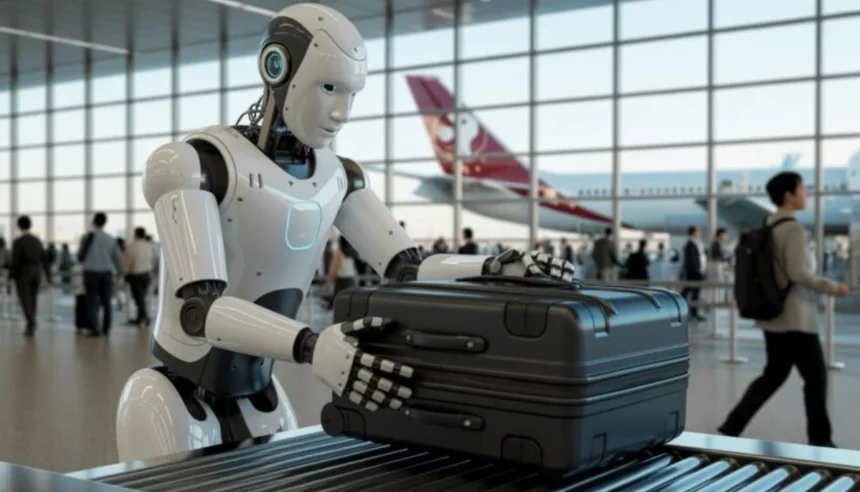
Japan Airline Trials Humanoid Robot for Ground Handling Tasks
Japan Airline trials humanoid robot ground handling tasks as part of a new effort to address labour shortages and improve operational efficiency at one of the country’s busiest airports. The airline has launched a two year trial at Tokyo’s Haneda Airport, marking a significant step toward integrating advanced robotics into aviation support services.
The initiative reflects a broader shift within Japan’s aviation sector, where companies are increasingly turning to automation to manage rising passenger numbers and a shrinking workforce.
Japan Airline Trials Humanoid Robot Ground Handling Tasks at Haneda
Japan Airline trials humanoid robot ground handling tasks beginning in May, with the robots initially deployed to assist in loading and unloading cargo containers. The project is being carried out in partnership with GMO AI and Robotics, which has developed the Chinese made humanoid machines.
During a media demonstration, the robots were seen handling cargo operations with precision, showcasing their ability to perform physically demanding tasks that are typically carried out by human workers. The trial aims to test not only the robots’ efficiency but also their ability to operate safely within a busy airport environment.
The airline currently employs around 4,000 ground handling staff, many of whom are responsible for labour intensive duties such as baggage handling and aircraft servicing.
Labour Shortages Drive Automation Push
Japan Airline trials humanoid robot ground handling tasks at a time when the aviation industry in Japan is facing a significant labour crunch. The country’s aging population and declining birth rate have reduced the available workforce, while tourism has surged in recent years.
According to travel data, Japan welcomed more than seven million foreign visitors in just the first two months of the year, putting additional pressure on airport operations.
Airport ground handling, despite being critical to flight operations, remains heavily reliant on manual labour. Tasks such as loading cargo, managing equipment, and preparing aircraft for departure require physical effort and long working hours.
Industry experts believe that introducing robotics into these areas could help reduce employee fatigue and improve overall productivity.
Expanding Role of Robots in Airport Operations
While Japan Airline trials humanoid robots ground handling tasks as an initial step, the airline has broader plans for the technology. Future applications could include cabin cleaning and operation of ground support equipment.
Robots are already being used in various capacities across Japanese airports. Some are deployed for security patrols, while others assist passengers in retail areas or provide information services.
The addition of humanoid robots to ground operations represents a more advanced use case, as it involves direct interaction with core airport logistics.
Tomohiro Uchida, president of GMO AI and Robotics, highlighted that despite the appearance of automation, many backend airport operations still rely heavily on human workers. He noted that labour shortages have made it necessary to explore new solutions.
Balancing Automation and Human Roles
Japan Airline trials humanoid robot ground handling tasks with a clear understanding that not all responsibilities can be automated. While robots can handle repetitive and physically demanding work, certain roles will continue to require human oversight.
Safety management, for example, remains a critical area where human judgment is essential. Airport environments are complex and dynamic, requiring quick decision making and adaptability that machines are not yet fully capable of replicating.
Yoshiteru Suzuki, president of JAL’s Ground Service division, emphasized that the goal is not to replace workers but to support them. By offloading physically intensive tasks to robots, employees can focus on more skilled and supervisory roles.
This hybrid approach is increasingly being seen as the most practical way to integrate automation into industries that depend heavily on human expertise.
A Glimpse Into the Future of Aviation
Japan Airlines trials humanoid robots ground handling tasks as part of a wider trend toward automation in global aviation. Airlines and airports around the world are exploring how technologies such as artificial intelligence and robotics can improve efficiency and reduce operational costs.
The success of this trial could influence how other airlines approach similar challenges, particularly in regions facing workforce shortages.
As technology continues to advance, the role of robots in aviation is expected to expand further. From assisting passengers to managing logistics, automation is gradually becoming an integral part of the airport ecosystem.
For now, Japan Airlines’ experiment offers a glimpse into a future where humans and machines work side by side to keep the aviation industry running smoothly.