Oil Prices: Why the Alarming 2026 Iran Shock Still Matters for Markets
Oil prices remain the clearest financial signal from the Iran conflict. Stock markets can rebound for a session, investors can rotate into energy shares, and traders can tell themselves that the worst disruption may be avoided. But as long as the Strait of Hormuz remains exposed to attacks, threats and military escorts, oil prices will keep shaping the global market mood.
The original story captured the first phase of the shock. Global stock markets were mixed, Brent crude had jumped after the opening US-Israel strikes on Iran, UK gas prices had surged, and tanker traffic through the Strait of Hormuz had almost frozen. Investors were trying to work out whether this was a short geopolitical panic or the beginning of a longer energy crisis.
That question is still alive. By July, the conflict had not disappeared. Reuters reported fresh U.S.-Iran exchanges around the Gulf, renewed attacks on military facilities and shipping risks near Hormuz. Oil prices rose again as traders priced in the chance that the world’s most important energy chokepoint could face another serious disruption.
This is why the market story cannot be reduced to one day’s movement in the FTSE 100, the S&P 500 or Asian indexes. The bigger issue is whether higher energy costs become embedded in inflation, shipping, aviation, food production and household bills. When oil prices rise because demand is strong, markets can sometimes absorb the move. When oil prices rise because tankers may not safely move through a narrow waterway, the calculation becomes more dangerous.
For readers following the wider crisis, The News Ink’s coverage of the U.S. and Israeli strikes on Iran, the fragile U.S.-Iran ceasefire and the Strait of Hormuz tensions gives the political background behind the financial moves.
Why oil prices are driving the market story
Oil prices matter because they sit at the centre of almost every part of the global economy. Crude oil affects petrol, diesel, aviation fuel, shipping costs, chemicals, plastics and fertiliser. Natural gas affects electricity, heating, industrial production and household energy bills. When both move sharply at the same time, markets start thinking beyond the battlefield.
That is what happened after the Iran war began. Brent crude climbed quickly as traders feared that Iranian attacks, U.S. military action and Israeli strikes could turn Hormuz into an unreliable route. Gas prices moved even more sharply because Qatar and the UAE depend heavily on Hormuz to move liquefied natural gas to international buyers.
The Energy Information Administration says the Strait of Hormuz carried about one-fifth of global petroleum liquids consumption in the first half of 2025. It also says about one-fifth of global LNG trade moved through the same route in 2024, mostly from Qatar. That makes the strait more than a regional pressure point. It is a global inflation channel.
Oil prices therefore became the market’s shorthand for risk. If the strait looked blocked, prices rose. If tankers moved again, prices eased. If talks appeared possible, traders relaxed. If missile and drone attacks returned, the risk premium came back.
That pattern explains why markets have often looked confused. Stocks can rise on hopes of diplomacy while energy traders stay nervous about supply. Both reactions can be rational at the same time.
Stocks are not reacting in one simple direction
Global stock markets have not moved as one block. Some indexes have fallen sharply on conflict fears. Others have been cushioned by energy stocks. The FTSE 100 has sometimes held up better than more technology-heavy markets because Shell and BP can gain when oil prices rise. Airlines, transport firms and consumer-facing companies usually face the opposite pressure.
That mixed reaction makes sense. Higher oil prices are good for producers but bad for most users. A large integrated oil company may benefit from higher crude prices. An airline faces higher fuel costs. A supermarket chain may face rising transport and food costs. A central bank may face a harder inflation problem. A consumer may have less money left after paying for petrol and energy.
The July market reaction showed that split clearly. Reuters reported the FTSE 100 was little changed as energy gains offset weakness elsewhere. The Guardian and AP both reported broader market stress, with Asian technology shares under pressure and investors watching oil, inflation and interest-rate expectations.
This is the key point for investors: the Iran conflict is not simply “bad for stocks” or “good for commodities.” It is a redistribution of pressure. Energy producers gain pricing power. Import-heavy economies lose flexibility. Central banks lose room to cut rates. Consumers face another squeeze.
Oil prices are therefore not just another commodity quote. They are the mechanism by which a regional war enters global portfolios.
The Strait of Hormuz is the main risk
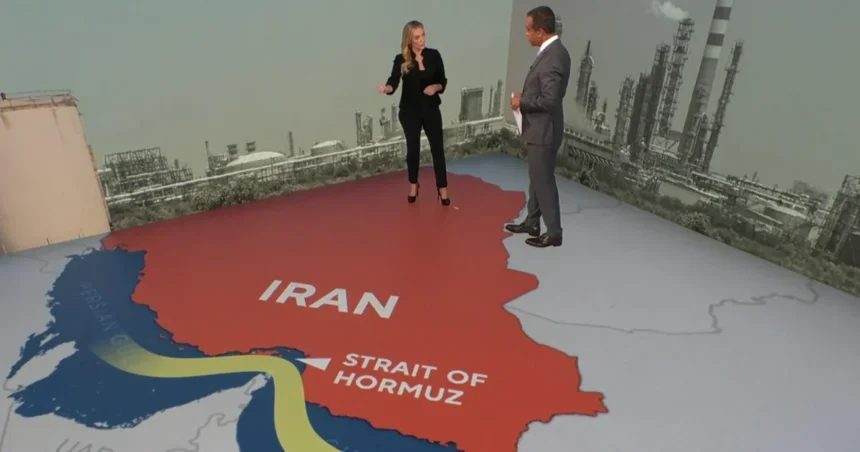
The Strait of Hormuz is narrow, crowded and strategically irreplaceable. It links the Persian Gulf with the Gulf of Oman and global shipping routes. Saudi Arabia, Iraq, Kuwait, Qatar, the UAE and Iran all depend on it directly or indirectly for energy exports.
The News Ink has already covered why supertankers breaking through the Strait of Hormuz became such a symbolic moment. A few successful crossings can calm markets, but they do not erase the underlying risk if shipowners, insurers and crews still fear attack.
Lloyd’s List Intelligence reported in March that around 200 internationally trading, non-sanctioned tankers were effectively stranded as traffic froze. Reuters later reported that vessel activity again slowed during July tensions, while U.S. officials insisted some commercial traffic continued under protection.
The difference between “closed” and “unsafe” matters. A strait does not need to be physically sealed to disrupt markets. If insurance costs jump, crews refuse routes, tankers wait outside the Gulf, or owners demand military escort, supply becomes slower and more expensive. That alone can lift oil prices.
This is why traders focus so closely on tanker data. A headline can move markets for an hour. Actual ship movements reveal whether cargo is flowing.
Gas prices make the shock broader
Oil gets the headlines, but gas is just as important. UK gas prices surged in the first phase of the crisis because LNG flows from Qatar were at risk. Qatar is one of the world’s largest LNG exporters, and the EIA says nearly all of Qatar’s LNG exports move through Hormuz.
That is why the conflict matters for Europe and Asia even if they do not import much crude directly from Iran. LNG markets are global. If Asian buyers fear supply disruption, they may bid up cargoes. If Europe needs to compete for the same cargoes, wholesale prices rise. Those wholesale prices can eventually feed into electricity bills, industrial costs and inflation.
Reuters reported that QatarEnergy halved scheduled LNG deliveries to Bangladesh for 2026 because the war continued to curb shipments through Hormuz. Earlier reporting also said Iranian attacks had damaged part of Qatar’s LNG capacity. Those developments show why gas markets cannot treat the conflict as background noise.
Oil prices and gas prices together create a more dangerous inflation mix. Petrol, shipping and aviation costs rise on the oil side. Power, heating and factory costs rise on the gas side. That is the combination governments fear most.
Inflation is the political danger
The financial-market shock becomes political when it reaches household bills. David Miles of the Office for Budget Responsibility warned that sustained energy price rises could push UK inflation higher, although he said the increase was nowhere near the scale seen after Russia’s full-scale invasion of Ukraine.
That distinction is important. The Iran shock may not repeat the exact European gas crisis of 2022. Storage levels, supply routes, demand patterns and policy responses are different. But the inflation direction is still clear: if energy remains expensive, it becomes harder for central banks to cut rates and harder for governments to ease living costs.
For the UK, that matters because households have already been through years of price pressure. A renewed energy squeeze would affect transport, food, heating and business costs. The Bank of England would also face a difficult trade-off. Cutting rates too early could look risky if oil prices keep feeding inflation. Waiting too long could hurt growth.
This is where the crisis connects directly to The News Ink’s wider economy coverage. Markets may see an oil move as a trading opportunity. Families experience it as another rise in the cost of living.
Why markets sometimes look too calm
Markets often recover faster than the real world. After an initial panic, investors look for reasons to buy: diplomacy, military escorts, spare capacity, strategic reserves, higher production elsewhere or signs that shipping is still moving. That can make indexes look calmer than the underlying situation.
Lindsay James of Quilter warned that markets could be too optimistic if they assume Iran cannot seriously disrupt shipping. That concern is reasonable. Iran does not need to win a naval war to create market stress. It only needs to raise uncertainty enough for insurers, shipowners and traders to demand a higher premium.
U.S. Treasury Secretary Scott Bessent tried to calm markets by saying crude markets remained well supplied and that hundreds of millions of barrels were already in transit outside the Gulf. President Donald Trump also said the United States would support risk insurance and could use Navy escorts for tankers.
Those steps may help. They do not remove the risk completely. Military escorts can protect some vessels, but they can also increase the chance of direct confrontation. Insurance support can lower financial fear, but it cannot guarantee physical safety. Spare barrels outside the Gulf can smooth a short shock, but they cannot fully replace a prolonged Hormuz disruption.
Oil prices reflect that tension: reassurances can push them down, but renewed attacks can pull them back up quickly.
Saudi and Qatari risks show the conflict is wider than Iran
The oil-market shock is not only about Iranian exports. Saudi Arabia’s Ras Tanura refinery was hit by attempted drone attacks early in the war. Reuters reported that drones were intercepted at the facility, with debris causing a limited fire and no injuries. Ras Tanura is strategically important because it is tied to Saudi Arabia’s refining and export system.
Qatar’s LNG exposure adds another layer. When QatarEnergy faces production or delivery disruptions, the effects are felt far beyond the Gulf. Bangladesh, India, China, Japan, South Korea and European buyers all have reasons to watch Qatari LNG flows closely.
This is why oil prices respond not only to what happens inside Iran, but also to the whole Gulf energy network. Refineries, offshore platforms, loading terminals, tankers, pipelines, insurance markets and naval patrols are all part of the same system.
A single drone strike that causes limited physical damage can still move prices if it proves that energy infrastructure is reachable. A single tanker incident can affect freight rates if owners fear more attacks. The market prices probability, not only confirmed loss.
The United States is trying to manage confidence
The Trump administration’s response has focused on keeping trade moving and preventing panic. Bessent’s message that markets remain well supplied was aimed at traders, consumers and allies. Trump’s insurance and escort comments were aimed at shipowners and energy buyers.
The logic is clear. If the United States can convince markets that tankers will keep moving, oil prices may stay below crisis levels. If insurers believe losses can be covered, some shipping may continue. If allies believe Washington can protect Gulf routes, political pressure may ease.
But there is a danger. The more the United States becomes directly involved in escorting vessels and striking Iranian assets, the more the market may price in a longer confrontation. Protection can calm one risk while increasing another.
That is why diplomacy still matters more than any escort plan. A convoy system can reduce immediate danger. A political settlement would reduce the need for convoys in the first place.
Markets understand this. They may react to military measures in the short term, but the largest and most durable relief would come from a credible de-escalation agreement.
Three scenarios for oil prices
The next phase of the conflict could move in several directions.
| Scenario | Market impact |
|---|---|
| Managed disruption | Tankers move under escort, insurance costs stay high, and oil prices remain volatile but below panic levels. |
| Prolonged semi-closure | Shipments slow, LNG cargoes are delayed, and energy prices stay elevated long enough to feed inflation. |
| Full escalation | More vessels or energy sites are hit, Hormuz traffic collapses again, and oil prices spike sharply alongside broader market stress. |
The first scenario is what markets appear to hope for. The second is the most uncomfortable for governments because it quietly damages growth and inflation. The third is the nightmare scenario, especially for energy importers.
At the moment, markets are moving between the first two. Oil prices have risen sharply at times, but they have not stayed permanently at the most extreme levels seen during the early panic. That suggests traders still believe supply can adapt. But the July escalation shows how quickly that belief can be tested.
Why this matters for ordinary consumers
Most people do not watch Brent crude futures every day. They feel oil prices through petrol pumps, delivery fees, food prices, airfares and utility bills. Businesses feel them through freight, packaging, manufacturing and energy contracts.
If energy prices stay high, the effect spreads slowly. A haulier pays more for fuel. A food distributor raises delivery charges. A supermarket absorbs some costs and passes on others. Airlines add fuel surcharges. Manufacturers face higher electricity and gas bills. Workers ask for higher wages to cover living costs. Central banks worry that inflation expectations are becoming sticky.
This is how a conflict thousands of miles away reaches a household budget. The transmission is not instant, but it is powerful.
The same logic applies to poorer countries with less fiscal space. Energy importers in South Asia, Africa and parts of Europe are more vulnerable to prolonged LNG and oil disruptions. They may face currency pressure, subsidy strain and higher food import costs.
Oil prices are therefore not only a market story. They are a social story.
What investors should watch next
The most important indicators are not only the headline price of Brent crude. Investors should watch tanker transits through Hormuz, war-risk insurance premiums, LNG delivery changes, Saudi and Qatari infrastructure updates, U.S.-Iran diplomatic signals, strategic reserve decisions and central-bank language on inflation.
Equity markets will also reveal stress through sector rotation. Energy shares may rise while airlines, logistics, retailers and rate-sensitive technology stocks weaken. Government bond yields can show whether investors fear inflation more than recession. Currency markets can show whether importers are under pressure.
Oil prices will remain the headline number, but the deeper signal is whether the shock becomes persistent. A one-week spike hurts traders. A three-month rise changes policy. A six-month disruption changes growth forecasts.
That is why the March panic and July escalation should be read together. This has not been one clean shock. It has been a rolling test of how much disruption the global economy can absorb.
The careful takeaway
Oil prices remain the market’s fear gauge. Oil prices and stock markets are sending the same message in different ways: investors do not know whether the Iran conflict will be contained or become a prolonged energy shock. Stocks can rebound when traders see diplomacy or U.S. protection for shipping. Oil can jump again when missiles, drones or tanker incidents return the Strait of Hormuz to the centre of attention.
The risk is not only that Brent crude rises for a day. The bigger risk is that higher energy costs last long enough to feed inflation, delay interest-rate cuts, squeeze consumers and slow global growth. Gas markets make that danger broader because Qatar’s LNG exports are deeply exposed to Hormuz.
The world has some buffers: strategic reserves, spare production, alternative routes, diplomatic pressure and naval protection. But Hormuz remains difficult to replace. Around one-fifth of global oil flows and one-fifth of LNG trade have depended on it in recent years. That gives the conflict power far beyond the Gulf.
If the crisis eases, markets may stabilise quickly. If it drags on, the cost will move from trading screens to fuel pumps, electricity bills, airfares, food prices and government budgets.
Oil prices are volatile because the world economy is waiting for an answer that markets cannot provide: whether the war will end before energy disruption becomes permanent.
For more business, market and geopolitical analysis, follow The News Ink on Medium.