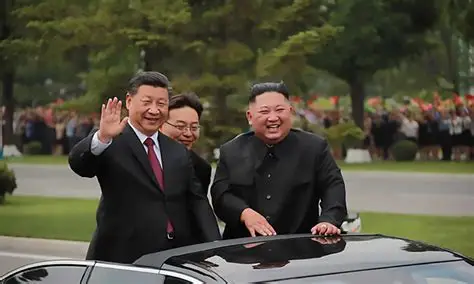
The Xi Jinping North Korea visit 2026 has been confirmed by both countries’ state media — China’s president will travel to Pyongyang on June 8 and 9 at the invitation of Kim Jong Un, marking his first trip to North Korea in nearly seven years. Xi last visited the hermit kingdom in 2019, and the gap between that visit and this one has been filled with events that have fundamentally reshaped the geopolitical landscape surrounding the Korean peninsula — including North Korea’s deployment of troops to support Russia in Ukraine, Kim Jong Un’s growing personal alliance with Vladimir Putin, and Xi’s recent hosting of both Trump and Putin in Beijing within the space of weeks.
The visit is laden with strategic significance for all parties. For Kim, Xi’s arrival provides propaganda value of immense domestic and international worth — the leader of the world’s second-largest economy and North Korea’s most important partner making the journey to Pyongyang in person. For Xi, the visit offers an opportunity to maintain Beijing’s position as Pyongyang’s primary external relationship at a moment when Kim’s deepening ties with Moscow have created a new dynamic that China is watching with considerable wariness.
Xi Jinping North Korea Visit 2026: Why Now — The Strategic Context
The Xi Jinping North Korea visit 2026 timing is not accidental. The visit arrives weeks after Xi hosted both US President Donald Trump and Russian President Vladimir Putin in Beijing — a sequence of diplomatic engagements that places China at the centre of the world’s most consequential geopolitical relationships simultaneously.
For Beijing, the management of its relationship with Pyongyang has become more complex in recent years as Kim’s alliance with Putin has deepened beyond what China had anticipated or desired. North Korea has entered the war in Ukraine on Russia’s side — providing troops and ammunition to Moscow in a development that has improved Pyongyang’s international standing in certain circles while alarming others. Kim attended Xi’s military parade in Beijing in September 2025 alongside Putin — a visible display of the triangular relationship between the three capitals that China must navigate carefully.
Despite Beijing’s close ties with both Pyongyang and Moscow, Xi is wary of the burgeoning Kim-Putin alliance. China does not want North Korea to become primarily oriented toward Russia rather than toward Beijing — a shift that would reduce Chinese influence over one of its most strategically important neighbours and complicate China’s own complex relationship with the West over the Ukraine war.
Why the timing of the visit matters:
- Xi hosted Trump in Beijing in recent weeks — signalling China’s centrality to US-China relations management
- Xi hosted Putin in Beijing in recent weeks — managing the Russia relationship at a critical moment
- The North Korea visit completes a diplomatic sequence placing Xi at the centre of all key relationships
- Xi is wary of the deepening Kim-Putin alliance — the visit reasserts Beijing’s primacy in Pyongyang
- The visit marks the 65th anniversary of the China-North Korea mutual defence pact — a symbolic milestone
- North Korea’s Ukraine deployment has improved Pyongyang’s international standing — shifting regional dynamics
- Kim attended Xi’s Beijing military parade in September 2025 alongside Putin — a visible triangular relationship
- Xi’s visit to Pyongyang reasserts that Beijing remains the primary partner — not merely one among equals
Xi Jinping North Korea Visit 2026: What China and North Korea Share
The Xi Jinping North Korea visit 2026 rests on a foundation of interconnection between the two countries that goes deeper than any recent diplomatic warming or cooling — a relationship built on geography, shared ideology in its founding decades, and the singular mutual defence commitment that makes China-North Korea ties structurally unique.
China and North Korea share a 1,400 kilometre border — a land boundary of enormous strategic significance to both countries. For China, a stable North Korea is essential — an unstable or collapsed North Korean state would create refugee flows, potential military presence of hostile forces near China’s border, and a level of regional disruption that Beijing considers intolerable. For North Korea, China’s border represents its primary economic lifeline — the route through which the vast majority of the goods, energy, and trade that sustain Kim’s regime flow.
The mutual defence pact that binds the two countries is the only such agreement China has with any country in the world. It guarantees mutual support if either country is attacked — a commitment that has made North Korea’s security posture possible for seven decades by removing the existential risk of facing the United States or South Korea without a nuclear-armed guarantor at its back. This year marks the 65th anniversary of that treaty — a milestone that gives the visit an additional layer of ceremonial and symbolic significance.
The China-North Korea relationship — structural foundations:
- A 1,400 kilometre shared land border — the primary route for North Korean trade and energy supply
- The only mutual defence pact China has with any country in the world — guaranteeing mutual support if attacked
- 65th anniversary of the defence treaty in 2026 — a milestone that gives the visit ceremonial significance
- China is North Korea’s largest trading partner and primary economic lifeline
- Beijing’s economic relationship with Pyongyang makes it the main financial enabler of Kim’s regime
- The defence pact’s existence has underpinned North Korea’s strategic confidence for seven decades
- Despite sanctions, China-North Korea trade continues through the land border
- The relationship is described as being “as close as lips and teeth” — a traditional Chinese formulation
Xi Jinping North Korea Visit 2026: What Kim Wants From the Meeting
The Xi Jinping North Korea visit 2026 offers Kim Jong Un a set of opportunities that he will pursue with the directness and strategic focus that has characterised his leadership of North Korea since he assumed power following his father’s death in 2011.
The propaganda value of Xi’s visit is, as observers note, self-evident. North Korea’s domestic media presents its leader as a figure of global stature — the recipient of visits from major world leaders who travel to Pyongyang to engage with Kim rather than summoning him elsewhere. Xi making the journey to Pyongyang reinforces that narrative with the most powerful possible evidence — the leader of China, the world’s most populous country and second-largest economy, coming to Kim.
Beyond propaganda, Kim has concrete economic interests he will press. It is widely expected that Kim will seek expanded trade across the land border — North Korea’s primary economic interface with the outside world — and an increase in Chinese tourism to the facilities Kim has been building and displaying to visiting dignitaries. North Korea has constructed beach and ski resorts that require foreign visitors to generate the revenue that justifies their existence — and Chinese tourists are the most realistic source of that visitor flow.
What Kim seeks from the Xi visit:
- Propaganda value — Xi’s physical presence in Pyongyang projects Kim’s international standing domestically
- Expanded land border trade — North Korea’s primary mechanism for economic exchange
- Increased Chinese tourism — to generate revenue for newly built beach and ski resorts
- Validation of North Korea’s nuclear and missile programme — without demanding concessions
- Continued diplomatic cover against international sanctions pressure
- Reassurance that China’s commitment to the defence pact remains firm despite changing regional dynamics
- A visible demonstration that North Korea’s Ukraine alliance with Russia has not damaged Beijing relations
Kim has been proudly displaying his nuclear and missile arsenal to visiting dignitaries — making clear that North Korea’s strategic capabilities have been developed and will not be surrendered. He wants Xi’s visit to reinforce the message that these achievements were accomplished without bending to American demands or engaging with South Korea on Seoul’s terms.
Xi Jinping North Korea Visit 2026: The South Korea Dimension
The Xi Jinping North Korea visit 2026 takes place against the backdrop of a complete and deliberate freeze in inter-Korean relations — a context that shapes both the meaning of Xi’s visit and the regional dynamics within which it occurs.
Kim Jong Un declared the end of reunification efforts with South Korea in December 2024 — a formal statement that has been followed by consistent actions demonstrating the freeze is genuine and comprehensive. Kim has called South Koreans a “sworn enemy” — language of a ferocity that has no precedent in decades of difficult inter-Korean relations. All levels of communication with Seoul have been cut. Seoul’s attempts at rapprochement have found no response from Pyongyang.
The completeness of the freeze was on vivid display when North Korea’s women’s professional football team visited South Korea to play a South Korean side last month. The North Korean players barely acknowledged the South Korean public who gathered to welcome them. They coldly shook hands with South Korean players before the match — then followed with rough and aggressive play that reflected the political temperature between the two states.
The North-South Korea freeze — key facts:
- Kim declared the end of reunification efforts with South Korea in December 2024
- He has called South Koreans a “sworn enemy” — unprecedented language in modern inter-Korean relations
- All communication channels between North and South Korea have been severed
- Seoul’s attempts at rapprochement have received no positive response from Pyongyang
- The North Korean women’s football team visit to South Korea demonstrated the freeze in concrete terms
- North Korean players barely acknowledged South Korean public and players — cold handshakes before rough play
- Xi’s visit to Pyongyang implicitly endorses Kim’s posture toward Seoul by engaging with him on his own terms
- The visit occurs without any indication that Beijing is pressing Kim on inter-Korean relations
The football match episode — a sporting event that could theoretically have served as a small confidence-building measure — instead became a demonstration of exactly how completely Kim has abandoned even the appearance of inter-Korean engagement. Xi’s visit to Pyongyang takes place in a region where the two Korean states have reached a level of deliberate estrangement not seen for decades.
Xi Jinping North Korea Visit 2026: North Korea’s Improved International Standing
The Xi Jinping North Korea visit 2026 arrives at a moment when Kim Jong Un’s international position is, paradoxically, stronger than it has been for years — not because sanctions have been lifted or nuclear negotiations have succeeded, but because North Korea’s decision to enter the Ukraine war on Russia’s side has earned Pyongyang a form of geopolitical credibility with a significant bloc of global opinion.
North Korea’s deployment of troops and ammunition to support Russia has given Kim leverage with Moscow that he did not previously possess. Putin’s evident gratitude — and his willingness to engage with Kim as a genuine partner rather than a junior recipient of Russian favour — has improved Pyongyang’s strategic position and given Kim confidence that he operates within a network of relationships that can absorb American and Western pressure.
North Korea’s improved international standing:
- Deployment of troops to support Russia in Ukraine has earned Pyongyang Moscow’s genuine gratitude
- The Kim-Putin relationship has deepened significantly — moving beyond the transactional toward something more durable
- North Korea withstood the pandemic without the collapse that some observers predicted — demonstrating regime resilience
- Kim’s nuclear and missile arsenal has been expanded and displayed to visiting dignitaries as evidence of achievement
- The Ukraine deployment has given Kim leverage with Russia that improves his negotiating position with China
- Beijing is wary of the Kim-Putin alliance precisely because it gives Pyongyang an alternative patron
- Xi’s visit is partly designed to ensure Beijing remains the primary partner rather than one among several
Final Word on Xi Jinping North Korea Visit 2026
The Xi Jinping North Korea visit 2026 is a meeting between two leaders who need each other — but who need each other in ways that have become more complicated, more carefully managed, and more strategically loaded than at any previous point in the relationship’s recent history.
Xi needs Kim to remain primarily oriented toward Beijing rather than toward Moscow. Kim needs Xi to maintain the economic lifeline through the land border and the diplomatic cover that China’s Security Council veto provides. Both need the relationship to appear stable and warm for domestic and international audiences.
Against that backdrop of mutual need, Xi will travel to Pyongyang on June 8. He will be received with the full display of North Korean ceremonial state hospitality. Kim will project the image of a leader receiving the world’s most powerful communist leader on his own soil. And somewhere beneath the pageantry, two leaders will have conversations about trade, tourism, nuclear weapons, Russia, and the management of a region that is more unstable, more nuclear, and more difficult to navigate than it has been in decades.
Seven years is a long time. A lot has changed. The visit is a reminder of how much still connects these two countries — and how carefully both must manage what might pull them apart.