The South China Sea dredging war 2026 has entered a dramatic new phase as China transforms previously submerged Antelope Reef in the Paracel Islands into a 6 square kilometre island at a speed that observers describe as probably some kind of world record — while Vietnam, the Philippines, and other claimants respond with their own accelerated building programmes in a race to consolidate territorial presence before the strategic map becomes impossible to change.
Antelope Reef was, until recently, almost entirely underwater — a turquoise speck on navigation charts visible only at low tide. In just six months, millions of tonnes of sand dredged from the sea bed have transformed it into a gleaming white crescent of solid land complete with buildings in one corner and dozens of dredging ships visible in the lagoon formed by the crescent’s shape. The speed and scale of the operation is extraordinary by any measure.
But China is not alone. After years of watching Beijing create solid land to back its expansive territorial claims, Vietnam has launched its own dredging spree. The new reality in the South China Sea is not one dominant power building while others protest — it is multiple claimants racing to grab what they can while they still can.
South China Sea Dredging War 2026: Antelope Reef’s Extraordinary Transformation
The South China Sea dredging war 2026 story begins with the single most dramatic example of land reclamation currently underway in the region — the transformation of Antelope Reef in the north-western corner of the South China Sea from a barely-visible submerged reef to a substantial island with strategic implications.
Antelope Reef sits in the Paracel Islands — a disputed archipelago claimed by China, Taiwan, and Vietnam. China has controlled the Paracels since 1974, when it defeated South Vietnamese forces in a fierce naval battle and established the dominance it has maintained ever since. Until this year, Antelope Reef was one of the many barely-above-water features in the chain — geographically real but strategically limited by its submersion.
The transformation has been achieved through the deployment of cutter suction dredgers — specialist vessels that scoop material from the sea bed and pump it onto a designated area to create solid land. China operates the world’s largest fleet of these vessels, and some of the most powerful examples can excavate 6,000 cubic metres of material per hour — enough to fill two Olympic-sized swimming pools every 60 minutes.
The Antelope Reef transformation — confirmed facts:
- Location: Paracel Islands, north-western South China Sea
- Previous status: Almost entirely submerged — a turquoise speck on navigation charts
- Current status: A 6 square kilometre crescent of white sand with buildings in one corner
- Time taken: Approximately six months — described as probably a world record for speed of land reclamation
- Method: Cutter suction dredgers excavating millions of tonnes of sand from the sea bed
- Dredgers visible: Dozens of ships visible in the lagoon formed by the crescent
- China’s dredging fleet: The world’s largest — some vessels scoop 6,000 cubic metres per hour
- Potential military use: The straight-line edge of a newly built beach suggests possible military-grade runway construction
That final detail — the straight-line edge on one of the newly made beaches suggesting a military-grade runway — is among the most strategically significant observations from the construction. China has already built military airports on three Spratly Island reefs — Mischief, Fiery Cross, and Subi — and a pattern of building followed by militarisation is well established enough to make the runway interpretation credible even before any military infrastructure appears.
South China Sea Dredging War 2026: China’s Established Pattern of Island Building
The South China Sea dredging war 2026 did not begin in 2026. China’s pattern of transforming submerged reefs into strategic islands with military infrastructure has been developing for years — and understanding what happened on Mischief, Fiery Cross, and Subi reefs in the Spratly Islands provides the template against which Antelope Reef’s transformation must be assessed.
On those three reefs, China followed a sequence that has now become recognisable. First, rapid land reclamation creates solid ground where previously there was only shallow water. Then infrastructure construction follows — buildings, ports, and eventually airports capable of receiving military aircraft. Finally, the completed installations become bases from which China projects power across the surrounding sea — hosting coastguard vessels, maritime militia ships, and military aircraft that enforce Beijing’s territorial claims across the nine-dash line it has drawn on the map claiming almost the entire South China Sea as sovereign Chinese territory.
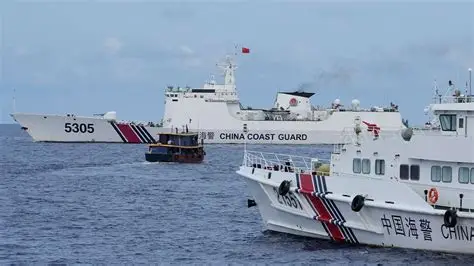
Swarms of Chinese coastguard and maritime militia vessels now patrol inside the nine-dash line — overwhelming the much smaller coastguards of other claimants and making physical challenges to Chinese supremacy increasingly difficult. The Philippines has experienced this most directly — multiple clashes between Philippine coastguard vessels and Chinese ships in areas both countries claim have occurred in recent years, with China’s numerical and material superiority making sustained Philippine resistance extremely difficult.
China’s South China Sea island building record:
- Mischief Reef, Fiery Cross Reef, and Subi Reef — all in the Spratly Islands — transformed from reefs to islands
- All three now host military-grade airports capable of receiving military aircraft
- Military bases established on all three — including radar systems, weapon emplacements, and harbour facilities
- The nine-dash line claims approximately 90% of the South China Sea as Chinese sovereign territory
- An international tribunal ruled in 2016 that China’s claims had no basis in international law — China rejected the ruling
- Coastguard and maritime militia vessels enforce Chinese claims across the nine-dash line
- Antelope Reef’s development follows the same pattern established at the Spratly sites
China has an existing airstrip on Woody Island — nearby in the Paracels — which might make a second airstrip at Antelope Reef seem redundant in purely military terms. Some analysts suggest the Antelope Reef construction may therefore be sending a political message to Vietnam as much as building a genuinely new military capability — a demonstration of Chinese capacity and intent in an area particularly sensitive to Vietnamese interests.
South China Sea Dredging War 2026: Vietnam Joins the Building Race
The most significant new development in the South China Sea dredging war 2026 is not what China is building — it is what Vietnam is building in response. After years of watching China’s construction programme transform the strategic geography of the South China Sea, Vietnam has launched its own accelerated dredging programme on the reefs it controls in the Spratlys.
Vietnam is using the same powerful cutter suction dredgers as China — vessels whose capabilities were previously associated almost exclusively with Beijing’s construction programmes. The scale and speed of Vietnam’s construction activity represents a qualitative shift in its approach to the territorial dispute — moving from protest and diplomacy toward the same physical consolidation strategy that China has employed so effectively.
This shift is politically complex. Vietnam’s recently-elected president and party general secretary To Lam made his first state visit to China, where both countries referred to their differences over the Paracels and Spratlys in unusually conciliatory language. Vietnam formally protested against China’s Antelope Reef construction — but in restrained, diplomatic terms rather than the heated anti-Chinese rhetoric that characterised previous decades of Vietnamese domestic politics on this issue.
Vietnam’s changing approach to the South China Sea:
- Launched its own dredging programme on Spratly reefs it controls — using the same cutter suction dredgers as China
- The scale of Vietnam’s construction represents a significant escalation in its consolidation strategy
- President To Lam’s first state visit was to China — signalling a diplomatic warming despite territorial tensions
- Both countries used unusually conciliatory language about their South China Sea differences during the Beijing visit
- Vietnam formally protested Antelope Reef construction — but only in restrained, diplomatic terms
- The dialling down of anti-Chinese rhetoric coincides with accelerated physical consolidation efforts
- Vietnam’s strategy appears to separate diplomatic tone from physical reality — talking softly while building rapidly
The apparent contradiction between diplomatic conciliation and physical escalation is not a contradiction at all — it is a strategy. Vietnam is choosing to minimise the diplomatic temperature of its relationship with China while simultaneously ensuring that its physical presence on disputed reefs is consolidated before any agreement could limit further construction.
South China Sea Dredging War 2026: The Broader Territorial Picture
The South China Sea dredging war 2026 involves not just China and Vietnam but a complex web of overlapping territorial claims from six sovereign states — China, Taiwan, Vietnam, the Philippines, Malaysia, and Brunei — each of which claims some portion of the Paracel or Spratly islands, or both.
The Philippines, like Vietnam, has been watching China’s construction with increasing concern — and to a lesser extent has also been building up features it controls. The pattern across the region is now unmistakable. Each claimant is accelerating its own physical consolidation on features it controls — driven by the calculation that the strategic geography of the South China Sea is being determined right now, and that whatever physical presence a country establishes in this period will be extremely difficult to reverse later.
The South China Sea claimants and their positions:
- China: Claims almost the entire sea within the nine-dash line — controls Paracels and three major Spratly islands with military bases
- Taiwan: Claims the same territory as China — controls Itu Aba, the largest natural island in the Spratlys
- Vietnam: Claims the Paracels (lost to China in 1974) and the Spratlys — currently accelerating construction on controlled reefs
- Philippines: Claims significant portions of the Spratlys — ongoing clashes with China over contested features
- Malaysia: Claims the southern Spratlys — controls several features including Swallow Reef
- Brunei: Claims a small area including Louisa Reef — least active militarily among the claimants
An international tribunal ruled in 2016 that China’s nine-dash line claims had no basis in international law under the UN Convention on the Law of the Sea. China rejected the ruling entirely and has continued its construction programme without modification. That rejection established the practical reality that international legal mechanisms cannot effectively constrain China’s territorial consolidation — a lesson that other claimants have absorbed and acted upon by accelerating their own building.
South China Sea Dredging War 2026: What Is Actually at Stake
The South China Sea dredging war 2026 is not merely a dispute about small reefs and uninhabited islands. The South China Sea carries approximately one-third of global maritime trade — trillions of dollars of goods pass through its waters annually. It contains significant hydrocarbon reserves whose full extent remains uncertain but potentially enormous. And its strategic geography determines the freedom of movement of naval forces across a region that is central to the global balance of power between the United States and China.
Control of the South China Sea — or the ability to deny others free movement through it — is therefore not a peripheral issue for any of the states involved. It is central to their economic security, their energy independence, and their strategic relationships with the great powers whose competition increasingly defines the international order.
What is actually at stake in the South China Sea:
- Approximately one-third of global maritime trade passes through the sea annually
- Significant and potentially enormous hydrocarbon reserves — oil and natural gas
- Strategic control of vital shipping lanes connecting East Asia to the Indian Ocean and beyond
- The freedom of movement of US and allied naval forces across the western Pacific
- The precedent for how international law applies to territorial disputes in the 21st century
- The balance of power between China and the United States in the Indo-Pacific region
- The sovereignty and economic rights of smaller claimant states including the Philippines and Vietnam
Every tonne of sand deposited on Antelope Reef is a statement about all of these stakes simultaneously. China understands this. Vietnam understands this. And the accelerating pace of construction across the region suggests that every claimant understands that the window for establishing physical facts on the water is open now — and may not remain open indefinitely.
Final Word on South China Sea Dredging War 2026
The South China Sea dredging war 2026 is a story about the oldest of geopolitical dynamics — the race to establish physical facts before diplomatic or legal processes can prevent them. Antelope Reef has been transformed from a submerged speck to a 6 square kilometre island in six months. Vietnam is building on its own reefs with the same machines. The Philippines is watching and building too.
The nine-dash line sits on China’s maps. International tribunals have ruled it illegal. China continues building. Vietnam continues building. And the South China Sea — one of the world’s most strategically consequential bodies of water — is being permanently and rapidly transformed by millions of tonnes of dredged sand and the political will of nations that have decided the moment to act is now.
Grab what you can while you can. That is the new reality at the edge of the world’s most contested sea.