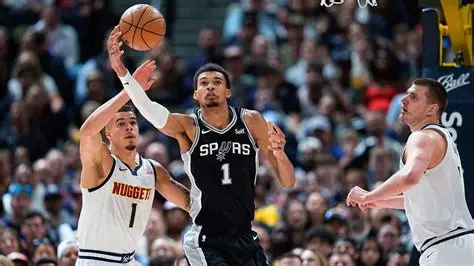
Victor Wembanyama Leads Spurs to Stunning 25-Point Comeback Win
Victor Wembanyama turned a March regular-season game into one of the defining statements of San Antonio’s season. The Spurs were down 25 points to the Los Angeles Clippers, looking flat, slow and close to finished. By the final seconds, they were celebrating a 116-112 comeback win that showed why this young team had become a serious Western Conference problem.
The box score was strong enough on its own. Victor Wembanyama finished with 27 points, 10 rebounds and four blocks, according to ESPN’s game recap. But the numbers only explain part of the night. What mattered more was the timing. With the score tight and the game almost gone, Victor Wembanyama scored the go-ahead basket with 16 seconds left and helped complete San Antonio’s largest comeback of the season.
The Spurs had trailed 75-50 in the third quarter. They did not panic. They defended, ran, attacked the rim and trusted the player who has already changed the long-term expectations around the franchise. Victor Wembanyama later admitted he had emptied himself physically, saying he had “zero left” after one of the best moments of his basketball career. That honesty made the win feel even bigger. It was not effortless greatness. It was exhaustion, belief and execution squeezed into one dramatic finish.
For San Antonio, the result improved the team to 46-17 at the time and extended its remarkable run to 14 wins in 15 games. The Spurs were still chasing the Oklahoma City Thunder near the top of the Western Conference, but the comeback made one thing clear: this was no longer a rebuilding team waiting for the future. With Victor Wembanyama at the centre, the future had already arrived.
Why This Comeback Felt Bigger Than One Game
A 25-point comeback is never just about hot shooting. It requires defensive stops, emotional discipline and a shift in body language. The Clippers had control in the third quarter. They were ahead by enough to make the game feel almost decided. Most teams in that situation need the opponent to collapse. The Spurs forced the collapse.
Victor Wembanyama was the obvious centre of attention, but the comeback was also about San Antonio’s collective maturity. Younger teams often rush when they fall behind. They try to erase the whole deficit in two possessions. The Spurs did something better. They chipped away. They protected enough possessions to make the Clippers uncomfortable. They turned what looked like a comfortable Los Angeles win into a pressure test.
That matters because late-season basketball reveals habits. San Antonio’s 14-1 surge entering the immediate aftermath of this game was not built only on talent. It was built on the kind of late-game trust that appears when a team believes its best player can bend the floor at both ends. Victor Wembanyama gives the Spurs that belief because he changes what is possible in close possessions. A bad shot can become a lob. A broken defensive rotation can become a blocked shot. A rushed opponent can suddenly see a 7ft 4in problem waiting near the rim.
The victory also carried psychological value. The Clippers were not a soft opponent. Coming back against a serious team gives a contender more than one win in the standings. It creates evidence players can recall later, especially in the playoffs, when a game begins badly and panic becomes tempting.
The Turning Point: Defence Before the Finish
The last basket will be replayed most often, but the comeback began before Victor Wembanyama scored the winner. It began when the Spurs finally made the Clippers play every possession under stress. Los Angeles could no longer cruise into early offence. Passing lanes became tighter. Shots became more hurried. The Spurs’ energy rose as the Clippers’ rhythm weakened.
Victor Wembanyama’s four blocks were important because blocks are not only statistical events. They change decisions. A driver who has already seen a shot erased may pull up early next time. A guard may hesitate before throwing a pass into the paint. A centre may rush a finish that would normally be simple. Even when Victor Wembanyama does not block the shot, his presence can turn clean looks into nervous ones.
That effect is why he is more than a scorer. The Spurs can run offence through him, use him as a finisher, let him trail for threes, and still rely on him as the last line of defence. Few players in the NBA can influence both ends so dramatically without dominating the ball every possession.
The final stretch showed that two-way power. Victor Wembanyama gave San Antonio a scoring option when the game tightened, but he also gave them protection when one Clippers basket could have stopped the rally. That combination is why the Spurs have moved from promising to dangerous so quickly.
Why Wembanyama Changes Every Late-Game Possession
The closing minutes explained why Victor Wembanyama is such a difficult late-game matchup. Most stars force opponents to choose between sending help or living with a one-on-one shot. Victor Wembanyama creates a different problem because the normal geometry of the floor changes around him. A pass that looks too high for most players can still be reachable. A defender who appears to have good position can still be shot over. A guard who thinks he has turned the corner can still see the ball taken away from behind.
That changes how San Antonio can play under pressure. The Spurs do not need to run only one kind of action. They can use the French star as a screener, a roller, a post target, a trailer, a weak-side cutter or a floor-spacing big. If the defence switches, he can shoot or catch over smaller defenders. If it drops, he can slip into space. If it loads up, the Spurs can move the ball and attack a rotating defence.
Late-game offence is often about getting to the one advantage that survives pressure. Against the Clippers, San Antonio’s biggest advantage was obvious. Victor Wembanyama was the player Los Angeles could not fully solve. The Spurs still needed poise from the rest of the lineup, but his presence gave every possession a simple logic: keep the floor organised, make the defence react, and trust the best player to turn small openings into winning plays.
A Quick Look at the Numbers
| Detail | Spurs vs Clippers |
|---|---|
| Final score | Spurs 116, Clippers 112 |
| Largest Spurs deficit | 25 points |
| Key Spurs record after win | 46-17 |
| Spurs recent run | 14 wins in 15 games |
| Victor Wembanyama | 27 points, 10 rebounds, 4 blocks |
| Decisive moment | Go-ahead basket with 16 seconds left |
The table explains why the game stood out. It combined a major deficit, a late winner, a strong individual line and a broader standings impact. For a franchise trying to prove it could contend ahead of schedule, that mix was powerful.
What the Win Said About Wembanyama’s Growth
Victor Wembanyama entered the NBA with impossible expectations. He was expected to become a defensive force, a franchise scorer, a global star and a championship-level player, all while still learning the league. That kind of pressure can distort normal development. Every great game becomes proof. Every quiet game becomes a debate.
This comeback mattered because it showed a more mature version of Victor Wembanyama. He did not need a 50-point explosion to control the story. He scored efficiently enough, rebounded, protected the rim and delivered when the game demanded one more play. That is the profile of a winning superstar, not only a highlight machine.
There is a difference between production and command. Many young stars can produce numbers. Fewer can command the emotional direction of a game. Victor Wembanyama did that against the Clippers. When the Spurs were behind, the game still felt recoverable because he was on the floor. When they needed a final basket, the possession naturally found him. When they needed stops, his length gave the defence a second chance.
The most encouraging part for San Antonio is that he still appears to be adding layers. His body is stronger than when he entered the league. His reads are quicker. His defensive timing is sharper. His teammates understand better where and when to find him. That growth is why a 25-point comeback did not feel like a random miracle. It felt like a preview.
Spurs Confidence Is No Longer Quiet
San Antonio’s recent history made this night even more meaningful. The Spurs spent years trying to move from the end of the Gregg Popovich dynasty into a new era. Drafting Victor Wembanyama changed the timeline, but young teams rarely become serious immediately. There is usually a long period of mistakes, lottery nights and lessons.
This version of the Spurs accelerated past some of that waiting. At 46-17 after the Clippers win, they were within reach of the Western Conference lead and had become one of the league’s most watched teams. That does not happen because of one player alone, even when that player is extraordinary. It happens when the rest of the roster grows into defined roles.
The Spurs’ rise also gave the NBA a compelling contrast in the West. Oklahoma City had youth, depth and pace. Denver still had Nikola Jokic. The Lakers had star power. The Clippers remained dangerous. San Antonio offered something different: a generational defensive anchor who could also become the first option late in games.
The News Ink has already covered major NBA storylines such as LeBron James’ field-goal record and Shai Gilgeous-Alexander’s scoring form. Victor Wembanyama now belongs in that same conversation, not as a future name, but as a present force.
Why the Clippers Let It Slip
The Clippers will look at the game differently. For Los Angeles, this was not only a case of Victor Wembanyama taking over. It was a failure to close. A 25-point lead should provide enough cushion, especially for a veteran team. When a team loses from that position, the film usually shows a combination of rushed shots, defensive breakdowns, turnovers and poor late-clock decisions.
The most damaging part was the shift in pressure. While the Spurs played with increasing freedom, the Clippers began playing as if they were trying not to lose. That is dangerous against a team with San Antonio’s length. The more cautious the Clippers became, the more the Spurs could set their defence and run after stops.
Comebacks often create two stories: one team’s belief and another team’s regret. The Clippers had chances to steady the game. They failed to do it. Against ordinary opponents, that might not matter. Against Victor Wembanyama and a confident Spurs team, hesitation became fatal.
How This Compared With the Rest of the NBA Night
The Spurs’ comeback was the headline, but it was not the only major NBA performance that night. Luka Doncic scored 44 points in only three quarters as the Los Angeles Lakers beat the Indiana Pacers 128-117 without LeBron James. Reuters reported that Doncic made seven three-pointers and recorded his 10th 40-point game of the season, joining a historic Lakers group that includes Kobe Bryant, Elgin Baylor and Jerry West.
That performance mattered because it showed how much responsibility Doncic had taken in Los Angeles. With James out because of elbow and foot issues, the Lakers needed one of their stars to control the game early. Doncic did exactly that. The Lakers’ win kept them moving in the right direction, while the Pacers’ struggles continued.
In Denver, OG Anunoby scored a season-high 34 points as the New York Knicks crushed the Nuggets 142-103. Reuters reported that Jamal Murray left with an ankle injury after stepping on Nikola Jokic’s foot while backpedalling late in the second quarter. For the Knicks, it was a statement road win. For Denver, it was a painful night that combined a heavy defeat with injury concern.
Boston also had one of the night’s most emotional stories. Jayson Tatum returned from a ruptured right Achilles and scored 15 points with 12 rebounds and seven assists in the Celtics’ 120-100 win over the Dallas Mavericks, according to the NBA’s game report. Tatum’s return gave Boston a major boost as the team continued to hold second place in the Eastern Conference.
Together, those results made the night feel like a snapshot of the league’s future and present: Victor Wembanyama delivering a comeback, Doncic carrying the Lakers, Anunoby powering a Knicks rout and Tatum beginning the next stage of his recovery.
The Bigger NBA Picture
The game also showed why the NBA’s star map keeps changing. For years, the league’s biggest stories were built around LeBron James, Stephen Curry, Kevin Durant, Giannis Antetokounmpo and Nikola Jokic. Those names still matter. But the next wave is already shaping the league.
Victor Wembanyama is at the front of that shift because his skill set is so unusual. He is not simply tall. The NBA has always had tall players. What makes him different is the combination of reach, coordination, shooting touch, defensive timing and competitive hunger. He can make a normal possession look unfair because his physical tools erase familiar choices.
The Spurs’ comeback over the Clippers gave fans one of the clearest examples yet. The game did not require complicated explanation. A team fell behind by 25. Its young superstar kept fighting. He made the decisive basket. The building erupted. The standings shifted. The story wrote itself.
For broader sports readers, the performance fits into The News Ink’s coverage of sports records and rising sports stars. The difference is that Victor Wembanyama is no longer only rising. He is already deciding games that matter.
What It Meant Later in the Season
Because this game came in March, it is now easier to view it as part of a larger Spurs season rather than a one-night surprise. By July, Reuters reported that Victor Wembanyama had signed a multi-year extension with San Antonio after a season in which he became the youngest Defensive Player of the Year and led the Spurs to the NBA Finals before they lost to the New York Knicks in five games.
That later context makes the Clippers comeback more important, not less. It was one of the regular-season moments that helped explain why San Antonio’s belief became so strong. Teams do not reach the Finals because of one comeback in March, but they often build their identity through games like it.
The Spurs learned that they could survive a terrible stretch and still win. Victor Wembanyama learned again that he could carry the physical and emotional weight of a late game. Opponents learned that no San Antonio deficit was safe. Those lessons travel with a team.
The Bottom Line
Victor Wembanyama’s 27-point, 10-rebound performance against the Clippers was not his biggest statistical night, but it may remain one of his most meaningful. The Spurs were down 25, the game looked lost, and the Clippers had every reason to believe they could close it out. San Antonio refused.
The final 116-112 score captured the result. It did not fully capture the pressure, the fatigue or the significance. Victor Wembanyama produced the go-ahead basket with 16 seconds left, protected the rim when the Spurs needed resistance and left the court saying he had nothing left. That is exactly the kind of performance that turns a star into a franchise standard.
For San Antonio, the win confirmed that its rise was real. For the Clippers, it was a warning about what happens when a game is not finished. For the rest of the NBA, it was another reminder that Victor Wembanyama is already shaping the league’s present, not simply waiting to inherit its future.
For more NBA and global sports coverage, follow The News Ink on X or read our latest basketball coverage on LeBron James’ NBA record.