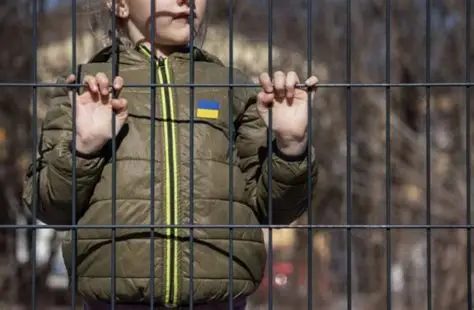
UN Says Russia’s Deportation of Ukrainian Children Is a Crime Against Humanity
The deportation of Ukrainian children by Russian authorities amounts to a crime against humanity as well as a war crime, according to the latest findings of the United Nations’ Independent International Commission of Inquiry on Ukraine.
The conclusion is more serious than the Commission’s earlier findings. Investigators had already said the unlawful removal and transfer of children constituted war crimes. The March 2026 report goes further, concluding that the conduct formed part of a widespread, systematic and state-directed policy. It also found that Russian authorities committed the crime against humanity of enforced disappearance by concealing children’s whereabouts and obstructing their return.
Behind the legal language are families who have spent months or years searching. Some children returned carrying Russian documents or struggling with fear and abandonment, while others remain separated from siblings and relatives.
The deportation of Ukrainian children was therefore not simply a wartime evacuation dispute. The UN says it involved long-term placement, altered citizenship, concealed information and blocked repatriation.
What the UN Found About the Deportation of Ukrainian Children
The UN’s findings on the deportation of Ukrainian children were set out in a main report and detailed conference paper issued in March 2026 for the UN Human Rights Council. Investigators confirmed 1,205 cases involving children taken from five Ukrainian regions to Russia or other Russian-occupied areas.
The Commission concluded that the deportation of Ukrainian children involved four overlapping international crimes:
- unlawful deportation or forcible transfer, treated as a war crime;
- unjustifiable delay in repatriation, also treated as a war crime;
- deportation and forcible transfer carried out as a crime against humanity;
- enforced disappearance carried out as a crime against humanity.
These categories describe different parts of the system behind the deportation of Ukrainian children. Unlawful removal, delayed return and concealment from families can become separate offences. When such acts are widespread, systematic and state-directed, they can reach the threshold for crimes against humanity.
The Commission said the pattern was planned and coordinated at the highest levels of the Russian state. It specifically identified President Vladimir Putin and bodies answerable to him as part of the structure that organised transfers, placements and legal changes affecting the children.
War Crime and Crime Against Humanity Are Not the Same
The terms are often used together, but they have different legal foundations.
A war crime is a serious violation of international humanitarian law committed in connection with an armed conflict. Civilians in occupied territory are protected from unlawful deportation or transfer. Children evacuated for genuine safety or medical reasons must generally be returned when circumstances permit, and family reunification must be facilitated.
A crime against humanity does not depend only on one unlawful event. In the deportation of Ukrainian children, it requires conduct forming part of a widespread or systematic attack directed against a civilian population, with knowledge of that attack. The UN Commission found that the deportation of Ukrainian children followed a consistent pattern across several regions and was carried out under a policy developed and executed through Russia’s state apparatus.
The finding is not a criminal conviction: the Commission investigates and reports but does not conduct trials. Its evidence can nevertheless support sanctions, prosecutions and future accountability proceedings.
The Deportation of Ukrainian Children in Five Numbers
The scale of the deportation of Ukrainian children is clearer when the most important figures are separated:
- 1,205: children whose deportation or forcible transfer the Commission has individually verified;
- 995: children taken from 11 institutions in the occupied Donetsk and Luhansk areas in an operation beginning shortly before the full-scale invasion;
- 80%: the share of children in the Commission’s verified cases who had still not returned;
- 21: Russian regions where children were placed with families or in institutions;
- 20,610: the wider number of deported or forcibly displaced children listed by Ukraine’s official tracking portal as of 17 July 2026.
The UN and Ukrainian totals for the deportation of Ukrainian children measure different things. The Commission counts independently verified cases; Ukraine uses a broader national identification process. Neither should be treated as complete because occupied areas remain difficult to access.
Ukraine’s Children of War portal showed how slowly the deportation of Ukrainian children was being reversed, recording 2,383 returned children by 17 July 2026. That was higher than the roughly 2,000 cited earlier in the year, but it remained a small share of the children Ukraine says were deported or forcibly displaced.
How the Deportation of Ukrainian Children Worked
Russian authorities described many movements as evacuations from areas exposed to fighting. International law does allow temporary evacuation of children when compelling health, medical or safety reasons require it.
The Commission found that most removals it examined did not remain temporary. Children were first moved to transit centres in Russia or occupied Ukraine and then dispersed across institutions or families in numerous Russian regions. Many were sent hundreds or thousands of kilometres away from their homes.
The deportation of Ukrainian children often involved residents of boarding schools, care homes or hospitals. Some had parents or relatives despite Russian references to orphans; in other cases, Ukrainian authorities held legal guardianship and did not consent.
The Commission said Russian authorities did not establish an effective central mechanism allowing parents to locate children, communicate with them and arrange safe return. Instead, families were frequently left to search through unofficial contacts, humanitarian intermediaries and complex journeys of their own.
The News Ink’s coverage of deadly Russian strikes and a record drone attack shows the danger civilians continue to face. Yet wartime danger does not convert an open-ended relocation into a lawful evacuation.
How the Deportation of Ukrainian Children Changed Identity
The detailed UN paper says the deportation of Ukrainian children included a coordinated effort to change their legal and family status after removal.
Putin approved a May 2022 decree simplifying Russian citizenship procedures for Ukrainian children without parental care. The Commission found that deported children received Russian citizenship, appeared in adoption or foster databases and were offered for long-term placement with Russian families.
Russian officials later placed greater emphasis on guardianship and foster care rather than adoption, particularly after the International Criminal Court issued warrants in 2023. The Commission nevertheless said long-term placements continued and that some cases appeared to be adoptions.
In two documented cases, new Russian documents changed a child’s name and birthplace. Other children were separated from siblings. One child was placed with Maria Lvova-Belova, Russia’s presidential commissioner for children’s rights, who is also wanted by the ICC over alleged unlawful deportation and transfer.
The deportation of Ukrainian children becomes harder to reverse when identity records, citizenship and family placement change. A child who receives a new passport, surname or registered family relationship may become more difficult to trace. Those steps also weaken the practical and emotional link with Ukraine.
Why the Deportation of Ukrainian Children Became Enforced Disappearance
In the deportation of Ukrainian children, enforced disappearance is not an abstract label. The term is often associated with adults taken into secret detention. The Commission applied it to children because authorities frequently failed to tell parents, guardians or Ukrainian officials where the children had been taken.
The report said information was deliberately withheld in cases it examined, children’s identities were concealed and reunification was prevented. The coercive environment, indefinite placements and obstacles to travelling home amounted to a deprivation of liberty.
For parents, the result was prolonged uncertainty. They could not establish whether a child was safe, sick, moved to another institution or placed with a family. Some searched for years.
The deportation of Ukrainian children therefore created two separations at once. The physical separation removed a child from home. The information barrier stopped families from knowing how to reverse it.
The UN concluded that this pattern was widespread and systematic enough to constitute the crime against humanity of enforced disappearance.
Who Directed the Deportation of Ukrainian Children?
The Commission did not describe the deportation of Ukrainian children as a collection of unrelated decisions by local administrators.
Its report says the deportation of Ukrainian children was coordinated by authorities at national, regional and occupation levels. Putin’s involvement was visible from the outset through his authority over the institutions directing the policy and through public decisions that simplified citizenship and encouraged permanent placement.
A March 2022 meeting between Putin and Lvova-Belova was among the evidence highlighted. When she raised legislative obstacles to placing children from occupied eastern Ukraine with Russian families, Putin said the obstacles should be identified and removed. The citizenship decree followed in May.
The Commission also referred to the use of government structures, regional administrations, occupation authorities, state aircraft, armed forces and children’s welfare bodies.
Not every official involved has been charged or convicted, but the UN inquiry found a centrally coordinated policy rather than spontaneous humanitarian action.
Russia’s Explanation for the Deportation of Ukrainian Children
Moscow has consistently said children were moved away from combat zones for their safety. Russian officials have denied carrying out forced mass adoption and have argued that children can return when parents or authorised relatives request them.
The UN Commission examined the evacuation argument and rejected it for the cases documented. It found that the movements were generally not temporary, were not based only on compelling safety or medical reasons and were often conducted without consent from parents, guardians or Ukrainian authorities.
The Commission also said Russia failed to create a proactive return system. Instead of identifying families and initiating reunification, Russian authorities placed the burden on parents, caregivers and intermediaries.
Russia did not recognise the Commission and left 39 requests for access, information and meetings unanswered, according to the main report. That lack of cooperation limited investigators’ access to official records and locations inside Russia, but the Commission used interviews, documents, official Russian statements, government websites, databases, videos and open-source material.
The deportation of Ukrainian children remains one of the areas where Russian and Ukrainian descriptions differ most sharply. The UN finding is significant because an independent international inquiry evaluated the evidence and concluded that the conduct was unlawful, systematic and policy-driven.
Children Returned After the Deportation of Ukrainian Children
The report’s most disturbing evidence came from children and relatives who experienced the placements directly.
Returned children described trauma, anxiety and fear of abandonment. One boy said he developed panic attacks and was placed in isolation when they occurred. Families reported inadequate medical care, hunger and significant weight loss in some institutions.
Some children said they were pressured to sing the Russian national anthem or were told that Ukraine no longer existed. One mother said staff told her son that his country had burned and that his parents were probably dead. Years after returning, he still had trouble sleeping.
The Commission also heard that promotional videos showing supposedly happy foster placements were staged. One returned child said children could be afraid to express a wish to return.
The deportation of Ukrainian children is therefore not measured only by travel routes or legal documents. It also includes the psychological effect of being separated from family, immersed in a new national identity and told that return may be impossible.
The News Ink has examined Russia’s domestic experience and how AI deepfakes support Russian disinformation. The children’s accounts show how information control can also operate at the most personal level.
Why Reversing the Deportation of Ukrainian Children Is So Difficult
Bringing a child home often requires more than locating an address.
Families may need identity records, proof of guardianship and permission to travel through Russia or occupied territory. Direct routes across the front line are dangerous or closed, forcing relatives to travel through third countries. Caregivers may face security checks and significant expense.
Some children no longer possess valid Ukrainian documents. Others have Russian citizenship papers or are living with families who believe the placement is lawful. Younger children may struggle to remember addresses or relatives. Children in institutions may have limited private communication.
The Commission said Russian authorities had not created a system that simplified these problems. Returns were instead organised through families, Ukraine, humanitarian organisations and international intermediaries.
The deportation of Ukrainian children can become more permanent with every passing year. Children grow older, attachments change, records become harder to reconstruct and relatives may die or be displaced. That is why the Commission called for immediate, safe and unconditional return rather than a slow process controlled by Russia.
ICC Warrants Over the Deportation of Ukrainian Children
In March 2023, the International Criminal Court issued arrest warrants for Putin and Lvova-Belova. ICC judges said there were reasonable grounds to believe each bore responsibility for the war crimes of unlawful deportation and unlawful transfer of Ukrainian children from occupied areas to Russia.
The warrants are allegations, not convictions. Russia rejects the court’s jurisdiction, and the ICC relies on member states to carry out arrests.
The new UN finding is legally distinct from the ICC case. The Commission has now concluded that the deportation of Ukrainian children also amounts to crimes against humanity and enforced disappearance. The ICC warrants publicly announced in 2023 focused on alleged war crimes.
The processes are separate: the Commission gathers evidence, while ICC prosecutors and judges pursue individual criminal responsibility.
Pressure to End the Deportation of Ukrainian Children
Ukraine has repeatedly called for the children’s unconditional return to be included in diplomatic negotiations and peace proposals. Governments and international organisations have also imposed sanctions on individuals and institutions accused of assisting deportation, adoption, re-education or militarisation programmes.
The central humanitarian demand is simpler than the broader political dispute: Russia should provide a full list of children, their current locations, legal status and family placements; restore contact with relatives; stop changing identity records; and facilitate safe return.
The UN Commission recommended that Russia disclose information about every child, including institutional and family placements, citizenship changes and adoptions. It called for communication with families to be restored and for immediate repatriation.
The deportation of Ukrainian children cannot be resolved through public promises that families may apply for return. A credible process requires active tracing, transparent records, international access and a presumption in favour of reunification.
A Wider Humanitarian Crisis
The case exists inside a war that has displaced millions. UNHCR estimated that 3.7 million people remained internally displaced in Ukraine in 2026 and 10.8 million needed humanitarian assistance.
Russian attacks on housing, energy systems and cities have repeatedly produced new displacement. The News Ink has reported on aerial attacks that killed civilians as the full-scale invasion moved beyond its fourth anniversary.
Displacement makes child tracing harder. A parent may be serving in the military, living abroad or displaced several times. Records may have been destroyed when institutions were occupied or buildings attacked. Some children had already been separated from parents because of disability, poverty or institutional care before Russian forces arrived.
Those vulnerabilities do not reduce their rights. The UN report stresses that the best interests of the child, preservation of identity and family reunification should guide every decision.
What Must Happen After the Deportation of Ukrainian Children
The report creates a clear set of priorities.
Russia should publish accurate records and allow international monitors to verify children’s locations. It should end new citizenship, adoption and long-term placement measures involving children removed from occupied Ukraine. It should restore communication and cooperate with a large-scale return mechanism.
Ukraine and partner governments need to maintain a reliable database, support families travelling to recover children and provide trauma-informed care after reunification. Returned children may require help with education, language, identity documents and family adjustment.
International mediators can assist, but returns should not be treated as political concessions exchanged for unrelated military or economic terms. Children should not become bargaining tools.
Accountability investigations must also continue. The deportation of Ukrainian children involves decisions made across ministries, occupation administrations, institutions and families. Identifying the chain of responsibility matters both for justice and for preventing further removals.
The Bottom Line on the Deportation of Ukrainian Children
The UN’s latest inquiry says the deportation of Ukrainian children was not a series of temporary wartime evacuations. It found a widespread and systematic policy involving removal, long-term placement, Russian citizenship, adoption or foster databases, concealed whereabouts and blocked returns.
Investigators verified 1,205 cases from five Ukrainian regions and found that more than 80% of those children had not returned. Ukraine’s broader official tracker listed 20,610 children as deported or forcibly displaced and 2,383 as returned by 17 July 2026.
The Commission concluded that the deportation of Ukrainian children constituted war crimes and crimes against humanity. It also concluded that the concealment and prolonged separation of children amounted to enforced disappearance.
Russia denies abducting children and says it moved them for safety. The UN found that the evidence did not support that explanation in the cases investigated, particularly because placements became indefinite and authorities did not establish a genuine system for return.
For families, the legal classification matters because it recognises that the harm did not end when a bus, train or aircraft crossed a border. It continued through every unanswered message, every changed document and every month in which a child remained separated from home.
The deportation of Ukrainian children is now a central accountability issue of the war. The immediate demand is clear: identify every child, disclose their location and bring them home safely.
For more world news and Russia-Ukraine coverage, readers can follow The News Ink on X.