Louisiana v Callais Voting Rights Decision Redraws Southern Districts
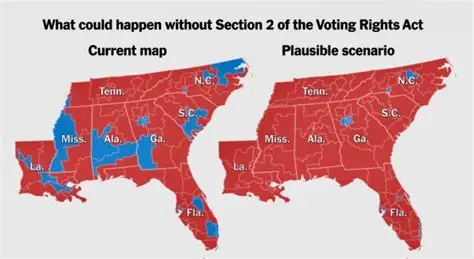
Louisiana v Callais Voting Rights decision culminates decades Supreme Court rulings limiting Voting Rights Act. No one disputes impact: throughout South, election districts drawn protect Black voters redrawn help Republicans.
Districts majority voters color become minority-white. Result: fewer people color elected Congress state legislatures.
Case product five prior decisions court voting rights area. All split along ideological lines: Mobile v Bolden, Shaw v Reno, Shelby County v Holder, Rucho v Common Cause, Alexander v South Carolina NAACP.
Mobile v Bolden (1980): Discriminatory Purpose Required, Not Just Impact
First case City Mobile v Bolden decided 1980. Held election system impacting minorities not strict scrutiny unless proof racially discriminatory purpose.
Case challenged Mobile Alabama at-large city council election. City predominately white sizeable Black population. Racially polarized voting meant only white individuals elected.
Supreme Court found no constitutional violation insufficient evidence discriminatory purpose. Previously court ruled 14th Amendment equal protection violation required racially discriminatory purpose proof.
Mobile v Bolden said applies 15th Amendment too. 15th Amendment broad goal eliminating race discrimination voting.
Congress Amended Voting Rights Act Section 2 After Mobile v Bolden
Two years after Mobile v Bolden, Congress amended Section 2 Voting Rights Act expressly. Proof racially disparate impact—not just racially discriminatory purpose—sufficient liability statute.
Amendment responded court ruling narrowed voting rights protection. Congress reasserted legislative power enforcing 15th Amendment.
Section 2 now prohibits election systems discriminating voters color. Disparate impact liability remains key tool.
Shaw v Reno (1993): Race Predominant Factor Violates Equal Protection
Next case Shaw v Reno 1993 held use race drawing election districts benefit racial minorities permissible only government shows necessary compelling purpose.
Premise Justice Samuel Alito majority opinion Louisiana v Callais. Government cannot use race predominant factor drawing districts even needed comply Section 2 Voting Rights Act.
Consistent Supreme Court cases mandating strict scrutiny government affirmative action efforts. Dissent argued affirmative action voting different employment education.
Voting affirmative action every person votes equally. No white individual disadvantaged losing job admission.
Shaw v Reno Predicate for Alito’s Callais Opinion
Shaw v Reno predicate Alito opinion Callais. Court held government use race predominant factor drawing election districts violates equal protection unless strict scrutiny met.
Court rejected preventing discriminatory effect voters color drawing district sufficiently compelling interest meet strict scrutiny.
Strict scrutiny highest judicial review standard. Government must prove narrowly tailored compelling interest.
Alito opinion Callais applies strict scrutiny race districting. Section 2 compliance not compelling interest enough.
Shelby County v Holder (2013): Section 5 Preclearance Nullified
Court decided Shelby County v Holder 2013. Wake Louisiana v Callais decision, discussion relationship Shelby County Callais rightly occurs.
Voting Rights Act 1965 two crucial mechanisms protect voting rights: Section 2 prohibits election systems discriminating voters color (at issue Callais), Section 5 requires jurisdictions history race discrimination voting obtain preapproval attorney general changing election systems.
Shelby County effectively nullified Section 5. No jurisdiction needed preclearance since decided.
Shelby County, Callais: Court Gives No Deference Congress
Shelby County relevant Callais another way: reflects court giving no deference Congress legislating Section 2 15th Amendment. 15th Amendment empowers Congress enact legislation enforcing prohibition race discrimination voting.
Shelby County first time since 19th century court declared unconstitutional federal civil rights law protecting racial minorities.
Similarly Supreme Court Callais gave no deference Congress. Congress 1982 amended Section 2 Voting Rights Act proof racially disparate impact sufficient liability.
Alito majority opinion Callais explicit only proof intentional race discrimination sufficient. Justice Elena Kagan dissent said plaintiff show legislators motivated discriminatory purpose—contrary Section 2 clear text design.
Kagan said almost always impossible legislators rarely express racist motive.
Rucho v Common Cause (2018): Partisan Gerrymandering Non-Justiciable
2018 case Rucho v Common Cause directly relevant. Rucho Supreme Court held 5-4 challenges partisan gerrymandering non-justiciable political questions (cannot heard federal court).
Partisan gerrymandering political party controls legislature draws election districts maximize safe seats party.
Result legislatures engage partisan gerrymandering impunity knowing no possibility challenge federal court. Witnessed year Texas, California, most recently Virginia.
Louisiana v Callais Voting Rights Impact: Fewer Minority Elected Officials
Louisiana v Callais Voting Rights decision forces Southern states redraw districts majority-Black majority-minority. Result: Republican gain seats, minority representation drops Congress state legislatures.
Black voters protected districts now split dilute voting power. Racial polarization voting means white voters elect white candidates.
Minority elected officials decrease significantly. Democratic party loses seats Republican gains.
Voting rights advocates challenge redistricting plans court. Section 2 claims harder prove intentional discrimination required.
Dissent Warns Louisiana v Callais Destroys Voting Rights Act Protection
Justice Elena Kagan dissent warned decision destroys Voting Rights Act Section 2 protection. Plaintiffs prove legislators racist motive impossible task.
Section 2 clear text design disparate impact sufficient. Court rewrites statute requires discriminatory purpose.
Civil rights lawyers face uphill battle challenging redistricting. Intentional discrimination evidence rarely exists.
Dissent calls majority opinion dangerous precedent voting rights. Future cases further limit protections.
Five Prior Cases Leading to Louisiana v Callais Voting Rights
Louisiana v Callais Voting Rights decision product five prior Supreme Court rulings. All split ideologically 5-4.
-
Mobile v Bolden (1980): Discriminatory purpose required, not impact.
-
Shaw v Reno (1993): Race predominant factor districting violates equal protection.
-
Shelby County v Holder (2013): Section 5 preclearance nullified.
-
Rucho v Common Cause (2018): Partisan gerrymandering non-justiciable.
-
Alexander v South Carolina NAACP: Narrowed Section 2 claims further.
Each case eroded Voting Rights Act protections. Callais culmination decades judicial rollback.
What Louisiana v Callais Means for Voters of Color
Louisiana v Callais Voting Rights decision reduces political power voters color. Districts drawn protect Black voters now redrawn help Republicans.