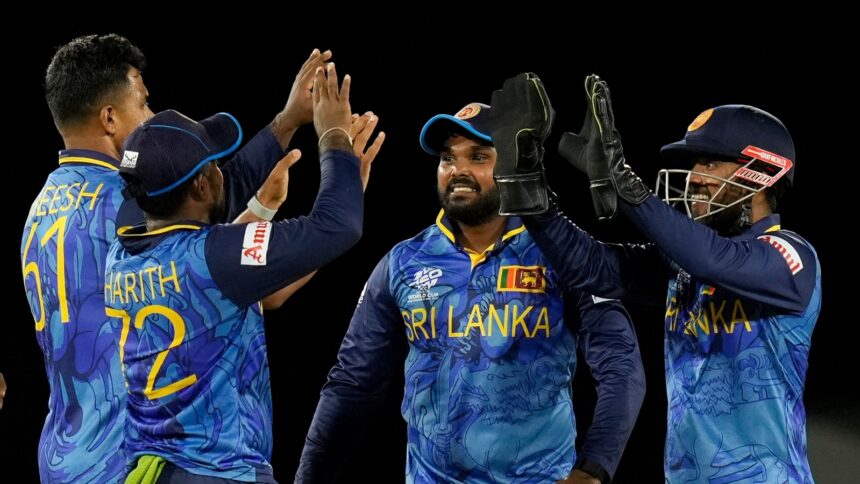
Sri Lanka knocked out: The Brutal 2026 T20 World Cup Defeat That Ended a Home Dream
Sri Lanka knocked out of the T20 World Cup on home soil was not just another disappointing result; it was the night a promising tournament collapsed in four brutal overs with the bat and a powerless chase under pressure.
Sri Lanka knocked out was the clear and painful outcome. New Zealand made 168/7 at R. Premadasa Stadium in Colombo. Sri Lanka replied with 107/8. The 61-run margin sent the co-hosts out of semi-final contention and kept New Zealand alive in Super Eight Group 2. For a home crowd watching Sri Lanka knocked out after the bowlers had dragged the match back from the edge of danger, the ending felt especially harsh.
Sri Lanka knocked out was not a match the hosts lost from the first ball. For 16 overs of New Zealand’s innings, Sri Lanka looked close to producing the kind of disciplined, spin-led performance that can define a home World Cup campaign. Maheesh Theekshana and Dushmantha Chameera had New Zealand wobbling at 84/6. The pitch was gripping. The crowd was awake. The chase looked manageable.
Then Mitchell Santner and Cole McConchie changed the entire night.
Their seventh-wicket stand turned 84/6 into 168/7, and Rachin Ravindra later finished the job with the ball. By the time Sri Lanka knocked out became the confirmed tournament headline, the match had become a clear lesson in how quickly T20 cricket punishes one lost phase.
Readers who want a broader guide to the format can use The News Ink’s cricket guide for context on why short-format matches can swing so violently in the final overs.
Why Sri Lanka knocked out became the defining story
Sri Lanka knocked out was the immediate headline because the result removed the co-hosts from the semi-final race. The tournament still had other Super Eight matches to play, but Sri Lanka’s path was gone. A second successive Super Eight defeat left them without enough room to recover.
That matters because Sri Lanka were not just another participant. They were co-hosts. They had conditions they understood, support they could feel and a squad built around spinners who should have enjoyed the Colombo surface. When a host nation exits after such a promising bowling start, the disappointment carries extra weight.
The official ICC match report described New Zealand’s win as a victory built on a late batting recovery and an all-round bowling performance. It also confirmed the central facts: New Zealand rose from 84/6, scored 70 from the last four overs, then restricted Sri Lanka to 107/8.
Sri Lanka knocked out also became a tactical story. The hosts did several things right, yet still lost heavily. That is the most worrying part. This was not a total mismatch from start to finish. It was a match where Sri Lanka created a winning position, failed to close the innings, then lost control of the chase almost immediately.
The match in one table
| Key moment | What happened | Why it mattered |
|---|---|---|
| New Zealand chose survival first | Sri Lanka reduced New Zealand to 84/6 | The hosts had control of the innings |
| Santner and McConchie counterattacked | They added 84 for the seventh wicket | New Zealand reached a defendable 168/7 |
| Final four overs exploded | New Zealand scored 70 runs | Sri Lanka’s bowling advantage disappeared |
| Henry struck first ball | Pathum Nissanka was bowled immediately | The chase lost its shape from the start |
| Ravindra broke the middle order | He finished with 4/27 | Sri Lanka could not rebuild |
| Sri Lanka ended 107/8 | New Zealand won by 61 runs | Sri Lanka knocked out of the semi-final race |
The table shows why Sri Lanka knocked out was not caused by one weakness alone. It came from the combination of poor death bowling, fragile top-order batting and an inability to respond once New Zealand’s spinners tightened the game.
How Sri Lanka lost control after having New Zealand 84/6
The most damaging part of the defeat was the swing from 84/6 to 168/7. Sri Lanka had done the hard work. Finn Allen and Tim Seifert were removed early. Theekshana struck with accuracy. Chameera brought pace and threat. Rachin Ravindra and Glenn Phillips briefly steadied New Zealand, but the hosts kept taking wickets.
At 84/6, New Zealand were not thinking about domination. They were thinking about survival. A total near 130 or 140 would have left Sri Lanka with a chase that suited their home conditions. Instead, Santner and McConchie bought time, trusted the surface, and chose the final four overs as their moment.
That decision was devastating. Santner made 47 from 26 balls, with four sixes and two fours. McConchie finished unbeaten on 31, adding three fours and two sixes. Their partnership was not just aggressive; it was calculated. They waited until Sri Lanka had to use their death options, then attacked the shorter boundary, the pace-off mistakes and anything overpitched.
Sri Lanka knocked out became inevitable partly because those final overs changed the required chase psychologically. A target that might have been 135 suddenly became 169. On a turning surface, under elimination pressure, that was a different game.
Sri Lanka knocked out also echoed a wider lesson from the tournament: teams that dominate the middle overs still need death-over clarity. The News Ink’s piece on T20 World Cup semi-final scenarios showed how net run rate and margins mattered throughout the Super Eight stage. Sri Lanka’s margin here was not only a defeat; it was a final statement of how badly the match had run away.
Rachin Ravindra delivered the complete all-round performance
Rachin Ravindra was named player of the match because he shaped both innings. His 32 from 22 balls gave New Zealand a platform when early wickets threatened to expose the middle order too soon. Later, his left-arm spin removed Sri Lanka’s ability to rebuild.
The most important sequence came when Kusal Mendis and Pavan Rathnayake were stumped off successive legal deliveries. Both dismissals looked similar: batters beaten by drift, length and pressure rather than mystery alone. Ravindra finished with 4/27, his best T20I figures, and gave New Zealand exactly what a knockout-pressure match demands from an all-rounder.
Sri Lanka knocked out therefore belongs partly to Ravindra’s maturity. He did not need a spectacular 70 or a five-wicket haul to dominate the match. He contributed at the points where New Zealand were vulnerable and then dangerous.
His spell also exposed a familiar Sri Lankan issue: when early wickets fall, the middle order too often shifts from recovery into survival. Kamindu Mendis and Dunith Wellalage resisted, but the chase never regained momentum. Singles did not hurt New Zealand. Dot balls did.
Matt Henry made the chase feel impossible from ball one
Every chase has an emotional first over. Sri Lanka’s was close to disastrous. Matt Henry bowled Pathum Nissanka first ball, immediately removing one of the batters most capable of controlling a chase. Henry then followed with the wicket of Charith Asalanka and ended with remarkable figures of 2/3 from two overs.
That spell mattered because it removed the possibility of a calm start. Sri Lanka could not take ten balls to assess the surface. They were forced into damage control from the first delivery. By the end of the powerplay, the hosts were 20/2, their lowest powerplay total at a T20 World Cup.
Sri Lanka knocked out became more likely with every dot ball after that. The target was not astronomical by modern T20 standards, but it was huge once the chase lost wickets and tempo. New Zealand understood that. Santner could spread the field, rotate spin and force Sri Lanka to manufacture boundaries from low-percentage shots.
For more on how pressure changes match management in cricket, The News Ink’s coverage of India staying on track for the T20 World Cup semi-finals offers a useful contrast: good teams do not only win big moments; they stop small mistakes from becoming tournament-ending ones.
Sri Lanka’s batting problem was bigger than one chase
Sri Lanka knocked out makes it easy to blame one poor innings. That would be too simple. Sri Lanka knocked out of the tournament reflected a broader batting problem: too few partnerships, too little boundary pressure and too many players left rebuilding from crisis positions.
In T20 cricket, a chase of 169 needs at least one of three things. It needs a strong powerplay, a major individual innings or a late hitter who can turn 12 an over into something realistic. Sri Lanka had none of those. Kamindu Mendis made 31. Wellalage made 29. Those were fighting efforts, not match-turning innings.
The boundary comparison was brutal. Sri Lanka scored only 38 runs in boundaries, while New Zealand scored 100. That gap told the story of the match more clearly than the final score. New Zealand found release shots. Sri Lanka found fielders.
This is why Sri Lanka knocked out should trigger more than emotional reaction. The issue was structural. A team can carry one misfiring batter. It cannot keep losing three or four early wickets and expect the lower order to solve everything against elite tournament bowling.
Theekshana and Chameera deserved a better ending
One reason the defeat hurt was that Sri Lanka’s bowlers had created the platform. Theekshana’s first spell was excellent. His control, pace variation and ability to attack the stumps made New Zealand uncomfortable. Chameera, too, had important moments with the new ball and through the middle.
Their final figures were damaged by Santner and McConchie, but that does not erase their early work. Theekshana ended with 3/30 and Chameera with 3/38. Those numbers contain two different matches: the first 16 overs, when Sri Lanka looked sharp, and the final four, when New Zealand attacked hard enough to change everything.
Sri Lanka knocked out was therefore not a simple bowling failure. It was a death-overs failure after a strong start. The more precise question is why Sri Lanka did not adjust quickly enough once Santner began lining up the hitting zones.
Did they miss yorkers? Yes. Did they feed the hitting arc? Too often. Did they let a recovering partnership become a match-winning one? Absolutely.
Those are coaching and execution questions, not just selection questions.
New Zealand showed why tournament teams need depth
New Zealand’s win was a reminder that T20 World Cup squads are not carried only by top-order stars. This match was rescued by a captain batting at No. 7 and a lower-order partner who understood the situation. It was then finished by a spinner who had already contributed with the bat and a fast bowler who reduced the chase before it had begun.
That depth is why New Zealand went on to become finalists, even though they later lost the final to India in Ahmedabad. The Sri Lanka match did not make them champions, but it showed their tournament strength: calm roles, flexible contributions and enough discipline to turn a poor start into a dominant result.
Sri Lanka knocked out, by contrast, showed what happens when a side depends too heavily on ideal match conditions. The hosts needed their spinners to dominate, their top order to survive and their middle order to avoid pressure. Once one part failed, the rest followed.
The News Ink’s report on Australia’s T20 World Cup exit made a similar point from another angle: in modern T20 tournaments, reputation matters far less than adaptability.
Why the home advantage did not save Sri Lanka
Sri Lanka knocked out proved that home advantage can help a team read conditions, understand boundary sizes and feed off the crowd. It cannot bat for them. It cannot close out death overs. It cannot undo a first-ball wicket.
That was the harsh truth in Colombo. Sri Lanka had the atmosphere, but New Zealand had the calmer execution. The crowd could sense the chance when New Zealand were 84/6, yet the energy changed as Santner’s sixes began to land. By the chase, the noise had become nervous rather than intimidating.
Sri Lanka knocked out on home soil also reopened a deeper conversation about expectations. Sri Lankan cricket has produced great white-ball sides, but the modern T20 game requires constant renewal. Power hitting, wrist spin, pace variation, fielding standards and flexible batting roles all have to move together.
The hosts had moments of high quality. They did not have enough complete phases.
What this result said about the Super Eight race
At the time, New Zealand’s win kept their semi-final hopes alive while England had already qualified from the group. Pakistan still had a mathematical route, but the margin New Zealand created in Colombo made the race harder for them. That is why the 61-run result mattered beyond the two teams involved.
The tournament later moved on, and New Zealand ultimately reached the final before losing to India by 96 runs. That later context makes the Colombo result look even more significant. New Zealand were not merely beating a struggling host. They were building the kind of confidence and net-run-rate cushion that tournament campaigns often need.
Sri Lanka knocked out also meant the co-hosts were reduced to playing for pride in their final Super Eight fixture. That is a hard emotional shift. One day a team is chasing a semi-final place; the next, it is trying to explain why the campaign ended early.
The contrast with other high-performing teams was clear throughout the competition. The News Ink’s coverage of South Africa’s dominant win over West Indies and West Indies’ T20 World Cup power hitting showed how quickly assertive batting could reshape group momentum.
What Sri Lanka must learn before the next cycle
The first lesson from Sri Lanka knocked out is that the team need more reliable top-order starts. A side cannot keep asking the middle order to rebuild inside the powerplay. In global events, that pattern becomes predictable, and opponents build plans around it.
The second lesson is death bowling. Sri Lanka had the match positioned beautifully at 84/6. From there, conceding 84 for the seventh wicket was not just expensive; it was tournament-ending. Better yorker execution, clearer boundary protection and faster tactical adjustments are essential.
The third lesson is batting intent. Intent does not mean reckless hitting. It means rotating strike, finding boundary options and refusing to let spinners bowl six low-risk balls in an over. Ravindra’s spell was excellent, but Sri Lanka allowed him to dictate rhythm too easily.
Sri Lanka knocked out should also push selectors to think about role clarity. Who is the designated powerplay aggressor? Who anchors when two wickets fall? Who is trusted to clear boundaries after the 15th over? T20 sides need those answers before the tournament begins, not during a crisis.
A painful defeat, but not a hopeless future
The danger after Sri Lanka knocked out of a home World Cup is overreaction. Sri Lanka do not lack talent. Theekshana, Chameera, Hasaranga, Wellalage, Nissanka and others offer pieces of a serious T20 side. The problem is connecting those pieces into a team that can survive pressure phases against the best.
Sri Lanka knocked out of a home World Cup is painful because the opportunity was real. The bowlers had New Zealand cornered. The crowd had reason to believe. The match was not beyond reach until the final overs of New Zealand’s innings and the first overs of Sri Lanka’s chase turned it.
That should be the lasting lesson. Sri Lanka were not eliminated because they had no good cricket. They were eliminated because their good cricket did not last long enough.
For a side with proud white-ball history, that distinction matters. It means the rebuild should be honest but not panicked. Fix the death overs. Build a more stable batting map. Develop power without losing skill. Give the next group clearer roles.
Sri Lanka knocked out will remain a painful phrase for supporters, especially because it happened in Colombo. But if the lesson is taken seriously, it can become more than a memory of failure. It can become the moment that forced Sri Lanka to confront the gap between talent and tournament toughness.
For more cricket features and tournament analysis, follow The News Ink on X.