Six Planet Parade: Stunning 2026 Sky Guide for Mercury, Venus and Jupiter
Six planet parade watchers had a rare chance to see Mercury, Venus, Saturn, Jupiter, Uranus and Neptune spread across the evening sky on 28 February 2026, creating one of the year’s most popular skywatching events.
The event was called a “planetary parade,” but that phrase needs careful explanation. The planets were not lined up in a perfect straight line in space. They were not unusually close to Earth. They simply appeared in the same broad section of sky from our viewpoint because the planets orbit the Sun along roughly the same apparent path, known as the ecliptic.
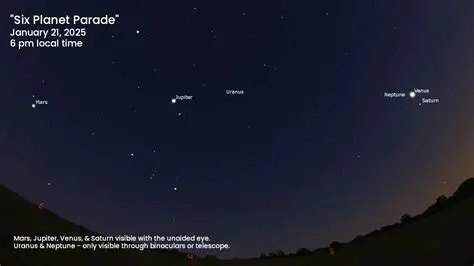
NASA listed the six planet parade among its notable astronomy events for 2026, saying Mercury, Venus, Neptune, Saturn, Uranus and Jupiter would appear shortly after sunset. Four of them were possible to see without equipment under good conditions. Uranus and Neptune required optical help, and Mercury was still challenging because it sat low in the twilight.
That makes this event exciting but also easy to oversell. Some viewers saw several bright planets clearly. Others struggled with haze, clouds, buildings, trees or a blocked western horizon. The best experience belonged to observers with clear skies, low light pollution and an open view of the west shortly after sunset.
For more astronomy coverage, The News Ink’s guide to the Blood Moon explains another major 2026 sky event that followed just days after this planetary lineup.
What the six planet parade actually showed
The six planet parade placed six planets in the evening sky at the same general time, but not all of them were equally easy to see.
Jupiter was the easiest. It appeared bright and steady, higher in the sky than the western cluster. Venus was also bright, but it sat very low after sunset, which made timing important. Mercury was even lower and harder to spot, especially through twilight haze. Saturn was above Mercury and Venus but still low enough to require a clear horizon.
Uranus and Neptune completed the six planet parade, but they were not naked-eye objects for most people. Uranus can sometimes be seen under very dark skies by experienced observers, but binoculars were the safer recommendation. Neptune always needs a telescope and was especially difficult because it sat low and close to the sunset glow.
That means the practical headline should be clear: this was a real six-planet alignment, but most casual viewers were likely to see three or four planets, not all six.
The planets at a glance
| Planet | Visibility | Where to look | Viewing note |
|---|---|---|---|
| Mercury | Naked eye, but difficult | Very low in the west after sunset | Needed a clear horizon and good timing |
| Venus | Naked eye | Low in the west after sunset | Bright, but still low in twilight |
| Saturn | Naked eye, but low | Above Mercury and Venus | Pale yellow and close to the western horizon |
| Jupiter | Naked eye | Higher toward the east/southeast | Brightest and easiest planet of the lineup |
| Uranus | Binoculars or telescope | Higher in the southwest | Needed a sky app or chart |
| Neptune | Telescope | Low near Saturn | Best left to experienced observers |
This table is important because the six planet parade was not like a row of streetlights. Some planets were bright. Some were faint. Some were low. Some required equipment. A realistic viewing guide helps readers avoid disappointment.
Best time to watch the six planet parade
The best time to watch the six planet parade was shortly after sunset, once the Sun had fully disappeared below the horizon but before Mercury, Venus and Saturn sank too low.
That created a narrow viewing window. If observers went out too early, the sky was too bright and it was unsafe to use optical equipment anywhere near the Sun. If they waited too long, the low western planets slipped below the horizon.
The practical window was usually around 30 to 60 minutes after sunset, depending on location. Jupiter remained visible longer, but Mercury, Venus, Saturn and Neptune were time-sensitive.
The best location was an open western horizon. A beach, field, hilltop, desert location or rooftop with no buildings in the way gave viewers the best chance. City lights were less damaging for bright Venus and Jupiter, but they made Uranus and Neptune harder.
The six planet parade rewarded planning. Viewers who checked sunset time, used a sky map and found a clear horizon had a much better chance than those who simply stepped outside late.
Safety matters near sunset
Unlike a solar eclipse, the six planet parade did not require eclipse glasses for normal naked-eye viewing. Looking at planets after sunset is safe.
The danger comes from using binoculars or telescopes too close to sunset. Looking at the Sun through optical equipment can cause severe and permanent eye damage. Because Mercury, Venus, Saturn and Neptune were close to the western horizon after sunset, observers had to wait until the Sun was completely below the horizon before attempting any optical viewing.
This is especially important for Neptune. It was low and faint, which means inexperienced observers could be tempted to scan near the horizon with a telescope. That is risky if the Sun has not fully set. For casual viewers, the safer advice was simple: enjoy Mercury, Venus, Saturn and Jupiter with the naked eye, and leave Neptune to experienced astronomers with proper planning.
The six planet parade was beautiful, but no sky event is worth risking eyesight.
Why planet parades happen
A six planet parade happens because the major planets orbit the Sun in roughly the same plane. From Earth, that plane appears as a path across the sky called the ecliptic. The Sun, Moon and planets all appear near this line.
At certain times, several planets happen to be on the same side of the Sun from Earth’s viewpoint. When that happens, we see them spread along the ecliptic in the same part of the evening or morning sky.
This does not mean the planets are physically close together. Jupiter, Saturn, Uranus and Neptune remain far apart in the outer Solar System. Mercury and Venus are inside Earth’s orbit. The alignment is visual, not a cosmic traffic jam.
That point matters because planetary parades often attract exaggerated claims online. They do not cause earthquakes, disasters or strange gravitational effects on Earth. They are impressive because of perspective, orbital motion and timing.
The News Ink’s report on the Milky Way center map offers a useful reminder that many beautiful space images also need scientific interpretation before their meaning is clear.
Why this event was still special
Even with realistic wording, the six planet parade was still special.
Seeing multiple planets in one evening connects viewers to the structure of the Solar System. Venus and Mercury show the inner planets. Jupiter and Saturn show the giant planets. Uranus and Neptune, though difficult, represent the distant ice giants. In one skywatching session, observers could trace a wide family of worlds.
It also gave casual skywatchers a reason to learn the sky. Many people can identify the Moon, but fewer can confidently identify Mercury or Saturn. A planetary parade turns the evening sky into a natural classroom.
Jupiter’s steady brightness, Venus’ intense glow, Saturn’s pale tone and Mercury’s low position all help viewers understand how planets differ from stars. Planets usually shine with steadier light than stars, which often twinkle more because they are point sources affected by Earth’s atmosphere.
The six planet parade was therefore not only a spectacle. It was an invitation to look more carefully.
How to identify each planet
The easiest starting point was Jupiter. It was bright, steady and higher in the sky, making it the anchor for the whole lineup.
Venus was the next most obvious because it is usually the brightest planet. It sat low in the western sky, so it could look brilliant but brief. If the horizon was blocked, Venus could vanish quickly.
Mercury was the hardest naked-eye planet. It appeared as a small white point near the horizon and was visible only during a short window. A clean horizon and transparent sky made a major difference.
Saturn appeared higher than Mercury and Venus but still low. Its pale yellow colour helped separate it from the brighter inner planets. Through a telescope, Saturn’s rings are famous, but during this event its low position made detailed viewing more difficult.
Uranus required binoculars or a telescope and a sky chart. It was higher in the sky, which helped, but it was still faint. Neptune was the hardest of all and needed a telescope. Casual viewers should not feel they failed if they could not see it.
A six planet parade is still successful if a viewer sees four planets clearly and understands where the other two are.
Why Mars was not part of this parade
Some early social posts and casual guides mention Mars when describing planet parades. For the February 2026 event, that would be inaccurate.
Mars was not part of this six planet parade. The six planets were Mercury, Venus, Saturn, Jupiter, Uranus and Neptune. BBC Sky at Night specifically noted that the 2026 alignment was a six-planet event because Mars was not visible that month.
This correction is useful for SEO and reader trust. Many users will search “planet parade Mars” or expect the red planet to appear because Mars is one of the most famous naked-eye planets. The article should answer that expectation clearly.
If readers looked for a red dot during this event, they were likely seeing a star or another object, not Mars.
Viewing from different locations
Visibility depended heavily on location.
NASA described the event for a broad skywatching audience, and BBC Sky at Night noted that observers in North America, the UK and Europe had opportunities to see the alignment. However, the exact arrangement, altitude and timing varied from place to place.
Northern Hemisphere observers generally had a strong evening setup, but still needed a clear western horizon. In some regions, Mercury and Venus were extremely low. In others, haze or city skyline made them hard to catch.
Southern Hemisphere observers could still follow the planetary grouping, but local sky charts were important because angles and horizon positions changed. This is why readers should use a reliable skywatching app set to their city, not a generic screenshot from another country.
For the six planet parade, location was not a small detail. It decided whether the low planets were easy, difficult or impossible.
The role of skywatching apps
Skywatching apps were genuinely useful for this event.
A good app can show where Mercury, Venus, Saturn, Jupiter, Uranus and Neptune are from a specific location at a specific time. That is especially helpful because Uranus and Neptune do not look obvious. Even Mercury can be confused with bright stars or aircraft near the horizon.
The best approach was to open the app after sunset, face west, identify Venus or Jupiter first, then use those bright planets as guideposts. From there, the app could help locate Mercury, Saturn and the two outer planets.
The News Ink’s coverage of AI trends in 2026 connects to this because public astronomy is increasingly supported by apps, augmented reality overlays and automated sky identification. Technology cannot make clouds disappear, but it can help people understand what they are seeing.
Photography tips for the alignment
Photographing the six planet parade was possible, but expectations mattered.
A phone could capture Venus and Jupiter easily if the sky was clear. Mercury and Saturn were harder because they were lower and dimmer. Uranus and Neptune were usually beyond normal phone photography unless using specialised equipment and careful tracking.
The best camera setup was a tripod, wide-angle lens and short exposure after sunset. Too long an exposure can make the sky too bright or smear stars if the camera is not tracking. A skyline, tree, hill or building silhouette could make the image more dramatic.
Photographers also had to move quickly. The western planets set fast, so composition had to be planned before the best window arrived.
A six planet parade photo does not need to show every planet to be valuable. A clean image of Venus, Mercury, Saturn and Jupiter in the same evening sky still tells the story.
Why the event does not affect Earth
Planet parades often attract dramatic claims about gravity, tides or disasters. There is no scientific reason to connect the February 2026 six planet parade with earthquakes, storms or human events.
The planets were not physically arranged in a tight line in space. They only appeared in the same region of our sky from Earth’s viewpoint. Their gravitational effects on Earth are tiny compared with the Sun and Moon.
The real significance is observational and educational. It gives people a reason to go outside, learn the ecliptic, identify planets and appreciate orbital motion.
The Solar System is dynamic, but it is not sending warnings through sky patterns. The six planet parade was a beautiful alignment, not an omen.
Why alignments help space missions
Planetary geometry does matter in one major scientific way: mission planning.
Space agencies time launches based on the relative positions of planets. For Mars missions, launch windows open roughly every 26 months, when Earth and Mars are positioned so spacecraft can travel efficiently. NASA’s InSight mission launched in 2018 during such a Mars opportunity and used orbital timing to reach the planet.
Other missions use gravity assists, where spacecraft fly past planets to gain speed or change direction. The famous Voyager missions used a rare outer-planet geometry to visit multiple worlds. In that sense, planetary positions can save fuel, time and money.
That is different from the six planet parade seen in the sky. The parade was a visual alignment. Mission windows depend on precise orbital mechanics. But both ideas come from the same truth: planets are always moving, and their positions matter.
More 2026 sky events after the parade
The six planet parade was only the beginning of a busy skywatching period.
Just days later, on 3 March 2026, a total lunar eclipse turned the Moon red for viewers across the Pacific Rim, Asia, Australia and the Americas. That event became a major Blood Moon moment and was the last total lunar eclipse until late 2028.
May 2026 brought a Blue Moon. BBC Sky at Night reported that May had two full Moons, one on 1 May and a second on 31 May. That second full Moon made 2026 a 13-full-Moon year.
Then came another bright planetary treat. Venus and Jupiter moved close together in early June, with the closest approach on 9 June 2026. BBC Sky at Night reported that they appeared about 1.6 degrees apart, roughly the width of a little finger held at arm’s length.
NASA also highlighted a mini parade from 11 to 15 June, when Mercury joined Venus and Jupiter low in the western sky.
The six planet parade therefore sat inside a wider year of strong skywatching opportunities.
The best way to cover this story now
Because the February 2026 event has passed, the strongest version of the article should not read only like a future preview. It should work as a guide, explanation and archive.
That means keeping the “how to watch” details for search value, while also making clear that the peak event was 28 February 2026. Readers may still arrive from Google after the date, searching for what happened, which planets were visible and whether another alignment is coming.
The best updated angle is: the six planet parade gave skywatchers a rare late-February view, but it required realistic expectations. Four planets were possible without equipment. Two required optical aid. Mercury, Venus, Saturn and Neptune were low. Jupiter was easiest. Mars was not part of the lineup.
That keeps the article accurate and useful beyond the weekend.
The final judgment
Six planet parade events are popular because they make the Solar System feel visible from a back garden, rooftop, field or beach.
The 28 February 2026 alignment brought Mercury, Venus, Saturn, Jupiter, Uranus and Neptune into the evening sky shortly after sunset. Jupiter and Venus offered the easiest views. Mercury and Saturn demanded a clear western horizon. Uranus needed binoculars or a telescope. Neptune was a difficult telescope target best attempted only by experienced observers after the Sun had fully set.
The event was not a mystical straight line or a sign of danger. It was a perspective effect created by planetary orbits along the ecliptic. That scientific truth makes it more impressive, not less. Six separate worlds, moving on different paths around the Sun, appeared together from Earth for a brief evening show.
The six planet parade also reminded viewers why skywatching remains so powerful. It does not always require expensive equipment. Sometimes it only requires a clear horizon, patience, and the decision to look up at the right time.
For more science and skywatching analysis from The News Ink, follow The News Ink on X.