Blood Moon: Stunning 2026 Eclipse Viewing Guide as Moon Turns Red
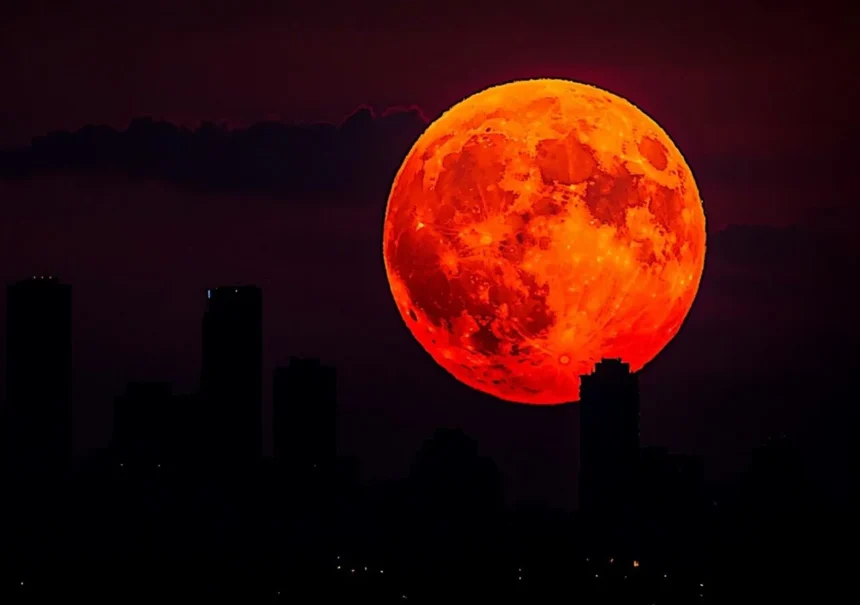
Blood Moon watchers were given one of the best sky shows of 2026 as a total lunar eclipse turned the March full Moon a deep copper-red across much of the Pacific Rim, eastern Asia, Australia, New Zealand and the Americas.
The total lunar eclipse took place on 3 March 2026, with the Moon passing through Earth’s shadow and darkening gradually before glowing red during totality. For many viewers in North and Central America, the best view came before sunrise. For eastern Asia and Australia, the eclipse was an evening event. Across the Pacific, the Moon remained visible through the heart of the eclipse.
This Blood Moon was especially important because it completed a short run of three consecutive total lunar eclipses: March 2025, September 2025 and March 2026. After this event, the next total lunar eclipse will not arrive until the final night of 2028 into the first day of 2029, making the March 2026 eclipse a rare chance for millions of skywatchers.
The event was safe to watch without eclipse glasses. Unlike a solar eclipse, a lunar eclipse does not involve looking directly at the Sun. Anyone with a clear view of the Moon could simply step outside and watch. Binoculars or a small telescope made the experience sharper, but they were not required.
For more astronomy and science coverage, The News Ink’s report on the Milky Way center map explains how scientists use light, wavelength and hidden signals to understand space.
What is a Blood Moon?
A Blood Moon is the popular name for a total lunar eclipse in which the Moon turns red, orange or copper while passing through Earth’s inner shadow.
The name sounds dramatic, but the science is simple and beautiful. A lunar eclipse happens when the Sun, Earth and Moon line up, with Earth in the middle. Earth blocks direct sunlight from reaching the Moon. However, some sunlight still bends through Earth’s atmosphere and reaches the lunar surface.
That light has passed through a thick slice of our atmosphere. Shorter blue and violet wavelengths scatter away more easily, while longer red and orange wavelengths pass through. NASA describes the effect as if all of Earth’s sunrises and sunsets are being projected onto the Moon.
That is why the Moon does not disappear completely during totality. Instead, it glows red.
The exact colour can vary. If Earth’s atmosphere is clear, the Moon may look bright copper or orange. If there is more dust, smoke or volcanic material in the atmosphere, the Moon can appear darker, deeper red or even brownish.
When did the 2026 Blood Moon happen?
The March 2026 Blood Moon unfolded over several hours, but the most dramatic phase was totality, when the full Moon was entirely inside Earth’s umbra.
Here are the main stages in Eastern Time and UTC:
| Eclipse stage | Eastern Time | UTC | What viewers saw |
|---|---|---|---|
| Penumbral eclipse began | 3:44 a.m. EST | 08:44 UTC | The Moon entered Earth’s faint outer shadow |
| Partial eclipse began | 4:50 a.m. EST | 09:50 UTC | A dark “bite” appeared on the Moon |
| Totality began | 6:04 a.m. EST | 11:04 UTC | The Moon turned copper-red |
| Greatest eclipse | 6:34 a.m. EST | 11:34 UTC | The Moon reached its deepest eclipse point |
| Totality ended | 7:03 a.m. EST | 12:03 UTC | The red colour began to fade |
| Partial eclipse ended | 8:17 a.m. EST | 13:17 UTC | The Moon fully left Earth’s dark umbra |
| Penumbral eclipse ended | 9:23 a.m. EST | 14:23 UTC | The eclipse ended |
For many observers, the best time to look was around totality, especially near greatest eclipse. The earlier penumbral phase was subtle and easy to miss because the Moon only dimmed slightly.
Where was the Blood Moon visible?
The Blood Moon was visible across a wide part of the world, but not everyone saw the same amount of the eclipse.
NASA said totality was visible in the evening from eastern Asia and Australia, throughout the night across the Pacific, and in the early morning from North and Central America and far western South America. Central Asia and much of South America saw partial phases. Africa and Europe missed this total lunar eclipse.
That geography made the Pacific Rim the best viewing zone. Hawaii, western North America, Alaska, New Zealand, eastern Australia, Japan and nearby regions had strong viewing opportunities, depending on weather and local moonrise or moonset.
Observers near the edges of the visibility map saw only part of the eclipse. In some places, the Moon set while still eclipsed. In others, it rose already in eclipse. Those horizon views can be especially dramatic, because the red Moon appears low in the sky and can look larger to the eye because of the familiar Moon illusion.
How to watch safely
Watching a Blood Moon is simple. You do not need solar eclipse glasses, filters or specialist equipment because you are looking at the Moon, not the Sun.
The best viewing tips are practical:
- Find a place with a clear view of the Moon.
- Avoid buildings, trees and hills that block the horizon.
- Move away from bright streetlights if possible.
- Check the weather forecast before the eclipse.
- Use binoculars or a telescope for more detail.
- Use a tripod if photographing the Moon.
A phone can capture the event, but a tripod or stable surface helps. During totality, the Moon becomes much dimmer than a normal full Moon, so cameras need longer exposures. This is why many quick handheld photos look blurry.
The simplest approach is often the best: go outside during totality, let your eyes adjust, and watch the Moon slowly change colour.
Why the Moon turned red instead of black
A common question is why the Moon remains visible during a total lunar eclipse. If Earth blocks the Sun, why does the Moon not go dark?
The answer is Earth’s atmosphere. Our atmosphere bends and filters sunlight. Blue light scatters in many directions, which is why our daytime sky looks blue. Red and orange light travel more directly through the atmosphere. During a lunar eclipse, that reddish light bends around Earth and falls onto the Moon.
This is the same physical reason sunsets look red. During sunset, sunlight travels through more atmosphere before reaching your eyes. Much of the blue light scatters away, leaving warmer colours. During a lunar eclipse, that sunset-like light reaches the Moon instead.
That is why a Blood Moon can look like a dim, global sunset painted across the lunar surface.
Why this eclipse was the end of a streak
The March 2026 Blood Moon mattered because it was the final total lunar eclipse in a short sequence.
The run included:
| Date | Eclipse type | Main visibility |
|---|---|---|
| 13–14 March 2025 | Total lunar eclipse | Americas and parts of western Europe/Africa |
| 7–8 September 2025 | Total lunar eclipse | Asia, Australia, Africa and Europe |
| 3 March 2026 | Total lunar eclipse | Pacific Rim, Asia, Australia and Americas |
After that, the next lunar eclipse in 2026 is only partial, on 28 August. The next total lunar eclipse comes on 31 December 2028 into 1 January 2029, depending on local time zone.
That gap gave the March 2026 event extra importance. Total lunar eclipses are not extremely rare, but they are not visible everywhere every time. A person can wait years for a well-placed total eclipse in their own sky.
Why lunar eclipses do not happen every month
A lunar eclipse can only happen at full Moon, but not every full Moon creates an eclipse.
The reason is the Moon’s tilted orbit. The Moon’s path around Earth is tilted by about five degrees compared with Earth’s orbit around the Sun. Most months, the full Moon passes slightly above or below Earth’s shadow. An eclipse happens only when the full Moon occurs close enough to one of the points where the Moon’s orbit crosses Earth’s orbital plane.
These periods are called eclipse seasons. They happen roughly every six months and last several weeks. During an eclipse season, the Sun, Earth and Moon can line up closely enough for solar and lunar eclipses.
The March 2026 Blood Moon belonged to the first eclipse season of 2026, which also included an annular solar eclipse in February. Later in 2026, another eclipse season brings a total solar eclipse on 12 August and a partial lunar eclipse on 28 August.
Why the March full Moon is called the Worm Moon
The March full Moon is often called the Worm Moon in North America, especially in popular skywatching calendars. The name is linked to seasonal change as winter weakens and signs of spring return. Traditionally, warming soil and the appearance of worms or insect larvae were associated with this time of year.
Other names exist too, and they reflect different landscapes and cultures.
The Ojibwe and Chippewa have used names such as Snow Crust Moon or Hard Crust on the Snow Moon, referring to snow that melts by day and freezes again at night. Dakota, Lakota and Assiniboine traditions include Sore Eyes Moon, linked to bright sunlight reflecting from late-winter snow.
These names are not scientific labels. They are cultural and seasonal markers. They show how people used the Moon to track the year long before modern calendars, apps and astronomy software.
In 2026, the Worm Moon coincided almost perfectly with the total lunar eclipse, turning the familiar March full Moon into a Blood Moon.
What made this Blood Moon photogenic
This eclipse was visually interesting because the Moon did not pass straight through the exact centre of Earth’s shadow. NASA and skywatching guides noted that the Moon’s path produced a colour gradient, with one side appearing darker and redder while the other could look more copper-orange.
That gradient is one of the reasons lunar eclipses are rewarding to watch slowly. The Moon is not simply red or not red. It changes minute by minute. During partial eclipse, the shadow looks like a dark bite. During totality, the Moon becomes dimmer and richer in colour. As it exits the shadow, the bright white lunar surface returns from the opposite side.
Binoculars make this especially striking because they reveal craters, dark maria and subtle colour differences across the lunar disk.
What else could skywatchers see?
During a normal full Moon, the sky is bright enough to wash out many stars. During a total lunar eclipse, the Moon dims dramatically. That makes nearby stars and constellations easier to see.
NASA said the Moon was in the constellation Leo during the March 2026 eclipse, under the lion’s hind paws. For observers with dark skies, the dimmed Moon made the surrounding star field more noticeable.
There was also a rare treat for experienced astrophotographers: a lunar occultation of the galaxy NGC 3423 during totality for some North American observers. That means the darkened Moon passed in front of the distant galaxy from the perspective of certain locations. This was not a naked-eye event, but it gave telescope users a special imaging opportunity.
For casual viewers, the main event remained the red Moon itself.
Why weather mattered more than equipment
The only major obstacle to watching a Blood Moon is usually weather.
Clouds can block the entire event. Haze can soften the view. Rain or snow can make observing impossible. Light pollution matters less for lunar eclipses than for meteor showers because the Moon is bright enough to see from cities, but darker locations still make the colour and surrounding stars more impressive.
The best advice is to check local cloud forecasts and find an open viewing site. If the sky is partly cloudy, patience helps. Totality lasted nearly 59 minutes, so even brief breaks in cloud could provide a view.
This is another reason lunar eclipses are popular. Unlike solar eclipses, which require being on a narrow path for totality, lunar eclipses can be seen by anyone on the night side of Earth with clear skies.
How the 2026 Blue Moon fits the year
The March Blood Moon was not the only notable full Moon event of 2026.
May 2026 featured two full Moons: one on 1 May and another on 31 May. The second full Moon in a calendar month is commonly called a Blue Moon. Despite the name, the Moon does not normally appear blue. The phrase refers to timing, not colour.
The May 31 Blue Moon also happened near lunar apogee, making it a micromoon, or a full Moon that appears slightly smaller than average because the Moon is farther from Earth in its orbit. The difference is usually subtle to the eye, but it gives skywatchers another reason to pay attention.
That made 2026 a strong year for Moon watchers: a major Blood Moon in March, a Blue Moon in May, a partial lunar eclipse in August and a major total solar eclipse in August for parts of the Northern Hemisphere.
What this event teaches about Earth
A Blood Moon is not only a skywatching spectacle. It also shows how Earth’s atmosphere works.
During totality, the Moon’s colour is shaped by the condition of the atmosphere. Dust, clouds, smoke, volcanic aerosols and air clarity can affect how much red light reaches the Moon. In that sense, Earth paints the eclipse.
Scientists and experienced observers sometimes use the Danjon scale to estimate eclipse brightness, ranging from very dark to bright copper-red. These observations can offer clues about atmospheric transparency, especially after major volcanic eruptions or wildfire seasons.
So when people watch a lunar eclipse, they are not only seeing the Moon. They are seeing sunlight filtered through Earth’s air and projected onto another world.
The final judgment
Blood Moon events are powerful because they turn a familiar object into something strange. The full Moon, usually bright and white, slowly dims, darkens and glows red as Earth’s shadow moves across it.
The March 2026 total lunar eclipse was especially valuable because it was the last total lunar eclipse before late 2028. It was visible across much of the Pacific Rim, eastern Asia, Australia, New Zealand and the Americas, and it required no special equipment to enjoy safely.
The science was elegant. Earth moved between the Sun and Moon. Earth’s atmosphere scattered blue light and bent red-orange light toward the lunar surface. The result was a copper-coloured Moon that reminded viewers that our planet, our atmosphere and our nearest neighbour are connected in one moving system.
The next time a Blood Moon appears, the same lesson will return. Space can feel distant, but sometimes the best astronomy show is simply outside, rising or setting above the horizon, waiting for people to look up.
For more science and skywatching analysis from The News Ink, follow The News Ink on X.