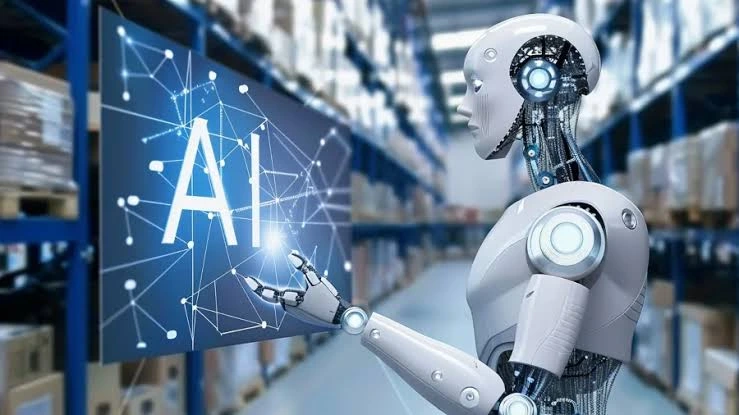
Robotics and AI Explained: How Artificial Intelligence Is Making Robots Smarter
For decades, robots became useful by becoming extremely good at following instructions.
A factory robot could weld the same point on a vehicle body thousands of times. An automated guided vehicle could follow a predefined path through a warehouse. A robotic arm could repeatedly move components between two known locations.
These machines could be fast, accurate and reliable.
But they were not necessarily intelligent.
AI robotics is beginning to change that.
Artificial intelligence can give robots capabilities that traditional programming struggles to provide: recognizing unfamiliar objects, interpreting camera images, planning around obstacles, learning from demonstrations, understanding natural-language instructions and adapting when the physical environment changes.
Instead of programming every movement individually, developers are increasingly trying to build robots that can understand what needs to be done and determine more of how to do it themselves.
The International Federation of Robotics identified AI and autonomy in robotics as its leading global robotics trend for 2026, describing analytical AI, generative AI and agentic AI as technologies increasing robot independence and adaptability.
That development is helping robotics move beyond repetitive automation toward what the industry increasingly calls Physical AI or embodied AI—artificial intelligence capable of perceiving and acting in the real world.
For the broader foundation covering industrial robots, service robots, humanoids, sensors and autonomous systems, start with The News Ink’s Robotics Explained: Complete Guide.
For the software intelligence behind these systems, see Artificial Intelligence Explained: Complete Guide.
What Is AI Robotics?
AI robotics is the combination of artificial intelligence with robotic hardware so machines can perceive, interpret, learn, reason or make decisions about the physical world.
Traditional robotics often depends on explicitly programmed rules.
An engineer might tell a robot:
- move to position A;
- close the gripper;
- move upward;
- travel to position B;
- open the gripper;
- repeat.
This works extremely well when everything remains predictable.
AI robotics becomes valuable when the robot faces uncertainty.
Imagine the same robot being asked:
“Find the red bottle on the table and place it inside the recycling container.”
Now the machine has several problems to solve.
It must identify the bottle.
It must distinguish red objects from other objects.
It needs to estimate where the bottle is located in three-dimensional space.
It must determine how to grasp it.
It needs to find the recycling container.
Then it has to calculate safe physical movements.
That requires much more than a fixed sequence of coordinates.
Modern AI robotics combines technologies such as:
- machine learning;
- computer vision;
- deep learning;
- reinforcement learning;
- natural-language processing;
- vision-language models;
- vision-language-action models;
- motion planning;
- sensor fusion;
- generative AI;
- agentic AI.
The robot provides the body.
Artificial intelligence increasingly provides parts of the perception, reasoning and decision-making system.
Traditional Robots vs AI-Powered Robots
The easiest way to understand AI robotics is to compare it with conventional automation.
| Traditional Robotics | AI Robotics |
|---|---|
| Relies heavily on predefined programming | Can use learned models |
| Works best in structured environments | Designed for greater environmental variation |
| Expects known object locations | Can recognize and locate objects |
| Repeats predefined movements | Can adapt actions |
| Usually requires specialist programming | Increasingly supports natural-language instructions |
| Limited generalization | Research aims for transfer across tasks |
| Excellent repeatability | Greater flexibility |
| Easier to validate in fixed tasks | More difficult to predict and validate |
| Mature industrial technology | Rapidly developing field |
This does not mean AI robotics is automatically better.
A traditional industrial robot performing one optimized welding operation may be faster, cheaper and more dependable than a sophisticated AI-powered system.
AI adds the most value when the environment or task contains variation that would otherwise require constant reprogramming.
How AI Makes Robots Smarter
A useful way to understand AI robotics is to divide robotic intelligence into several layers.
Sensors → Perception → Understanding → Planning → Action → Feedback → Learning
Each layer solves a different problem.
Perception: Helping Robots Understand What They See
Robots first need information about their environment.
They can use:
- cameras;
- LiDAR;
- radar;
- microphones;
- force sensors;
- tactile sensors;
- depth cameras;
- joint encoders;
- proximity sensors.
Sensors alone do not create intelligence.
A camera produces pixels.
AI helps transform those pixels into useful information.
A computer-vision model may identify:
person, box, pallet, apple, vehicle, doorway or manufacturing defect.
NIST describes robotic perception systems as combinations of sensors and algorithms that provide machines with information about the physical world, allowing them to become safer, more adaptive and productive. These algorithms increasingly include machine-learning approaches.
This is one of the most important differences between older automation and AI robotics.
A conventional machine follows what engineers told it would happen.
An AI-powered robot increasingly tries to understand what is actually happening.
Computer Vision in AI Robotics
Computer vision is already one of the most commercially important forms of AI robotics.
Consider a robotic picking system.
Products may be scattered inside a container.
The robot needs to determine:
- what objects are present;
- which item should be selected;
- where the object is located;
- which direction it is facing;
- where a gripper can safely contact it.
AI-powered vision can perform much of this perception.
That is particularly useful in warehouses, where products come in thousands of shapes and packages.
It also matters in agriculture.
An agricultural robot may use cameras to distinguish a crop from a weed before deciding whether to remove the plant.
You can see these real-world applications in The News Ink’s Warehouse Robotics Explained and Agricultural Robots Explained.
AI Robotics and Machine Learning
Traditional robot programs are written primarily by humans.
Machine learning allows robotic systems to learn patterns from data.
A model could be trained using thousands of examples showing:
- successful grasps;
- defective products;
- human demonstrations;
- navigation routes;
- robot trajectories;
- images of objects.
The machine does not necessarily memorize every example.
Instead, the objective is to learn patterns that help it respond correctly when it encounters similar situations.
This can make AI robotics more adaptable.
However, robots introduce a problem that purely digital AI systems do not face.
Physical training is expensive.
A language model can process enormous digital datasets.
Collecting millions of high-quality examples of a real robot physically manipulating objects is slower and more costly.
Motors wear.
Batteries discharge.
Objects break.
Humans may need to reset environments after failed attempts.
This data problem is one reason simulation has become so important to AI robotics.
Simulation and Physical AI
Robots can increasingly learn inside simulated environments before operating in the physical world.
A digital environment can generate enormous numbers of scenarios without damaging real hardware.
Robots can practice:
- grasping;
- walking;
- navigation;
- manipulation;
- collision avoidance.
Simulation also allows developers to create rare or dangerous scenarios that would be difficult to reproduce safely.
The challenge is known as the sim-to-real gap.
A simulated object may behave differently from its real equivalent.
Friction changes.
Lighting changes.
Sensors contain noise.
Materials deform.
Real environments are much messier than virtual ones.
Companies are therefore investing heavily in simulation platforms and world models designed to represent how physical environments behave.
NVIDIA expanded its Physical AI ecosystem in March 2026 with new Cosmos world models, Isaac simulation technologies and GR00T robotics models, while working with industrial, surgical and humanoid-robot developers.
IFR similarly identifies simulation-driven Physical AI as an important direction for robotics, allowing machines to gain experience virtually rather than requiring every individual behavior to be programmed manually.
What Is Physical AI?
Physical AI describes artificial intelligence designed to understand and interact with the physical world.
Generative AI systems primarily produce digital outputs:
- text;
- images;
- audio;
- video;
- software.
Physical AI goes further.
Its output ultimately affects a machine.
A Physical AI system might:
- move a robotic arm;
- drive an autonomous vehicle;
- walk a humanoid robot;
- select a warehouse package;
- manipulate manufacturing equipment.
This means Physical AI has different requirements from conventional generative AI.
A chatbot can generate another response after making a mistake.
A robot dropping a heavy object may not get that opportunity.
AI robotics therefore requires much stronger connections between artificial intelligence and traditional engineering disciplines such as control theory, mechanical design, sensor validation and functional safety.
Vision-Language-Action Models
One of the most important developments in AI robotics is the emergence of Vision-Language-Action models, usually called VLAs.
Large language models learn relationships between language tokens.
Vision-language models combine language with images.
Vision-language-action models add something critical:
physical actions.
A simplified VLA system can be represented as:
Vision + Language → Understanding → Action
The robot may receive camera images plus a command such as:
“Put the green cup beside the plate.”
The system interprets the scene and instruction before producing actions that control the robot.
A 2025 IEEE review described VLAs as an emerging robotics architecture designed to unify vision, language and action data so robots can generalize across tasks, objects and environments rather than learning each task completely separately.
This generalization is one of the central goals of modern AI robotics.
Google Gemini Robotics
Google DeepMind provides an important example of how quickly AI robotics is evolving.
In March 2025, DeepMind introduced Gemini Robotics, adding physical actions as an output modality to a Gemini-based model.
Its related Gemini Robotics-ER system focused on embodied reasoning and spatial understanding.
DeepMind demonstrated the models across different robotic platforms, including research robotic arms and Apptronik’s Apollo humanoid.
In September 2025, Gemini Robotics 1.5 expanded toward more agent-like physical tasks, combining high-level reasoning with a VLA model capable of performing physical actions.
The company continued developing the approach through 2026.
Gemini Robotics-ER 1.6 added improved physical reasoning and instrument-reading capabilities, while the newer Gemini Robotics 2 family focuses on whole-body manipulation, longer multi-step tasks and even coordination between different robots.
These remain rapidly developing technologies rather than evidence that general-purpose human-level robots have already been solved.
But they show the direction AI robotics is taking:
from executing commands toward interpreting goals.
AI Agents Are Moving Into Robotics
This creates an important connection between AI agents and robots.
A conventional robot program contains steps.
An AI agent is intended to pursue a goal by reasoning about what actions are necessary.
Combine an AI agent with robotic hardware and the concept becomes much more powerful.
Suppose a warehouse robot receives this objective:
“Prepare workstation five for tomorrow’s production run.”
A future agentic robotic system might need to:
- determine which components are needed;
- identify where they are stored;
- navigate to those locations;
- inspect inventory;
- retrieve materials;
- transport them;
- verify completion;
- report any missing components.
That is very different from programming every movement.
IFR’s 2026 robotics trends specifically identifies agentic AI as an important step toward robots capable of working more independently in complex environments.
For the software concept behind these systems, read The News Ink’s AI Agents Explained.
NVIDIA GR00T and Robot Foundation Models
Another major direction is the development of robot foundation models.
The idea resembles foundation models in generative AI.
Instead of building a completely separate AI model for every robot and every task, researchers want general models that can be adapted across multiple machines and behaviors.
NVIDIA introduced Isaac GR00T N1 in 2025 as an open foundation model aimed at general-purpose humanoid robots.
Its training data included real robot trajectories, simulation data, synthetic examples and human video. NVIDIA reported demonstrations involving multiple humanoid platforms and language-conditioned manipulation.
The company’s 2026 Physical AI expansion continued this strategy with updated GR00T models and simulation tools.
The broader ambition is significant.
Instead of teaching a humanoid:
one robot + one factory + one task
developers want systems capable of transferring knowledge across:
many robots + many environments + many tasks.
Achieving that reliably remains an enormous research challenge.
AI Robotics in Manufacturing
Manufacturing is one of the strongest environments for AI robotics because companies already use millions of industrial robots.
The opportunity is to make those machines more adaptable.
AI can help industrial robots perform:
- visual inspection;
- predictive maintenance;
- flexible picking;
- adaptive welding;
- anomaly detection;
- machine tending;
- production planning.
The International Federation of Robotics identifies manufacturing and industrial automation as one of the leading sectors integrating AI with robotics.
NIST’s 2026 Roadmap on Artificial Intelligence and Machine Learning for Smart Manufacturing similarly identifies advanced sensing, autonomous systems, robotics, digital twins and supply-chain optimization among major areas where AI is reshaping manufacturing.
For the hardware side of this transformation, see The News Ink’s Industrial Robots Explained.
AI and Collaborative Robots
AI can also make collaborative robots more adaptable.
A cobot traditionally follows programmed movements but may operate closer to workers than conventional industrial robots.
Adding artificial intelligence can improve:
- human detection;
- visual understanding;
- object recognition;
- adaptive picking;
- natural-language programming.
The long-term goal is not simply robots that can safely stop when a person approaches.
It is robots that better understand what their human partners are trying to accomplish.
That could make human-robot collaboration more natural, although safety-critical functions cannot simply depend on unpredictable AI outputs.
For the differences between cobots and conventional factory machines, read Collaborative Robots Explained.
AI Robotics in Warehouses
Logistics is another leading commercial field.
AI-powered mobile robots can calculate routes, avoid congestion and coordinate fleets.
Picking robots use computer vision to identify products.
Warehouse software can assign tasks dynamically according to demand.
IFR identified logistics and warehousing as one of the leading industries adopting AI robotics because warehouses combine high automation demand with relatively controlled operating environments.
These conditions make warehouses an important bridge between predictable factories and completely unstructured public environments.
Read Warehouse Robotics Explained for the complete logistics-automation picture.
AI Robotics in Agriculture
Agriculture demonstrates why artificial intelligence matters when environments become unpredictable.
An agricultural robot may need to distinguish:
crop or weed
ripe or unripe fruit
normal leaf or diseased leaf
clear path or obstacle.
Traditional fixed programming struggles with this level of biological variation.
AI-powered perception can help machines interpret what they encounter.
That is why machine learning and computer vision are becoming central to robotic harvesting, precision spraying and autonomous farming.
Read The News Ink’s Agricultural Robots Explained for a deeper look.
AI Robotics and Humanoid Robots
Humanoid robots may become the most visible expression of AI robotics.
Their appeal comes from a simple observation:
the world was designed for humans.
Doors, shelves, stairs, tools, factories and warehouses are generally built around human dimensions.
A capable humanoid robot might therefore use existing environments without requiring every workplace to be redesigned.
But creating a human-shaped machine is only the hardware problem.
The robot must also understand what to do.
AI is therefore fundamental to most modern humanoid projects.
Humanoids need:
- computer vision;
- balance;
- navigation;
- manipulation;
- task planning;
- language understanding;
- failure detection.
IFR listed humanoid reliability and efficiency as another major global robotics trend for 2026, while warning that humanoid machines still need to prove industrial-level productivity, energy efficiency, durability and safety.
The News Ink has explored this transition in Humanoid Robots Are No Longer Science Fiction and Humanoid Robots Could Have Their ChatGPT Moment.
Why Robot Intelligence Is Harder Than Chatbot Intelligence
AI robotics faces an important reality:
understanding language is not the same as understanding physics.
A language model can know that a glass is fragile.
A robot has to determine how tightly to grip the glass.
It must understand where the glass is located.
Its arm must approach without collision.
Its fingers must establish contact.
The system needs to apply enough force to lift the glass but not enough to break it.
Then it must maintain stability while moving.
Every physical action creates consequences.
That is why impressive progress in generative AI does not automatically mean general-purpose robots are close to solving every household or industrial task.
Robotics requires intelligence plus reliable physical execution.
The Data Problem in AI Robotics
Modern AI improves by learning from data.
Robotics data is difficult to scale.
Internet-scale text and images already exist.
There is no equally enormous natural database containing perfectly labelled robot actions across every machine and environment.
Developers therefore combine:
- real robot demonstrations;
- teleoperation;
- human videos;
- simulation;
- synthetic data;
- reinforcement learning;
- shared robotics datasets.
VLA research increasingly focuses on whether knowledge learned across many robots and tasks can generalize to new machines.
The challenge is especially difficult because different robots have different:
- arms;
- joints;
- grippers;
- sensors;
- payloads;
- movement capabilities.
An action learned on one robot cannot always be transferred directly to another.
AI Robotics Safety
Artificial intelligence creates a new robotics safety problem.
Traditional industrial automation can be highly deterministic.
Engineers can test known paths and known operating conditions.
AI-powered robots may make decisions dynamically.
That adaptability is exactly what makes AI robotics valuable, but it also makes behavior more difficult to validate.
Safety therefore has to exist at multiple layers.
A modern AI robot may combine:
AI reasoning
with
traditional safety-rated controllers
with
physical emergency systems.
Google DeepMind describes its robotics-safety approach in similar layered terms, separating higher-level AI reasoning from lower-level safety-critical controls. Its latest robotics work also tests whether embodied reasoning systems recognize unsafe requests, uncertainty and human proximity.
IFR likewise warns that AI-driven autonomy makes testing, validation, human oversight and liability more complicated.
For the broader challenge of trustworthy intelligent systems, read AI Safety Explained.
Cybersecurity Becomes Physical
AI robotics also changes cybersecurity.
A compromised website affects information.
A compromised robot could potentially affect physical equipment.
Connected robots may communicate through:
- factory networks;
- cloud platforms;
- remote-control systems;
- AI services;
- fleet-management software.
Possible risks include:
- unauthorized robot access;
- manipulated commands;
- stolen sensor data;
- production disruption;
- ransomware;
- compromised software updates.
IFR lists cybersecurity as a growing concern as robotics moves toward cloud-connected and AI-driven systems.
This makes cybersecurity part of robot engineering rather than simply an IT department issue.
For the wider framework, see The News Ink’s Cybersecurity Explained: Complete Guide.
Limitations of AI Robotics
AI robotics is advancing quickly, but several major obstacles remain.
Reliability
A robot must work repeatedly, not occasionally.
A system that performs a task successfully eight times out of ten may look impressive in a research demonstration while remaining unacceptable for commercial deployment.
Physical Dexterity
Human hands remain extraordinarily capable.
We effortlessly manipulate fabric, cables, tools, food and fragile objects.
Robotic manipulation is still far less general.
Cost
Powerful processors, sensors, actuators and training infrastructure can make AI robotics expensive.
Computing Requirements
Large AI models require substantial processing power.
Running everything through the cloud creates latency and connectivity problems.
This is one reason companies are developing smaller on-device robotics models. Google DeepMind, for example, introduced Gemini Robotics On-Device specifically to run robot intelligence locally.
Explainability
Modern deep-learning models can be difficult to interpret.
That becomes especially important when machines make decisions around people.
Generalization
A robot that learns one task in one laboratory does not necessarily understand how to perform it in a different building with different objects.
Generalization remains one of the central goals of VLA and foundation-model research.
Will AI Create General-Purpose Robots?
This is the biggest question surrounding AI robotics.
Today’s economy mostly uses specialized robots.
A welding robot welds.
A warehouse AMR transports inventory.
An agricultural robot weeds crops.
A surgical robot assists with procedures.
A general-purpose robot would need to learn many unrelated tasks.
AI foundation models, VLA systems and embodied reasoning are attempts to move in that direction.
The progress is meaningful.
But general-purpose physical intelligence is much harder than demonstrating several learned behaviors.
Robots still need major advances in:
- dexterity;
- reliability;
- energy efficiency;
- perception;
- reasoning;
- long-term planning;
- safety;
- hardware durability.
General-purpose robots are therefore a credible research direction rather than a solved technology.
The Future of AI Robotics
The next phase of AI robotics will probably be defined by several technologies converging.
Vision-Language-Action Models
VLAs will continue trying to connect visual understanding and language directly to robotic action.
Robot Foundation Models
Developers will attempt to train broader models that transfer knowledge across robots.
Physical AI
Simulation and world models will help machines learn more about physical environments before deployment.
Agentic Robotics
High-level AI systems will increasingly plan multi-step goals rather than executing only individual commands.
On-Device AI
Smaller models will allow robots to perform more intelligence locally without depending continuously on cloud connectivity.
Multi-Robot Intelligence
Different robots may coordinate their strengths rather than every machine operating independently.
Google DeepMind’s 2026 Gemini Robotics work already demonstrates research into multi-robot coordination, where machines identify their different capabilities and divide tasks.
These developments suggest that the future of AI robotics will not be defined by a single breakthrough.
It will come from the integration of better AI models, better sensors, stronger simulation, more capable hardware and stricter safety systems.
Frequently Asked Questions About AI Robotics
What is AI robotics?
AI robotics combines artificial intelligence with robotic systems so machines can perceive environments, recognize objects, learn patterns, make decisions and perform physical actions with greater adaptability.
How is artificial intelligence used in robots?
AI is used for computer vision, navigation, object recognition, grasp planning, predictive maintenance, natural-language interaction, task planning, anomaly detection and other capabilities.
Are all robots powered by AI?
No. Many industrial robots operate using conventional programming and control systems without modern artificial intelligence.
What is Physical AI?
Physical AI refers to artificial intelligence designed to understand and act within the physical world through machines such as robots, autonomous vehicles and other embodied systems.
What is a vision-language-action model?
A vision-language-action model combines visual information, language instructions and robotic actions. VLAs aim to allow robots to interpret what they see, understand a command and convert that understanding into physical movement.
Can robots learn new tasks using AI?
Yes. Modern AI robotics can use human demonstrations, reinforcement learning, simulation, robot trajectories and other training data to learn behaviors. Generalizing reliably to completely unfamiliar tasks remains difficult.
Are AI robots safe?
AI robots can operate safely when properly designed, but AI-driven autonomy creates additional validation challenges. Safety-critical systems should include tested physical controls, risk assessment, human oversight and fail-safe mechanisms rather than depending entirely on AI reasoning.
Will AI make humanoid robots possible?
AI is a major enabling technology for humanoids because these machines need perception, language understanding, manipulation, navigation and planning. However, reliable humanoid robotics also depends heavily on mechanical engineering, actuators, batteries, sensors and safety.
Conclusion: AI Is Giving Robots Something Traditional Automation Never Had
Robotics has spent decades mastering movement.
Artificial intelligence is increasingly giving robots the ability to decide what those movements should achieve.
That difference could transform the field.
Traditional robots became valuable because they could repeat known tasks with extraordinary precision.
AI robotics aims to make robots valuable even when every situation is not completely known in advance.
Computer vision allows machines to recognize the world.
Machine learning helps them learn patterns.
Vision-language-action models connect instructions with physical behavior.
AI agents introduce higher-level planning.
Simulation and world models allow robots to gain experience before entering real environments.
The International Federation of Robotics now identifies AI and autonomy as the leading robotics trend of 2026, while Google DeepMind, NVIDIA and industrial robotics companies are actively developing technologies that connect powerful AI models with physical machines.
But the transition from digital intelligence to physical intelligence should not be underestimated.
A chatbot operates in information.
A robot operates in reality.
Objects have weight.
Machines have momentum.
People can be injured.
Actions cannot always be undone.
That means the future of AI robotics will depend not simply on building increasingly powerful AI models but on combining those models with reliable hardware, traditional control engineering, cybersecurity and strong safety systems.
The most realistic future is not one in which every robot suddenly becomes generally intelligent.
Instead, AI will gradually make robots better at tasks that have historically been difficult to automate because they contain too much variation.
Industrial robots will recognize less predictable components.
Warehouse robots will coordinate more efficiently.
Agricultural robots will distinguish individual plants.
Collaborative robots will interact more naturally with workers.
Humanoids will attempt increasingly complex multi-step activities.
Eventually, the distinction between AI software and robotics hardware may become less useful.
Artificial intelligence will become the intelligence layer.
Robotics will give that intelligence the ability to sense and act.
That combination—AI with a physical body—is why AI robotics has become one of the most important frontiers in both artificial intelligence and robotics.
For the complete technology landscape, continue with The News Ink’s Robotics Explained: Complete Guide and Artificial Intelligence Explained: Complete Guide.
Follow The News Ink
X · Pinterest · Medium · Quora · TikTok · Instagram · Substack · Threads · Bluesky · Mastodon