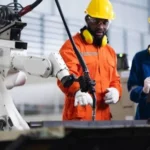
Robot Safety Explained: How Humans and Robots Can Work Together Safely
Robot safety is becoming one of the most important questions in modern automation.
For decades, industrial robots were often separated from people by fences, cages and restricted production cells. The principle was relatively simple: allow powerful machines to operate quickly while preventing workers from entering their movement area during automatic operation.
Modern robotics is making that separation less straightforward.
Collaborative robots can operate close to workers. Autonomous mobile robots move through warehouses shared with people. Artificial intelligence is giving robots greater ability to perceive environments and make decisions. Humanoid robots are increasingly being tested in workplaces originally designed for humans.
The result is a new safety challenge.
How can machines become more autonomous and physically capable without creating unacceptable risks for the people around them?
The answer involves much more than adding an emergency-stop button.
Effective robot safety requires understanding the entire robotic application: the robot itself, its tools, the materials it handles, the surrounding machinery, workers, software, operating environment and every situation in which people may interact with the system.
That includes installation, programming, maintenance and troubleshooting—not simply normal production.
The issue is becoming more important as robotics expands. The International Federation of Robotics identified safety and security in robotics as one of its five major global robotics trends for 2026, specifically highlighting the challenges created by AI-driven autonomy, human-robot interaction, cybersecurity and humanoid robots.
For the wider technology behind these systems, start with The News Ink’s Robotics Explained: Complete Guide.
What Is Robot Safety?
Robot safety refers to the principles, technologies, standards and procedures used to reduce the risk that robotic systems cause injury, damage or other unacceptable harm.
A robot cannot be considered in isolation.
Imagine a robotic arm with sophisticated collision detection.
If that robot is holding a sharp cutting tool, the hazard changes.
If it is carrying a heavy metal component, the hazard changes again.
If it is welding, additional risks may include heat, sparks, radiation and fumes.
The safety question therefore becomes:
Is the complete robotic application safe enough for its intended use and reasonably foreseeable misuse?
This application-based approach is reflected in modern international standards.
ISO 10218-1:2025 covers safety requirements for industrial robots themselves, while ISO 10218-2:2025 addresses industrial robot applications and robot cells, including integration, commissioning, operation, maintenance and decommissioning.
That distinction matters.
The robot manufacturer is responsible for the machine it produces.
The integrator and user must also consider what happens when that robot becomes part of a real production system.
Why Robot Safety Is Becoming More Complicated
Traditional robot safety relied heavily on physical separation.
A fast industrial robot could perform repetitive work behind guarding while people remained outside its operating space.
Today’s robotic systems are increasingly designed to share environments with people.
NIOSH’s Center for Occupational Robotics Research now examines not only conventional industrial robots but also:
- collaborative robots;
- mobile and co-existing robots;
- powered exoskeletons;
- autonomous vehicles;
- drones;
- future robots using advanced artificial intelligence.
NIOSH says the rapid growth of these technologies creates new questions about safe human-robot interaction.
Robot safety is therefore evolving from:
Keep people away from robots
toward:
Control how people and robots safely share increasingly complex environments.
That is a much harder engineering problem.
Major Robot Safety Hazards
Robot-related hazards depend on the machine and application.
| Hazard | Example | Possible Control |
|---|---|---|
| Impact | Robot arm strikes worker | Guarding, speed limits, detection |
| Crushing | Worker trapped between robot and structure | Restricted zones, safe clearances |
| Pinching | Body part trapped near joints or tooling | Guards, safe design |
| Unexpected startup | Robot moves during maintenance | Lockout/tagout, safe control |
| Tool hazard | Robot carries blade or welding equipment | Application-specific guarding |
| Dropped load | Gripper loses heavy component | Tool monitoring, exclusion areas |
| Mobile collision | AMR contacts worker | Detection, speed management |
| Electrical hazard | Fault during maintenance | Energy isolation |
| Software/control error | Unexpected robot command | Functional safety, validation |
| Cybersecurity | Unauthorized system manipulation | Secure access, segmentation |
NIOSH identifies struck-by, caught-between, crushing, trapping, electrical and slip or fall hazards among the risks that may exist around workplace robotics.
The exact controls depend on the robot and operating environment.
A warehouse mobile robot moving lightweight containers requires a different robot safety strategy from a six-axis industrial robot carrying a heavy engine component.
The Most Dangerous Moment May Not Be Normal Operation
One of the most important robot safety lessons is that workers can face greater risk when the robot is not performing its normal automatic cycle.
OSHA notes that many robot accidents occur during non-routine activities including:
programming, maintenance, testing, setup and adjustment.
During these activities, workers may temporarily enter the robot’s working envelope. Unexpected movement can then create serious danger.
This changes how companies should think about robot safety.
It is not enough to ask:
“Can workers safely stand outside this robot cell while production is running?”
Safety teams also need to ask:
What happens when a sensor fails?
Who enters the cell to repair it?
How is the robot taught new positions?
What happens during tool changes?
Can stored energy cause movement?
What if someone bypasses an interlock to diagnose a problem?
Real-world safety problems often emerge during these unusual situations.
1. Robot Safety Starts With Risk Assessment
The first principle of robot safety is to identify hazards before deciding which safeguards are required.
A risk assessment examines:
- what can go wrong;
- who could be exposed;
- how severe the possible harm could be;
- how likely exposure is;
- what measures can reduce the risk.
ISO 12100 provides the broader machinery-safety methodology for risk assessment and risk reduction, including hazard identification and risk evaluation across the machine lifecycle. The 2010 edition remains published while a revised edition is currently under development.
For robotic applications, risk assessment should consider far more than the robot arm.
The assessment can include:
robot + tool + workpiece + machinery + environment + software + workers + task.
Suppose a collaborative robot has limited force.
That does not automatically make its application low risk.
If the cobot carries a sharp sheet of metal, the workpiece creates a different hazard.
If it operates beside a press, the press may represent the greater danger.
Robot safety therefore needs to evaluate the complete system.
2. Eliminate Hazards Before Depending on Warnings
A strong safety strategy follows the hierarchy of controls.
NIOSH ranks controls from most effective to least effective:
Elimination → Substitution → Engineering Controls → Administrative Controls → Personal Protective Equipment
Elimination and engineering approaches are generally preferred because they reduce exposure without depending as heavily on workers remembering procedures correctly every time.
This principle applies directly to robot safety.
Instead of simply telling workers:
“Do not stand here.”
a designer could potentially change the workstation so people do not need to enter that location.
Instead of relying only on warning lights, an engineering control could physically prevent access while hazardous robot motion occurs.
Training and PPE remain important, but robot safety should not depend entirely on human attention when stronger technical controls are available.
3. Guarding Separates People From Dangerous Motion
Physical guarding remains one of the most effective robot safety methods in many industrial applications.
A robotic cell may use:
- perimeter fencing;
- interlocked gates;
- fixed barriers;
- protective enclosures.
An interlocked gate can be connected to the safety system so opening the gate causes hazardous operation to stop.
This approach works particularly well when workers do not need to share the robot’s working area during normal production.
Traditional industrial robots can move extremely quickly and handle substantial payloads.
In these applications, attempting to make close human interaction possible may provide little benefit.
Sometimes the safest and most productive approach remains simple:
Let the robot operate at high speed behind properly designed safeguarding.
Robot safety does not require humans and robots to work shoulder-to-shoulder simply because modern technology makes such collaboration possible.
4. Safety Sensors Can Monitor Human-Robot Separation
Not every robot can remain completely enclosed.
Modern robot safety increasingly uses sensing technologies such as:
- laser scanners;
- light curtains;
- safety mats;
- vision systems;
- position sensors;
- proximity systems.
These devices can monitor whether people enter defined zones.
A robotic application might have several operating areas.
When no person is nearby, the robot can operate normally.
As someone approaches, it may reduce speed.
If the worker gets too close, hazardous movement can stop.
This concept becomes particularly important for collaborative and mobile robotic applications.
But sensors create their own engineering requirements.
Designers need to consider detection range, response time and the distance a robot will travel before it actually stops.
Detecting a worker is only useful if the system can respond before dangerous contact occurs.
5. Emergency Stops Are Important—but They Are Not the Main Safety System
The emergency-stop button is probably the most recognizable safety feature on industrial machinery.
It provides a way to stop hazardous operation quickly during an emergency.
But emergency stops are not a substitute for proper robot safety design.
A worker may not have enough time to reach a button before being struck.
Someone trapped inside an automated cell may not have access to the nearest control.
Emergency stopping should therefore act as another protective layer rather than the primary method of preventing contact.
Strong robot safety aims to prevent dangerous situations before a worker has to react.
6. Control Unexpected Startup
Robots contain multiple forms of energy.
These can include:
- electrical energy;
- mechanical motion;
- pneumatic pressure;
- hydraulic pressure;
- gravitational energy;
- stored spring energy.
A robot that appears stopped may still contain enough stored energy to move.
Maintenance therefore requires controlled energy isolation.
In the United States, OSHA’s general-industry standards include 29 CFR 1910.147 for the control of hazardous energy, commonly called lockout/tagout, among standards relevant to robotic workplaces. OSHA does not currently have one standalone robotics-specific regulation covering the entire industry.
Robot safety procedures should clearly define when normal stopping is sufficient and when energy isolation is required.
Turning off an operating program is not necessarily the same as making a machine safe for maintenance.
7. Collaborative Robots Require Application-Level Safety
Collaborative robots, or cobots, are one of the most misunderstood areas of robot safety.
The word collaborative can create the impression that the robot is inherently safe around people.
That is not correct.
A collaborative robot application may use several safety approaches, including:
Safety-rated monitored stop
The robot stops when a worker enters the collaborative area under defined conditions.
Hand guiding
An operator intentionally guides part of the robotic system.
Speed and separation monitoring
The system controls robot motion according to the distance between the robot and people.
Power and force limiting
The system restricts forces and pressures associated with potential contact.
ISO/TS 15066:2016 provides additional safety requirements and guidance for collaborative industrial robot systems. The document remains published, but ISO now lists it as “to be revised.”
ISO has also begun developing ISO 15066-1, focused on biomechanical thresholds and data for physical contact with robots or moving machine parts. As of 2026, that work remains under development rather than being a completed replacement standard.
That distinction is important for a researchable article: ISO/TS 15066:2016 remains relevant today, but the collaborative robot safety framework is actively evolving.
A Cobot Is Not Automatically Safe
Consider two cobot applications.
The first robot moves lightweight cardboard packaging using a rounded vacuum gripper at controlled speed.
The second holds a sharp metal component beside a powered machine.
The robot arms might be identical.
The risks are completely different.
This is why the 2025 U.S. robot safety framework places greater emphasis on the collaborative application rather than treating “cobot” as a universal safety category. ANSI/A3 R15.06-2025 is the U.S. national adoption of ISO 10218-1:2025 and ISO 10218-2:2025 and replaces the older 2012 industrial robot safety standard.
The correct question is not:
“Is this robot collaborative?”
It is:
“Is this complete human-robot application acceptably safe?”
That is the foundation of modern collaborative robot safety.
8. Safe Robot Programming and Maintenance Matter
Robot programmers and maintenance technicians often need access that normal operators do not.
They may work inside robot cells, move axes manually, adjust tooling or investigate faults.
These situations require carefully controlled modes and procedures.
OSHA’s observation that many incidents happen during programming, maintenance, testing and setup is especially important here.
A strong robot safety program should define who is authorized to perform these activities and what safeguards apply.
Training should cover not only normal operation but also:
- fault recovery;
- manual operation;
- tool changes;
- energy isolation;
- emergency procedures;
- unexpected robot behavior.
A machine can be technically well designed while still becoming dangerous when workers improvise unsafe recovery procedures under production pressure.
Robot safety therefore depends on engineering and safety culture.
9. AI and Cybersecurity Are Becoming Robot Safety Issues
Artificial intelligence is changing robotics from machines that execute predictable programs toward systems with greater perception, planning and autonomy.
That creates enormous opportunities—but also new robot safety challenges.
The International Federation of Robotics says AI-driven autonomy makes testing, validation and human oversight more complex and more necessary.
An AI-powered robot may interpret camera data, identify objects or decide how to complete a task.
That flexibility creates a difficult safety question:
How do engineers prove that a system with adaptive behavior will remain within safe boundaries?
One solution is to separate AI capability from safety-critical control.
The AI may decide what task should be attempted, while certified safety systems still define hard limits on speed, force, position or access.
For the broader challenge of safe intelligent systems, see The News Ink’s AI Safety Explained.
Cybersecurity Can Affect Physical Safety
Modern robots are also connected computers.
They may communicate with:
- factory networks;
- cloud services;
- remote-support platforms;
- fleet-management systems;
- cameras and sensors;
- AI systems.
This means robot safety and cybersecurity increasingly overlap.
IFR’s 2026 analysis warns that cloud-connected and AI-driven robotics exposes industrial environments to cybersecurity risks including attacks against robot controllers and connected platforms.
If attackers can manipulate production software or gain unauthorized access to robotics infrastructure, the consequences may extend beyond stolen information.
Cybersecurity controls can therefore support robot safety through measures including secure authentication, network segmentation, controlled remote access, software updates and monitoring.
For the wider security framework, read The News Ink’s Cybersecurity Explained: Complete Guide.
Robot Safety Standards in 2026
Robotics safety standards have changed significantly in the last two years.
| Standard | Main Purpose | Current Status |
|---|---|---|
| ISO 10218-1:2025 | Safety requirements for industrial robots | Published |
| ISO 10218-2:2025 | Industrial robot applications and robot cells | Published |
| ISO/TS 15066:2016 | Collaborative industrial robot safety | Published; revision planned |
| ISO/AWI 15066-1 | Biomechanical thresholds for physical contact | Under development |
| ANSI/A3 R15.06-2025 | U.S. industrial robot safety framework | Published |
| ISO 12100:2010 | Machinery risk assessment principles | Published; revision underway |
The 2025 editions of ISO 10218-1 and ISO 10218-2 replaced older editions of the main international industrial robot safety framework.
In the United States, ANSI/A3 R15.06-2025 incorporates the two new ISO standards and updates the previous ANSI/RIA R15.06-2012 framework. A U.S.-specific Part 3 also addresses the use of industrial robot cells.
However, standards have specific scopes.
ISO 10218 does not cover every robot on Earth. For example, its scope excludes areas including medical robots, consumer robots and certain service-robot applications.
A company therefore needs to identify which standards and legal requirements actually apply to its machine, industry and jurisdiction.
Mobile Robot Safety
Warehouse automation introduces another kind of human-robot interaction.
Instead of a stationary arm, autonomous mobile robots can move throughout an environment shared with workers.
Possible hazards include:
collision, trapping, obstructed walkways and unexpected interaction at intersections.
Mobile robot safety requires attention to route planning, sensing, braking, speed, visibility and pedestrian traffic.
Workers also need to understand how the machines behave.
A person may incorrectly assume an autonomous robot can always detect them or predict their movement.
That assumption can be dangerous.
The goal should not be to make humans responsible for constantly avoiding robots.
The robotic system and workplace should instead be designed so safe interaction is predictable.
NIOSH specifically includes co-existing and mobile robots among the emerging technologies studied by its occupational robotics program.
Humanoid Robot Safety
Humanoid robots create another emerging challenge.
Factories, warehouses and other workplaces are largely designed around the human body.
That makes humanoids attractive because they may be able to use existing stairs, tools, workstations and materials.
But human-like mobility also means they can potentially enter far more areas than fixed industrial robots.
Humanoid robot safety must consider:
- balance failures;
- falling robots;
- unexpected arm movement;
- heavy loads;
- battery risks;
- AI decision-making;
- interaction with workers;
- cybersecurity.
IFR lists humanoids and robot safety as closely related 2026 trends, noting that humanoid systems need to meet demanding requirements for safety, reliability, durability and industrial performance before large-scale workplace deployment.
The News Ink has explored the rapidly developing sector in Humanoid Robots Are No Longer Science Fiction and Humanoid Robots Could Have Their ChatGPT Moment.
Can Robots Actually Make Work Safer?
Robot safety is not only about protecting people from robots.
Robots can also protect people from dangerous work.
OSHA notes that robots are frequently used for hazardous, repetitive and unpleasant tasks such as welding, material handling, assembly, painting and machine loading.
NIOSH similarly emphasizes that robotics can improve worker safety and well-being when machines take over physically demanding or hazardous work.
Robots can potentially reduce human exposure to:
- extreme heat;
- heavy lifting;
- repetitive movements;
- dangerous machinery;
- toxic environments;
- heights;
- confined spaces.
This creates an important principle:
Good robot safety should reduce the total amount of workplace risk—not simply prevent robot-related accidents.
If a robot removes workers from one hazardous operation but introduces an equally serious new hazard, the automation project has not fully achieved its safety objective.
Human Factors Matter
Even technically safe systems can cause problems when workers do not understand how robots behave.
People need to know:
Will the robot stop when I approach?
What does this warning light mean?
Where should I walk?
What happens when the robot detects me?
What should I do when it stops unexpectedly?
Confusing robot behavior can lead workers to distrust the system—or become overconfident in it.
NIOSH notes that emerging robotics may create not only physical hazards but also psychological concerns, including distrust of robot capabilities and anxiety around job displacement.
Human-robot workplaces should therefore be designed for predictable interaction.
A safe machine should not constantly surprise the people working around it.
Frequently Asked Questions About Robot Safety
What is robot safety?
Robot safety is the process of identifying and reducing hazards created by robotic systems so people can work around them with acceptable levels of risk.
What are the biggest robot safety hazards?
Common hazards include impact, crushing, trapping, unexpected startup, electrical hazards, dropped objects and dangerous tools attached to robotic systems.
What is ISO 10218?
ISO 10218 is the main international safety standard series for industrial robots. ISO 10218-1:2025 addresses industrial robots themselves, while ISO 10218-2:2025 covers industrial robot applications and robot cells.
Are collaborative robots completely safe around humans?
No. Collaborative robots can include functions designed for closer human-robot interaction, but the complete application still requires risk assessment. Tools, workpieces and surrounding machinery can create hazards even when the robot arm contains force-limiting technology.
Do robots always need safety fences?
No. Some applications can use alternative safeguarding methods such as safety-rated monitored stopping, speed and separation monitoring or properly designed collaborative operation. Other high-speed or high-force applications may still be best protected through physical separation.
Why do robot accidents happen during maintenance?
Workers may enter robot working areas during programming, maintenance, testing or fault recovery. If hazardous energy is not properly controlled or unexpected movement occurs, serious injuries can result. OSHA specifically identifies non-routine operation as an important robot safety concern.
Can AI make robots less safe?
AI can improve perception and decision-making, but adaptive behavior can make verification more complex. AI-powered robots therefore require strong safety constraints, testing, human oversight and independent safety systems.
Is cybersecurity part of robot safety?
Increasingly, yes. Connected robotic systems can depend on networks, remote software and cloud platforms. Security weaknesses may disrupt operations or potentially affect how connected equipment behaves.
Conclusion: Safe Robotics Is About Designing the Whole System Around People
Robot safety is entering a new era.
The traditional factory model placed fast industrial robots behind fences and kept workers outside their operating areas.
That approach remains valuable.
But robotics is expanding into environments where complete separation is no longer always possible.
Collaborative robots work closer to people.
Autonomous mobile robots travel through shared warehouses.
AI-powered machines make increasingly complex decisions.
Humanoid robots may eventually operate directly inside spaces designed for human workers.
These changes make robot safety more important, not less.
The fundamental principle remains straightforward:
The technology should adapt to protect people—not require people to constantly protect themselves from the technology.
That starts with risk assessment.
Designers need to identify hazards throughout the entire lifecycle of the robotic system, including programming, maintenance and fault recovery.
Where possible, hazards should be eliminated or engineered out.
When separation is appropriate, guarding remains valuable.
When humans and robots need to share space, reliable sensing, speed control, force limitation and safety-rated systems become critical.
Emergency stops, training and PPE provide additional layers but should not replace sound engineering.
The newest safety standards reflect this broader understanding.
ISO 10218-1:2025 and ISO 10218-2:2025 now provide the current international framework for industrial robot safety, while the collaborative safety framework around ISO/TS 15066 is undergoing further development.
AI introduces the next challenge.
Robots will increasingly perceive, plan and adapt rather than simply execute fixed commands.
That makes robotics more useful—but also harder to validate.
Cybersecurity, AI reliability, human oversight and physical safety are therefore beginning to merge into one larger question:
Can intelligent machines behave predictably enough to earn a place beside people?
The future of robotics depends heavily on getting that answer right.
Robots can already remove workers from dangerous, repetitive and physically demanding tasks.
If new machines are designed around strong robot safety principles, the expansion of robotics could make workplaces not only more productive but genuinely safer.
For the wider technology connecting industrial robots, collaborative machines, warehouse automation, AI robotics and humanoids, continue with The News Ink’s Robotics Explained: Complete Guide.
Follow The News Ink
X · Pinterest · Medium · Quora · TikTok · Instagram · Substack · Threads · Bluesky · Mastodon