Collaborative Robots Explained: How Cobots Work Alongside Humans
Collaborative robots are changing one of the oldest assumptions about factory automation: that industrial robots and human workers must always operate in completely separate spaces.
For decades, many powerful industrial robots worked inside fenced production cells. Their speed, payload and force made physical separation an important part of factory safety.
Collaborative robots, commonly called cobots, introduced a different approach.
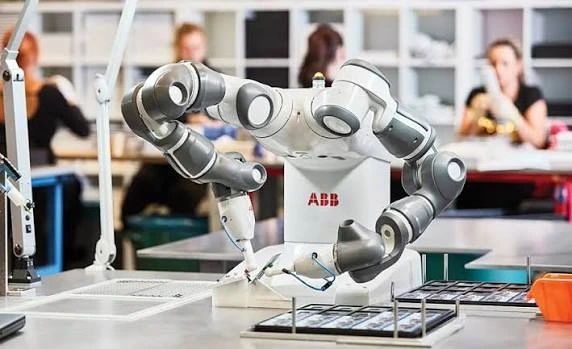
Instead of building every robotic system around complete physical separation, collaborative robot applications can be designed so people and robots work more closely together. A human may position a component while a cobot handles repetitive fastening. A machinist may inspect finished parts while a collaborative robot loads the next workpiece. A worker may perform judgment-intensive tasks while the robot handles lifting, dispensing, sanding or repetitive movement.
The category is growing quickly.
According to the International Federation of Robotics, global installations of collaborative robots reached 64,542 units in 2024, up approximately 12% from 2023. Cobots represented 11.9% of all industrial robots installed worldwide in 2024, compared with just 2.8% in 2017.
That growth reflects a larger change in manufacturing.
Factories increasingly need automation that can handle shorter production runs, product variation, workforce shortages and changing customer demand without requiring every process to be completely redesigned.
Collaborative robots have emerged as one solution.
But cobots are often misunderstood. They are not automatically safe, they do not eliminate the need for risk assessment, and they are not always better than traditional industrial robots.
Understanding where collaborative robots actually make sense is essential.
For the wider technology behind factory robots, autonomous machines and modern automation, see The News Ink’s Robotics Explained: Complete Guide.
What Are Collaborative Robots?
Collaborative robots are industrial robotic systems designed for applications in which humans and robots may share or interact within a collaborative workspace under defined safety conditions.
The term cobot is widely used as shorthand for collaborative robot.
The important word, however, is application.
Buying a robot advertised as collaborative does not automatically make the entire workstation collaborative or safe.
A robot arm may include force sensing and safety-rated functions, but the complete system can also contain:
- sharp tools;
- welding equipment;
- heavy workpieces;
- rotating machinery;
- grippers;
- cutting tools;
- hot surfaces;
- moving conveyors.
Any of these can introduce hazards.
That is why collaborative robot safety has to be evaluated at the system and task level rather than based only on the robot model.
ISO/TS 15066:2016 provides safety requirements for collaborative industrial robot systems and their work environments, supplementing the broader industrial robot standards. The document remains published but ISO currently lists it as to be revised, with a successor work item under development.
Meanwhile, ISO 10218-1 and ISO 10218-2 were updated in 2025, reflecting the continuing evolution of industrial robot safety requirements.
Collaborative Robots Are Growing Rapidly
The growth of collaborative robots becomes clearer when installations are compared over time.
| Year | Collaborative Robot Installations | Share of Industrial Robot Installations |
|---|---|---|
| 2017 | 11,107 | 2.8% |
| 2018 | 18,518 | 4.4% |
| 2019 | 20,810 | 5.4% |
| 2020 | 26,045 | 6.7% |
| 2021 | 41,729 | 7.9% |
| 2022 | 57,966 | 10.5% |
| 2023 | 57,148 | 10.6% |
| 2024 | 64,542 | 11.9% |
Source: International Federation of Robotics, World Robotics 2025.
The trend is significant.
Collaborative robots represented less than 3% of new industrial robot installations in 2017. Seven years later, their share had risen to almost 12%.
This does not mean collaborative robots are replacing conventional industrial automation.
Traditional industrial robots still dominate because many production processes require greater speed, larger payloads and extremely high throughput.
The IFR has specifically described collaborative robots as a technology that will complement rather than replace traditional industrial robots.
That distinction is important when manufacturers choose between the two.
How Do Collaborative Robots Work?
A collaborative robot still contains many of the same basic components as other robotic manipulators.
These include:
- electric motors;
- joints;
- encoders;
- controllers;
- sensors;
- software;
- end effectors;
- communication systems.
What makes collaborative robots different is the way these components are combined with safety functions, sensing and application design.
A simplified cobot workflow may look like this:
Receive Task → Sense Position → Calculate Motion → Move → Detect Changes → Adjust or Stop → Repeat
Traditional industrial robots frequently operate in highly controlled environments.
Collaborative robots are often expected to function closer to people and therefore need greater awareness of movement, contact and operating conditions.
Force and Torque Sensing
Many collaborative robots monitor forces in their joints or use dedicated force-torque sensors.
If the system detects unexpected resistance, it may slow or stop depending on how the safety system has been configured.
Force sensing can also improve manufacturing processes.
A collaborative robot inserting a component, polishing a surface or performing assembly may need to understand how much physical pressure it is applying.
Position and Speed Monitoring
Robot controllers continuously track joint position and movement.
Safety-rated control functions can enforce limits on:
- robot speed;
- joint movement;
- working areas;
- tool position;
- operating zones.
These limits help integrators design collaborative applications around defined safety requirements.
Vision Systems
Cameras can make collaborative robots more adaptable.
Machine vision may help a cobot:
- identify components;
- locate randomly positioned objects;
- inspect products;
- recognize orientation;
- guide picking;
- monitor production.
Vision is especially useful in high-mix manufacturing where components do not always arrive in identical positions.
NIST research into collaborative robotics emphasizes that perception, communication, human-robot interaction and reliable system performance remain important areas for improving collaboration between workers and robotic systems.
Collaborative Robots vs Industrial Robots
Collaborative robots and traditional industrial robots belong to the same broader automation ecosystem, but they are optimized for different situations.
| Feature | Collaborative Robots | Traditional Industrial Robots |
|---|---|---|
| Human interaction | Designed for collaborative applications | Often physically separated |
| Speed | Frequently lower in collaborative operation | Often much faster |
| Payload | Commonly light to medium | Can reach very high payloads |
| Programming | Often simplified | May require specialist programming |
| Installation | Can be relatively flexible | Often requires engineered workcells |
| Production volume | Strong for high-mix environments | Strong for high-volume manufacturing |
| Redeployment | Often easier | Frequently more fixed |
| Safety | Application-dependent collaborative functions | Often guarding and separation |
| Typical user | SMEs and flexible factories | Large and small manufacturers |
| Main strength | Flexibility | Speed and productivity |
The difference should not be simplified into “cobots are safe and industrial robots are dangerous.”
A properly designed conventional industrial robot installation can be extremely safe.
Likewise, a badly designed collaborative robot application can create serious risks.
The correct automation choice depends on the production task.
For a deeper look at conventional factory robotics, read The News Ink’s Industrial Robots Explained cluster article after publication at:
Where Are Collaborative Robots Used?
Collaborative robots are increasingly used where manufacturers need automation but still require human skills, flexibility or frequent product changes.
Common applications include:
- machine tending;
- assembly;
- welding;
- screwdriving;
- packaging;
- palletizing;
- quality inspection;
- dispensing;
- sanding;
- polishing;
- pick-and-place;
- laboratory work.
The IFR identifies applications such as welding, machine tending, bin picking and end-of-line palletizing among important collaborative robot use cases.
Machine Tending
Machine tending is one of the strongest collaborative robot applications.
A cobot may:
- pick up an unfinished component;
- place it into a CNC machine;
- start the machine cycle;
- wait for machining to finish;
- remove the finished component;
- place another part inside.
A human operator can then supervise multiple processes, inspect products or handle exceptions.
This is particularly valuable where workers previously spent large amounts of time repeating simple loading and unloading movements.
Assembly
Collaborative robots can assist workers with repetitive assembly operations.
Tasks may include:
- screwdriving;
- inserting components;
- fastening;
- applying adhesive;
- positioning parts;
- testing assemblies.
A human worker can handle tasks requiring judgment and dexterity while the cobot performs repetitive movements.
This division of work represents the central idea behind human-robot collaboration: using automation where machines are strong without assuming every human task should be automated.
Welding
Welding has become an important growth area for collaborative robots.
Traditional robotic welding systems can require dedicated automated cells and significant production volume.
Cobots can make robotic welding more accessible for companies producing smaller batches.
A manufacturer may program several welding paths and later redeploy the collaborative robot when production requirements change.
However, collaborative robot welding still creates hazards from:
- arc radiation;
- heat;
- fumes;
- sparks;
- welding equipment.
The robot arm may be collaborative, while the welding process itself still requires additional protection.
This example demonstrates why cobot does not automatically mean fenceless.
Packaging and Palletizing
End-of-line work often involves repetitive lifting and placing.
Collaborative robots can assist with:
- loading boxes;
- stacking products;
- packing goods;
- palletizing;
- depalletizing.
These tasks can be physically demanding for workers, especially when repeated thousands of times.
Cobots can reduce repetitive handling while allowing people to supervise packaging, resolve product problems and manage changing orders.
Quality Inspection
Machine vision allows collaborative robots to move cameras or sensors around components.
Instead of placing inspection equipment in a fixed position, a cobot can examine multiple angles.
This can support inspection of:
- dimensions;
- surface defects;
- assembly errors;
- labels;
- welds;
- product completeness.
Artificial intelligence may increasingly improve this process by helping visual systems classify defects that are difficult to capture with traditional rule-based software.
Why Small Manufacturers Are Interested in Cobots
One reason collaborative robots have attracted so much attention is their potential accessibility for small and medium-sized manufacturers.
Traditional robot automation can require substantial engineering.
A company may need:
- fencing;
- complex integration;
- specialist programming;
- dedicated floorspace;
- fixed production layouts.
Collaborative robots can sometimes reduce these barriers.
NIST notes that advances in robotics, sensors, software and vision systems are making automation accessible even to smaller manufacturers.
Collaborative robots are particularly attractive in high-mix, low-volume manufacturing.
This describes factories that produce many different products but relatively small quantities of each.
Instead of building a fixed automated line that performs one task for years, the company may want a robot that can move between processes.
NIST has identified high-mix, low-volume manufacturers as an especially promising environment for collaborative robotics because of their need for flexibility and redeployment.
Are Collaborative Robots Easy to Program?
Ease of programming is one of the major selling points of cobots.
Some collaborative robots can be programmed through graphical interfaces rather than traditional robot code.
Operators may select actions such as:
- move;
- grip;
- wait;
- release;
- repeat.
Another approach is hand guiding or lead-through teaching.
An operator physically guides the collaborative robot arm through positions, allowing the system to record points and create a motion sequence.
The IFR identifies hand-guiding and tablet-style interfaces as important factors making cobots easier to deploy.
However, easy programming should not be confused with easy engineering.
A complete application may still require knowledge of:
- tooling;
- fixtures;
- electrical systems;
- safety;
- machine communication;
- production processes;
- cycle-time optimization.
The robot program may be simple while the complete automation problem remains difficult.
How Collaborative Robot Safety Works
Safety is perhaps the most misunderstood part of collaborative robotics.
The correct question is not:
“Is this cobot safe?”
The better question is:
“Is this entire collaborative robot application acceptably safe for the task being performed?”
Modern collaborative robot systems can use several approaches to reduce risk.
Safety-Rated Monitored Stop
A robot may operate automatically while a worker remains outside a defined collaborative area.
When a person enters, the robot performs a safety-rated stop.
Once conditions become safe again, operation can resume.
This allows humans to interact with the workstation without requiring the robot to continue moving during every interaction.
Hand Guiding
Some applications allow an operator to physically guide the robot.
This can be useful during:
- programming;
- positioning;
- teaching;
- specialized processes.
Safety controls remain necessary because the worker is intentionally close to the robotic system.
Speed and Separation Monitoring
Sensors can help monitor the distance between a person and robot.
The collaborative robot can reduce speed as a worker approaches and stop if separation becomes too small.
This approach depends heavily on reliable sensing, stopping performance and system design.
Power and Force Limiting
Power-and-force-limited applications are probably what most people imagine when they hear “cobot.”
The robot is designed and controlled so contact forces remain within defined limits for the specific application.
However, the tool and workpiece also matter.
A rounded gripper handling a lightweight plastic item presents a very different risk from a cobot carrying sharp metal.
ISO/TS 15066:2016 addresses collaborative industrial robot systems and includes safety guidance related to human contact. ISO has now started work on a replacement addressing biomechanical thresholds and data for physical contact.
A Collaborative Robot Is Not Automatically Safe
This point deserves repetition.
A manufacturer cannot simply purchase collaborative robots, remove all guarding and assume employees can safely stand beside them.
The complete risk assessment needs to consider:
- robot speed;
- payload;
- end effector;
- sharp edges;
- pinch points;
- workpiece shape;
- crushing hazards;
- machine tools;
- surrounding equipment;
- foreseeable misuse;
- maintenance activities.
For example, imagine a collaborative robot holding a knife.
The robot may contain advanced force-limiting technology, but the tool fundamentally changes the risk.
The same principle applies to welding torches, drills, heavy metal components and other dangerous equipment.
Industrial robot safety standards were substantially updated with ISO 10218-1:2025 and ISO 10218-2:2025. In the United States, ANSI/A3 R15.06-2025 adopted these ISO standards into the revised national industrial robot safety framework.
For the broader relationship between intelligent systems, reliability and human oversight, see The News Ink’s AI Safety Explained.
Benefits of Collaborative Robots
Collaborative robots can provide several advantages when matched with the right application.
1. Flexible Automation
Cobots can often be redeployed between tasks.
A collaborative robot might perform machine tending today and assist with inspection after a production change.
This flexibility can improve the economics of automation where product volumes are not high enough to justify a permanently dedicated robotic line.
2. Smaller Production Batches
Traditional automation works extremely well when millions of identical components are produced.
Collaborative robots can be valuable when products change more frequently.
That makes them particularly relevant for manufacturers operating high-mix production environments.
3. Reduced Repetitive Work
Workers may spend hours:
- lifting;
- loading;
- placing;
- fastening;
- inspecting.
Collaborative robots can take over some repetitive portions while employees handle tasks requiring greater judgment.
4. Better Ergonomics
Some production tasks are not immediately dangerous but create long-term physical strain.
Examples include repetitive reaching, lifting or holding tools.
Cobots can reduce exposure to these movements.
5. Easier Redeployment
Compact collaborative robots can sometimes be installed on mobile stands or moved between workstations.
This allows manufacturers to treat automation more like a flexible production resource.
6. Lower Entry Barrier
A collaborative robot project can sometimes require less infrastructure than a traditional automated cell.
This does not guarantee low cost, but it may make robotics realistic for businesses that could not justify large fixed automation projects.
Limitations of Collaborative Robots
Cobots also have significant disadvantages.
Lower Speed
When humans work close to robots, safety requirements can limit speed.
Traditional industrial robots operating behind guarding can often move much faster.
For high-volume manufacturing, speed may matter more than flexibility.
Lower Payload
Collaborative robots historically concentrated on relatively modest payloads.
Capabilities are increasing, but conventional industrial robots still dominate many heavy-duty applications.
Safety Can Reduce Productivity
A cobot that repeatedly slows or stops whenever a worker approaches may produce disappointing cycle times.
Poor workstation design can erase the productivity benefits that motivated the automation project.
Integration Still Requires Expertise
The robot itself may be simple to operate, while:
- PLC integration;
- machine communication;
- vision;
- tooling;
- fixtures;
- safety validation
remain technically demanding.
Not Every Task Should Be Collaborative
Sometimes physical separation is simply better.
If a robot must move extremely quickly or handle dangerous tools, placing it behind guarding may deliver higher productivity and a simpler safety solution.
Manufacturers should choose collaboration because the process benefits from human-robot interaction—not because “cobot” sounds more advanced.
Collaborative Robots and Artificial Intelligence
Artificial intelligence could significantly expand what collaborative robots can do.
Traditional automation relies heavily on predefined instructions.
The system knows:
- where objects should be;
- what movement to make;
- when each operation happens.
AI can help collaborative robots operate when these conditions are less predictable.
Potential applications include:
- visual object recognition;
- adaptive grasping;
- defect detection;
- task planning;
- natural-language interfaces;
- predictive maintenance;
- human-motion prediction;
- intelligent path planning.
NIST has studied machine learning and AI as technologies that could improve human-robot interaction, situational awareness, communication and ease of integration in manufacturing.
For the wider technological background, read The News Ink’s Artificial Intelligence Explained: Complete Guide.
Can Workers Talk to Future Cobots?
Natural-language interfaces may eventually make robot programming more accessible.
Instead of writing complex code, an operator could potentially describe a goal such as:
“Pick the finished components from this tray and place damaged pieces in the inspection bin.”
An AI system would still need to translate that instruction into safe, reliable physical actions.
That is much harder than generating text.
A language-model mistake produces a wrong answer.
A robotics mistake can damage equipment or physically injure someone.
For that reason, AI-powered collaborative robots will require strong verification, safety constraints and human oversight.
Collaborative Robots and Jobs
Collaborative robots are frequently marketed around the idea of assisting workers rather than replacing them.
Reality is more complicated.
Any automation technology can reduce labor demand for specific tasks.
If one worker and a cobot can perform work that previously required two people, labor requirements have changed.
At the same time, automation can create or expand roles involving:
- robot programming;
- maintenance;
- system integration;
- production engineering;
- quality control;
- data analysis;
- automation supervision.
Collaborative robots may be particularly useful when factories cannot recruit enough workers for repetitive manufacturing positions.
The IFR identifies labor and skills shortages as one of the factors supporting continued cobot development.
The broader effect of automation on employment is explored in The News Ink’s AI Jobs Are Changing Faster Than Expected.
Collaborative Robots and Cybersecurity
Modern collaborative robots are increasingly connected machines.
They may communicate with:
- factory networks;
- cloud systems;
- manufacturing software;
- PLCs;
- cameras;
- remote maintenance systems;
- other robots.
Connectivity creates opportunities but also expands the potential attack surface.
A cybersecurity problem could theoretically affect:
- robot availability;
- production data;
- intellectual property;
- system configuration;
- remote access;
- manufacturing continuity.
Safety and cybersecurity therefore become increasingly connected as robots gain autonomy and network access.
Factories introducing connected collaborative robots should treat cybersecurity as part of the overall automation architecture rather than an IT problem that can be considered later.
For a wider overview, see The News Ink’s Cybersecurity Explained: Complete Guide.
How Much Do Collaborative Robots Cost?
There is no single cobot price that represents the true cost of deployment.
The robot arm is only one part of the project.
A manufacturer may also need:
- grippers;
- cameras;
- force sensors;
- fixtures;
- safety scanners;
- software;
- integration;
- training;
- electrical work;
- mobile stands;
- machine interfaces.
A useful calculation is therefore:
Total Automation Cost = Robot + Tooling + Integration + Safety + Training + Maintenance
A low-cost collaborative robot can become expensive if the application requires complicated custom engineering.
Likewise, a more expensive cobot can produce strong returns if deployment is simple and the robot can be reused across multiple tasks.
Manufacturers should measure:
- labor hours saved;
- increased throughput;
- reduced defects;
- reduced downtime;
- changeover time;
- utilization;
- maintenance expense;
- expected equipment life.
Return on investment should be calculated around the complete manufacturing process rather than the robot’s purchase price.
The Future of Collaborative Robots
Collaborative robots are likely to become more capable, but their biggest change may come from software rather than mechanical design.
Better Machine Vision
Improved cameras and AI could help cobots recognize greater product variation.
Instead of requiring every component to arrive in a carefully engineered fixture, future collaborative robots may become better at locating and manipulating less structured objects.
More Intelligent Gripping
Manipulation remains one of robotics’ hardest challenges.
Humans effortlessly adjust grip based on shape, weight, texture and movement.
Better sensors, tactile feedback and AI could make cobots more adaptable.
Easier Programming
Programming interfaces are moving toward graphical tools, demonstration and potentially natural language.
Lowering the technical barrier could accelerate collaborative robot adoption among small manufacturers.
Mobile Manipulation
Another important development is combining robotic arms with autonomous mobile platforms.
Instead of remaining attached to one workstation, a robot could move through a factory and perform tasks at different locations.
This would combine two major robotics fields:
collaborative manipulation + autonomous mobile robotics.
Physical AI
The wider AI industry is increasingly interested in systems capable of perceiving and acting in the physical world.
Collaborative robots are an obvious platform for this transition.
AI models may eventually help robots understand environments, interpret instructions and choose actions with less explicit programming.
This connects collaborative robotics directly to the emerging field sometimes called Physical AI.
Frequently Asked Questions About Collaborative Robots
What are collaborative robots?
Collaborative robots are robotic systems designed for applications in which humans and robots can work more closely together under defined safety conditions. They are commonly called cobots.
What is a cobot?
Cobot is a shortened form of collaborative robot. The term usually refers to industrial robotic arms designed with functions that can support human-robot collaborative applications.
How many collaborative robots are installed worldwide?
The International Federation of Robotics reported 64,542 collaborative robot installations in 2024. Cobots represented approximately 11.9% of all industrial robot installations that year.
Are collaborative robots safe?
Collaborative robots can include safety-rated technologies such as force monitoring, speed limits and monitored stopping. However, the complete application still requires risk assessment. The robot, tool, workpiece and surrounding machinery all affect safety.
Do cobots need safety fences?
Not always, but sometimes they do. Whether physical guarding is required depends on the application and risk assessment. A cobot performing a low-force handling task may operate differently from one using welding or cutting equipment.
What are collaborative robots used for?
Common applications include machine tending, assembly, welding, palletizing, packaging, inspection, dispensing, sanding, polishing and pick-and-place operations.
What is the difference between collaborative robots and industrial robots?
Traditional industrial robots are often optimized for high speed, large payloads and highly repetitive production. Collaborative robots generally emphasize flexibility, easier programming and applications involving closer interaction with workers.
Will cobots replace workers?
Collaborative robots can automate individual tasks and may change labor requirements. However, workers remain important for programming, maintenance, inspection, troubleshooting, production management and tasks requiring judgment or dexterity.
Conclusion: Collaborative Robots Are Expanding Flexible Automation
Collaborative robots are becoming an increasingly important part of modern manufacturing.
Global installations reached 64,542 units in 2024, giving cobots an 11.9% share of new industrial robot deployments. That represents a major increase from only 2.8% in 2017.
Their growth is being driven by a different automation problem than the one traditional factory robots originally solved.
Manufacturers do not always need machines capable of producing millions of identical components at maximum speed.
Many factories need automation that can handle:
- smaller production batches;
- labor shortages;
- frequent product changes;
- repetitive manual work;
- limited floorspace;
- flexible production.
Collaborative robots can address some of these challenges by allowing people and automation to operate more closely within the same production process.
But their advantages should not be exaggerated.
Cobots are often slower than traditional industrial robots. They may have lower payloads. Integration can still be complicated. Safety engineering remains essential.
Most importantly, a collaborative robot is not automatically a safe robot.
Safety depends on the entire application.
The strongest future for cobots is therefore not based on replacing every industrial robot or removing every worker.
It is based on combining what humans do well with what machines do well.
Humans bring judgment, adaptability, dexterity and problem solving.
Collaborative robots bring repeatability, precision, endurance and the ability to automate physically repetitive work.
As machine vision, force sensing and artificial intelligence improve, that partnership may become significantly more capable.
The next generation of collaborative robots could move beyond repeating programmed movements and begin adapting to greater variation in products, environments and instructions.
That would make cobots an important bridge between traditional industrial automation and the emerging world of intelligent machines.
For the complete picture of how collaborative robots connect with industrial automation, autonomous robots, humanoids, AI and Physical AI, continue with The News Ink’s Robotics Explained: Complete Guide.
Follow The News Ink
X
Pinterest
Medium
Quora
TikTok
Instagram
Substack
Threads
Bluesky
Mastodon