


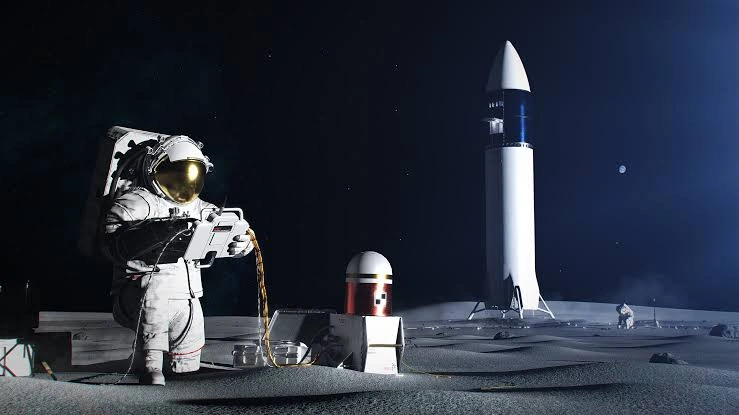
NASA Space Technology Explained: Propulsion, Robotics, Communications and Future Exploration
NASA space technology is what turns an ambitious mission concept into something capable of surviving outside Earth.
A Moon base needs reliable electricity.
A Mars spacecraft needs propulsion.
Astronauts need oxygen and water.
Robots need autonomous navigation.
Spacecraft hundreds of millions of miles away need communications.
Heavy vehicles landing on Mars need technologies capable of surviving atmospheric entry.
And crews operating far from Earth cannot depend on replacement parts arriving overnight.
These are not separate problems.
Together, they form the technological foundation beneath modern space exploration.
NASA develops and demonstrates new systems because many of the technologies needed for future exploration either do not yet exist or are not mature enough to trust on missions where failure could cost billions of dollars or human lives.
That makes NASA space technology one of the most important links connecting nearly every major NASA program.
The NASA Artemis Program needs power, communications, navigation, robotics and lunar construction systems.
NASA Mars missions depend on autonomous robots, advanced communications and entry technologies.
The NASA International Space Station has served for decades as a laboratory for life-support, manufacturing and robotic technologies.
And NASA’s longer-term ambitions require systems capable of operating much farther from Earth than existing crews normally travel.
NASA reorganized much of this work in 2026. Its new Research and Technology Mission Directorate, or RTMD, now brings together space technology, aeronautics, nuclear power and propulsion, and Space Communications and Navigation. NASA describes the organization as responsible for delivering technological breakthroughs needed across the agency’s aviation and space missions.
NASA Space Technology at a Glance
| Technology Area | Why NASA Needs It |
|---|---|
| Advanced propulsion | Travel farther or more efficiently |
| Nuclear propulsion | Faster or more capable deep-space missions |
| Nuclear surface power | Reliable electricity on the Moon and eventually Mars |
| Laser communications | Return much larger volumes of data |
| Navigation | Enable precise and increasingly autonomous travel |
| LunaNet | Internet-like communications and navigation around the Moon |
| Robotics | Reduce human risk and operate when astronauts are absent |
| ISRU | Produce useful resources from lunar or Martian materials |
| Manufacturing | Build or repair hardware away from Earth |
| Solar sails | Propellant-free spacecraft propulsion |
| Entry technology | Safely deliver heavier payloads through atmospheres |
| Autonomous systems | Operate despite long communication delays |
NASA’s current technology organization emphasizes cross-cutting capabilities that can serve science, commercial activity and human exploration rather than technologies designed for only one mission.
What Is NASA Space Technology?
NASA space technology is the research, development, testing and demonstration of new technologies intended to enable future space missions.
This work exists between an idea and an operational spacecraft.
An engineer may know that a particular technology is theoretically possible.
That does not mean NASA is ready to put astronauts’ lives on it.
New systems must progress through:
concept studies,
laboratory testing,
prototype development,
environmental testing,
flight demonstrations,
and eventually operational use.
NASA’s technology programs are designed partly to bridge that gap.
A technology that works on a laboratory bench may behave differently in:
vacuum,
radiation,
extreme cold,
lunar dust,
microgravity,
or atmospheric entry.
NASA therefore tries to test promising systems in increasingly realistic environments before relying on them for critical missions.
NASA Space Technology Changed Organization in 2026
For years, much of NASA’s technology development was managed under the Space Technology Mission Directorate, commonly called STMD.
That structure changed in May 2026.
NASA combined its Aeronautics Research and Space Technology organizations into the new Research and Technology Mission Directorate.
The new structure includes major divisions covering:
- Aeronautics;
- Advanced Research and Technology;
- space reactors;
- Space Communications and Navigation.
Older NASA webpages may still use the STMD label because programs and archives were created before the reorganization.
That does not mean the underlying technology work ended.
It means NASA consolidated several research areas into a broader organization.
For aviation-focused research, see NASA Aeronautics Explained.
Why Chemical Rockets Are Not Enough for Every Mission
Chemical rockets are extremely powerful.
They are excellent for leaving Earth because they can produce enormous thrust.
But deep-space travel creates a different engineering problem.
A spacecraft traveling between planets may benefit more from high efficiency than enormous thrust.
NASA therefore studies multiple propulsion technologies instead of expecting one engine type to solve every mission.
These include:
chemical propulsion,
electric propulsion,
solar sails,
nuclear thermal propulsion,
nuclear electric propulsion.
The correct choice depends on the mission.
A crew leaving Earth’s surface needs something very different from a robotic spacecraft slowly accelerating toward the outer solar system.
NASA Space Nuclear Propulsion
One of the most ambitious areas of NASA space technology is nuclear propulsion.
Instead of relying entirely on chemical reactions, nuclear systems use energy released through fission.
NASA is developing two major concepts:
nuclear thermal propulsion
and
nuclear electric propulsion.
NASA says nuclear thermal propulsion could provide high thrust with roughly twice the propellant efficiency of conventional chemical systems.
Nuclear electric propulsion works differently. A reactor produces electricity, which powers electric thrusters that accelerate propellant very efficiently over long periods.
Neither approach means astronauts are currently flying to Mars aboard nuclear spacecraft.
These technologies are still being developed.
But NASA now has a particularly important flight demonstration planned.
Space Reactor-1 Freedom
NASA’s current 2026 plans include a future mission called:
Space Reactor-1 Freedom
or SR-1 Freedom.
NASA describes the spacecraft as its planned first fission-powered interplanetary spacecraft.
The mission currently targets launch in late 2028, followed by Mars operations beginning around 2029.
SR-1 is intended to demonstrate nuclear electric propulsion in deep space while also delivering three SkyFall helicopter vehicles toward Mars.
NASA says the spacecraft’s reactor will provide about 20 kilowatts of electrical output, while the broader spacecraft power-and-propulsion architecture will support electric thrusters and other systems.
If successfully flown, the mission could provide operational experience relevant to:
deep-space propulsion,
space nuclear power,
future Mars missions,
outer-solar-system exploration
and eventually lunar surface reactors.
Because SR-1 is still a future mission, the 2028 schedule should be described as a target, not a guaranteed launch date.
Why Nuclear Propulsion Could Matter for Mars
Mars is months away using conventional trajectories.
That creates problems.
More travel time means:
greater radiation exposure,
more food,
more water,
more life-support consumables,
greater psychological strain,
and more opportunities for equipment failure.
A propulsion technology that improves mission flexibility or reduces transit time could therefore have benefits much larger than fuel efficiency alone.
NASA also notes that nuclear systems can provide significant electrical power when spacecraft travel far from the Sun, where solar energy becomes progressively less useful.
This is why NASA space technology treats power and propulsion as closely connected.
Nuclear Power on the Moon
Propulsion is only one use for nuclear energy.
Future lunar explorers need electricity.
Solar panels work well when sunlight is available.
The Moon, however, presents difficult lighting conditions.
A lunar day-night cycle lasts roughly 29.5 Earth days, creating extremely long periods of darkness in many locations.
Some scientifically interesting regions near the lunar poles also receive limited sunlight.
NASA and the U.S. Department of Energy announced in January 2026 that they are working toward developing a lunar surface fission reactor by 2030.
The objective is reliable power independent of sunlight.
Fission Surface Power
NASA has long studied compact fission systems for lunar and Martian exploration.
Earlier project requirements investigated approximately 40-kilowatt-class systems, enough electrical output to support significant surface activity.
Unlike solar panels, a fission reactor could continue generating electricity:
during lunar night,
inside shadowed regions,
during difficult surface conditions,
and without requiring enormous energy-storage systems merely to survive darkness.
Reliable electricity could eventually support:
habitats,
science instruments,
rovers,
communications,
resource-processing equipment,
heating
and industrial activity.
This is why surface power may be just as important to sustained lunar exploration as the lander that delivers astronauts.
Using the Moon’s Own Resources
Another major area of NASA space technology is known as:
In-Situ Resource Utilization
or ISRU.
The concept is simple:
instead of launching everything from Earth, use materials already available at the destination.
On the Moon, those materials include lunar soil, known as regolith, and potentially water ice in some polar regions.
NASA is developing technologies capable of extracting or processing local materials into useful products such as:
water,
oxygen,
metals,
construction material,
and potentially resources connected with future fuel production.
This could fundamentally change exploration economics.
Why Oxygen From Lunar Soil Matters
Launching material from Earth requires enormous energy.
If explorers could produce oxygen directly from lunar regolith, they could reduce how much material must be transported from Earth.
Oxygen is valuable for:
breathing,
oxidizer for propulsion,
industrial processes.
NASA’s Carbothermal Reduction Demonstration, or CaRD, is one example.
In 2026, NASA and Sierra Space conducted integrated prototype tests using concentrated solar energy to process simulated lunar regolith while demonstrating oxygen production through the chemical process.
NASA has also worked on molten-regolith electrolysis, which can separate oxygen while leaving metal-rich material that could potentially support manufacturing.
ISRU remains developmental.
NASA is not currently running a lunar oxygen factory.
But the technology illustrates how a future Moon base could become progressively less dependent on Earth.
Water Ice Could Become a Critical Resource
Scientists have found evidence of water ice in permanently shadowed lunar regions.
If future missions can locate, extract and process it economically, water could potentially serve several purposes.
It can support crews directly.
Electrolysis can split water into hydrogen and oxygen.
Those elements could contribute to fuel cells, life-support systems and potentially propellant.
NASA’s 2026 lunar-technology program is supporting new resource-seeking technologies designed to investigate materials such as hydrogen in lunar regolith.
Finding a resource is only the first step.
Engineers must then learn how to:
excavate it,
transport it,
process it,
store it
and use it safely.
Robots Could Build Before Astronauts Arrive
Robotics is another foundational part of NASA space technology.
Sending people into hazardous environments is expensive and risky.
Robots can work first.
NASA’s current Moon-base planning places robotic activity early in the development sequence.
Robots could:
survey terrain,
move lunar soil,
prepare landing areas,
build protective berms,
inspect equipment,
deploy infrastructure,
transport cargo.
NASA highlighted this strategy in 2026 while describing robotic construction and excavation as important early capabilities for lunar infrastructure.
This connects directly with The News Ink’s broader Robotics Explained pillar.
Autonomous Robots Become More Important Farther From Earth
Remote control works reasonably well when a robot is nearby.
Mars is different.
Signals between Earth and Mars can take many minutes each way.
A human operator cannot safely steer a rover around every rock in real time.
Future robots therefore need increasing levels of autonomy.
NASA’s robotics work includes:
dexterous manipulators,
autonomous vehicles,
intelligent robotic systems,
robotic construction
and hardware capable of supporting human crews.
Autonomy does not necessarily mean removing people from the decision-making process.
It means machines can perform more local tasks without constantly waiting for Earth.
The role of intelligent autonomy also connects naturally with Artificial Intelligence Explained.
Building Infrastructure in Space
A traditional spacecraft is manufactured on Earth.
Every component must fit inside a rocket.
That creates obvious constraints.
Large antennas must fold.
Solar arrays must fold.
Structures must survive launch vibrations.
Future NASA space technology could change that model.
Instead of launching every structure fully assembled, robots might build some systems after reaching orbit or the lunar surface.
NASA’s Fly Foundational Robots technology demonstration is currently targeted for late 2027.
The mission plans to operate a commercial robotic arm in low-Earth orbit as a platform for robotic manipulation demonstrations.
If technologies like this mature, future spacecraft and infrastructure could become less constrained by the dimensions of a launch-vehicle fairing.
3D Printing and Additive Manufacturing
Manufacturing far from Earth is another major goal.
Imagine a Mars crew discovering that a small mechanical part has failed.
Waiting months for a replacement is not practical.
In-space manufacturing could eventually allow crews to produce some replacement components locally.
NASA has already demonstrated additive manufacturing aboard the International Space Station and continues developing:
metal printing,
advanced alloys,
composite manufacturing,
rocket-engine components,
construction techniques.
NASA-supported manufacturing research has also influenced terrestrial construction techniques, showing how NASA space technology can produce applications outside the original space mission.
Manufacturing With Lunar Materials
The long-term concept goes further than carrying a printer from Earth.
NASA is investigating ways to combine manufacturing with ISRU.
Instead of importing every kilogram of construction material, explorers could potentially use lunar regolith.
Applications might eventually include:
landing pads,
roads,
radiation barriers,
protective berms,
structural material.
NASA’s current lunar-surface technology portfolio explicitly includes manufacturing and construction alongside power and resource utilization.
This remains an emerging field.
A permanent lunar industrial system does not yet exist.
But the engineering logic is powerful.
The less material that must be lifted from Earth, the more sustainable long-duration exploration becomes.
Communications Are a Space Technology Problem
A spacecraft can carry extraordinary scientific instruments.
Those instruments are useless if their data cannot reach Earth.
Radio communications have supported NASA missions for decades.
But modern spacecraft are producing increasingly large datasets.
High-resolution cameras.
Radar.
Scientific spectrometers.
Video.
Human exploration.
All require bandwidth.
That is why NASA space technology is rapidly advancing optical communications.
Laser Communications
Laser communications transmit information using infrared light rather than traditional radio-frequency systems.
NASA says comparable optical systems can provide roughly 10 to 100 times higher data rates while potentially using smaller and lighter hardware.
NASA has already demonstrated the technology at multiple distances.
LCRD
The Laser Communications Relay Demonstration launched in 2021 and operates as NASA’s long-duration optical communications relay experiment.
By 2026, NASA reported more than 2,600 experimental configurations using LCRD and its ground stations.
TBIRD
NASA’s TBIRD experiment demonstrated a 200-gigabit-per-second laser downlink from low-Earth orbit.
Deep Space Optical Communications
NASA’s DSOC experiment aboard Psyche demonstrated optical communications from as far as approximately 307 million miles from Earth in September 2025.
These demonstrations move optical communications from theory toward operational mission capability.
Artemis II Tested Laser Communications With Astronauts
A particularly important step occurred during Artemis II in 2026.
The Orion Artemis II Optical Communications System, known as O2O, flew aboard the crewed mission.
NASA says the system supported data transmission rates of up to:
260 megabits per second
and transmitted more than:
484 gigabytes
during the mission.
This was especially important because it extended high-rate optical communications into a crewed deep-space mission.
Future astronauts may produce enormous amounts of:
scientific data,
medical data,
high-definition video,
engineering information.
Laser communications could help return that information much more efficiently.
Why Lasers Will Not Completely Replace Radio
Optical communications also have disadvantages.
Clouds can block the laser path to Earth.
Laser beams are extremely narrow, requiring precise pointing.
NASA therefore does not simply plan to throw away radio communications.
Future networks will likely combine:
radio,
laser,
multiple ground stations,
relay satellites.
The correct technology depends on mission conditions.
This redundancy is essential when communication failure could threaten a spacecraft or crew.
Deep Space Network
NASA’s Deep Space Network remains one of the foundations of planetary exploration.
Large antennas in California, Spain and Australia allow NASA to maintain communication with spacecraft across the solar system.
As missions increase, the network must handle increasing traffic.
NASA continues upgrading Deep Space Network infrastructure while also developing laser communications and more autonomous networking.
Space communications are therefore not simply an antenna problem.
They are becoming a network architecture problem.
LunaNet: An Internet-Like Network for the Moon
Imagine driving around Earth without GPS or cellular networks.
Now imagine astronauts and robots trying to operate around the Moon without comparable infrastructure.
NASA’s answer is LunaNet.
LunaNet is a framework for interoperable lunar communications and navigation.
NASA describes four major service categories:
- networking;
- navigation;
- detection and information;
- radio and optical science.
Rather than every lunar mission building an entirely independent communications system, compatible satellites, landers, rovers and commercial services could become part of a shared network.
That is conceptually similar to the internet.
Communications on the Far Side and South Pole
Direct communication with Earth is not always possible from every lunar location.
The far side of the Moon cannot see Earth directly.
Some polar terrain can also create communications challenges.
Relay satellites can solve this problem.
NASA’s lunar relay architecture is intended to provide communications and navigation services even where direct Earth visibility is unavailable.
In August 2026, NASA delivered the NavCube3-mini navigation payload for integration with Intuitive Machines’ Altus-1 lunar relay satellite, an important step toward future commercial lunar communications and navigation infrastructure.
GPS for the Moon
Navigation on Earth feels effortless because GPS infrastructure already exists.
The Moon does not yet have an equivalent.
NASA is developing positioning, navigation and timing technologies that could allow astronauts, rovers and spacecraft to determine their location more independently.
LunaNet’s navigation framework includes shared standards intended to support compatible lunar positioning services.
This could eventually allow a lunar rover to determine its location more like a vehicle using GPS on Earth rather than requiring every position calculation to be performed by mission control.
CAPSTONE Demonstrated Autonomous Lunar Navigation
NASA’s CAPSTONE mission provided an important technology demonstration.
Launched in 2022, the small spacecraft tested operations in the near-rectilinear halo orbit environment around the Moon.
NASA announced in July 2026 that CAPSTONE had completed all primary and extended mission objectives.
Among its achievements were technologies connected to autonomous positioning and navigation.
Capabilities like these become increasingly important as more:
landers,
rovers,
satellites,
commercial missions
and astronauts operate around the Moon simultaneously.
Solar Sails: Propulsion Without Conventional Fuel
One of the more unusual forms of NASA space technology uses sunlight itself.
Photons carry momentum.
When light strikes a reflective sail, it creates an extremely tiny force.
That force is small.
But in space it can continue acting for long periods without consuming conventional propellant.
NASA’s Advanced Composite Solar Sail System, or ACS3, launched in April 2024 and remains listed as an active technology-demonstration mission in 2026.
Its sail is approximately nine meters on each side.
The technology focuses particularly on lightweight composite booms used to deploy the sail.
Why Solar Sails Matter
A solar sail will not launch astronauts from Earth.
The thrust is far too small.
But for some lightweight robotic missions, continuous propellant-free acceleration could become extremely valuable.
Potential uses include:
space-weather monitoring,
small deep-space missions,
unusual orbital operations,
long-duration science.
Again, NASA space technology is about creating a toolbox.
Nuclear propulsion, chemical engines and solar sails are not necessarily competitors.
Each can be useful for different jobs.
Landing Heavy Payloads on Mars
Reaching Mars is difficult.
Landing there can be even harder.
Mars has an atmosphere, but it is extremely thin.
That creates an awkward problem.
The atmosphere is thick enough to generate intense heating during entry.
But it is too thin for parachutes alone to easily land extremely heavy vehicles.
Future human missions may require landing:
habitats,
power systems,
rovers,
supplies,
ascent vehicles,
and eventually crewed spacecraft.
NASA therefore needs larger and more capable atmospheric-entry systems.
LOFTID and Inflatable Heat Shields
NASA’s Low-Earth Orbit Flight Test of an Inflatable Decelerator, or LOFTID, demonstrated a different approach to heat shields.
The vehicle launched in 2022, inflated in space, re-entered Earth’s atmosphere and splashed down successfully.
NASA concluded that the flight successfully demonstrated large-scale inflatable aerodynamic decelerator technology in a relevant environment.
Traditional rigid heat shields are limited by the width of the rocket carrying them.
An inflatable system can launch compactly and then expand after reaching space.
A larger atmospheric braking surface could help future missions deliver heavier payloads to Mars.
Technology Demonstrations Reduce Mission Risk
Why test something like LOFTID before a Mars mission?
Because Mars is a terrible place to discover that an engineering theory was wrong.
Technology demonstrations intentionally isolate risk.
They allow NASA to test:
one new system,
in a relevant environment,
before combining it with an expensive science or human mission.
DART did this for asteroid deflection.
Ingenuity did it for powered flight on Mars.
LOFTID did it for inflatable entry systems.
Laser communications missions are doing it for high-bandwidth networking.
This demonstration-first approach is one of the central methods behind NASA space technology.
NASA Works With Private Companies
NASA increasingly develops technology through partnerships rather than only through internal government laboratories.
In June 2026, NASA selected 41 proposals from 37 U.S. companies for collaborations aimed at advancing technologies involving space transportation, planetary surface operations and lunar infrastructure.
Companies can contribute:
specialized engineering,
commercial investment,
manufacturing capability,
rapid development.
NASA can contribute:
facilities,
technical expertise,
testing,
mission requirements,
flight opportunities.
The objective is not simply outsourcing.
It is creating a broader technology ecosystem.
NASA Space Technology Can Become Everyday Technology
NASA technology programs also produce benefits outside spaceflight.
Some technologies are directly transferred or licensed to companies.
Others influence commercial products indirectly.
Examples across NASA’s broader history include developments associated with:
materials,
manufacturing,
sensors,
medical devices,
navigation,
computing,
aviation.
NASA’s technology-transfer program refers to many of these applications as spinoffs.
Not every consumer invention associated with NASA was literally invented from scratch by the agency, so exaggerated lists of “things NASA invented” should be treated cautiously.
The better way to describe the process is:
spaceflight requirements produce research,
research produces technology,
and some technologies later find additional uses on Earth.
NASA Space Technology and the Moon-to-Mars Strategy
The purpose behind many of these technologies becomes clearer when they are viewed together.
Consider a sustained lunar operation.
Astronauts need:
power,
communications,
navigation,
robots,
surface mobility,
construction,
water,
oxygen,
maintenance,
manufacturing.
Now consider Mars.
Every one of those problems becomes harder.
Mars is farther away.
Resupply is slower.
Communications are delayed.
Solar power can be less reliable in some circumstances.
Emergency return is far more difficult.
Robots need more independence.
Life-support systems need far greater endurance.
That is why NASA space technology development today is closely connected to the agency’s long-term Moon-to-Mars goals.
Ten NASA Space Technologies to Watch
| Technology | Current Importance |
|---|---|
| Space Reactor-1 Freedom | Planned nuclear-electric propulsion demonstration |
| Lunar fission power | Targeted for reliable Moon-base electricity |
| Laser communications | Much higher potential data rates |
| LunaNet | Shared lunar communications/navigation network |
| Autonomous robotics | Lunar construction and Mars operations |
| ISRU | Water, oxygen and materials from local resources |
| Additive manufacturing | Build and repair parts away from Earth |
| Solar sails | Propellant-free robotic propulsion |
| Inflatable heat shields | Landing heavier payloads on Mars |
| Advanced navigation | Increasing spacecraft independence from Earth |
Frequently Asked Questions About NASA Space Technology
What is NASA space technology?
NASA space technology includes the research, development and demonstration of new propulsion, power, communications, navigation, robotics, manufacturing and exploration systems needed for future NASA and commercial missions.
What happened to NASA’s Space Technology Mission Directorate?
NASA reorganized in 2026, combining major aeronautics and space-technology functions under the new Research and Technology Mission Directorate. Space-technology development continues within that broader organization.
Is NASA developing nuclear-powered spacecraft?
Yes. NASA is developing nuclear thermal and nuclear electric propulsion technologies. Its current Space Reactor-1 Freedom mission targets a nuclear-electric propulsion demonstration beginning with a planned late-2028 launch.
Is NASA putting a nuclear reactor on the Moon?
NASA and the Department of Energy announced a goal in 2026 to develop a lunar surface reactor by 2030. As with any future mission, the schedule can change.
What is NASA laser communication?
Laser communications use infrared light to transmit spacecraft data at potentially much higher data rates than comparable traditional radio systems.
Did Artemis II use laser communications?
Yes. NASA’s O2O system flew on Artemis II in 2026, supporting rates up to 260 Mbps and transmitting more than 484 GB during the mission.
What is LunaNet?
LunaNet is NASA’s developing framework for internet-like lunar networking, communications and positioning/navigation services.
Can NASA make oxygen from Moon soil?
NASA is developing ISRU technologies capable of extracting oxygen from lunar regolith. Prototype systems have demonstrated relevant chemical processes using simulated lunar material, but an operational lunar oxygen industry does not yet exist.
Does NASA use robots to prepare Moon missions?
Yes. NASA is developing autonomous robotic systems for excavation, infrastructure construction, equipment manipulation and other lunar operations.
What is a solar sail?
A solar sail uses the pressure of sunlight to generate small but continuous thrust without consuming conventional rocket propellant. NASA’s ACS3 technology demonstration remains active.
What is LOFTID?
LOFTID was NASA’s successful inflatable heat-shield demonstration. The technology could eventually allow much larger payloads to use atmospheric drag when landing on destinations such as Mars.
Why does NASA develop technology years before a mission?
New technology must be demonstrated and matured before NASA can safely depend on it. Early development reduces risk and allows future missions to use systems that have already been tested in relevant environments.
Conclusion: NASA Space Technology Is Building the Infrastructure Behind Exploration
A spacecraft launch receives attention because it is visible.
The deeper technological work often happens years earlier.
A propulsion experiment.
A new antenna.
A robotic arm.
A heat shield.
A reactor component.
A navigation receiver.
A lunar-soil processing system.
A manufacturing technique.
Each may look like an isolated engineering project.
Together, they determine what NASA can actually do.
That is the real purpose of NASA space technology.
Apollo succeeded because the United States developed an enormous technological system around one destination.
Modern NASA is trying to solve a much broader problem.
How do humans operate beyond Earth repeatedly?
How do lunar crews survive nights that can last around two Earth weeks?
How do they generate electricity when sunlight is unavailable?
How do they locate themselves near the lunar South Pole?
How do they communicate when Earth is hidden behind terrain or the Moon itself?
How can robots construct infrastructure before astronauts arrive?
How can explorers produce oxygen instead of launching every kilogram from Earth?
And how can those lessons eventually be applied to Mars?
NASA’s current answer is not one super-technology.
It is a network of technologies.
Nuclear systems could provide power and more efficient propulsion.
Laser communications could return enormous quantities of data.
LunaNet could give lunar spacecraft and astronauts shared communications and navigation.
Robotic systems could excavate soil, transport cargo and build infrastructure.
ISRU could turn lunar material into oxygen and useful products.
Advanced manufacturing could reduce dependence on spare parts delivered from Earth.
Inflatable heat shields could help land heavier spacecraft on Mars.
Solar sails could enable specialized robotic missions without conventional propellant.
The NASA Artemis Program is where several of these systems may first become operational together.
The Moon provides an important proving ground because it is much closer to Earth than Mars.
Problems can be discovered.
Technology can be improved.
Crews can return comparatively quickly.
Mars removes those advantages.
That is why technologies designed for lunar exploration increasingly have a second purpose:
preparing for deeper space.
One of the boldest examples is Space Reactor-1 Freedom.
NASA currently intends to launch the nuclear-electric spacecraft toward Mars in late 2028 as a technology pathfinder, while a separate lunar-reactor effort aims to provide reliable surface power.
Whether every current target date is achieved remains uncertain.
Technology development is difficult precisely because engineers are attempting things that have not been done operationally before.
Schedules can slip.
Designs can change.
Demonstrations can fail.
Some technologies will be replaced by better ideas.
That does not weaken the importance of the research.
It explains why NASA performs it early.
The history of space exploration repeatedly shows that technologies once considered experimental can become routine.
Digital computers once seemed radically advanced for spacecraft.
Autonomous planetary rovers are now normal.
Reusable rockets have transformed launch economics.
Laser communications are moving from demonstration toward real mission use.
Robots are becoming more independent.
And space nuclear systems are moving from decades of study toward planned flight demonstration.
The technology that eventually enables humans to live on Mars may already exist as a small experimental project today.
That is why NASA space technology deserves its own major place inside The News Ink’s NASA pillar.
It is not merely the hardware surrounding exploration.
It determines the limits of exploration itself.
For the complete NASA entity guide, read NASA Explained.
For the lunar missions that will use many of these technologies, continue with NASA Artemis Program Explained.
For the robotic exploration and engineering challenges of the Red Planet, read NASA Mars Missions Explained.
For the aviation side of NASA’s Research and Technology organization, see NASA Aeronautics Explained.
For the orbital laboratory where many exploration technologies have been tested, read NASA International Space Station Explained.
Follow The News Ink
Stay connected with The News Ink for technology, science, robotics and space exploration:
X
Pinterest
Medium
Quora
TikTok
Instagram
Substack
Threads
Bluesky
Mastodon