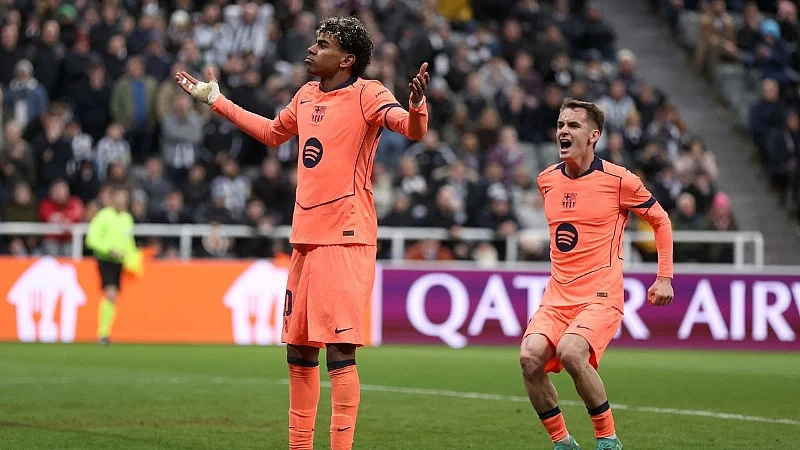
Yamal Penalty Denies Newcastle Before Barcelona’s 7-2 Rout
The Yamal penalty that rescued Barcelona at St James’ Park was not merely a dramatic equaliser. It became the hinge of a Champions League tie that changed completely eight days later. Newcastle United were seconds away from taking a 1-0 advantage from the first leg on 10 March 2026, only for Lamine Yamal to convert from the spot in the sixth minute of added time and secure a 1-1 draw.
At that moment, the result felt painfully harsh on Eddie Howe’s side. Newcastle had carried the greater attacking threat, created the clearer chances and finally broken through when Harvey Barnes finished Jacob Murphy’s cross in the 86th minute. Yet the Yamal penalty ensured Barcelona returned home level rather than behind.
The wider story is now known. Barcelona won the second leg 7-2 at Camp Nou on 18 March and advanced 8-3 on aggregate. That outcome does not erase Newcastle’s excellent first-leg performance, but it changes how the night should be remembered. This was no longer simply the occasion on which a late Yamal penalty denied a famous victory. It was the opening chapter of a tie that exposed the difference between competing with an elite side for one night and controlling an elite knockout contest across 180 minutes.
Newcastle 1-1 Barcelona: the First-Leg Facts
The original report correctly captured the heartbreak but was published before the return match. The completed story needs both legs, exact timings and the confirmed route by which Barcelona advanced.
| Detail | Confirmed information |
|---|---|
| Competition | UEFA Champions League, round of 16 |
| First leg | Newcastle United 1-1 Barcelona |
| Date and venue | 10 March 2026, St James’ Park |
| Newcastle scorer | Harvey Barnes, 86th minute |
| Barcelona scorer | Yamal penalty, 90+6 |
| Second leg | Barcelona 7-2 Newcastle United |
| Aggregate result | Barcelona won 8-3 |
The official UEFA match information records the Yamal penalty in the 96th minute, while Newcastle’s own match report places Barnes’ breakthrough in the 86th. Those details matter because the Yamal penalty was even later than the original 85th- and 95th-minute references suggested.
Newcastle had arrived at the last-16 stage after finishing 12th in the league phase and beating Qarabağ 9-3 across the knockout play-off. Barcelona, fifth in the league-phase standings, qualified directly. The teams had already met at St James’ Park in September, when Barcelona won 2-1 through two Marcus Rashford goals before Anthony Gordon replied late.
Why Newcastle’s Plan Worked
Newcastle’s display was built on aggression without recklessness. They pressed Barcelona’s first pass, competed hard in midfield and attacked the spaces behind the visiting full-backs. The approach was familiar to readers of The News Ink’s wider football guide: pressure is most effective when the team behind it remains compact enough to compete for the second ball.
Sandro Tonali, Joelinton and Jacob Ramsey gave Newcastle the energy to contest central areas. Anthony Elanga offered direct running on the right, Harvey Barnes attacked from the opposite side and William Osula occupied the centre-backs. Anthony Gordon, one of Newcastle’s leading Champions League scorers, began on the bench because illness had limited him.
Barcelona’s possession figure, just above 54%, gave them only a narrow territorial advantage. Newcastle recorded 16 attempts to Barcelona’s nine, four shots on target to two and nine corners to four. Those numbers support what the eye suggested: the hosts were not simply surviving and waiting for one chance. The full match statistics underline Newcastle’s attacking superiority.
The Yamal penalty therefore felt less like the logical reward for sustained Barcelona dominance and more like punishment for one final defensive mistake. That distinction is central to understanding why the Newcastle dressing room reportedly felt as if it had lost.
Lewis Hall’s Demanding Assignment Against Lamine Yamal
One of Newcastle’s strongest individual performances came from Lewis Hall. The left-back had to manage Yamal, a winger capable of creating danger from a standing start, carrying the ball through pressure or combining inside with Barcelona’s midfielders.
Hall did not eliminate every threat, but he limited Yamal’s influence in open play. Newcastle often gave the defender nearby support, closing the inside channel while encouraging Barcelona to attack from less dangerous areas. Dan Burn and the midfield line also protected the space behind Hall when the full-back stepped forward.
Yamal had already become one of Europe’s defining young players, and the match marked his 30th Champions League appearance at 18 years and 240 days, making him the youngest footballer to reach that total. Yet for most of the evening, his impact was subdued.
That is what made the Yamal penalty so striking. A player can be contained for 95 minutes and still decide the match with one action. The Yamal penalty required composure rather than invention. With the home crowd attempting to unsettle him and the tie resting on one strike, Yamal sent Aaron Ramsdale the wrong way and found the bottom corner.
The moment illustrated an uncomfortable truth of knockout football: defensive success is never complete until the final whistle. Newcastle’s work against Yamal had been excellent, but the Yamal penalty ensured his name still dominated the result.
Harvey Barnes Appeared to Have Delivered the Perfect Ending
Barnes’ goal was the product of Newcastle’s attacking identity rather than a lucky break. Howe introduced Gordon, Tino Livramento and Jacob Murphy together during the second half, refreshing the speed around Barcelona’s defence. Murphy soon became decisive.
The move developed down Newcastle’s right. Murphy reached the byline and delivered an inviting cross into the area. Barnes escaped his marker and met it first time, steering the ball past Joan García. St James’ Park erupted because the goal seemed to reward everything Newcastle had done well.
Barnes had already been one of the match’s most dangerous players. He attacked the box with conviction, tested García and hit the post in the disallowed Joelinton sequence. His finish was his sixth goal of that Champions League campaign, an important return for a player whose movement repeatedly stretched Barcelona.
The timing intensified the emotion. With only a few minutes of normal time remaining, Newcastle appeared close to one of their most significant European victories. Howe had described the occasion as one of the biggest at St James’ Park in the club’s recent history. The lead seemed to confirm that his players could meet that scale of challenge.
How the Yamal Penalty Was Created
Barcelona’s final attack developed through Dani Olmo, whose quick feet inside the area invited Malick Thiaw to challenge. The defender committed himself, Olmo went down and referee Marco Guida awarded the spot kick. Replays supported the decision, and the Yamal penalty followed with the last kick of the game.
For Newcastle, the painful part was not a prolonged period of pressure but the avoidable nature of the foul. Thiaw did not need to win the ball immediately. With Olmo moving in a crowded area and the angle narrowing, delaying him may have allowed another defender to recover.
This is easier to explain after the event than to execute during the 96th minute of a high-intensity Champions League match. Fatigue changes body position, timing and judgement. A defender who has made dozens of correct decisions can still mistime the one challenge everyone remembers.
UEFA’s technical analysis focused on Olmo’s movement and Yamal’s composure. The attacker’s shimmy created the contact, and the Yamal penalty taker showed no hesitation. The Yamal penalty was therefore a combination of Barcelona’s individual quality and Newcastle’s final lapse, rather than evidence that the visitors had suddenly discovered control.
Hansi Flick acknowledged that Newcastle may have deserved to win. Barcelona had struggled with the ball, produced little attacking fluency and relied heavily on collective defending to remain close enough for one late action to matter. Their official account of the draw described the result as a reprieve after a difficult performance.
What the 1-1 Draw Meant Before the Return
At the final whistle, the Yamal penalty changed both the score and the psychology of the tie. Newcastle had lost the tangible reward of their superiority. Barcelona had gained a level starting point for the second leg, home advantage and the reassurance that they had survived close to their poorest performance.
There was no away-goals rule to give Barcelona an extra mathematical benefit. A 1-1 draw simply meant that the winner at Camp Nou would progress, while another draw after 90 minutes would have taken the contest into extra time. Even so, context favoured Barcelona.
UEFA’s pre-match facts showed the scale of Newcastle’s task. Barcelona had lost only two of 37 home matches against English visitors and were unbeaten in 14 such games. Newcastle, meanwhile, had lost four of five away matches against Spanish opposition.
The first leg still gave Howe genuine reasons for belief. Newcastle had shown they could trouble Barcelona’s build-up, run behind their defence and create chances. The club’s earlier preview on making Champions League history did not look like empty optimism after the 1-1 draw.
However, the Yamal penalty denied Newcastle the possibility of travelling with a lead that might have changed Barcelona’s emotional state. Flick’s team could begin the second leg without chasing the contest, while Newcastle knew they would probably need to score at Camp Nou.
Eight Days Later, Barcelona Turned the Tie Into a Rout
The return on 18 March began as an extraordinary contest. Barcelona scored through Raphinha after six minutes, but Anthony Elanga equalised nine minutes later from Hall’s cross. Marc Bernal restored the home advantage, only for Elanga to score again in the 28th minute after Yamal failed to clear.
At 2-2 on the night and 3-3 on aggregate, Newcastle were fully alive. Their pace and willingness to attack had again exposed Barcelona’s defensive weaknesses. For a brief period, the first-leg frustration seemed irrelevant.
Then another Yamal penalty changed the direction of the tie. After a video review, Kieran Trippier was penalised for holding Raphinha inside the area. The second Yamal penalty was converted in first-half added time, giving Barcelona a 3-2 lead at the interval.
This second Yamal penalty reinforced the importance of the original Yamal penalty. Across the tie, Barcelona repeatedly turned Newcastle’s defensive errors into immediate scoreboard damage. Newcastle created enough attacking problems to compete, but Barcelona were more ruthless when decisive opportunities appeared.
The second half became one-sided. Fermín López scored in the 52nd minute, Robert Lewandowski added two goals and Raphinha completed the 7-2 victory in the 73rd. Barcelona advanced 8-3 on aggregate, a margin that looked almost impossible when Newcastle led late at St James’ Park.
The official UEFA round-up confirmed the scale of the turnaround. Raphinha finished the second leg with two goals and two assists, while Barcelona’s four unanswered goals after the interval transformed a competitive tie into an emphatic result. The detailed second-leg report recorded Barcelona’s devastating attacking response.
The First Leg Was Not Meaningless Because of the Second
A 7-2 defeat naturally changes public memory. It can make the earlier performance look like a temporary illusion, but that would be too simplistic. Newcastle genuinely played well in the first leg. Barcelona’s own reporting acknowledged that the hosts produced most of the major chances, and Flick conceded that Newcastle may have deserved victory.
The problem was sustainability. Champions League knockout ties reward teams that can manage changing game states, survive periods of pressure and remain precise when fatigue rises. Newcastle demonstrated the intensity required to trouble Barcelona, but the second leg showed how difficult it is to repeat that standard while also controlling transitions and defending the penalty area.
The difference was not merely experience. Newcastle had senior internationals throughout their team and had already handled demanding European nights. Nor was it simply possession. They were dangerous without monopolising the ball in both matches.
The larger issue was the cost of errors. The first Yamal penalty came from a late challenge when the game was nearly over. The second followed a holding offence spotted by VAR. Barcelona’s fifth and sixth goals in the return came rapidly after the break, before Newcastle could reset, while the seventh followed a Jacob Ramsey mistake.
At this level, strong passages of play do not compensate for repeated decisive errors. The tie offered a harsh example of the standards discussed in The News Ink’s analysis of Newcastle’s financial limits: building a squad capable of reaching elite European nights is different from building one deep and mature enough to control them consistently.
What Newcastle Can Take From the Experience
The aggregate score was brutal, but the tie still provided evidence that Howe’s side belonged in the competition. Newcastle reached the Champions League knockout rounds for the first time, beat Qarabağ convincingly and pushed Barcelona to the limit at St James’ Park.
Several lessons stand out:
- Newcastle’s pace can damage technically superior opponents when the press and defensive distances remain connected.
- Hall showed he can handle an elite one-on-one assignment while still contributing in attack.
- Barnes and Elanga demonstrated the value of wide players who attack the penalty area rather than remaining outside it.
- Game management must improve when Newcastle lead late or when momentum begins to swing.
- Squad depth matters because knockout ties demand intensity, tactical flexibility and high-level replacements across both legs.
Those conclusions should be more useful than treating the Yamal penalty as an isolated piece of bad luck. The Yamal penalty was painful, but Newcastle still entered the second leg level and twice equalised at Camp Nou. Their elimination was decided by the totality of the tie, not one refereeing decision.
The wider pressures on English clubs in Europe also deserve context. Domestic intensity, injuries and limited recovery can affect performance, although those factors should not become an excuse for a seven-goal defeat. The News Ink has examined how the Premier League schedule affects European ambitions and how UEFA spending rules shape the environment in which clubs attempt to strengthen.
What the Night Revealed About Barcelona
Barcelona’s first-leg display was far from convincing. Newcastle disrupted their passing, limited Lewandowski and reduced Yamal’s open-play influence. Yet elite teams often advance because they remain close enough to exploit one moment even when their structure is not functioning smoothly.
The Yamal penalty represented that survival instinct. Barcelona defended collectively, avoided conceding a second goal and trusted their individual quality. At Camp Nou, their attacking ceiling became clear. Raphinha led the second-leg rout, Lewandowski punished Newcastle after the interval and Barcelona gained another Yamal penalty, while the winger also supplied a through ball for one of the striker’s goals.
There were still warnings for Flick. Barcelona conceded twice in the opening 28 minutes of the return and had not kept a clean sheet in the competition at that stage. Their attacking power could overwhelm opponents, but defensive vulnerability remained visible.
That contrast made the tie compelling. Newcastle proved Barcelona could be pressed and opened up. Barcelona proved they could concede chances, absorb discomfort and still score seven when a match became stretched.
A Painful Moment, but a Complete Story
The Yamal penalty will remain the image most closely associated with the first leg: a teenager standing over the ball, a packed stadium waiting and Newcastle one kick from victory. The finish from the Yamal penalty was calm, decisive and valuable.
But the completed story should not stop there. Barnes gave Newcastle a deserved lead in the 86th minute. Thiaw’s stoppage-time foul allowed Barcelona to escape with a draw. Eight days later, Elanga scored twice at Camp Nou before Barcelona’s attacking quality overwhelmed Howe’s team in a 7-2 victory.
Seen in full, the Yamal penalty was both a cruel ending and a warning. Newcastle had shown they could compete with one of Europe’s strongest teams, but Barcelona had preserved the tie long enough to bring their full power to the return.
For Newcastle, the lasting value lies in understanding why the first leg worked and why the second fell apart. For Barcelona, the episode demonstrated that composure can rescue an imperfect night and create the platform for a dominant one.
Follow The News Ink on X for more football analysis, match retrospectives and major European stories.