Dark Galaxy: Stunning 2026 Hubble Breakthrough Reveals Nearly Invisible CDG-2
A dark galaxy candidate about 300 million light-years from Earth may have given astronomers one of their clearest views yet of how a galaxy can exist with almost no visible stars.
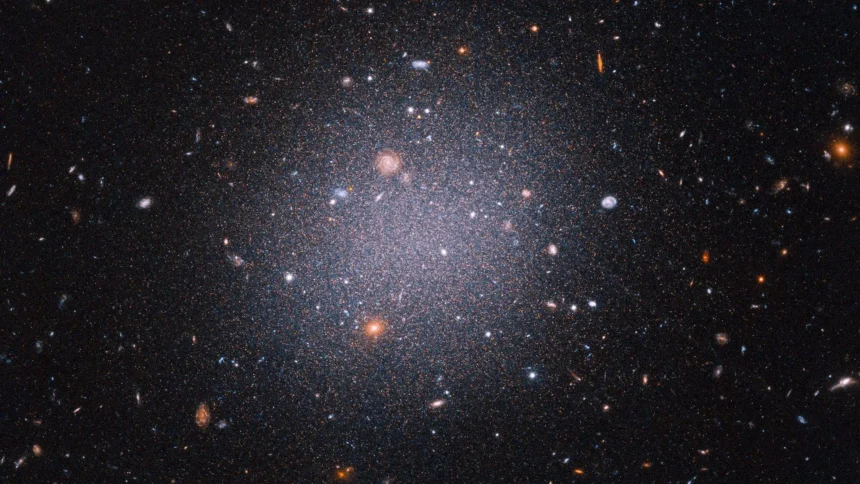
The object is known as Candidate Dark Galaxy-2, or CDG-2. It sits in the Perseus Cluster, one of the richest nearby galaxy clusters, and appears to contain only a tiny amount of ordinary starlight compared with the amount of dark matter thought to hold it together. Unlike the Milky Way, which shines through hundreds of billions of stars, CDG-2 is so faint that astronomers had to find it indirectly.
That is what makes this dark galaxy story so unusual. Scientists did not first see a bright galaxy and then measure its hidden mass. Instead, they noticed four globular clusters grouped together in Hubble Space Telescope data. Those clusters acted like cosmic signposts. Follow-up observations from Hubble, ESA’s Euclid space telescope and the Subaru Telescope in Hawaii then revealed an extremely faint glow around them, strong evidence that the clusters belong to a hidden galaxy.
The discovery matters because galaxies like CDG-2 test one of astronomy’s biggest ideas: that dark matter acts as the invisible framework on which galaxies form. Most galaxies contain stars, gas, dust and dark matter. CDG-2 appears to sit near the extreme end of that scale, with a dark matter halo and only a small visible remnant.
For readers following major astronomy discoveries, The News Ink’s report on the Milky Way center map explains how modern telescopes reveal hidden structures that ordinary visible-light images cannot show.
What is a dark galaxy?
A dark galaxy is a galaxy that contains very little visible light compared with its total mass. It is not completely black, and it is not made only of dark matter. The term usually describes a faint, low-surface-brightness system where stars are sparse and dark matter appears to dominate the gravitational structure.
Dark matter itself does not absorb, reflect or emit light. Scientists infer its presence through gravity: the way galaxies rotate, how clusters hold together, and how mass bends light from more distant objects. Because dark matter cannot be seen directly, galaxies with very few stars are valuable laboratories. They remove much of the bright clutter and make the hidden gravitational structure more important.
CDG-2 is not being described as a fully confirmed “invisible galaxy” in the simple sense. The careful wording is that it is a candidate or almost-dark galaxy with exceptionally strong evidence of being real. The published research calls it Candidate Dark Galaxy-2 and says it may be one of the most dark-matter-dominated galaxies ever discovered.
That careful wording matters. Science moves by evidence, not headlines. CDG-2 is exciting because the evidence is strong, but future observations will still be needed to refine its mass, structure and history.
How astronomers found CDG-2
Astronomers found this dark galaxy by looking for globular clusters.
Globular clusters are dense, spherical groups of old stars. They can contain tens of thousands or even millions of stars packed tightly together. In normal galaxies, globular clusters orbit within the wider gravitational field of the galaxy. The Milky Way has more than 150 known globular clusters.
CDG-2 appears to have only four visible globular clusters, but those four were enough to raise suspicion. David Li of the University of Toronto and colleagues used advanced statistical methods to search Hubble images of the Perseus Cluster for unusual groupings of globular clusters. They found a tight grouping that did not look like a random arrangement.
At first, the question was simple: were these four clusters just coincidentally close together, or were they tracing something hidden?
Follow-up work with Hubble, Euclid and Subaru found a faint, diffuse glow around the clusters. That glow is the key. It suggests the clusters are not floating alone. They are likely embedded in a very faint galaxy.
This makes CDG-2 especially important because researchers say it is the first galaxy detected purely through its globular cluster population.
Key facts about CDG-2
| Feature | What scientists found | Why it matters |
|---|---|---|
| Object name | Candidate Dark Galaxy-2, or CDG-2 | A possible almost-dark galaxy |
| Location | Perseus Cluster | About 300 million light-years away |
| Main clue | Four globular clusters | They revealed the hidden system |
| Telescopes used | Hubble, Euclid and Subaru | Space and ground data confirmed the faint glow |
| Visible light | Extremely faint | One of the faintest galaxies with associated globular clusters |
| Dark matter estimate | Possibly more than 99% of total mass | Would make it among the most dark-matter-dominated galaxies known |
| Published study | The Astrophysical Journal Letters | Peer-reviewed science paper |
| Main importance | New way to find hidden galaxies | Globular clusters can expose nearly invisible systems |
Why Hubble was essential
The Hubble Space Telescope was crucial because it can separate tiny points of light with extraordinary sharpness. In crowded galaxy clusters, that matters. A faint galaxy like CDG-2 can disappear into background noise if the telescope cannot distinguish small objects clearly.
Hubble’s Advanced Camera for Surveys captured the images that allowed astronomers to identify the four globular clusters. Those clusters were the first clue. Without Hubble’s resolution, the object might have remained hidden.
But Hubble was not working alone. Euclid added wide-field imaging and confirmed the extremely faint diffuse light around the clusters. Subaru contributed ground-based data that helped strengthen the interpretation. This combination is important because each telescope sees the universe in a different way. Hubble gives sharp detail. Euclid gives a wide and sensitive view. Subaru adds deep observational support from Earth.
The discovery is therefore not simply a “Hubble found it” story. It is a Hubble-led, multi-telescope discovery that shows how modern astronomy works.
The News Ink’s cloud computing guide connects naturally here because projects like this depend on processing, comparing and storing enormous astronomical datasets.
Why CDG-2 is so faint
The best explanation is that CDG-2 once had more normal matter but lost much of the gas needed to form stars.
Galaxies need gas, especially hydrogen, to keep making new stars. If that gas is stripped away early, star formation slows or stops. In a crowded environment like the Perseus Cluster, galaxies can lose gas through gravitational encounters, tidal forces or interactions with the hot cluster environment.
CDG-2 may therefore be the skeleton of a galaxy that never grew normally. It appears to have kept a dark matter halo and a few old star clusters, but it lost or failed to keep enough gas to build a bright stellar body.
That is why the object is so useful. It may show what happens when galaxy formation is interrupted. Instead of a rich galaxy full of stars, dust and gas, CDG-2 may be a stripped-down remnant: a dark matter structure with only a faint trace of visible matter.
This is not proof of one exact formation story. It is the leading interpretation based on the current evidence.
How dark matter dominates the system
The research team’s analysis suggests CDG-2 could be extremely dominated by dark matter. The paper estimates that, if standard relationships between globular clusters and dark matter halos apply, the system may have a minimum dark matter halo mass fraction of 99.94% to 99.98%. Under another assumption, the fraction could be even higher.
That number should be handled carefully. It depends on whether the usual relationship between globular cluster populations and halo mass works for such an extreme object. If CDG-2 formed in an unusual way, the relationship may need adjustment.
Still, the result is striking. Most galaxies have dark matter halos, but they also have far more stars than CDG-2 appears to contain. In CDG-2, the visible part is so small that the dark matter may dominate almost everything.
That is why astronomers describe it as potentially one of the most dark-matter-dominated galaxies ever discovered.
The visible light is tiny
The galaxy is faint enough that the numbers can sound almost unreal.
The ESA/Hubble release says CDG-2 shines with the light of roughly one million Suns. The scientific paper gives a preliminary V-band luminosity estimate of about 6.2 million solar luminosities under conservative assumptions, with the four globular clusters contributing at least about 16.6% of the visible light.
Either way, CDG-2 is extraordinarily dim for a galaxy.
The Milky Way is tens of billions of times brighter than the Sun. CDG-2 is tiny by comparison. That contrast explains why scientists needed a clever method to find it. If astronomers only searched for normal-looking galaxies, CDG-2 could have been missed.
This dark galaxy candidate shows that the universe may contain more faint systems than traditional surveys can easily detect.
Why globular clusters are powerful clues
Globular clusters are useful because they can survive where ordinary diffuse starlight becomes hard to see.
A faint galaxy may lose gas, stop forming stars or have its outer stars stripped away. But dense globular clusters are more tightly bound by gravity. They can remain visible as compact points of light even when the galaxy around them is extremely faint.
That makes them ideal markers of hidden galaxies. If several globular clusters appear close together and share a likely physical connection, they may reveal an underlying dark matter halo.
CDG-2 proves the value of this approach. Astronomers did not begin with a visible galaxy and then find its clusters. They began with the clusters and then found the galaxy.
That is why the discovery could change how astronomers search for other dark galaxy candidates.
Why the Perseus Cluster matters
The Perseus Cluster is a massive collection of galaxies about 300 million light-years away. Galaxy clusters are crowded environments where gravity, hot gas and close encounters can transform smaller galaxies over billions of years.
That environment matters for CDG-2. A small galaxy inside a rich cluster is vulnerable. Larger galaxies and the cluster’s gravitational field can strip material away. Hot gas in the cluster can remove cold gas from smaller galaxies. Repeated interactions can reshape or weaken small systems.
This makes the Perseus Cluster a good place to search for unusual faint galaxies. Some may be remnants. Some may be ultra-diffuse galaxies. Some may be almost-dark systems like CDG-2.
The discovery suggests that galaxy clusters may hide many more faint objects than astronomers currently know.
Why this challenges galaxy formation theories
In standard models, dark matter halos help gather gas. That gas cools, collapses and forms stars. Over time, the result becomes a visible galaxy.
CDG-2 complicates that picture because it appears to have a dark matter halo but very little visible stellar material. That raises several questions.
Did CDG-2 form stars normally at first and then lose most of its gas? Did it form only a few stars before its growth was interrupted? Did cluster interactions strip away its visible material? Did it once look brighter and then fade? Did globular clusters form early and survive after the rest of the galaxy failed to grow?
These questions matter because dark matter is supposed to be the scaffolding of galaxy formation. CDG-2 may show what happens when the scaffolding remains but the building never fully appears.
The News Ink’s quantum computing explainer is relevant because future breakthroughs in physics and computation may help scientists model complex dark matter structures more accurately.
What CDG-2 is not
It is important to avoid overclaiming.
CDG-2 is not a discovery of what dark matter is made of. Scientists still do not know whether dark matter is a particle, a family of particles, or something that requires new physics.
CDG-2 is also not a galaxy made of pure dark matter. It has visible globular clusters and faint diffuse light. That visible matter is small, but it is not zero.
The discovery is also not direct proof that every missing faint object in a galaxy cluster is a dark galaxy. Some apparent groupings can be coincidences. Some may be stripped star clusters. Some may be pieces of larger systems. That is why confirmation with multiple telescopes matters.
The safest and strongest wording is this: CDG-2 is an almost-dark galaxy candidate with strong evidence of a real, extremely faint galaxy dominated by dark matter.
Why this discovery is exciting for dark matter research
Dark matter is difficult to study because it does not interact with light in the normal way. Scientists usually infer it through gravity. That means the best dark matter laboratories are places where gravity and visible matter appear out of balance.
CDG-2 may be one of those laboratories.
If a galaxy contains very few stars but still holds together as a system, something must be providing the gravity. Dark matter is the leading explanation. By studying CDG-2 and objects like it, astronomers can test whether dark matter behaves the way galaxy-formation models predict.
Such objects may also help explain why some small galaxies form efficiently while others remain faint. That question is central to understanding how structure emerged after the Big Bang.
The News Ink’s AI trends in 2026 is useful background because astronomy increasingly uses advanced statistical tools and machine learning-style methods to find objects that are too faint for traditional searches.
A new method for finding hidden galaxies
The most important long-term result may be the detection method.
Searching for globular cluster overdensities gives astronomers a way to find galaxies that have almost no diffuse light. Instead of asking, “Where is the galaxy?” researchers can ask, “Where are clusters grouped in a way that suggests an unseen galaxy?”
This could reveal many more hidden systems in rich clusters. Some may be low-surface-brightness galaxies. Some may be ultra-diffuse galaxies. Some may be dark galaxy candidates. Together, they could reshape estimates of how many small galaxies exist in the universe.
That matters because missing faint galaxies have been a long-running issue in cosmology. Simulations often predict more small dark matter halos than astronomers observe as visible galaxies. If many halos host extremely faint objects, discoveries like CDG-2 could help close part of that gap.
What scientists need to confirm next
Future research will need to refine the mass of CDG-2 and understand whether the four globular clusters truly represent the entire cluster population.
Spectroscopic observations could help measure the motion of the clusters. If the clusters move as if they are bound inside a larger mass, that would strengthen the dark matter case. Deeper imaging could reveal more faint stars or additional clusters. Future space telescopes may also help separate CDG-2’s light from background galaxies and cluster glow.
The James Webb Space Telescope could help examine faint stellar populations in infrared light, although measuring dark matter directly still requires gravitational and dynamical evidence. Euclid may also find more objects like CDG-2 as it surveys large areas of sky.
The next step is not only to confirm one galaxy. It is to find a population. One strange object is interesting. Many similar objects would change the field.
Why the discovery matters to ordinary readers
A discovery like CDG-2 matters because it reminds us that most of the universe is not obvious.
Stars, planets, nebulae and bright galaxies dominate space images, but dark matter makes up much of the mass that shapes cosmic structure. We live in a universe where the visible part is only part of the story.
CDG-2 turns that idea into a concrete object. It is not just a theory on a blackboard. It is a faint system in the Perseus Cluster, revealed by four old star clusters and a barely visible glow.
That makes the universe feel stranger but also more understandable. Scientists are building better tools to find what used to be invisible.
The final judgment
This dark galaxy discovery is important because CDG-2 may be one of the clearest examples yet of a galaxy dominated almost entirely by dark matter.
Using Hubble, Euclid and Subaru, astronomers found strong evidence that four globular clusters in the Perseus Cluster belong to a faint underlying galaxy. The object is so dim that it had to be detected through its cluster population rather than normal galaxy light. Preliminary analysis suggests it may be more than 99% dark matter by mass, making it one of the most extreme galaxy candidates known.
The discovery should be described carefully. CDG-2 is not a fully dark object, and it does not solve the mystery of what dark matter is. But it does open a new way to search for hidden galaxies and test how galaxies form when star-making gas is stripped away or never fully retained.
The most exciting part is not only that astronomers found CDG-2. It is that they may now know how to find more objects like it.
A galaxy can be almost invisible and still matter. CDG-2 proves that some of the universe’s most important structures may be hiding in plain sight, waiting for the right method to reveal them.
For more science and technology analysis from The News Ink, follow The News Ink on X.