Iran Preparing for a US Strike: How Alarming Warning Signs Became a 2026 Reality
Iran preparing for a US strike was once a warning visible in satellite images. It is now part of a much larger and more dangerous story. In February 2026, imagery reviewed by analysts showed Iran burying tunnel entrances, strengthening underground access points and repairing missile-related infrastructure after earlier attacks. Days later, the United States and Israel launched a new military campaign against Iran on 28 February, turning a potential scenario into an active conflict.
The most important question is no longer whether Iran was taking precautions. The evidence shows that it was. The more difficult question is what those preparations achieved, what remains hidden underground and how much can be verified while inspectors lack access to several sensitive sites.
A Reuters satellite-imagery investigation published on 18 February documented changes at the Parchin military complex, the Isfahan nuclear complex, a deeply buried site near Natanz and missile bases at Shiraz and Qom. The findings did not prove that every location had the same purpose. However, they showed a consistent pattern: Iran was trying to make strategic infrastructure harder to reach, harder to assess and potentially harder to disable.
That pattern matters because Iran preparing for a US strike was not limited to one bunker or one nuclear facility. It involved a wider effort to reduce vulnerability across military and nuclear-linked sites at a time when negotiations with Washington were under severe pressure.
Why Iran Preparing for a US Strike Became an Actual US-Israeli Campaign
The original interpretation of Iran preparing for a US strike must now be read in hindsight. Reuters reported that the United States and Israel launched strikes against Iran on 28 February 2026, beginning a conflict that continued to produce military exchanges and regional instability months later. By 6 June, Reuters reported fresh US strikes on Iranian coastal radar sites after Iranian drones were intercepted near the Strait of Hormuz, alongside Iranian claims of retaliatory attacks on US-linked targets in the Gulf.
This shift changes the article from a speculative preview into an updated analysis. Iran preparing for a US strike was no longer a hypothetical interpretation after the campaign began. Before the February attacks, satellite imagery offered clues about what Tehran feared. After the attacks, the same images became evidence of how Iran tried to prepare for a confrontation it considered possible.
| Date | Confirmed development | Why it matters |
|---|---|---|
| June 2025 | US and Israeli strikes damaged major Iranian nuclear sites during an earlier conflict | Iran began assessing damage and protecting remaining infrastructure |
| Late 2025 to February 2026 | Satellite images showed repairs, buried tunnel entrances and stronger defensive work | The images supported the view that Iran preparing for a US strike had become a practical planning priority |
| 27 February 2026 | The IAEA issued a safeguards report describing limited access and unresolved questions over enriched uranium | International inspectors still could not verify the status of key material |
| 28 February 2026 | The United States and Israel launched a new campaign against Iran | The potential-strike scenario became an active war |
| 4 June 2026 | Reuters reported that the IAEA’s latest assessment still contained no major change in its central concerns | The fate of enriched uranium and the lack of access remained unresolved |
| 6 June 2026 | Reuters reported another exchange involving Iranian drones and US strikes on coastal radar sites | The conflict remained volatile despite negotiations |
The physical preparations did not guarantee protection. Nor did they prove that every underground site contained nuclear material. Their significance lies in the defensive logic behind them. Iran preparing for a US strike meant creating obstacles, buying time and complicating the ability of an attacker to know whether a target had been destroyed or merely made inaccessible.
Why Iran Preparing for a US Strike Was Most Visible at Isfahan
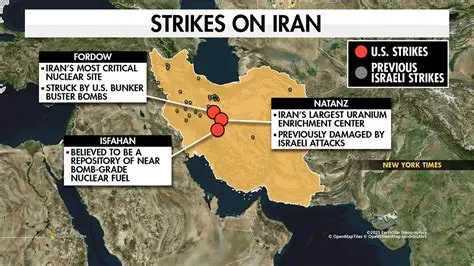
The Isfahan nuclear complex is central to understanding Iran preparing for a US strike. Reuters reported that satellite images showed all three entrances to an underground tunnel complex had been buried by February 2026. Analysts assessed that backfilling the entrances with soil could reduce the effects of an airstrike and make a ground operation more difficult.
The IAEA safeguards report dated 27 February 2026 adds an important layer of caution. The agency said it had observed regular vehicle activity around the entrance to the Isfahan tunnel complex through commercially available satellite imagery. It also said uranium hexafluoride enriched up to 20% and 60% U-235 for four declared facilities had been stored in parts of that underground complex. The IAEA requested access for inventory verification and design-information checks.
That does not mean the agency confirmed that all previously declared material remained in exactly the same place. In fact, the IAEA said it could not provide current information on the size, composition or whereabouts of Iran’s enriched-uranium stockpile because it lacked access to the declared enrichment facilities.
This distinction is critical. Iran preparing for a US strike involved making access more difficult, but difficult access also creates a verification problem. Satellite images can show vehicle movements, soil, concrete and blocked entrances. They cannot independently establish what is inside a tunnel, whether material has moved or whether enrichment-related equipment remains operational.
The uncertainty has strategic consequences. Iran preparing for a US strike created barriers for attackers, but it also made independent verification harder. If an underground complex is sealed, an attacker may find it harder to reach. At the same time, inspectors may also find it harder to determine whether sensitive material remains secure and accounted for.
Iran Preparing for a US Strike Raised New Questions at Natanz
Iran preparing for a US strike was also visible near Natanz, one of the best-known locations associated with Iran’s uranium-enrichment programme. Reuters reported work to harden two entrances to a tunnel complex beneath a nearby mountain roughly 2 kilometres from Natanz. The site is often referred to as Pickaxe Mountain.
The Center for Strategic and International Studies previously analysed construction at Pickaxe Mountain and noted that work on the deeply buried complex began after a 2020 fire at a Natanz centrifuge-assembly hall. CSIS said imagery showed tunnel portals, a security wall and continued construction. It also stressed that imagery alone could not definitively establish the site’s full purpose.
That caution remains necessary. The existence of a deeply buried facility near Natanz is important, but it should not be described as proof of a specific nuclear-weapons activity. Publicly available evidence supports a narrower conclusion: the site has a declared connection to Iran’s centrifuge-related programme, construction has continued and its depth makes it strategically significant.
An Institute for Science and International Security assessment published in November 2025 said the Pickaxe Mountain complex could become relevant to any attempt to rebuild centrifuge-related capabilities. It also noted the existence of a nearby older tunnel complex dating to 2007. The Institute argued that the area warranted close scrutiny, particularly because underground construction can serve several purposes and because inspectors need access to make stronger conclusions.
The Natanz story illustrates the limits of remote analysis. Iran preparing for a US strike is a defensible conclusion when visible hardening work is considered, but the limits of imagery must remain clear. Iran preparing for a US strike can be inferred from visible strengthening work. The exact function of every underground hall cannot.
Iran Preparing for a US Strike Also Changed Parchin
The Parchin military complex, around 30 kilometres southeast of Tehran, is another important part of the story. Reuters reported that satellite images showed a new facility at the site covered by a concrete shield and soil. The Institute for Science and International Security identified the location as Taleghan 2 and described the protective structure as a type of concrete enclosure.
Western intelligence has previously linked Parchin to tests potentially relevant to nuclear-weapon development. Iran has denied seeking an atomic weapon. Those two statements must remain separate. It is not accurate to state as a confirmed fact that the newly covered facility is part of an active weapons programme.
Analysts said imagery appeared to show a large cylindrical chamber inside the rebuilt structure. Such a chamber could be relevant to high-explosive testing, but it can also have conventional military uses. That is why Iran preparing for a US strike should not be presented as proof of weaponisation. It is evidence of defensive construction at a sensitive military site whose purpose remains contested.
Reporting on Iran preparing for a US strike creates a recurring challenge in nuclear-related security coverage. A satellite image can reveal changes in shape, access and construction pace. It cannot always reveal intent. Credible reporting must explain what analysts observed without turning an assessment into a certainty.
Iran Preparing for a US Strike Extended Beyond Nuclear Sites
The evidence of Iran preparing for a US strike extended beyond nuclear-linked infrastructure. Reuters reported repair and clearance work at the Shiraz South missile base and roof repairs at a missile base north of Qom. These locations matter because Iran’s ability to respond to an attack depends not only on protecting nuclear-related facilities but also on preserving military capacity.
At Shiraz South, satellite comparisons showed reconstruction and clearance work after earlier damage. The site had not necessarily returned to full operational capacity. At Qom, imagery showed a new roof over a previously damaged building. These details are modest compared with dramatic claims about underground bunkers, but they are strategically important.
Repairs to logistics buildings, command compounds and missile-related infrastructure can help a state restore resilience after an attack. Iran preparing for a US strike therefore involved both hardening sensitive underground spaces and repairing above-ground support systems.
The wider conflict has also shown why missile capacity matters. In its 6 June report, Reuters said US President Donald Trump estimated that Iran retained roughly 21% to 22% of its missiles, while Iranian forces continued to launch drones and missiles during periodic escalations. That estimate is a political claim from the US president rather than an independently verified inventory. It should be presented as such.
The IAEA Access Problem Is Now Central
The most serious issue is not simply the existence of fortifications. It is the loss of verifiable knowledge.
The IAEA’s February report estimated that, as of 13 June 2025, Iran’s total enriched-uranium stockpile was 9,874.9 kilograms. That included 440.9 kilograms of uranium enriched up to 60% U-235. The agency stated that it could not provide current information on the stockpile’s size, composition or whereabouts because it had not been able to access the declared enrichment facilities for verification.
On 4 June 2026, Reuters reported that the IAEA’s first assessment since the latest war began contained no major change in this central concern. The agency continued to call for Iran to explain the fate of previously declared low- and highly enriched uranium. It also warned that the prolonged lack of access had caused a loss of what safeguards specialists call continuity of knowledge.
| Verification issue | What is known | What remains unresolved |
| Isfahan tunnels | The IAEA observed vehicle activity and requested verification access | The present location and condition of stored material cannot be confirmed remotely |
| Enriched uranium | The IAEA estimated 440.9 kg enriched up to 60% U-235 as of 13 June 2025 | The current size, composition and whereabouts of the stockpile are not verified |
| Natanz and Fordow | The IAEA observed activity at affected facilities through satellite imagery | The agency could not confirm the nature or purpose of the activity without access |
| Pickaxe Mountain | Construction and defensive work are visible | Public imagery cannot establish the site’s complete purpose |
| Parchin / Taleghan 2 | A rebuilt structure appears to have been covered and protected | The precise current use of the facility remains uncertain |
Iran has maintained that its nuclear programme is peaceful. The IAEA’s role is not to rely on competing political claims but to verify nuclear material and declared activities through safeguards. When inspections are blocked or delayed, uncertainty grows. Iran preparing for a US strike may help explain why facilities were fortified, but it does not remove the need for verification.
What the Fortifications Can and Cannot Achieve
Iran preparing for a US strike does not mean Iran found a perfect defensive solution. Underground facilities and buried entrances can create serious obstacles, but they also have limitations.
Fortification can:
- absorb or reduce some blast effects;
- slow access to a tunnel complex;
- conceal the condition of infrastructure;
- complicate damage assessment;
- make a ground operation more difficult;
- force an attacker to use additional strikes or specialised capabilities.
Fortification cannot automatically:
- guarantee that underground equipment survives;
- prove that a facility remains operational;
- prevent every form of surveillance;
- replace damaged above-ground utilities;
- account for enriched uranium;
- resolve the diplomatic crisis.
The military value of a buried site depends on details that may remain unknown outside classified assessments: tunnel depth, geology, ventilation, power supply, access routes, internal layout and the type of weapon used against it.
That is why the public debate should avoid two extremes. It is too simplistic to claim that every fortified site is invulnerable. It is also too simplistic to assume that a strike permanently eliminates every capability inside a complex underground network.
Why the Strait of Hormuz and Regional Escalation Matter
Iran preparing for a US strike was never only about protecting fixed sites. Iran’s broader strategy also involves its ability to impose costs across the region. By June 2026, the conflict had affected Gulf security, maritime traffic and energy markets.
Reuters reported on 6 June that Iran had effectively blocked the Strait of Hormuz, where about one-fifth of the world’s oil transited before the war. The same report described stalled indirect negotiations and renewed military exchanges. This means the nuclear dispute cannot be separated from shipping, oil prices, sanctions, regional bases and the conflict involving Hezbollah in Lebanon.
For readers following the economic consequences, The News Ink’s economy explainer provides useful context on how energy disruptions can contribute to inflation and wider pressure on households. The military confrontation also has a digital dimension: the site’s analysis of the hidden digital battlefield explains why modern conflicts are not limited to visible airstrikes.
Iran preparing for a US strike therefore needs to be understood as part of a wider resilience strategy. Physical bunkers are one layer. Missile forces, maritime pressure, regional alliances and cyber capabilities can all shape the costs of escalation.
Diplomacy Still Depends on Verifiable Answers
The existence of fortifications does not make diplomacy irrelevant. It makes verification more important.
Any durable agreement would need to address practical questions. Where is the previously declared enriched uranium? Can inspectors regain access to affected facilities? What is the status of the Isfahan tunnel complex? What work is continuing near Natanz? Which facilities remain damaged, and which have been repaired or repurposed?
The IAEA monitoring page remains the most important official source for safeguards updates. Political leaders may disagree over the meaning of the conflict, but the agency’s access problem is measurable: inspectors cannot provide assurances where they cannot inspect.
Iran preparing for a US strike showed that Tehran expected military pressure and invested in delay, concealment and resilience. The February 2026 attacks showed that those fears were not theoretical. The months that followed showed something else: airstrikes can damage infrastructure, but they do not automatically answer the nuclear questions at the centre of the crisis.
What Comes Next
The most responsible conclusion is also the least dramatic. Iran preparing for a US strike was visible in satellite imagery before the latest war. The defensive work at Isfahan, Natanz, Parchin, Shiraz and Qom revealed an effort to protect sensitive infrastructure and restore military capacity. Some of those preparations may have made targeting more difficult. Some may have complicated inspection and damage assessment. None provides a complete public picture of what remains underground.
The next phase depends on access, evidence and diplomacy. Without renewed safeguards verification, claims from every side will remain difficult to test. With military exchanges still occurring, the risk is that uncertainty itself becomes a driver of further escalation.
For continuing coverage of security, technology and global affairs, readers can follow The News Ink on X.
D. Rank Math Checklist
| Requirement | Where it is addressed |
| Focus keyword in SEO title | Included at the beginning: “Iran Preparing for a US Strike” |
| Focus keyword in meta description | Included in the opening phrase |
| Focus keyword in URL | Closely aligned with the existing slug |
| Slug unchanged | Existing permalink preserved exactly |
| Focus keyword near the beginning | Included in the first sentence |
| Focus keyword throughout content | Used naturally across the opening, body and closing |
| Exact keyword density | 28 placements across approximately 2,742 words: about 1.02% |
| Focus keyword in subheadings | Included in several H2 headings |
| Image alt text contains keyword | Included naturally |
| Power word in title | “Alarming” |
| Sentiment in title | “Alarming warning signs” |
| Number in title | 2026 |
| External links included | Reuters, IAEA, CSIS and Institute for Science and International Security |
| DoFollow external links | Use standard WordPress links without special attributes |
| Internal links included | Economy explainer and Iran cyber-warfare article |
| Social link rotated | X profile used near the conclusion |
| Focus keyword not bolded | Confirmed |
| Style variation | Updated retrospective and evidence-based analysis rather than a breaking-news preview |
E. Editorial Research Note
The original article used a future-tense angle, suggesting that Iran might be preparing for a possible attack. That framing became outdated after the United States and Israel launched a new campaign against Iran on 28 February 2026. The rewritten version preserves the existing slug but changes the article into a retrospective analysis.
The main factual foundation came from the following sources:
- The Reuters satellite-imagery investigation documented construction and fortification activity at Parchin, Isfahan, Natanz, Shiraz South and Qom.
- The official IAEA safeguards report provided the verified uranium-stockpile figures and explained the agency’s inability to confirm the current size, composition or whereabouts of the stockpile without access.
- The CSIS satellite-imagery analysis added context on Pickaxe Mountain and clearly stated the limits of conclusions drawn from imagery alone.
- The Institute for Science and International Security assessment provided additional background on the underground Natanz-area complexes and possible reconstitution risks.
- The 4 June Reuters report confirmed that the IAEA’s central concerns remained unresolved after the latest fighting.
- The 6 June Reuters update confirmed that military exchanges and indirect negotiations were continuing.
The rewrite avoids claiming that every fortified facility has a confirmed weapons-related purpose. It also avoids presenting satellite imagery as proof of what is stored inside underground tunnels. The article separates verified IAEA findings, analyst assessments, political claims and unresolved questions.