German Paralympians Protest Exposes Sport’s Russia Dilemma
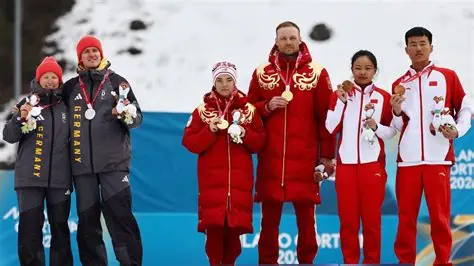
The German Paralympians protest lasted only as long as the Russian anthem, but it captured the central political conflict of the Milano Cortina Winter Games. Linn Kazmaier and her guide Florian Baumann stood on the medal podium after winning silver, kept their hats on and turned away from the Russian flag as gold medallists Anastasiia Bagiian and guide Sergei Siniakin were honoured.
Their action was silent, deliberate and immediately recognisable. Kazmaier and Baumann said the German Paralympians protest was intended as solidarity with Ukraine and opposition to the International Paralympic Committee’s decision to restore Russian national symbols. They emphasised that their objection was not directed personally at Bagiian or Siniakin.
The IPC said it was gathering information and reviewing what happened. The protest raised the possibility of disciplinary action because medal ceremonies are treated as restricted spaces under Paralympic rules. Publicly available reporting reviewed for this article did not show a final sanction against the German pair.
The Podium Moment
Bagiian and Siniakin won the women’s sprint classic vision-impaired event. Kazmaier and Baumann took silver, placing them together on the podium for one of the Games’ most politically sensitive ceremonies.
When the Russian anthem began, the Germans did not face the flag. They turned their backs and declined the customary medallists’ selfie.
Kazmaier later said the ceremony had felt strange because it was overshadowed by politics. She explained that she could not support the flag or the system it represented while the war in Ukraine continued.
Baumann made a similar distinction. He said the German Paralympians protest was not an attack on the Russian athletes, who also operated within decisions made by sporting and political authorities. His objection was that Russia had been restored under its flag while Ukrainian athletes were competing during an ongoing invasion.
What Happened in the Race
| Medal | Athlete and guide | Nation | Ceremony response |
|---|---|---|---|
| Gold | Anastasiia Bagiian and Sergei Siniakin | Russia | Russian flag and anthem used |
| Silver | Linn Kazmaier and Florian Baumann | Germany | Turned away and kept hats on |
| Bronze | Other medallists in the event | — | No comparable action reported |
The German Paralympians protest did not challenge the race result. Kazmaier and Baumann accepted their silver medals and did not accuse the Russian winners of cheating.
Their objection concerned representation. Russia’s anthem and flag transformed Bagiian’s victory from an individual sporting achievement into an official national moment.
That distinction explains why the protest occurred during the anthem rather than the competition.
Why Russia Was Competing Under Its Flag
Russia’s Paralympic status had changed repeatedly over more than a decade.
Russian athletes faced restrictions following revelations of state-sponsored doping. After the full-scale invasion of Ukraine in 2022, additional sanctions excluded or neutralised athletes across major international competitions.
The IPC’s General Assembly later restored the full membership rights of the Russian and Belarusian Paralympic committees. That decision allowed qualifying athletes to return under national names, flags and anthems rather than as neutrals.
Six Russian athletes and four Belarusian athletes competed at Milano Cortina under those restored arrangements.
The German Paralympians protest challenged the principle behind that restoration. Kazmaier and Baumann believed that allowing national symbols while the war continued suggested a return to normality that had not been earned.
Why National Symbols Changed the Meaning
An athlete competing neutrally can still produce political controversy, but the ceremony focuses more heavily on the individual.
A national flag and anthem carry a different message. They connect the medal to the state, its institutions and its public image.
Supporters of the IPC’s decision argued that Paralympians should not be permanently punished for government actions and that membership rights had been restored through the organisation’s constitutional process.
Opponents argued that national symbols allow Russia to present sporting success as evidence of international acceptance.
The German Paralympians protest occurred at the exact point where those positions collided. Bagiian had earned the fastest time. Kazmaier and Baumann believed honouring Russia as a state was morally different from recognising her athletic achievement.
The Opening Ceremony Boycott
The podium action did not emerge in isolation.
Teams and representatives from several European countries boycotted or limited their involvement in the opening ceremony in Verona. Reuters identified Ukraine, the Czech Republic, Estonia, Finland, Latvia, Lithuania, Poland and the Netherlands among the delegations protesting the return of Russian and Belarusian symbols.
Those actions established the Games as politically contested before the first major medal ceremonies.
The German Paralympians protest brought the argument directly onto the podium, where the contrast between flags, anthems and athletes could not be separated from the competition.
Other ceremonies involving Russian winners also attracted scrutiny, although not every medallist protested. The different responses showed that athletes were making personal decisions under intense pressure rather than following one coordinated rule.
What the IPC Rules Say
The IPC restricts demonstrations in designated ceremonial areas, including medal podiums. The organisation argues that competitions and award ceremonies should remain focused on athletes and free from political confrontation.
At the same time, Paralympians retain rights of expression. The difficult question is where and when that expression may occur.
A protest in an interview zone may be permitted. A protest during an anthem may be reviewed more strictly because the ceremony is formally controlled by the organising body.
The German Paralympians protest was non-violent and did not disrupt the presentation of medals. Yet it was unmistakably political.
The IPC’s case-by-case approach gives the organisation flexibility, but it can also create uncertainty. Athletes may not know whether a silent gesture will result in a warning, fine or stronger punishment.
Neutrality Is Not the Absence of Politics
Sporting bodies often describe themselves as politically neutral. The phrase can be misleading.
Choosing to ban a nation is political. Choosing to restore it is also political. Allowing a flag sends a message, just as removing one does.
The German Paralympians protest exposed this reality. Kazmaier and Baumann did not introduce politics into an otherwise neutral ceremony. The political argument already existed in the decision to play the Russian anthem.
The IPC had to balance several principles:
- protecting athletes from collective punishment;
- respecting the rights of member committees;
- responding to war and international law;
- maintaining consistency with previous sanctions;
- protecting Ukrainian athletes;
- preserving the ceremonial traditions of the Games.
No choice could make those questions disappear.
The Athletes Were Put in an Impossible Position
Bagiian and Siniakin arrived to compete in sport. Their victory was the product of training, technical skill and teamwork.
Kazmaier and Baumann also arrived to compete. They then had to decide whether standing normally during the Russian anthem would conflict with their values and solidarity with Ukrainian athletes.
The German Paralympians protest placed both pairs in an uncomfortable image. The Russians stood facing their national flag while the Germans turned away.
That picture could easily be misread as personal hostility. Baumann specifically rejected that interpretation.
His distinction matters because individual Russian athletes may have limited power over state policy. Yet they still benefit from the return of national representation.
The dispute was not about whether Bagiian deserved gold. It was about what the flag above her medal was allowed to represent.
Solidarity With Ukraine
Ukraine’s Paralympians were competing while their country remained under attack. Some athletes had experienced displacement, damaged training facilities or the loss of people close to them.
The News Ink’s report on a Ukrainian biathlete’s silver medal showed the sporting achievement produced by Ukraine’s Para team under extraordinary conditions.
For Kazmaier and Baumann, solidarity could not be limited to private sympathy. The German Paralympians protest made their position public at the most visible moment available to them.
Critics could argue that the medal ceremony belonged to the winners and should not have been used for protest. Supporters responded that silence would also have communicated acceptance.
This tension is why podium gestures have carried such power throughout sporting history.
Protest Traditions in International Sport
Athletes have used medal ceremonies to address racial injustice, war, discrimination and government policy.
The most famous examples become celebrated later, even when sporting authorities condemned them at the time. That history does not mean every podium protest is automatically justified, but it shows why ceremonial silence can become a moral issue.
The German Paralympians protest differed from a speech or banner. It used posture: hats remained on, bodies turned away and the selfie was declined.
The gesture was simple enough to avoid interrupting the anthem but clear enough that nobody could mistake its meaning.
Its power came partly from restraint.
Could the Germans Be Punished?
The IPC confirmed that it was reviewing the incident and gathering evidence.
Possible responses could range from no action to a formal warning or disciplinary sanction. The organisation would have to consider the protest rules, proportionality and the fact that the gesture did not prevent the ceremony from continuing.
No public source reviewed for this rewrite confirmed a final punishment.
That absence should not be misrepresented as a formal clearance. It means only that a final public disciplinary outcome could not be verified.
The German Paralympians protest nevertheless achieved its immediate purpose. The restoration of Russian symbols became a major story beyond specialist Paralympic coverage.
Why the IPC’s Decision Was So Divisive
Supporters of readmission argued that sport should create opportunities for contact rather than deepen permanent exclusion.
They also noted that individual athletes cannot choose their nationality and may have already lost years of competition because of decisions outside their control.
Opponents saw the restoration as premature. Russia’s invasion had not ended, and Ukrainian athletes were still living with its consequences.
The German Paralympians protest concentrated that dispute into one question: can an organisation honour Russian national identity while claiming that the ceremony is separate from politics?
The IPC’s answer was yes. Kazmaier and Baumann visibly disagreed.
The Difference Between Doping and War Sanctions
Russia’s previous restrictions involved two distinct issues.
State-sponsored doping challenged the integrity of sporting results. War-related sanctions concerned international conduct, athlete safety and the symbolic use of sport.
Combining them can create confusion. A Russian athlete who meets anti-doping requirements may still face restrictions because of the invasion. Conversely, restoring national membership does not erase the history of doping violations.
The German Paralympians protest focused principally on the war and solidarity with Ukraine, not on an allegation that the gold medallists had violated competition rules.
That clarity strengthened the message.
The Risk of Selective Outrage
International sport applies sanctions inconsistently. Some governments involved in wars or human-rights abuses continue competing normally.
Russia’s supporters use that inconsistency to argue that its athletes have been singled out.
The criticism deserves examination, but inconsistency does not automatically make every sanction wrong. It may show that sporting bodies need clearer universal standards.
The German Paralympians protest should therefore lead to a broader debate:
- What state actions justify sporting suspension?
- How long should restrictions remain?
- Should individual athletes compete neutrally?
- When may national symbols return?
- What protections are owed to athletes from countries under attack?
- How should comparable conflicts be treated?
Without transparent answers, every future decision will appear political even when framed as neutral.
What the Protest Cost the German Pair
Kazmaier and Baumann risked shifting attention away from their silver medal.
Years of training had produced a podium finish, yet much of the discussion centred on the anthem rather than their race.
That was part of the sacrifice. The German Paralympians protest used their most valuable moment to make a statement they believed could not be postponed.
They also accepted the possibility of criticism from people who believed the podium should remain untouched by politics.
The action therefore carried personal as well as regulatory risk.
What It Meant for the Russian Winners
Bagiian and Siniakin did not choose the Germans’ response.
Their gold medal ceremony became a geopolitical image rather than an uncomplicated celebration. That may have felt unfair after an athletic victory.
The German pair’s explanation attempted to protect the distinction between person and state, but images can be harsher than words.
The incident shows why returning flags and anthems affects every athlete on a podium, not only those representing the restored nation.
The Wider Games Continued
Milano Cortina featured hundreds of athletes from dozens of countries competing across 79 medal events. The official sporting programme continued despite the political disputes.
Most competitions were decided without protest. Athletes set records, won first medals and celebrated with teammates.
The German Paralympians protest did not define every moment of the Games. It did become one of the clearest symbols of a disagreement that organisers could not contain through rules about neutrality.
What Sporting Authorities Should Learn
The IPC needs clearer communication before future competitions.
Athletes should understand:
- Why a sanctioned committee has been restored.
- Which evidence and votes determined that decision.
- Whether national symbols or neutral status will apply.
- Which forms of peaceful protest are permitted.
- What sanctions apply during medal ceremonies.
- How athletes affected by war will be supported.
Clarity will not produce agreement. It will prevent athletes from learning the practical boundaries only after a protest occurs.
The Bottom Line
The German Paralympians protest transformed a cross-country skiing medal ceremony into a defining argument about Russia’s return to international sport.
Linn Kazmaier and guide Florian Baumann turned away during the Russian anthem after finishing second behind Anastasiia Bagiian and Sergei Siniakin. They kept their hats on and declined the customary selfie.
The German Paralympians protest was aimed at the use of Russia’s flag and anthem, not personally at the gold medallists. Kazmaier and Baumann said they acted in solidarity with Ukraine and believed the IPC had restored Russian national symbols too soon.
The IPC reviewed the incident under rules restricting political demonstrations at medal ceremonies. No final public sanction was verified in the sources checked for this article.
The German Paralympians protest did not resolve the central dilemma. Russian athletes had earned the right to compete under the IPC’s restored rules. Ukrainian athletes were competing while their country remained under invasion.
Turning away could be interpreted as disrespecting a winner or refusing to normalise a state’s return. That tension is precisely why the gesture mattered.
For more Paralympic and international-sport reporting, follow The News Ink on Instagram or read our coverage of Russia’s continuing wartime impact and the 2026 Winter Games.