Six Nations 2026 Title: How France Beat England 48-46 in an Unforgettable Paris Finale
The Six Nations 2026 title was decided by the final kick of the final match. On 14 March 2026 at the Stade de France, Thomas Ramos landed a long-range penalty after the clock had turned red to give France a 48-46 victory over England and secure a second consecutive championship for Fabien Galthié’s side.
It was an extraordinary ending to an extraordinary tournament. England had scored seven tries and led 46-45 after Tommy Freeman’s late score, while Ireland had already beaten Scotland 43-21 in Dublin and were seconds away from being crowned champions. France regained possession from the restart, earned the decisive penalty and trusted Ramos from roughly 42 metres. His kick sailed between the posts, giving France the Six Nations 2026 title in the most dramatic way possible.
The victory also carried historic weight. France claimed an eighth championship since Italy joined in 2000, moving clear of England’s seven as the most successful country of the Six Nations era. It was France’s first run of back-to-back championships since 2006 and 2007, and it completed a campaign that survived a spectacular 50-40 defeat by Scotland only one week earlier.
Six Nations 2026 title decided by the last kick in Paris
The final scoreboard, France 48-46 England, tells only part of the story. The match contained 13 tries, relentless changes of momentum and enough late drama to shift the championship between France and Ireland in a matter of minutes.
France began aggressively. Louis Bielle-Biarrey scored twice inside the opening 13 minutes, first reaching a Thomas Ramos kick and then finishing after a precise Matthieu Jalibert effort. England immediately answered through Tom Roebuck and Cadan Murley, establishing the pattern for a match in which neither team could create lasting separation.
England led 27-24 at half-time. Ollie Chessum crossed twice during the match, while Alex Coles, Marcus Smith and Freeman also added tries. France answered through Bielle-Biarrey’s remarkable four-try haul, Théo Attissogbe and a penalty try.
By the closing stages, the Six Nations 2026 title was still changing hands.
Bielle-Biarrey’s fourth try put France 45-39 ahead, but Demba Bamba was shown a yellow card and England made the numerical advantage count. Freeman’s 76th-minute try, converted by Marcus Smith, put England 46-45 ahead.
At that moment, Ireland were effectively champions on the live table.
France recovered possession after the restart and built one final attack. England conceded the penalty that presented Ramos with a difficult long-range shot. The France full-back had already kicked accurately throughout the night and did not miss the attempt that mattered most.
France 48. England 46.
The tournament was over.
For France, the Six Nations 2026 title was secured. For Ireland, a championship celebration disappeared with the last kick of Super Saturday. For England, perhaps the finest performance of a desperately disappointing campaign ended in another defeat.
Readers can revisit the official France v England match report for the full championship account.
Why Ireland were so close to taking the Six Nations 2026 title
The drama in Paris was intensified by what had happened earlier in Dublin.
Ireland defeated Scotland 43-21 at the Aviva Stadium, scoring six tries and securing the Triple Crown. Andy Farrell’s side did everything required of them and temporarily moved into position to win the championship.
That result simplified France’s task: beat England and become champions. Fail to win and Ireland would finish on top.
Ireland’s victory was convincing. Jamie Osborne opened the scoring and Tommy O’Brien scored twice late in the contest as Scotland’s resistance faded. The bonus-point victory left Ireland on 19 championship points.
France eventually finished on 21.
That total deserves emphasis because some secondary summaries listed France on 20. The correct total is 21: France won four matches for 16 points and earned an attacking bonus point in every round.
Even the 50-40 defeat by Scotland produced two bonus points because France scored six tries while losing by 10.
The Six Nations 2026 title therefore came down to a two-point championship margin even though France and Ireland both won four matches and lost one.
Final 2026 Six Nations standings
| Position | Team | Won | Lost | Bonus points | Points difference | Championship points |
|---|---|---|---|---|---|---|
| 1 | France | 4 | 1 | 5 | +81 | 21 |
| 2 | Ireland | 4 | 1 | 3 | +38 | 19 |
| 3 | Scotland | 3 | 2 | 4 | -1 | 16 |
| 4 | Italy | 2 | 3 | 1 | -38 | 9 |
| 5 | England | 1 | 4 | 4 | +2 | 8 |
| 6 | Wales | 1 | 4 | 2 | -82 | 6 |
The final table captures how unusual the championship became. France were champions despite conceding 50 points in Edinburgh. Scotland won three matches but were eliminated from contention on the final afternoon. Italy recorded a historic first victory over England. Wales avoided last place by beating Italy 31-17 in Cardiff.
England, meanwhile, finished fifth despite a positive points difference. Their 48-7 opening victory over Wales was followed by four consecutive defeats.
France’s path to the Six Nations 2026 title
France did not simply survive the final match. Their championship had been built through relentless try-scoring and an extremely powerful opening three rounds.
| Round | France result | Why it mattered |
|---|---|---|
| 1 | France 36-14 Ireland | Beat their biggest eventual title rival |
| 2 | Wales 12-54 France | Eight-try attacking statement in Cardiff |
| 3 | France 33-8 Italy | Maintained perfect start and Grand Slam push |
| 4 | Scotland 50-40 France | Grand Slam ended, but two bonus points limited damage |
| 5 | France 48-46 England | Ramos penalty secured championship |
The opening 36-14 victory over Ireland became particularly valuable once the final standings were known.
France then overwhelmed Wales 54-12 and defeated Italy 33-8, building the tournament’s strongest points difference.
The setback at Murrayfield was severe.
Scotland scored seven tries in a 50-40 victory and at one stage led 47-14. France appeared to be collapsing just when the Grand Slam had seemed within reach.
Yet the closing stages changed the mathematical impact of the defeat.
France continued attacking and scored enough tries to leave Edinburgh with two bonus points. Those points proved hugely valuable before the final weekend.
That recovery is one reason the Six Nations 2026 title cannot be understood only through Ramos’ final kick. France also won the championship by squeezing value out of their worst performance.
The News Ink covered how Scotland’s stunning win over France transformed the championship race.
Louis Bielle-Biarrey turned the finale into a record night
No individual did more to shape France’s final victory than Louis Bielle-Biarrey.
The winger scored four tries against England and finished the championship with nine tries in five matches. Guinness World Records now recognises that as the most tries by an individual in a single Five or Six Nations championship.
Bielle-Biarrey had already produced eight tries in 2025. In 2026, he went one better.
He scored in every round for a second consecutive championship and extended his scoring streak to 10 successive Six Nations matches. By the end of the England fixture, he had scored 18 Six Nations tries in only 14 appearances.
His contribution to the Six Nations 2026 title ran through the entire campaign.
He scored twice against Ireland in round one, crossed against Wales, Italy and Scotland, and then delivered four tries in the title decider.
The later recognition was equally significant. On 2 April, Bielle-Biarrey was voted the 2026 Guinness Player of the Championship, winning the award for a second consecutive year after receiving 44% of the fan vote.
The News Ink has also profiled Louis Bielle-Biarrey’s extraordinary rise.
Thomas Ramos delivered the decisive Six Nations 2026 title moment
Bielle-Biarrey supplied the tries. Thomas Ramos supplied the final act.
The France full-back had already contributed heavily before the decisive kick, converting five French tries and landing another penalty.
When England infringed late, Ramos faced the kind of moment capable of defining an international career.
The kick came from roughly 42 metres with the match clock beyond 80 minutes. There would be no meaningful opportunity to recover if he missed.
England would win.
Ireland would take the championship.
Ramos struck cleanly.
The ball sailing between the uprights produced two completely different scenes across Europe: celebration in Paris and disbelief among Irish supporters who had watched their team do everything required earlier in Dublin.
That pressure makes the penalty one of the defining moments in the history of the Six Nations 2026 title. It was not simply a match-winning kick. It directly changed the identity of the champion.
Antoine Dupont lifted the trophy in Paris
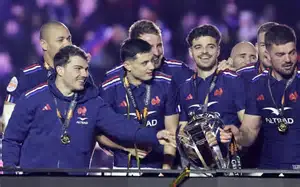
Once Ramos’ penalty had settled the match, France captain Antoine Dupont lifted the championship trophy at the Stade de France as fireworks marked the victory.
Dupont had been another essential part of the campaign. France possessed enough attacking talent to play at frightening speed, but their captain also gave them control at the base of the breakdown and remained central to the team’s decision-making.
The Six Nations 2026 title added another major achievement to this French generation.
France had completed the 2022 Grand Slam and won the 2025 championship before successfully defending their crown in 2026.
Most importantly, France had not won consecutive Six Nations championships since 2006 and 2007. The 2025-26 double finally ended that 19-year wait.
France became record champions of the Six Nations era
The phrase “record eighth championship” requires one important qualification.
France did not become the most successful country across the complete history of the competition, which stretches back through the Five Nations and Home Nations eras.
What the Six Nations 2026 title gave France was an eighth championship since Italy joined in 2000.
That moved Les Bleus clear of England, who have seven titles in the six-team era. Ireland and Wales have six each. Scotland and Italy have yet to win since the competition became the Six Nations.
France’s eight modern Six Nations championships are:
- 2002
- 2004
- 2006
- 2007
- 2010
- 2022
- 2025
- 2026
The Six Nations 2026 title therefore placed France alone at the top of the competition’s modern-era honours list.
Why England nearly stole the Six Nations 2026 title
France were champions, but England’s performance deserves considerably more than a footnote.
Steve Borthwick’s side arrived in Paris after three successive defeats: 31-20 against Scotland, 42-21 at home to Ireland and 23-18 in Rome.
The Italy result was particularly damaging because it represented Italy’s first-ever men’s Test victory over England, after 32 unsuccessful attempts.
England therefore travelled to Paris under intense pressure.
Instead of collapsing, they produced their most expansive attacking performance of the tournament.
Roebuck, Murley, Chessum twice, Coles, Marcus Smith and Freeman all scored. England led at half-time, regained the lead near the end and finished with seven tries compared with France’s six.
That is what made the Six Nations 2026 title finale so remarkable.
England did enough attacking work to win almost any international. But Bielle-Biarrey’s finishing, France’s refusal to surrender and Ramos’ composure turned those seven tries into another defeat.
England finished with one win and four losses, their first single-win campaign of the Six Nations era.
For wider context, The News Ink has examined England’s rugby struggles under Steve Borthwick and Ireland’s record Six Nations away victory over England.
Scotland’s 50-40 victory changed everything
One week before the Paris finale, Scotland had produced the result that transformed the championship.
Gregor Townsend’s side defeated France 50-40 at Murrayfield in a 90-point spectacle. Darcy Graham and Kyle Steyn scored twice each as Scotland posted its highest points total against France.
At 47-14, France appeared to be heading towards a disastrous afternoon.
Instead, Les Bleus kept attacking. Dupont, Ramos and others helped generate a frantic late scoring surge that eventually secured two bonus points.
Those points later helped underpin the Six Nations 2026 title.
The match simultaneously destroyed France’s Grand Slam attempt and kept Scotland’s championship hopes alive. Scotland then travelled to Dublin with an outside possibility of finishing first, only for Ireland’s 43-21 victory to end that dream.
France’s championship can therefore be viewed as a story of brilliance and damage limitation.
At their best, they overwhelmed opponents.
At their worst, they still collected enough table points to preserve their title path.
Why the Six Nations 2026 title race felt different
Calling any championship the “greatest ever” is subjective, but the 2026 edition produced an unusually strong argument.
France beat Ireland convincingly in the opening match.
Italy shocked Scotland 18-15 in round one.
England started with a 48-7 demolition of Wales but then lost four consecutive matches.
Ireland won 42-21 at Twickenham.
Scotland put 50 points on France.
Italy finally beat England.
Wales defeated Italy 31-17 on the final day.
Ireland claimed the Triple Crown but missed the overall championship by the final kick of another match.
And then France and England produced a 94-point finale.
The Six Nations 2026 title was therefore not dramatic because of one isolated penalty. Ramos’ kick was simply the final moment in a championship where expectations were repeatedly overturned.
The News Ink’s later 2026 Six Nations team-of-the-tournament analysis also showed how widely the standout individual performances were spread.
What the Six Nations 2026 title says about France
France’s championship was not perfect.
Their defence conceded 50 points against Scotland and another 46 against England in consecutive matches. Those numbers would concern any coaching staff preparing for other elite international opponents.
Yet championships are not always won by perfect teams.
France scored enough tries to earn an attacking bonus in all five rounds.
They defeated Ireland directly.
They responded to their Murrayfield collapse by returning to Paris and putting 48 points on England.
And when their championship came down to one restart, one attacking sequence and one difficult pressure kick, they found a way to execute.
That resilience is the strongest argument for why the Six Nations 2026 title was deserved despite the turbulence.
Several individual pillars of the French side were also reinforced.
Dupont remained the leader.
Ramos confirmed his status as one of international rugby’s most dependable pressure kickers.
Bielle-Biarrey moved beyond being merely an exciting young winger and became a genuine championship record-holder.
France were not unbeatable. Scotland had already demonstrated that.
But they were still the team that finished first.
A final kick that changed the history books
The lasting image of the Six Nations 2026 title will remain simple: Thomas Ramos standing over a long-range penalty with the clock red and an entire championship depending on his boot.
England had scored seven tries.
Ireland had done its job in Dublin.
France had already lost their Grand Slam opportunity in Edinburgh.
One miss would have transformed the story of the entire championship.
Ramos did not miss.
France won 48-46, finished on 21 points and became the first country to reach eight championships in the modern Six Nations era.
Bielle-Biarrey finished with a record nine tries and later retained the Player of the Championship award. Dupont raised the trophy in Paris. France completed back-to-back championship victories for the first time since 2007.
The Six Nations 2026 title also demonstrated why tournament rugby can be decided by details accumulated weeks apart: a bonus point in Cardiff, late tries in a defeat at Murrayfield, Ireland’s results, one restart in Paris and finally one kick from Ramos.
The Six Nations 2026 title was ultimately decided by the smallest possible margin at the final possible moment.
That is why France’s 48-46 victory over England will remain one of the defining matches of the modern championship.
For more international sport and rugby coverage, follow The News Ink on X.