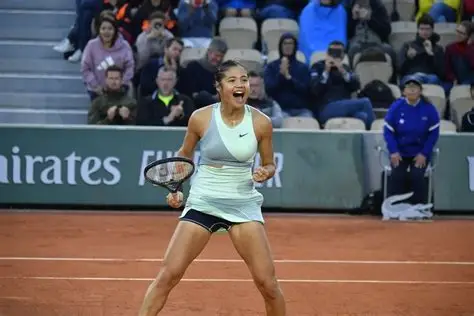
Emma Raducanu Roland Garros 2026 ended in painful fashion on Thursday as the British number one suffered a 6-0 7-6 (7-4) defeat against Argentina’s Solana Sierra in the first round — a result that starkly illustrated just how far behind her peers she currently sits after a 2026 season decimated by viral illness. The defeat was only her second match back after more than two months away from tour action, and the gap between Raducanu’s current condition and the level required to compete at Grand Slam tennis was painfully clear across 23 minutes of a first set that produced arguably the lowest level of her career.
Yet Raducanu herself stands by the decision to compete in Paris. Her reasoning is rooted in a philosophy of confronting difficulty rather than avoiding it — and her eyes are firmly fixed on what comes next. The British grass season, and Wimbledon in particular, represents the real target. The question now is whether this painful Paris experience becomes the catalyst for the stronger, sharper Raducanu that British tennis desperately wants to see emerge on home soil in the weeks ahead.
Emma Raducanu Roland Garros 2026: What Went Wrong in Paris
The Emma Raducanu Roland Garros 2026 defeat was not a surprise to those who had tracked the context surrounding her appearance at the tournament. The scale of the defeat — particularly the 23-minute first set in which she won zero games — was nevertheless difficult to watch for even the most measured observer of her career.
The first set exposed fundamental problems that had less to do with Raducanu’s quality as a player and more to do with the specific circumstances she brought to the match. She had played just one match since Indian Wells in early March — a straight-set defeat to France’s Diane Parry in Strasbourg the previous week. That singular match represented the sum total of her competitive preparation for a Roland Garros first round against a healthy, rhythm-laden opponent who had been competing regularly throughout the clay season.
The conditions added further difficulty. Thirty degree Celsius heat in Paris — combined with lingering post-viral symptoms that had Raducanu coughing between points — created a physical environment that made her tactic of trying to end points quickly entirely logical but ultimately counterproductive in execution.
Why the defeat unfolded as it did:
- Only her second match back after more than two months away from the tour
- Post-viral illness has dominated and disrupted her entire 2026 season
- Still symptomatic — coughing between points throughout the match in Paris
- Just one match played since Indian Wells in early March — the Strasbourg defeat to Parry
- Facing a healthy, match-sharp opponent in 30 degree heat on a surface that does not suit her game
- Aggressive early tactics designed to shorten points made sense given her physical limitations but misfired on execution
- Timing was clearly off — leading to a high volume of unforced errors
- The 23-minute first set produced arguably the lowest level of Raducanu’s career
“I felt like the conditions were extremely lively, and I felt like I wasn’t able to kind of trust my shots in that and didn’t feel like I had control over the ball,” Raducanu said after the match. “It was a really difficult set-up for me to step into, having not had many matches.”
Emma Raducanu Roland Garros 2026: Why She Chose to Play
The most revealing element of the Emma Raducanu Roland Garros 2026 story is not the defeat itself but the reasoning behind the decision to compete at all. Several logical arguments existed for sitting out Roland Garros — saving energy, avoiding a demoralising early exit, spending the time on the practice court with rehired coach Andrew Richardson, and arriving at Wimbledon with better preparation and greater confidence.
Raducanu rejected that path. Her explanation for doing so offers genuine insight into how she is approaching the challenge of reviving a career that has struggled to find consistent footing since her extraordinary 2021 US Open triumph.
“It was always going to be a big ask coming in. I really wanted to play the French, so that was my decision,” she said. The acknowledgement that it was always going to be difficult — paired with the clear assertion that she chose to be there — reflects a willingness to accept discomfort as the price of competitive experience.
Her broader statement on the philosophy behind the decision was the most significant thing she said all day. “I didn’t necessarily do as well as I’d like to this year. But I think the only way to face — and improve — how I’m feeling is to go through the tough parts, to go through the pain of it, and hopefully come out on the other side better and stronger.”
Why Raducanu chose to play at Roland Garros:
- She genuinely wanted to play the French Open — a personal desire rather than a strategic calculation
- She believes confronting difficulty is more beneficial than avoiding it
- Going through the pain of difficult matches is part of her recovery and development process
- She hopes the experience — however painful — accelerates her return to competitive form
- She acknowledged in hindsight that saving herself from the Paris match might have been sensible
- But she remains committed to the principle of competing through the tough phases rather than waiting for perfect conditions
“In hindsight, after the two matches I’ve played, it could have been nice to have saved yourself a match like today,” she conceded — a rare and honest acknowledgement that the alternative path had merit. But her commitment to the principle of competing through difficulty rather than around it suggests this is a considered strategic position rather than a defensive rationalisation.
Emma Raducanu Roland Garros 2026: The Andrew Richardson Reunion
The Emma Raducanu Roland Garros 2026 chapter also marks a significant development in the coaching dimension of Raducanu’s career — the rehiring of Andrew Richardson, the coach who had worked with her before her 2021 US Open victory and who departed after that triumph in circumstances widely described as unceremonious.
Richardson’s return represents an attempt by Raducanu to reconnect with the coaching relationship under which she produced her most extraordinary tennis. The 2021 US Open — won as a qualifier without dropping a set — remains the defining achievement of her career and the baseline against which everything since has been measured. Richardson was part of the team that prepared her for that tournament.
Whether his return will provide the stability and direction that her coaching situation has sometimes lacked in the years since the US Open remains to be seen. But the decision to rehire him — apparently setting aside whatever circumstances surrounded his original departure — signals a pragmatic willingness to prioritise what works over other considerations.
The Andrew Richardson coaching reunion:
- Richardson is the coach who worked with Raducanu before and during her 2021 US Open triumph
- He left following the US Open victory in circumstances described as unceremonious
- Raducanu has rehired him — apparently setting aside the circumstances of his departure
- His return represents an attempt to reconnect with the coaching relationship that preceded her best tennis
- The reunion is taking place during one of the most difficult periods of her career
- His familiarity with her game and her tendencies may provide stability during a challenging rebuild
- The Roland Garros appearance — however difficult — represents early work in their renewed partnership
Emma Raducanu Roland Garros 2026: Sierra’s Quality in Context
Any fair analysis of the Emma Raducanu Roland Garros 2026 defeat must acknowledge the quality of the opponent who defeated her. Solana Sierra is not a journeywoman who scraped through qualifying — she is a 21-year-old Argentine who has been playing on clay since the age of three and whose form entering Roland Garros was formidable.
Sierra recently demonstrated her ability in emphatic fashion by pushing reigning French Open champion Coco Gauff in Rome — a result that placed her firmly in the category of genuine clay-court threats rather than straightforward first-round opponents. She arrived in Paris healthy, match-sharp, and with the rhythm that comes from an uninterrupted clay-court season. The contrast with Raducanu’s preparation could not have been more stark.
Solana Sierra — why she was a difficult opponent:
- 21 years old — a young Argentine who has been developing on clay since childhood
- Healthy and match-sharp — the direct opposite of Raducanu’s physical condition
- Recently pushed reigning French Open champion Coco Gauff in Rome — a genuine quality marker
- Had the benefit of rhythm from consistent recent match play
- Her clay-court pedigree and current form made her a tricky first-round draw for anyone
- The ranking difference — Raducanu 29 places higher — was rendered irrelevant by the context gap
Sierra’s quality does not excuse the scoreline in the first set. But it provides essential context for understanding why Raducanu’s specific vulnerabilities — match rustiness, physical fatigue, loss of confidence in her shot-making — were so comprehensively exposed on this particular day against this particular opponent.
Emma Raducanu Roland Garros 2026: What Comes Next — The Wimbledon Question
The Emma Raducanu Roland Garros 2026 exit focuses all attention on what happens next — specifically on the British grass season and Wimbledon, where the circumstances are significantly more favourable to everything Raducanu does well.
The observation that sitting out Roland Garros and preparing specifically for grass would have been the logical alternative path is well made — and probably accurate. Raducanu’s aggressive, flat-hitting style translates far better to grass than to clay. At Wimbledon, her instinct to attack early in rallies and take the ball on the rise is a strength rather than a liability. The surface rewards exactly the kind of tennis she wants to play.
The question is whether the Roland Garros experience — however painful — has contributed something to her physical and mental preparation that pure practice could not have provided. Her belief that it has is the argument she is making to herself and to the watching world.
Why Wimbledon represents a genuine revival opportunity:
- Grass suits Raducanu’s aggressive, flat-hitting style far better than clay
- Her instinct to attack early in rallies is rewarded on grass rather than punished
- Wimbledon is her home Grand Slam — playing in front of a home crowd provides emotional energy
- By Wimbledon her match fitness should be significantly better than it was in Paris
- Andrew Richardson’s presence as coach should provide greater stability and direction
- The Roland Garros experience — however difficult — has added competitive match time
- Her world ranking of 39 gives her a seeded or high-profile position in the draw
- Historically her best results have come on faster surfaces — grass gives her maximum opportunity
Raducanu will need to play warm-up events on grass before Wimbledon to build the match practice she currently lacks. The Birmingham Classic and Eastbourne tournament represent the most likely preparation vehicles — giving her the competitive repetitions that Paris could not provide.
Final Word on Emma Raducanu Roland Garros 2026
The Emma Raducanu Roland Garros 2026 story is painful in its immediate detail and hopeful in its longer-term framing — which is, perhaps, an accurate description of Emma Raducanu’s entire career since September 2021.
She lost 6-0 in 23 minutes. She was coughing between points. Her timing was off. Her confidence was low. And she stood in front of the media afterwards and said she was going through the pain of it because she believes that is how she comes out on the other side better and stronger.
That belief — in confrontation over avoidance, in experience over comfort, in the value of the difficult match even when it ends in humiliation — is either the defining quality of a comeback that has not yet fully materialised or the philosophical foundation of a return that is genuinely coming.
MORE INFO ON THE NEWS INK SPORTS.