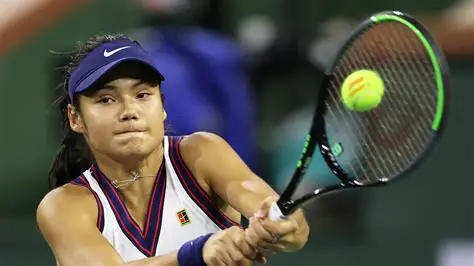
Emma Raducanu Admits Long Way to Go After Quick Defeat at Indian Wells
Emma Raducanu left Indian Wells with an honest assessment rather than an excuse. After a 6-1, 6-1 defeat to Amanda Anisimova in just 52 minutes, the British player admitted she still has “a long way to go” before she can consistently match the pace, power and certainty of the WTA’s strongest opponents.
The scoreline was not close, and the match did not need much tactical decoding to understand the problem. Anisimova hit bigger, returned deeper, served with more authority and denied Raducanu the time she needs to build points. From the opening game, the American played like a top seed in control of her weapons. Raducanu played like a player still rebuilding confidence, rhythm and aggression after another period of change.
The official WTA score page confirmed the 6-1, 6-1 result in the Indian Wells round of 32, while the WTA match report described Anisimova’s performance as a 52-minute all-court masterclass. It was the type of defeat that can look brutal on paper but still be useful if the player and team treat it as a clear diagnostic.
For Raducanu, the lesson was simple but uncomfortable: against elite ball-strikers, good intentions are not enough. The game must be faster, the serve must hold up better, and the first strike has to come earlier in rallies.
Emma Raducanu Faces the Reality of Elite Power
Emma Raducanu has always been judged through the lens of her 2021 US Open title. That is both a privilege and a burden. Winning a Grand Slam as a teenager from qualifying created a career-defining peak before she had built the normal tour foundations around it. Every defeat since then has been compared with that miracle run, even when the circumstances are completely different.
Indian Wells showed the current challenge clearly. Anisimova did not beat Raducanu with mystery. She beat her with weight of shot. She served more freely, attacked second serves, took control early and made the court feel smaller for the British player. Raducanu had little time to set her feet, and when she did get neutral balls, she often lacked the confidence to take them on.
According to Sky Sports, Raducanu said matches against players at that level can make the difference in serve speed and physical ball-striking feel more obvious, especially when she is not fully confident. That was an important admission. It was not only about Anisimova being better on the day. It was about Raducanu recognising the standard she must reach.
This is the gap between being talented and being tour-ready every week. Raducanu has the timing, athleticism and shot quality to trouble strong players, but she still needs a reliable base. The top of the WTA does not give players long stretches to feel their way into matches. If the serve is loose, the return games become harder. If the forehand is uncertain, opponents attack it. If court position drops, powerful players step forward and finish.
That is what happened in California.
The First Set Became a Warning Sign
The opening set was gone almost before Emma Raducanu could settle. Anisimova broke immediately, established control and turned the first set into a demonstration of pressure tennis. Raducanu won only a small number of points in the set and struggled to find any pattern that could slow the American down.
The danger was not just the score. It was the way the match felt. Raducanu was not losing long, grinding games. She was being rushed. That is a very different kind of defeat because it can affect decision-making quickly. When a player feels late to every ball, panic can enter the feet, the swing and the shot selection.
Anisimova’s flat power made the court uncomfortable. Her backhand in particular gave Raducanu little margin. If the Briton returned short, Anisimova stepped in. If Raducanu tried to redirect too soon, errors followed. If she defended, the next ball was often heavier.
This is why the match mattered beyond Indian Wells. Emma Raducanu is not trying only to win a round here and there. She is trying to rebuild a level capable of lasting across tournaments. A defeat like this shows exactly where the rebuild still needs work.
The News Ink’s sports training technology guide explains how modern performance is increasingly built around data, movement, load management and recovery. For a player like Raducanu, the challenge is not just hitting harder. It is building the physical and technical platform that lets her play aggressively without breaking down.
Anisimova Looked Like a Player Who Knows Her Identity
Amanda Anisimova’s performance was the opposite of uncertain. She knew what she wanted to do and did it repeatedly. The American served with purpose, attacked the return, hit through the middle when needed and opened the court when Raducanu gave her a shorter ball.
That clarity is valuable. On the WTA Tour, power alone is not enough. Many players hit hard. The difference is whether they can organise that power into repeatable patterns. Anisimova did that at Indian Wells.
She also entered the match as the sixth seed, which reflected her status in the draw. This was not an upset. This was a higher-ranked player playing like one. After the win, Anisimova moved into the fourth round, where she was due to face Victoria Mboko.
For Raducanu, there is no shame in losing to a player of that level. The concern is the margin. A 6-4, 7-5 defeat would suggest small execution gaps. A 6-1, 6-1 defeat suggests structural issues: serve pressure, first-strike tennis, physical confidence and point tolerance under pace.
Emma Raducanu does not need to become Anisimova. She needs to become a sharper version of herself.
Mark Petchey’s Role in the Rebuild
Emma Raducanu arrived at Indian Wells after another coaching change. She had ended her partnership with Francisco Roig and started working with Mark Petchey on a temporary basis. Petchey knows British tennis well and has previously worked with Raducanu, which gives the partnership some familiarity.
The coaching issue has followed Raducanu throughout her career. Since the US Open title, her team structure has changed several times, and every new voice has brought new technical ideas, training priorities and tactical language. Some changes may have been necessary. Too many changes, however, can make it harder for a player to build continuity.
Indian Wells showed both the problem and the opportunity. The problem is that Raducanu is still searching for the most reliable version of her game. The opportunity is that she appears aware of what needs to improve. She spoke about needing to play more aggressively against top players, but also needing time to reach that level.
That is the correct balance. Aggression without confidence becomes errors. Patience without aggression becomes passivity. Raducanu’s next stage is finding controlled aggression: stepping in earlier, trusting the forehand, protecting second serves, and not waiting for elite opponents to miss.
The News Ink recently covered another athlete’s long rebuild in Fred Warburton’s Paralympic journey, and the lesson is similar. Progress is rarely linear once physical, technical and mental demands overlap.
Why This Loss Hurt More Than the Scoreline
A 52-minute defeat can feel like one bad day, but for Emma Raducanu it touched several bigger questions. Can she absorb top-level pace? Can her serve become a weapon rather than a pressure point? Can she stay aggressive when confidence dips? Can her team give her enough stability to build for months rather than weeks?
The Indian Wells match did not answer all of those questions, but it showed why they remain important.
Raducanu has already proved she can play extraordinary tennis. The 2021 US Open run cannot be erased. Yet the tour judges players by current level, not memory. The top players have improved. New young contenders have arrived. Established names have added power, fitness and tactical detail. Standing still is effectively moving backward.
That is why Raducanu’s “long way to go” comment felt honest. It did not sound like a player giving up. It sounded like a player recognising that the top of the game is not reached through nostalgia. It is reached through weeks of repeated training, matches, losses, adjustments and better habits.
A defeat like this can become damaging if it leads to panic. It can become useful if it becomes evidence.
The Second-Round Win Still Matters
The danger after a heavy loss is that everything before it gets forgotten. Emma Raducanu had already shown some progress at Indian Wells by beating Anastasia Zakharova in the previous round. That result mattered because it gave her match time and some positive evidence from practice.
Raducanu herself pointed to the productive days before the Anisimova defeat. That is not empty optimism. Players often know whether practice quality is improving before results fully reflect it. A single match against a powerful opponent can expose weaknesses without cancelling all progress.
However, the level required changes quickly in WTA 1000 events. Early-round wins are useful, but seeded opponents test different parts of the game. Anisimova did not allow Raducanu to build gradually. She forced the match onto her terms immediately.
That is the step Raducanu must now prepare for. It is not enough to beat players when rallies settle. She needs answers when the match starts fast, the opponent returns big and the first service game becomes a statement.
Coco Gauff’s Injury Added to a Dramatic Day
Raducanu’s defeat was not the only major women’s story at Indian Wells. Coco Gauff retired from her match against Alexandra Eala after suffering arm pain. Reuters reported that Gauff described the pain as feeling like her arm was “on fire,” took a medical timeout and stopped while trailing 6-2, 2-0.
That result sent Eala into the fourth round and added another reminder of how physically demanding the tour can be. Fans often focus on ranking, form and draw position, but injuries can change a tournament in minutes.
For Gauff, the retirement was a concern because she is one of the sport’s most durable and high-profile players. For Eala, it was an important breakthrough, even if it came in difficult circumstances. For the tournament, it created a day full of sharp contrasts: Raducanu overpowered, Gauff injured, Anisimova surging and younger names moving forward.
This is the reality of elite tennis. A draw can look stable when it is released, then change dramatically through injury, confidence and matchups.
Sabalenka, Osaka and the Bigger WTA Picture
The wider Indian Wells draw also showed why Emma Raducanu’s path is so difficult. Aryna Sabalenka, Naomi Osaka, Amanda Anisimova, Victoria Mboko and other powerful players all represented different versions of the same challenge: the WTA’s top end is physically demanding and increasingly aggressive.
The WTA reported that Sabalenka defeated Jaqueline Cristian 6-4, 6-1 to set up a fourth-round meeting with Osaka, who beat Camila Osorio 6-1, 3-6, 6-1. That meant two four-time Grand Slam singles champions were heading into a major desert showdown, while Anisimova and Mboko formed another power-versus-youth storyline.
Raducanu’s defeat should be read in that context. The players ahead of her are not waiting. Sabalenka’s serve and first strike remain massive. Osaka, when confident, can take the racket out of an opponent’s hands. Anisimova can flatten the ball through the court. Mboko brings the fearlessness of a teenager rising quickly.
To compete with that group, Emma Raducanu must do more than defend well. She must be able to impose.
The Men’s Draw Offered Its Own Warning About Pace
The men’s competition at Indian Wells carried the same message about modern tennis: pace, precision and first-strike pressure are increasingly decisive. ATP reported that João Fonseca powered past Tommy Paul 6-2, 6-3 to set up a meeting with Jannik Sinner, while the BNP Paribas Open reported that Sinner beat Denis Shapovalov and Alexander Zverev survived Brandon Nakashima in three sets.
This matters for Raducanu’s story because the same tactical trend is visible across both tours. Players who take time away from opponents are thriving. Players who rely only on reaction are under pressure.
The women’s game has always had power, but the current top group combines power with movement, return aggression and improved serving. Raducanu’s challenge is to become more proactive without losing the timing and court sense that made her breakthrough so exciting.
The News Ink’s Henry Patten tennis story shows how tennis careers can also be shaped by travel, disruption and resilience beyond the court. Raducanu’s challenge is different, but the theme is the same: elite sport rarely allows perfect conditions.
What Emma Raducanu Must Improve Next
The Indian Wells defeat made Raducanu’s priorities clear.
First, the serve needs to become more reliable under pressure. Against top players, weak service games create immediate danger. If she is constantly defending second serves, she will spend too much time reacting.
Second, the return position and first return need more bite. Raducanu cannot allow bigger servers to start every point comfortably. Even when she does not hit winners, she needs depth that prevents opponents from stepping in easily.
Third, the forehand must become a more consistent attacking shot. Her backhand can redirect pace well, but opponents will look for the wing that breaks down first. To climb back toward the top, she needs both sides to hold up.
Fourth, she needs continuity. That does not mean one coach forever, but it does mean enough stability to build a clear identity. Constant resets can make every tournament feel like another trial period.
Finally, she needs matches. Practice can improve patterns, but pressure only appears fully in competition. Raducanu must play enough to learn, lose, adjust and trust the work.
The News Ink’s coverage of Daniel Berger’s missed chance at Bay Hill showed how one painful sporting result can still reveal a player is close to something better. Raducanu’s defeat was heavier, but the principle remains: the result hurts, yet the lesson can still help.
Why Patience Is Hard With Raducanu
Patience sounds easy until the player is famous. Emma Raducanu does not get the quiet rebuild that many young players receive. Every coaching change, injury concern and defeat becomes a headline. Every positive practice week is measured against a Grand Slam title won years ago.
That makes her career unusually difficult to evaluate. She is still young enough to improve significantly, but famous enough to be judged like an established superstar. She has already achieved more than most players ever will, yet she is still building the week-to-week durability that ordinary tour careers require.
The public often wants a simple story: comeback or crisis. Tennis rarely works that way. A player can improve technically and still lose badly. A player can feel better in practice and still be exposed by a bad matchup. A player can be moving in the right direction and still be far from the level required to beat the top seeds.
Raducanu’s honesty after Indian Wells should therefore be seen as a strength. She did not pretend the match was close. She did not hide from the power gap. She recognised the work ahead.
The Danger of Overreacting
A heavy defeat can create pressure for immediate change. That is dangerous. Emma Raducanu does not need another frantic reset every time a top player exposes her weaknesses. She needs a clear plan and enough time to test it.
That does not mean ignoring problems. The Anisimova match showed real gaps. But the answer should be systematic: build the serve, sharpen the return, strengthen the body, improve shot tolerance and create tactical patterns that hold up under pace.
The worst response would be chasing short-term fixes that disappear at the next tournament. The best response would be using Indian Wells as a reference point. This is the level. This is the pace. This is the pressure. Now build toward it.
The News Ink’s report on Victor Wembanyama’s comeback win shows how elite athletes can change a game by adjusting under pressure. For Raducanu, the comeback is longer. It is not one night. It is a season-by-season rebuild.
What Anisimova’s Win Says About the WTA
Anisimova’s performance also deserves its own credit. Too often, Raducanu losses become only Raducanu stories. This one should also be remembered as a statement from Amanda Anisimova.
She showed the ball-striking quality that has made her one of the most dangerous players in the draw. She also showed maturity. The match could have become complicated if she allowed Raducanu time to settle, but she never did. She kept the scoreboard moving and finished quickly.
That ruthless efficiency is what separates top players from dangerous players. Anisimova did not only hit big. She controlled the match structure. That is why Raducanu felt the gap so clearly.
For the WTA, the result added another layer to a draw already full of strong storylines. Sabalenka and Osaka were heading toward a blockbuster meeting. Gauff’s injury created uncertainty. Mboko’s rise continued. Anisimova sent a warning that she could not be treated as simply another seed.
Indian Wells is often called Tennis Paradise, but for players trying to rebuild, it can be an unforgiving mirror.
The Bottom Line
Emma Raducanu’s Indian Wells defeat was heavy, honest and revealing. Amanda Anisimova beat her 6-1, 6-1 in 52 minutes, and the match exposed the gap Raducanu still has to close against the WTA’s most powerful players.
The loss does not erase Raducanu’s talent or her previous achievements. It does show that her current level is still not stable enough against elite pace. Her serve, first-strike tennis, confidence under pressure and coaching continuity all remain central to the next stage of her career.
There were positives around Indian Wells, including a useful second-round win and productive practice days. But the Anisimova match gave a clearer measurement of the standard required. At the top of the women’s game, opponents do not wait. They serve big, return deep and punish hesitation.
Emma Raducanu admitted she has a long way to go. That may sound negative, but it is also the beginning of a realistic plan. The road back does not require another miracle like the US Open. It requires health, stability, aggressive habits and enough patience to build a game that can survive when the ball comes faster.
For more tennis and sports coverage, readers can follow The News Ink on X.